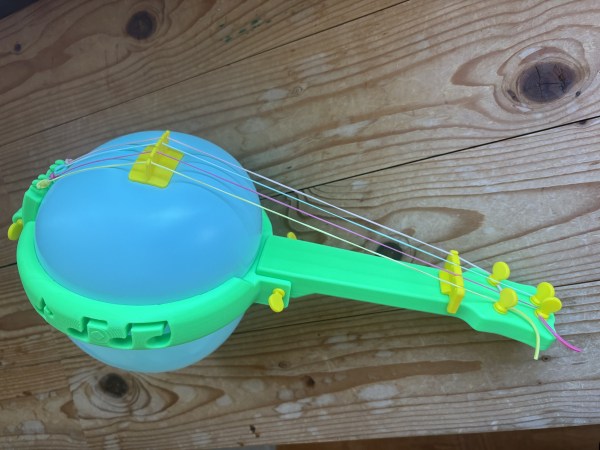
A small, 3D-printed banjo frame that uses a party balloon for the resonating chamber.

May This Balloon Banjo Resonate With You

Most instruments, with maybe the exception of pianos, have consumable parts. Guitars need string changes, bows need rosin, saxophones need reeds. [Co:Creation Lab]’s balloon banjo requires both fishing line and a party balloon, lest it be semi-silent.

If you want to change the resonance, just increase or decrease the amount of air inside the balloon. Neither the balloon nor the strings need tools to adjust, but we might argue that tuning pegs are tools.

The balloon banjo was the result of a design constraint: a parent should be able to build it with their child. To that end, there are no metal screws, no recurring snap-fits in the assembly, and a single, internal, one-time-use snap fit for the adult’s tactile satisfaction. Instead, the balloon banjo uses 3D-printed screws. A six-year-old can turn them with their fingers, and it’s difficult to over-tighten them and strip the plastic threads.

Be sure to check it out in action after the break. If you would rather use extant plastic to make music, the Bottlephone 2.0 is calling.
Continue reading “May This Balloon Banjo Resonate With You”

More On Wave Overhangs For 3D Printing

We’ve heard of wave overhangs before. It is a new technique for printing horizontal overhangs with no supports. Building on some other techniques like arc overhangs. The idea is to teach the slicer not to try to draw overhangs in the middle of free space. Instead, when the slicer realizes there is a horizontal overhang, it tries to “grow” the overhang from the main part. You can see an overview in the video below.

For example, imagine printing a letter ‘T’ vertically. The stem of the T is no problem, but when you try to print the arms it will normally need support. But if you could just print the arms starting at the stem with slight overlapping, the arms could grow as they hang onto either the stem or the last overhang line.

That makes sense, but it only works for very simple cases. Arc overhangs can fill more complex cases, but suffer from little dimples at the center of each arc. The realization for wave overhangs is to replace the arcs with waves as you would see in a pond. The waves diffract around holes and corners.

Perfect? Not quite. They are still experimenting with settings, but there seems to be some increase in warping. If you want to experiment, you can download a fork of Orca and contribute your results to the community.

We looked at this technique earlier, but we haven’t seen much about it in practice yet. Let us know in the comments if you’ve tried it and how it worked for you. There are more details in the paper on the subject, or you can jump right to the software.

Continue reading “More On Wave Overhangs For 3D Printing”

Using The Famicom Network System In 2026

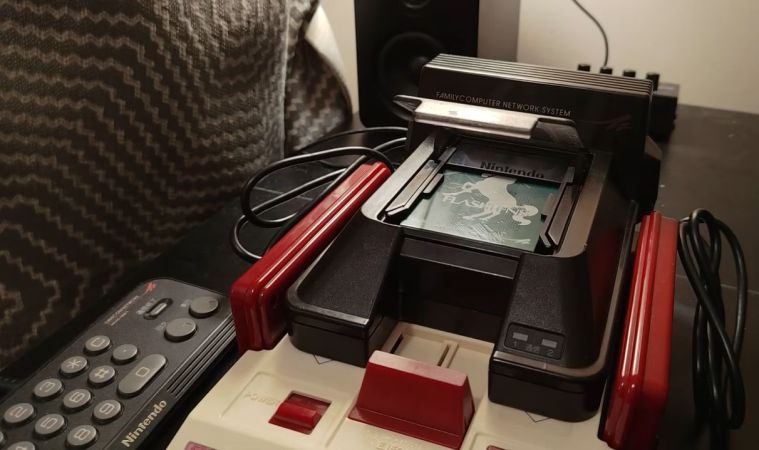
Usually, the name ‘Famicom’ and the associated Nintendo Entertainment System (NES) don’t exactly bring to mind downloadable content and online services. However, at least in Japan, a modem add-on for the Famicom offered those features. Released in 1988, the Family Computer Network System (FCNS) offered all that using its modem to dial into Nintendo’s servers. Recently, [Throaty Mumbo] got his mitts on one of these units to try and see what you can still do with it in 2026.

Voiding that Nintendo warranty. (Credit: Throaty Mumbo, YouTube)

Although only mildly successful in the Japanese market, Nintendo still sold 130,000 of these modem add-ons, with tens of thousands of users for the stock brokering, banking, and Super Mario Club services offered. The experiences with the FCNS would form the foundation for Nintendo’s Satellaview for the Super Famicom and from there into today’s Nintendo Online offerings.

Of course, the main challenge with reviving the FCNS in 2026 is that the remote servers were turned off decades ago, along with the minor detail that to do anything with it you need to insert a special card. This was missing in the used version that [Throaty Mumbo] bought, but fortunately he got a workable Super Mario Club card. The next struggle? He doesn’t speak Japanese, so it took a while to eke out the details.

Continue reading “Using The Famicom Network System In 2026”

Hackaday Links Column Banner

Hackaday Links: August 16, 2026

We’re no strangers to unusual hardware failures around these parts, but even so, a swarm of jellyfish clogging up the works is a new one to us. That’s exactly what happened to the cooling system at the Gravelines nuclear power plant in France earlier this week, resulting in three reactors having to be shut down. This isn’t even an isolated incident, as POLITICO points out that the same thing actually happened last year around this same time.

So why are jellyfish staging an annual protest against nuclear power? A warming of the North Sea has extended breeding seasons and produced larger populations of the plankton that the jellyfish feed on. This is great for the gelatinous sea creatures, but not exactly ideal if you’re trying to pump the water they live in through a complex cooling system. The French installed filter screens and monitoring systems after this happened in 2025, but clearly they’re going to need to keep working on the problem.

From a new problem to a very old one, a BBC investigation has revealed that the UK’s National Health Service (NHS) Blood and Transplant department was inadvertently leaking private patient data by sending it in the clear over the pager network. Sniffing pager messages was fairly trivial decades ago, and is even easier these days thanks to the proliferation of cheap software-defined radios and open source decoding software. Given the fragility of the underlying communication network they use, the NHS announced they were going to stop using pagers by 2021, but clearly not everyone got the memo.

Continue reading “Hackaday Links: August 16, 2026”

Another Radio On A Chip Design

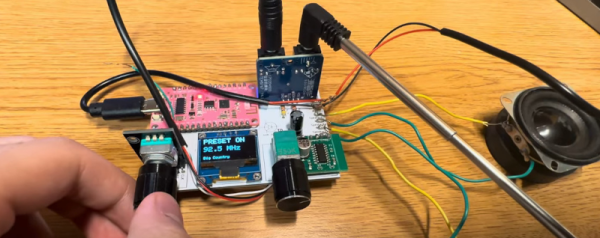
It used to be a rite of passage to build some sort of AM radio receiver. Many people started with a crystal radio, of course, but you’d graduate to maybe a TRF or superhet design. FM radio projects were not as common, because demodulating an FM signal was harder, as was making things work in the 100 MHz range. These days, though, you can get everything on a chip like the TEA5767, and [turtushig22-blip] has an open design that uses that device on a breakout board, a display, a knob, and an external amplifier. An ESP-32 pulls it together. You can see two videos about the project below.

Unlike older FM radio designs, the TEA5767 doesn’t require any adjustments. RF goes in, and stereo audio goes out. You can control the device through I2C or a 3-wire serial interface.

Continue reading “Another Radio On A Chip Design”

Laser Layers For (Almost) Isotropicly Strong Prints

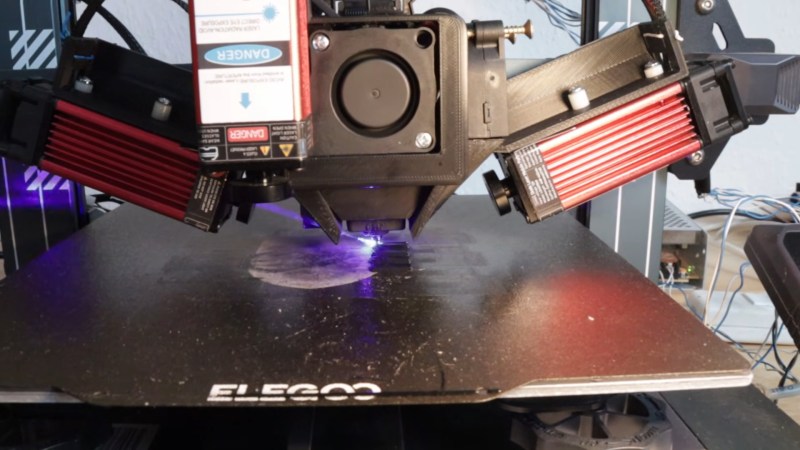
If there’s one defining factor about 3D printing you have to account for when you’re making a design, it’s probably layer adhesion. Sure, there are a lot of factors to consider, but having the z-axis of your part dramatically weaker than x- and y- is a pretty big deal in a whole lot of applications. [I Changed a thing] changed a thing to fix that — namely, he changed his 3D printer by strapping a couple of lasers to it. That’s the kind of hack we like to see!

What the lasers are doing is a very simple idea: they’re pre-melting the last-laid-down-layer just under the nozzle so that molten plastic is meeting molten plastic to create a much stronger joint than you get when you extrude onto an already-cold layer. The second layer keeps the hotspot warmer longer, which also helps the bond. The resulting parts are not purely isotropic, but he’s getting breaking strain along the z-axis of ABS that’s up to 94% of what he’s measuring in the x direction, while PLA still rates at 77.9%. That’s compared to 60% and 41%, for un-lasered samples, respectively. If you watch the video, you’ll get all the details for the printing process and can see more test data.

These lasers look like a game-changer, but their mass might slow down the fast coreXY printers that are so popular these days. If you don’t want to slow down, remember that changing your layer patterns can boost a print’s strength on its own.

Thanks to [Josh Pensel] for the tip!

Continue reading “Laser Layers For (Almost) Isotropicly Strong Prints”

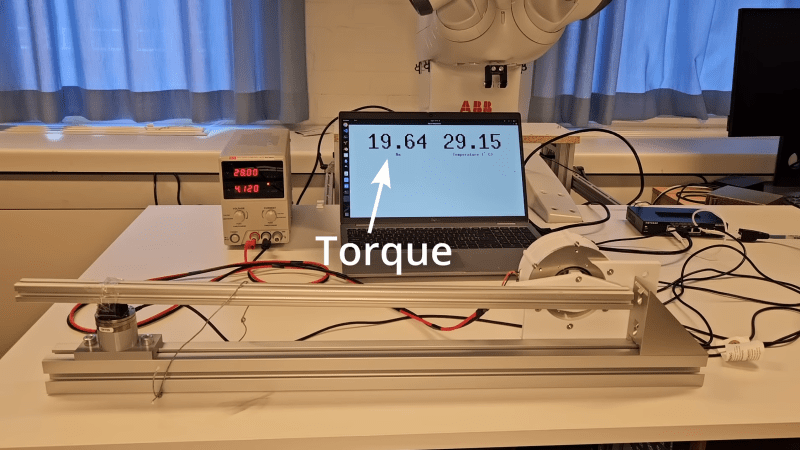
A test setup for an actuator is shown on a benchtop. A power supply connects to a cylindrical actuator, which has an arm pressing against a load cell. The load cell's output is shown on a computer screen, which is labelled "Torque".

Building An Actuator For A Walking Robot

Unlike biological systems, which can use muscles, robots that try to imitate them don’t have particularly fast, powerful, compact linear actuators available. This puts walking robots at a particular disadvantage, since they can’t spread their actuators along a limb and have to place them right at the joint. [Food for Robots] took on the challenge of building such a joint-mounted actuator, and shared the results in a recent video.

[Food for Robots] is building a walking robot, so he needed a compact, lightweight, and backdrivable actuator capable of producing 20 Newton-meters of torque. He’d previously built a largely 3D-printed actuator, but when he tried to exceed 10 Nm of torque with it, various parts kept breaking. He therefore machined the second iteration out of aluminum; since it didn’t need to be 3D printed, he switched from a Capstan drive to a planetary gearbox. The gearbox sits in the center of the actuator, inside the stator, and uses several stacked layers of gears to increase strength within the limits of a small CNC.

Continue reading “Building An Actuator For A Walking Robot”