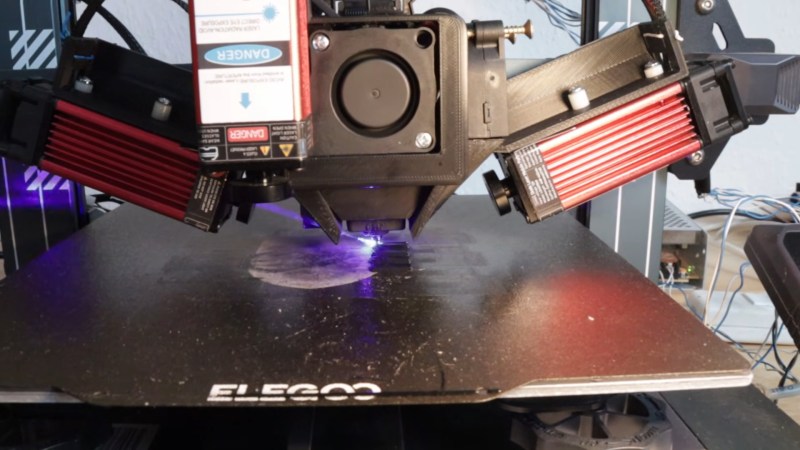
Laser Layers For (Almost) Isotropicly Strong Prints

If there’s one defining factor about 3D printing you have to account for when you’re making a design, it’s probably layer adhesion. Sure, there are a lot of factors to consider, but having the z-axis of your part dramatically weaker than x- and y- is a pretty big deal in a whole lot of applications. [I Changed a thing] changed a thing to fix that — namely, he changed his 3D printer by strapping a couple of lasers to it. That’s the kind of hack we like to see!

What the lasers are doing is a very simple idea: they’re pre-melting the last-laid-down-layer just under the nozzle so that molten plastic is meeting molten plastic to create a much stronger joint than you get when you extrude onto an already-cold layer. The second layer keeps the hotspot warmer longer, which also helps the bond. The resulting parts are not purely isotropic, but he’s getting breaking strain along the z-axis of ABS that’s up to 94% of what he’s measuring in the x direction, while PLA still rates at 77.9%. That’s compared to 60% and 41%, for un-lasered samples, respectively. If you watch the video, you’ll get all the details for the printing process and can see more test data.

These lasers look like a game-changer, but their mass might slow down the fast coreXY printers that are so popular these days. If you don’t want to slow down, remember that changing your layer patterns can boost a print’s strength on its own.

Thanks to [Josh Pensel] for the tip!

Continue reading “Laser Layers For (Almost) Isotropicly Strong Prints”

R-Selecting Tiny Probes To Shotgun Into Saturn’s Rings

In ecology, there used to be a concept — now largely unfashionable — that species could be described as r- or K-selected, depending on how they treat their offspring. An elephant that has one calf every few years and devotes immense resources to them is adopting a K-selection strategy — much as NASA traditionally has to its flagship probes, like Cassini. A sea turtle who leaves hundreds of eggs in a clutch on the beach and leaves without saying “good luck”, content in the knowledge that one of them will probably make it to adulthood is engaging in an r-selected strategy, and it’s this strategy that [Dr. Michael Rubenstein] is proposing for a next-generation mission to Saturn as part of NASA’s Innovative Advanced Concepts Program for 2026. Entitled “Actively Steerable Femtosat Constellations for In-situ Exploration of Saturn’s Rings, Atmosphere, and Magnetosphere

The concept is pretty simple: the rings are a horrifying mess of dust, debris, and ice bits of all sizes that represent almost certain death for a spacecraft. By launching 10,000 femtosatellites, those odds of almost certain death become an almost certainty that one or more will make it through with precious data. In the immortal words of Lord Farquhar, “Some of you may die, but that is a sacrifice I am willing to make.” With Cassini, NASA would never consider such a sacrifice. With itty-bity femtosatellites, it starts to make sense. We’ve been saying for years that the future of space is tiny, but these sacrificial probes would make even modern cubesats and picosatellites look big.

Thanks to [Richard HT] for the tip! His tip was to a podcast featuring [Dr. Rubenstein] with [Fraser Cain], which we’ve embedded below. It has a lot more details than NASA’s official blurb page.

Continue reading “R-Selecting Tiny Probes To Shotgun Into Saturn’s Rings”

Machine Learning COFFIES “Hears” Sunspots Before We Can See Them

In this age of neural net “AI”, even the most skeptical of Butlerians have to agree that these machine learning models can be very, very good at pattern recognition if nothing else. NASA is on the same page, and to take advantage of that pattern recognition, they’ve built a machine learning module called COFFIES, which stands for Consequence Of Fields and Flows in the Interior and Exterior of the Sun, because at NASA everything is an acronym, or at least a backronym. Like most such names, this one is at least vaguely descriptive: the model is trying to predict what’s going on in the material flows and magnetic fields deep within our local star, and using those inferences is able to predict active regions– that’s sunspots to us chickens — up to 12 hours before they visibly form.

Continue reading “Machine Learning COFFIES “Hears” Sunspots Before We Can See Them”

Scanning For Lifesigns With ESP32 And Raspberry Pi

It’s a sci-fi trope that you can ‘scan for life signs’ and detect if there are humans — or suspiciously human-shaped aliens — present, but in real life it’s harder than that. [The Masked Bear]’s wifisense-pi project isn’t really scanning for signs of life, either, unless you happen to consider breathing a sign of life. Even then, it’s not detecting breathing per se, but the subtle motion that goes with it: it’s a very sensitive motion detector that relies on the fact that we fleshy bags of goo disturb WiFi signals with our presence, and motion alters those disturbances.

We’d probably waste a lot of time watching the signal graphs on the WifiSense-Pi dashboard.

The device uses an ESP32-S3 to measure the radio channel 100 times per second, while a Raspberry Pi 4 provides the signal processing muscle. It can detect the slightest motions, and even determine the presence of a perfectly still human by their breathing, though you can hide your presence for as long as you can hold your breath. A single sensor, no matter how sensitive, cannot give position information, and while multiple humans will distort WiFi more than a single one, [The Masked Bear] reports you cannot reliably extract that signal. So this project answers the question: “are there humans in this room?” Or, even more likely, “are there any large breathing animals in this room?” We can’t imagine a 50 kg Mastiff looking any different to this sensor than an equivalent mass of quivering human flesh.

Before you dismiss this as just another motion sensor, keep in mind that it is sniffing the signals already present on the 2.4 GHz band, and, like the WiFi signals themselves, it can work through walls. So we think it’s pretty nifty. Of course, there are many other ways to detect humans, from machine-learning cameras to millimeter-wave sensors to a simple PIR. This isn’t the first project we’ve seen that uses WiFi like this. It isn’t even the first with an ESP32, but it’s an interesting implementation worth checking out.

ESP32 Music Sequencer Is Clearly Nailing The Y2K Aesthetic

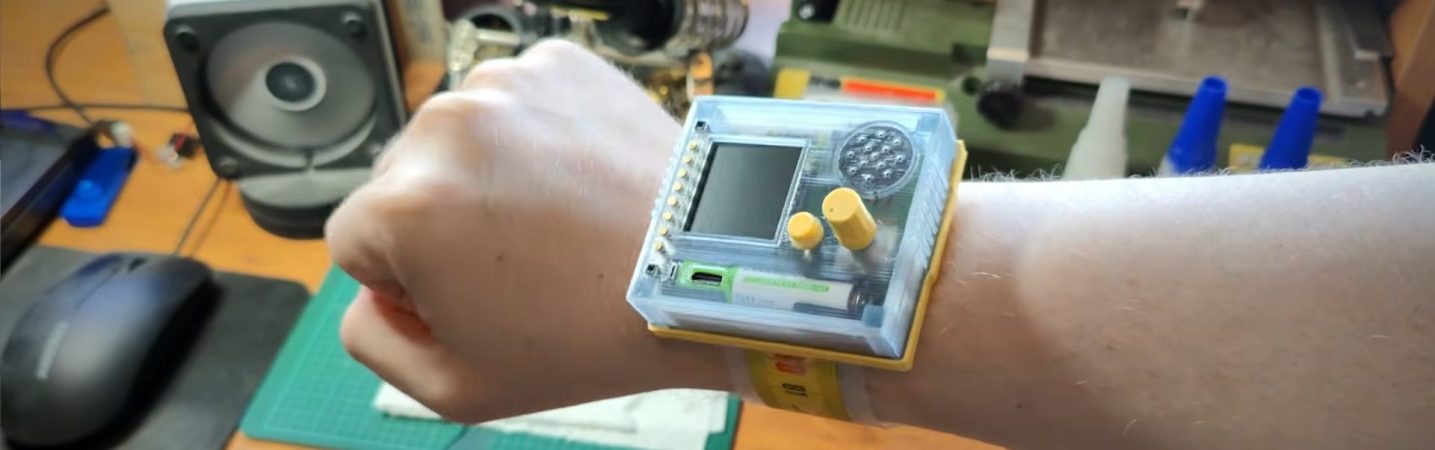
Do you remember back when electronics came in clear cases? Back around the turn of the millennium, when translucency was chic. [3DSage] sure does, which is why he went to great lengths to make a clear case for his Clear Retro Music Sequencer.

The sequencer itself is based around an ESP32-S3 module with a built-in display, and a rotary encoder that handles most of the input. Most, because there’s a second button and a stylophone-like array of brass rods on one edge of the custom PCB he made with his fiber laser that can also handle note input. Other notable features include a phono jack with built-in switching so the tunes come out automatically from headphones or the internal speaker, and a AAA battery-lookalike. It’s a small detail, but that 666 mWh 3.7 V lithium cell is the demon’s meow for this project, seeing as it gives the convenience of a modern battery without compromising that Y2K look — remember you can see the battery through the translucent case.

About that translucent case: it’s 3D printed out of PETG, with settings similar to those we’ve reported on before: hot, slow, and don’t cross the streams! Which is to say every layer must line up with the one above. Oh, use filament fresh out of the drier of you live somewhere as humid as [3DSage]. The result is not totally see-through, but an application of clear enamel fills in the surface well enough to read through, giving the vintage look [3DSage] was after. To complete that Y2K feel, he turns the device into a slap bracelet, because why not? For those of you who missed due to the aforementioned federal prison arc, slap-on wristbands were all the rage amongst the kids back in those days.

The wristband is a length of measuring tape at its core, the springy steel having been cold-worked to hold the radius of [3DSage]’s wrist in its relaxed state, encapsulated in clear gorilla tape for comfort. We probably don’t have to tell you that getting slapped with a raw tape measure isn’t the nicest. For the actual operation of the sequencer, check out the video embedded below — the first 9 minutes cover the build, while the rest shows off the product.

Of course you don’t need an ESP32 for this kind of music maker– you can do it with a C64, or even discrete parts and rope-core memory. 

Continue reading “ESP32 Music Sequencer Is Clearly Nailing The Y2K Aesthetic”

Automatic Naptime With BabyBjorn Bouncing Servo

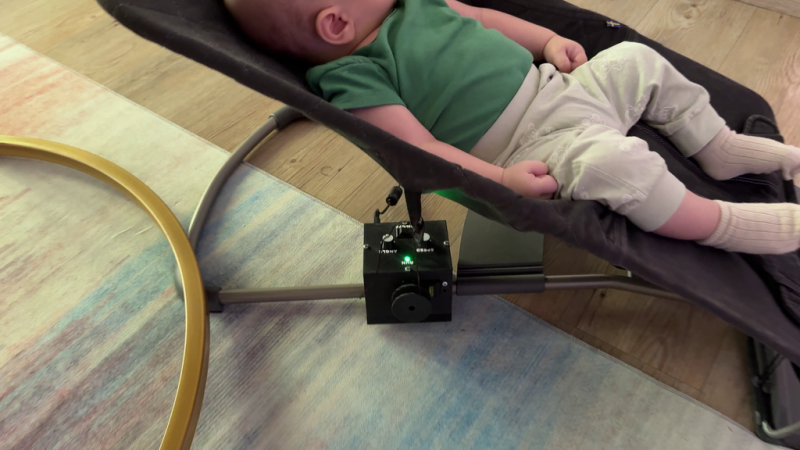
Any parent with a baby and deep pockets– or friends with deep pockets– will probably sing the praises of the BabyBjorn rocking sling chair. A simple spring-loaded sling seat allows you to rock a child to sleep like magic– but you do have to rock the child. In the tradition of fathers everywhere since the stone age, [Ceyhun Karataş] saw that as something to tinker around, creating his Automatic BabyBjorn Bouncer/Rocker with a servo, an Arduino, and some 3D printed parts.

You still can’t leave your child unattended with this hack, [Ceyhun] takes pains to point out, but it will free a hand so you can keep junior happy while tinkering up other toys for him or her. Music players are a popular staple, for example.

You should have plenty of time for such projects, because it won’t take long for you to replicate [Ceyhun]’s invention– it’s only as complicated as it needs to be, which is not very. The servo, a Futaba S3003 which is mounted to the bottom of the rocker in a 3D printed case, reels the baby in with a string tied to the bouncing seat portion.  The BabyBjorn’s built-in spring bounces junior back up. As stated, Arduino Nano controls the servo, with two potentiometers in the build allowing you to control the speed and amplitude of the bounce independently to get the perfect naptime ratio. Everything you need to get started — aside from the hardware and the child– is available at the link above. You can see it in action in the video below, which in spite what you may fear from the Turkish thumbnail, does have authentic English audio, not AI auto-dubbing.

If you’ve got the baby but not the bouncy chair, have a gander at this mechatronic crib that does something similar on a much larger budget.

Thanks to [Ceyhun] for overcoming the new-parent sleep deprivation to document this project and send in a tip.

Continue reading “Automatic Naptime With BabyBjorn Bouncing Servo”

Have Scientists Stuck The Landing On The Glueball Discovery?

Exciting discoveries in particle physics are one of those things that it can be easy to get blase about. Some people get caught up in the obvious excitement, while others yawn: “Oh, you found the Higgs Boson, just like Higgs predicted. Call me when you have something new.” Well, if you’re in category B, prepare to yawn while the rest of us break out champagne, because it looks like we’ve finally found the glueball. 

The glueball has got to be one of the oddest particles to fall out of the Standard Model. It’s not a fundamental particle, but its makeup contains no quarks– those itty bits that make up protons and neutrons– nor any leptons like electrons or muons. No, the glueball is a hadron made entirely of bosons: specifically, gluons, the force-carrying particles of the strong nuclear force. It’s also been called gluonium or a gluon-ball, but glueball is more fun.

Try and imagine a proton without any quarks. Remember that inside the proton there are three quarks, held together with force-carrying gluon particles. If you have zero quarks, but enough of those gluons tangled up in the right ways, and you get a tangible, if short lived particle. That’s the glueball, a neutral particle that will decay almost immediatly in to Pions. It works because gluons have ‘colour charge’– the strong nuclear force’s answer to electric charge.

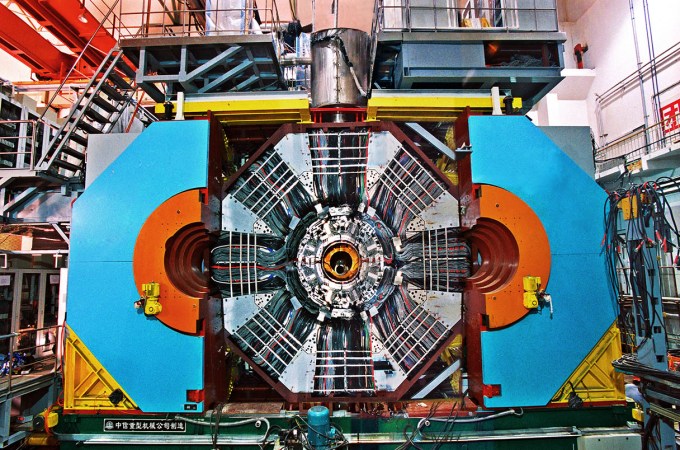
It’s also one of those things that will probably never be seen in nature: odds are, even in the hottest collisions, you’re going to get a quark or two mixed up with your gluon soup. That’s okay; the gluonic state is what we’ve been looking for. As long as the particle is mostly gluons, and behaves as the Standard Model predicts it should, physicists are inclined to call it good enough. The latest candidate to hit “good enough” is X(2370), which fell out of a collision in the Beijing Electron–Positron Collider II (BEPC II), as detected by the Beijing Spectrometer III (BES III). The paper hit ArXiv at the end of July. It’s taken the collaboration this long to make sure of what they were looking at, as they sorted through the terabytes of data an instrument like this generates.

Is this likely to affect you in any way? No. It confirms what we already thought we knew about the universe, and the particle itself is too short-lived to ever exist outside of some very extreme– mostly man-made– environments. On the other hand, it’s an excuse to celebrate scientific discovery, and we’ll take any of those we can, just like when the Muon Magnetic Moment measured in at the expected value, or neutrinos transmuted elements in exactly the way the models said they would. Besides, if we’re really lucky this result will turn out not to be a glueball, but something new and interesting. Then even the most jaded nerds will have reason to celebrate.

Header image: The Bejing III Spectrometer, BESII.