Laser Layers For (Almost) Isotropicly Strong Prints

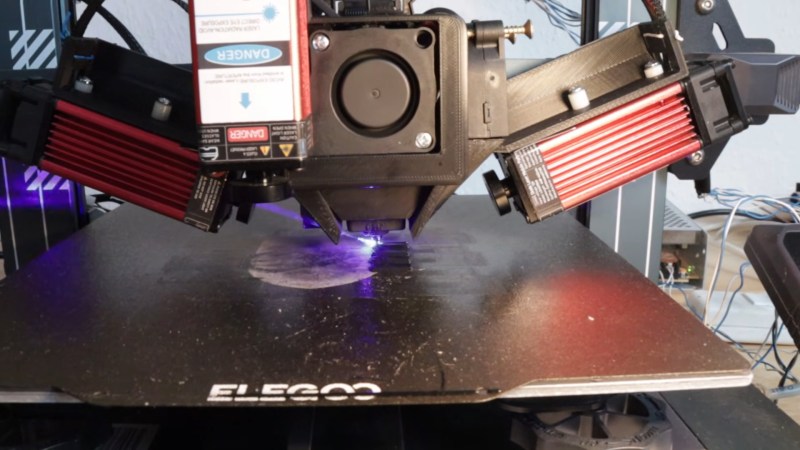
If there’s one defining factor about 3D printing you have to account for when you’re making a design, it’s probably layer adhesion. Sure, there are a lot of factors to consider, but having the z-axis of your part dramatically weaker than x- and y- is a pretty big deal in a whole lot of applications. [I Changed a thing] changed a thing to fix that — namely, he changed his 3D printer by strapping a couple of lasers to it. That’s the kind of hack we like to see!

What the lasers are doing is a very simple idea: they’re pre-melting the last-laid-down-layer just under the nozzle so that molten plastic is meeting molten plastic to create a much stronger joint than you get when you extrude onto an already-cold layer. The second layer keeps the hotspot warmer longer, which also helps the bond. The resulting parts are not purely isotropic, but he’s getting breaking strain along the z-axis of ABS that’s up to 94% of what he’s measuring in the x direction, while PLA still rates at 77.9%. That’s compared to 60% and 41%, for un-lasered samples, respectively. If you watch the video, you’ll get all the details for the printing process and can see more test data.

These lasers look like a game-changer, but their mass might slow down the fast coreXY printers that are so popular these days. If you don’t want to slow down, remember that changing your layer patterns can boost a print’s strength on its own.

Thanks to [Josh Pensel] for the tip!

Continue reading “Laser Layers For (Almost) Isotropicly Strong Prints”
Transmitting Analog Video Via Frikkin’ Laser Beams

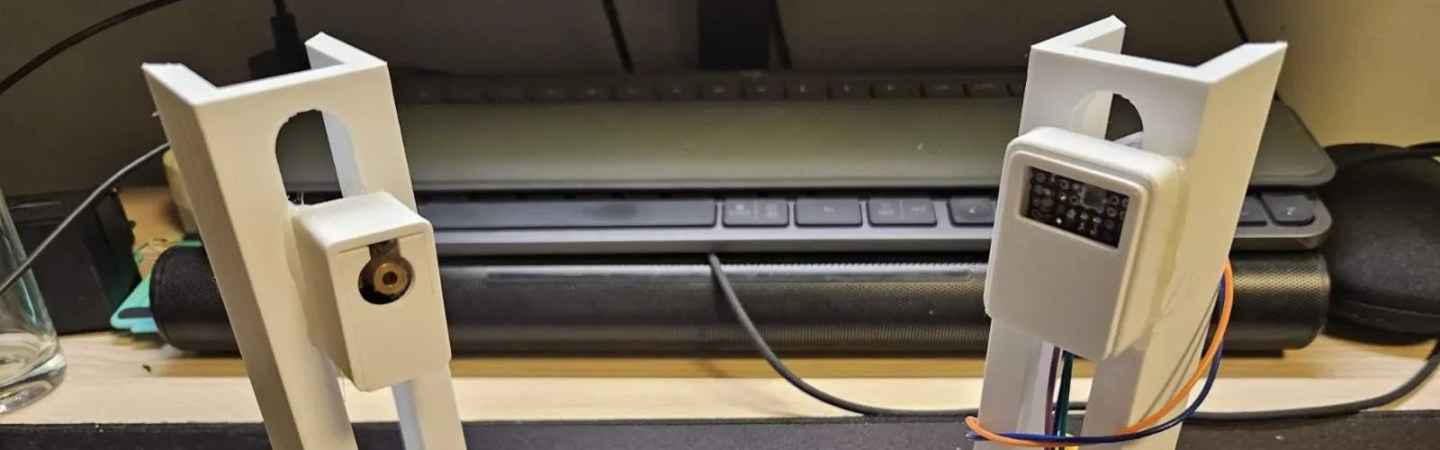
Transmitting analog video via photons is old hat: that’s how everything started, after all, back in the day with over-the-air TV. Up the frequency of those photons from radio to visible light, though? Well, now that’s rather interesting. [Daniel] aka [milar111]’s LYME 101– which doesn’t seem to stand for anything–laser-video transmitter/receiver pair was a strong contender in the recently-completed Frikken’ Laser Beams challenge, but somehow we missed putting it up on the blog.

The project is documented quite well on GitHub as linked above, as well as on Instructables, and Hackaday.io, and in a YouTube video we’ve embedded below so you can see it in action. In principle it’s pretty simple: a Raspberry Pi is used to generate the composite video signal, which modulates a red laser diode through a 2N2222 NPN transistor and some passives. The reciever is a BPW34 photodiode wired with reverse bias for speed and fed through a LM318N op-amp. To get +9V and -9V for this circuit, [Daniel] makes the easy hack of using a pair of 9V batteries for a noiseless dual supply. It hooks up to a CRT just fine, but a little finessing in the form of a terminator resistor and a DC bias pot on the transmitter were needed to get his USB capture card working with the signal.

It’s not the weirdest way we’ve seen people hack analog video signals– there’s no audio cassettes to be seen,  and the signal isn’t even SECAM, the oddest encoding— but that’s not a slight. Transmitting video with higher-than-normal-frequency photons might not be that weird, but it looks like a lot of fun.

Continue reading “Transmitting Analog Video Via Frikkin’ Laser Beams”

Security Camera Gets Several Defensive Upgrades

Ever since the early web, people have been streaming video with inexpensive webcams, and since the advent of the Raspberry Pi and its dedicated camera slot we’ve really seen how easy it can be to build security cameras or any other webcam and get it online quickly. But these cameras notably lack defensive capabilities if anyone tries to break into an area they shouldn’t be, and [John] added some features to this webcam to help defend his garage.

The webcam itself is a custom build, mounted on a custom-built tilt-and-pan mount that lets it freely rotate to view any location in the garage. Some custom software running on a Raspberry Pi lets it operate in autonomous mode or be controlled manually from an Android tablet. But for the defensive capabilities, it also carries a Nerf machine gun with a laser sight and spotlights which can all be controlled autonomously by the Raspberry Pi, including a computer vision system that lets it track various objects. While this is mostly a fun novelty for his security camera, the noise it makes might be enough to startle any would-be burglar.

[John] added a few other features to this build as well, including a speaker, which allows the system to be voice-controlled and to communicate back to the user. This lets him activate and deactivate the system using a verbal password. These types of Nerf guns are fairly popular for turrets as well, and some have practical uses as well like keeping cats from walking on the kitchen counters.

Continue reading “Security Camera Gets Several Defensive Upgrades”

The Frikkin Lasers Contest Starts Now

We don’t need to tell you: lasers are awesome. Those tiny red beams aren’t just for frustrating cats, but can do real work, be a source of infinite beauty, or constitute a science project in its own right — and you can win a $150 DigiKey gift certificate simply by writing your project up on Hackaday.io. The contest runs until July 23rd.

Of course, red lasers are only the beginning. If you have enough energy to move electrons into higher orbitals, you can make nearly anything lase. RGB setups can be breathtaking. Powerful IR and UV lasers are real tools. And the DIY side of lasering combines physics and electronics, with a spicy side of danger that needs to be contained.

We love laser builds of all sorts, and we’d like to see yours! Create a new Hackaday.io project that features what you’re working on, and we’ll pick our three favorites for a $150 gift certificate courtesy of this contest’s sponsor, DigiKey.

Continue reading “The Frikkin Lasers Contest Starts Now”

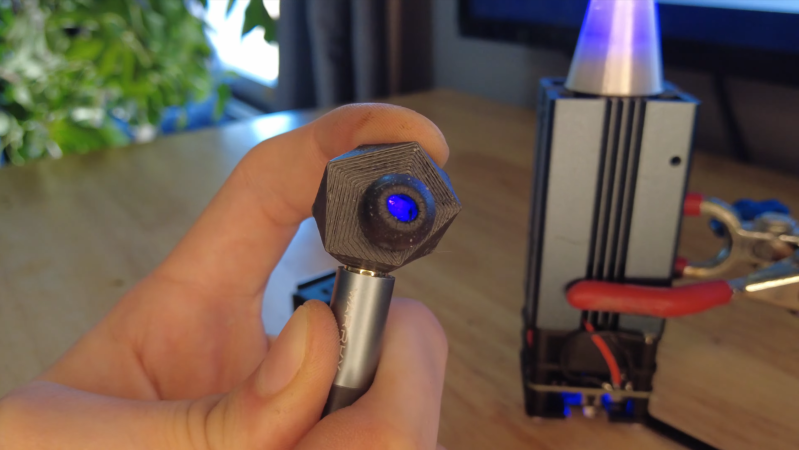
A man's hand is shown holding a 3D-printed structure. The structure is hollow and has a fiber-optic cable leading to it. Blue light shines from a hole in the structure. In the background, a laser module is coupled to a fiber-optic cable.

Building A Laser-Driven Photoacoustic Speaker

An MRI scan is never a pleasant occasion – even if you aren’t worried about the outcome, lying still in a confined, noisy space for long periods of time is at best an irksome experience. For hearing protection and to ameliorate boredom or claustrophobia, the patient wears headphones. Since magnets and wires can’t be used inside an MRI machine, the headphones have to literally pipe the sound in through tubes, which gives them poor sound quality and reduces the amount of noise they can block. [SomethingAboutScience], however, thinks that photoacoustic speakers could improve on these, and built some to demonstrate.

Continue reading “Building A Laser-Driven Photoacoustic Speaker”

The Amazing Maser

While it has become a word, laser used to be an acronym: “light amplification by stimulated emission of radiation”. But there is an even older technology called a maser, which is the same acronym but with light switched out for microwaves. If you’ve never heard of masers, you might be tempted to dismiss them as early proto-lasers that are obsolete. But you’d be wrong! Masers keep showing up in places you’d never expect: radio telescopes, atomic clocks, deep-space tracking, and even some bleeding-edge quantum experiments. And depending on how a few materials and microwave engineering problems shake out, masers might be headed for a second golden age.

Simplistically, the maser is — in one sense — a “lower frequency laser.” Just like a laser, stimulated emission is what makes it work. You prepare a bunch of atoms or molecules in an excited energy state (a population inversion), and then a passing photon of the right frequency triggers them to drop to a lower state while emitting a second photon that matches the first with the same frequency, phase, and direction. Do that in a resonant cavity and you’ve got gain, coherence, and a remarkably clean signal.

Continue reading “The Amazing Maser”

The Random Laser

When we first heard the term “random laser,” we did a double-take. After all, most ordinary sources of light are random. One defining characteristic of a traditional laser is that it emits coherent light. By coherent, in this context, that usually includes temporal coherence and spatial coherence. It is anything but random. It turns out, though, that random laser is a bit of a misnomer. The random part of the name refers to how the device generates the laser emission. It is true that random lasers may produce output that is not coherent over long time scales or between different emission points, but individually, the outputs are coherent. In other words, locally coherent, but not always globally so.

That is to say that a random laser might emit light from four different areas for a few brief moments. A particular emission will be coherent. But not all the areas may be coherent with respect to each other. The same thing happens over time. The output now may not be coherent with the output in a few seconds.

Baseline

A conventional laser works by forming a mirrored cavity, including a mirror that is only partially reflective. Pumping energy into the gain medium — the gas, semiconductor, or whatever — produces more photons that further stimulate emission. Only cavity modes that satisfy the design resonance conditions and experience gain persist, allowing them to escape through the partially reflecting mirror.

The laser generates many photons, but the cavity and gain medium favor only a narrow set of modes. This results in a beam that is of a very narrow band of frequencies, and the photons are highly collimated. Sure, they can spread over a long distance, but they don’t spread out in all directions like an ordinary light source. Continue reading “The Random Laser”