
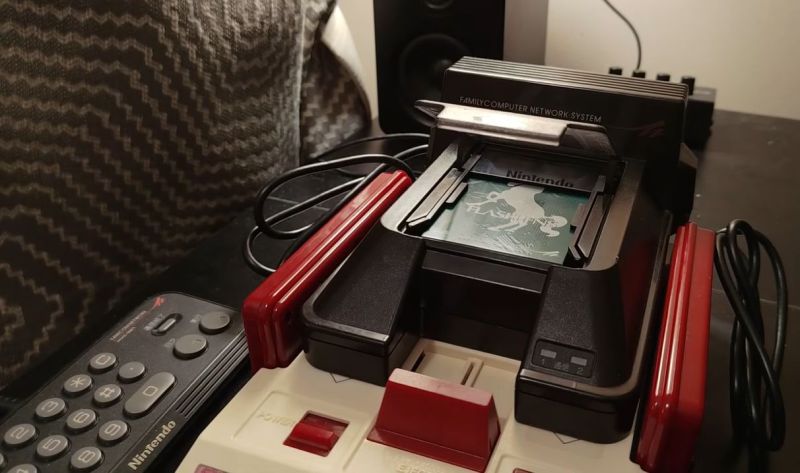
Usually, the name ‘Famicom’ and the associated Nintendo Entertainment System (NES) don’t exactly bring to mind downloadable content and online services. However, at least in Japan, a modem add-on for the Famicom offered those features. Released in 1988, the Family Computer Network System (FCNS) offered all that using its modem to dial into Nintendo’s servers. Recently, [Throaty Mumbo] got his mitts on one of these units to try and see what you can still do with it in 2026.

Although only mildly successful in the Japanese market, Nintendo still sold 130,000 of these modem add-ons, with tens of thousands of users for the stock brokering, banking, and Super Mario Club services offered. The experiences with the FCNS would form the foundation for Nintendo’s Satellaview for the Super Famicom and from there into today’s Nintendo Online offerings.
Of course, the main challenge with reviving the FCNS in 2026 is that the remote servers were turned off decades ago, along with the minor detail that to do anything with it you need to insert a special card. This was missing in the used version that [Throaty Mumbo] bought, but fortunately he got a workable Super Mario Club card. The next struggle? He doesn’t speak Japanese, so it took a while to eke out the details.
With a phone line simulator, it’s at least possible to try to have the FCNS try to dial, but that only throws another error. Ultimately it turned out that the FCNS uses NTT’s proprietary DDX-TP (in Japanese) protocol, which isn’t really documented outside of some Japanese sources. This is where the NES Dev site and its forum thread full of FCNS enthusiasts proved essential, as they had already done all the reverse-engineering.

NES Dev user [Ben Boldt], for example, made a DIY version of the FCNS access (tsuushin) card that lets you configure its details. For development, the PLCC-based CPLD was a bit of an annoyance, so the FCNS got somewhat modified along the way for more direct access.
After five months of work, he was finally able to connect the Famicom via the FCNS and a telephone line simulator for some Super Mario Club action. This connects to the SMC Server simulator on the PC, with the detailed manual that comes with the access card helping a lot.
After all this, the Super Mario Brothers game was graced with a game patch that allows for network-based SMB two-player action. This adds a ‘dial’ and ‘answer’ option so that the two Famicoms can connect and commence the two-player session. Although one can question the latency this would entail without a direct POTS connection as here, it is definitely a nifty demonstration of what ultimately would become the multiplayer gaming on Nintendo consoles today.
You can still do Famicom programming. There were even clones.






Other 1980s systems had dialup systems. Some were third party. Atari 2600’s GameLine is one.
To be annoying, the Atari 2600 is a 70’s machine.
Yes, but it enabled the availability of STEM education for children coming from all backgrounds, not just those who could afford to play with expensive UNIX workstations.
I’m trying to remain kind and respectful to you, maybe you’re playfully citing a meme here? but I do want to dissuade anyone of Atari’s actual ability to do what you describe. Atari 2600 were rather inexpensive, but modems then were not, and long distance charges would be more expensive than the computer system itself. I tried looking up baud speeds on commercially available modems at that time, but got hallucinations myself instead of answers. I can just assure you they were slow! You could argue that schools might get these, but most US schools would consider those expenses extravagant at that time, even schools with connections to Universities in California and Massachusetts… in schools in poor districts? I don’t think so. Finally you have the awkward issue that the computers dialed into on the other end might well be expensive UNIX computers, expensive servers at any rate. You might have a cheap Atari terminals at one end, but the costs of dialing in and using servers at the source would have to be factored in. It wasn’t free, and maybe Nintendo tried to claw back some of that with the price of “Super Mario Club cards” and such. Maybe your post was a polite troll to get knowledgeable people to post? I mean, the term STEM hadn’t even been invented in the early 80s. Or maybe you asked AI, because Atari Inc. playing Robin Hood in education at the time is very much a hallucination.
Very interesting! 😃
I also like the idea that SMB1 now has a patch for this.
Something else makes me wonder though: Why do phone line simulators exist? Why are they a thing now?
I mean, back in the 90s, we simply had an ordinary PBX at home.
So each room could have a telephone plugged into the wall socket.
Our PBX was made in late 80s and used pulse dialing (older models were from the 1970s, even).
It was not just simulating a simple phone line, it was a miniature landline.
You could call all the phones in the house (up to four ?), each had a short number (31, 32 etc).
Another extra feature was a gate opener, I think.
To peripherals, it was an analog landline (POTS).
Modems and fac machines had no issues with it, the audio/line quality was excellent (no ADC/DAC conversion).
In fact, it was far better than the public phone network! 😉
There was a microcontroller that generated the busy tone, dial tone etc.
The tone for the internal landline was slightly different to the real thing (a few Hz),
so you could hear if you had left the internal network or not.
Pressing “0” often made the PBX connect to real landline.
But often via an opto coupler, which added an additional layer of safety.
There also were ISDN based PBXes which had some extra ports for analog phones, I remember.
(Just like DSL and cable routers used to have one or two analog phone sockets.)
So someone could still use an ordinary modem,
in order to call a BBS (mailbox) or another computer terminal that uses a modem.
ISDN also allowed peer-to-peer conections, though.
There were BBSes that had separate logins for modem and ISDN users.
That’s why I wonder why those line simulators do exist these days.
Wouldn’t it be more practical to simply make a modern, open hardware version of a fully functional “analog” PBX?
With proper analog circuit, real AC ringing, relays and opto couplers?
So that it’s possible to dial in-house, to use multiple modems and phones same time?
So that phone port A+B and C+D can do have a connection simultanously? Or A+D and B+C?
It’s not meant as a complaint, I do have a vintage PBX here. I’m happy.
I just think it would be an interesting project, maybe? 🙂
Dialing to the outside world isn’t needed more, perhaps.
Unless someone is a BBS fan and wants to hook the PBX up to some VOIP device (router modem etc).
SMB1.. Haha! I just realized it can mean both Super Mario Bros. 1 and Server Message Block v1! 🤣
“Wouldn’t it be more practical to simply make a modern, open hardware version of a fully functional “analog” PBX?”
Why? Get some cheap ATAs, optionally order a SIP trunk from your ISP and run Asterisk on your router or on a Pi → Instant PBX with more features than a full-blown Siemens Hicom ever had.
D/A and A/D conversion may cause headaches with high speed modem connections (beyond V32bis?) and fax transmissions (classic fax machines).
Things like latency are very sensitive factors here.
Even old G.711 isn’t an ideal solution, it seems.
Except for an old 1200 Baud Bell connection, probably.
A clean, analog PBX likely has a much higher audio bandwidth and cleaner signal quality to offer.
The resolution of the waveforms is much higher due to it being analog (no “steps” as with G.711 etc).
https://en.wikipedia.org/wiki/G.711
The old Panasonic hybrid systems are wonderful, cheap and plentiful these days too. They support DTMF and pulse dialing at 10 pps and 20 pps.
Those were commonly used in Italy before they were replaced with fully digital switchboxes. My father worked on those when I was a child.
In my experience this works pretty well. Of course you have to set up the ATAs correctly to use the same non-compressing codec and compander on both ends, like G.711/a-law. This is exactly what ATM-based PSTNs in the 1990s did and what V.34 modems of that era were designed for. Old and fully analog PSTNs couldn’t do much more than 9600bps, maybe 14400bps on a lucky day, because amplifiers and FDM links had lots of distortion. btw, POTS lines were limited to 300..3400Hz in clean designs.
Ah, I see. Yes, a digital PSTN was quite an upgrade over an traditional PSTN.
Here in Germany (W-Germany) of the late 70s and 80s the digitalization process had already started, I think.
The connections between the telephone exchanges started to switch to use microprocessors and optical fibres.
ISDN technology then was going to supersede the analog PSTN.
Given the low quality wiring in some locations and buildings
(“Klingeldraht” aka bell wire or even simple loudspeaker wire instead of twisted-pair),
the digital, lossless connection really increased phone quality.
That being said, I think an analog PBX at home can still be excellent in quality if the phone wiring is properly done, short in length and without influence of external noise. :)
Btw, I forgot to mention former E-Germany. So for sake of fairness I’d like to mention it, too.:
Because copper wire was on shortage, steel wire (!) had been used as substitute for wiring of the telephone lines.
Which did result in very bad phone quality.
After re-union in 1990, it was very difficult to establish a reliable BTX connection over the old telephone exchanges in the new states of Germany.
The default speed for BTX online service (aka Datex-J, T-Online Classic) was a cozy 1200 Baud down/75 Baud up (V.23).
The state of art of 1980, basically. That’s the technology what the infamous DBT-03 modem had used.
Some telephone exchanges in E-Germany were from the 1950s, still
and there were still calls connected manually by an operator in some places.
After re-union, there were new temporary telephone exchanges being installed in metal containers.
They used racks of microprocessor cards made Siemens, I think.
The new states got satellite links and other modern things over night, basically.
More information (early 90s):
GDR phone line upgrade (first aid): https://www.youtube.com/watch?v=W0eDR5y_Lko
ISDN: https://www.youtube.com/watch?v=1lYFr-C_SKg
REBELLL system: youtube.com/watch?v=N-J4xKHOWKE
Optical fibre: https://www.youtube.com/watch?v=YcQW8z-iSvI
Throaty Mumbo… i never get if he plays dumb or is dumb. Not my favorite Youtuber. ¬.¬
Besides that, another piece of tech for the NES that Nintendo kept from the rest of the world. Yay. I hated them for that and still hold a grudge to this day that my younger self never got to write FamilyBASIC as the folks in Großostheim never thought that people over here in Europe might have loved all these gadgets too.
Hi, I share your feelings about the Famicom exclusive hardware.
Though I think Nintendo Europe/Germany didn’t really exist in the 80s during the NES heyday.
Back then, the NES was sold via Bienengräber in W-Germany.
Großostheim was more active during the Super NES days, I think.
Ie, the early to mid-90s. When there had been Club Nintendo and all those magazines.
In the later years, past N64, Großostheim itself had been neglected by Nintendo more and more, I’m afraid.
Which is sad, because I think it had very committed personel.
The “huh? what? what is this? I don’t know. huh? what? huh?” shtick gets tiresome after the first 30 seconds, and he keeps it up through the whole hour-long video. Yet another Youtuber exclusively presenting other people’s achievements. Garbage.