
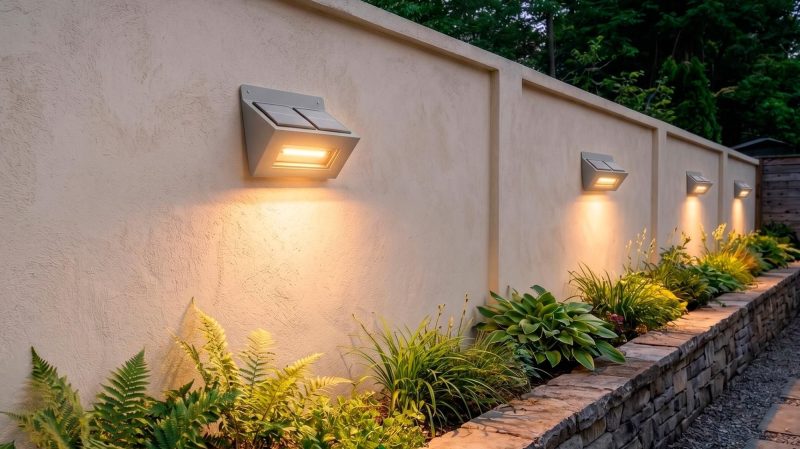
In this modern age, if you want a truly swish garden that makes your friends sad when they visit, you need good lighting. [technocraftStudio] has been working on just such a project, creating custom wedge lights to illuminate garden beds in style.
You might look at the plastic housings involved and assume that they’re 3D printed, like the vast majority of such projects we cover these days. Instead, the enclosures are crafted out of PVC plastic, harvested by flattening sections of pipe with a heat gun. It has the benefit of being highly weather resistant, and cheap to boot. The lights themselves are small LED panels mounted on aluminium plate as a heatsink, and fitted with an acrylic diffuser to spread the light out more evenly. Power for the lights comes from an 18650 lithium-ion cell, charged by a pair of solar panels hooked up to an MPPT charge controller. A TP223 capacitive touch module is also included in the design to allow the lights to be turned on with just the touch of a finger.
The result is a surprisingly stylish bit of garden furniture which provides warm, even light and, ideally, needs a minimum of maintenance and attention since the sun provides the power. We’ve featured some other great solar lamps before, too, like this lovely Pokemon-themed build. If you’re building your own solar projects at home, or doing weird things with PVC, we’d probably love to hear about it on the tipsline!










Any idea why they’re not connected to something like PoE for voltage? It could be much cheaper than Li-Pol batteries and solar cells.
It’s a guess, but my guess would be the difficulty of running the cabling through the wall, or the aesthetics of having conduit to each light.
Plus, if you haven’t done much with LiPo before, I imagine this is a somewhat gentle way to learn about charge controllers with something a little lower-stakes. If you bork it and it kapows, it kapows outside and against a stone wall over some dirt also surrounded by stone instead of in the house. That might be somewhat offset by the challenges of an outdoor environment, but still, I wouldn’t mind using it as a skill builder :)
That’s a pretty good instructable. I can’t help but think they’ll eventually stop getting turned on since you’d have to do it every day you want them on, and you’d have to touch each one. The addition of a small ESP module of whatever variety is lowest power for this job would allow ESPNOW functionality to turn them all on or off remotely, or hook them into a smart home system. One of these days I’ll get out of the rental cycle, surely. Maybe the addition of an ATTiny and an RTC would work, cause you could put it on a timer. Or just a daylight sensor in place of the capacitive switch. So many options.
Checked out the instrucables but couldn’t find what MPPT charge controller he used, did I skip over it or did he leave that out?
It’s not you. He doesn’t say it at all. I can’t even find a picture of it.
It’s a CN3065 solar charger module, there are two pictures of it in the instructable but you have to click “more images” in the relevant sections. It has a built-in MPPT and seems a reasonable match for the used panels.
The pictures show a charger module based on the Consolance CN3065. The datasheet doesn’t talk about MPPT, but mentions a “Charging Current limited by the Output capability of Input Power Supply” feature.
Consonance
Just want to comment that these lights are not going to be UL (or other underwriting) listed, so insurance will deny any claim they are involved with. This goes for any homemade electronics or luminaires you install permanently, especially ones that plug into mains power. You can get them listed, but that costs an arm and a leg.
Anyway, I don’t want to be all negative; cool project.
Thanks for letting us know here, but why exactly here and now? As this goes for almost every project posted on this webpage? Did I miss something? After all insurance companies cling on to every possible exception in order to deny a claim of any kind (or at least reduce the size of the claim), it’s their business model.
I’m an electrician and saw the wall mounted luminaires. That set off my professional red flag. That was the whole motivation for the post.
its solar powered tho, so no mains power involved.
Do you have a source for your statement that an insurance claim would be denied? I’ve worked for nearly 10 years in property and casualty insurance and have never seen a claim denied for such a reason, nor have I seen a policy that had clause mentioning anything similar.
It would fall under electrical code violation if you’re drawing power from the mains. In NFPA 70 (NEC or the National Electrical Code) it states when you are powering devices they have to be “listed” with UL or some other recognized underwriter. I imagine a similar argument could be made for small solar powered devices like this in case of fire, especially if permanently installed.
That being said, this is more applicable if you’re selling the house and you built a giant custom RGB chandelier, it might cause some hiccups with inspections and insurance.
Unfortunately paying insurance will be no guarantee you are covered. It’s a legalized scam which pays out only under rarely met conditions.
This is the real issue. They often do not have a valid reason and still deny payments. Medical insurance is the same in the US. You’re paying premiums for the hope of something that may never come.
The PVC enclosures are the clever part here. They avoid the layer lines and UV concerns of a quick 3D print, while the wedge shape puts light exactly where it is useful instead of spilling it across the yard. I would be curious how the battery compartment is sealed for winter rain.
Technically you don’t actually need to seal outdoor electronics, as long as it won’t die to condensation settling on it and you have a path that lets water drain out freely enough wet weather won’t matter much.
Conformal coatings, gaskets etc wouldn’t be a bad idea but other than higher voltage stuff where arcing just from humid air could become a problem if you let any moisture in you should get a pretty good lifespan just from having a good drain path so the electronics never actually sit in water.
Yep. Boat trailers rely on this. Check the lighting out on one close up sometime.
Not trying to be negative here, but unshielded wallpack style lighting creates potential issues with glare, and light trespass into neighboring properties. It would be better to design with cutoff shielding to ensure the light goes where it is needed on the property and does not spill out unnecessarily to the sides.