Building Custom Backyard Solar Lights

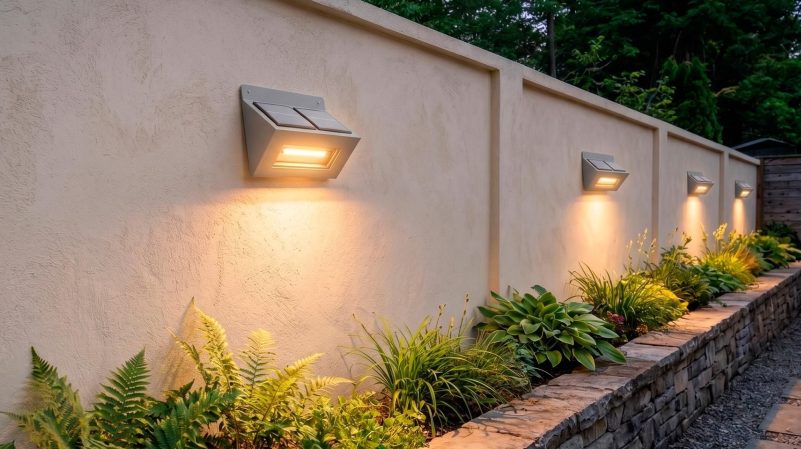
In this modern age, if you want a truly swish garden that makes your friends sad when they visit, you need good lighting. [technocraftStudio] has been working on just such a project, creating custom wedge lights to illuminate garden beds in style.

You might look at the plastic housings involved and assume that they’re 3D printed, like the vast majority of such projects we cover these days. Instead, the enclosures are crafted out of PVC plastic, harvested by flattening sections of pipe with a heat gun. It has the benefit of being highly weather resistant, and cheap to boot. The lights themselves are small LED panels mounted on aluminium plate as a heatsink, and fitted with an acrylic diffuser to spread the light out more evenly. Power for the lights comes from an 18650 lithium-ion cell, charged by a pair of solar panels hooked up to an MPPT charge controller. A TP223 capacitive touch module is also included in the design to allow the lights to be turned on with just the touch of a finger.

The result is a surprisingly stylish bit of garden furniture which provides warm, even light and, ideally, needs a minimum of maintenance and attention since the sun provides the power. We’ve featured some other great solar lamps before, too, like this lovely Pokemon-themed build. If you’re building your own solar projects at home, or doing weird things with PVC, we’d probably love to hear about it on the tipsline!
Five Solar Air Heating Methods Tested

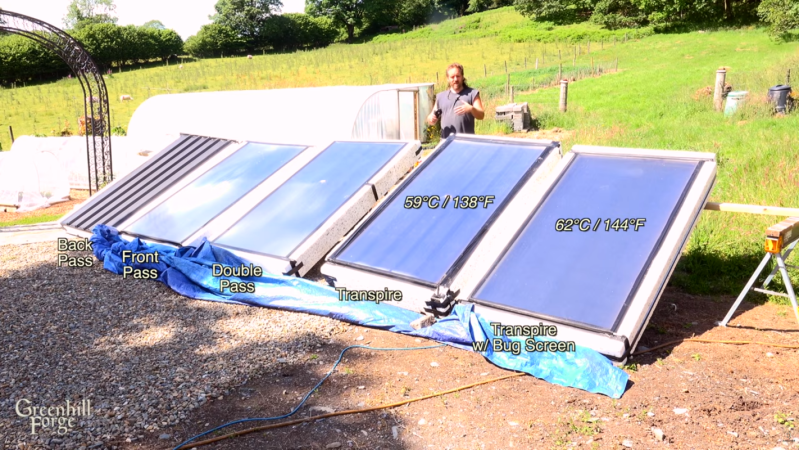
For as good as solar panels are at converting sunlight directly into usable electricity, especially for how cheap they’re becoming, they can still only gather around 20-30% of the energy that hits them. That’s fine if you have a large roof or a huge tract of land, but if you have limited space and need to do something like heat a home, there are better options available to capture more of that energy. [Greenhill Forge] has built five solar air heating panels to test this concept, and do it much more inexpensively than commercial options.

These solar heaters use sunlight to heat a fluid, in this case air, and move that heated fluid to another space. Each panel is about two square meters, insulated on all sides except the top, and configured in a way that air can flow past something that the sun has heated. The first panel, a control, does not use a glazing to help trap this heat, but the rest all have a polycarbonate window to increase the greenhouse effect of the panels. The four remaining all experiment with the way air flows around a black corrugated steel sheet to gather more of the heat, with the fifth panel using a set of black screen instead.

With the panels all set out in the sun, [Greenhill Forge] is using a set of thermocouples from a previous project to measure the efficiency of each panel. Surprisingly, he found that the panel using the layers of screen was the best at gathering energy, although he notes several times that these types of panels are extremely sensitive to changes in physical configuration, so this is not the most definitive test possible. However, at only around $100 per panel it’s quite a deal if the goal is a usable space heater that doesn’t use any fuel or grid electricity.

Continue reading “Five Solar Air Heating Methods Tested”

LightInk, A Solar Powered ESP32 Smartwatch

There’s something about the ESP32 family of microcontrollers and timekeeping. We probably see it in clocks as often as we do anything else; we also probably see more clocks with one as the beating heart than any of the many other possible timekeeping options.

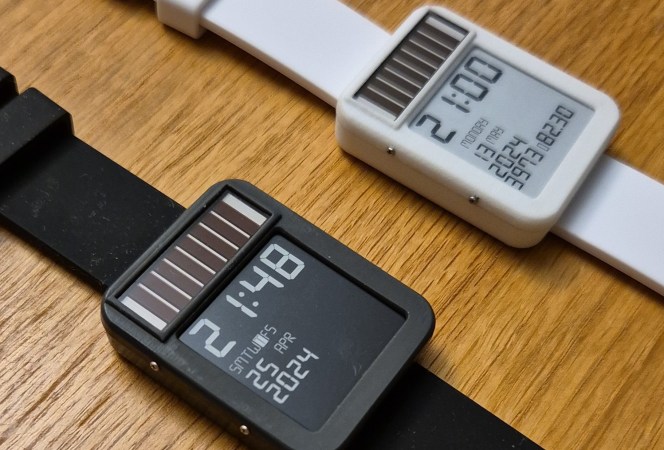
[Daniel Ansorregui]’s LightInk watch is no different in that regard — but it is very different in one important detail, because unlike most other smartwatch designs, you won’t have to worry about battery life. Outside of gloomiest Gotham, its built-in solar panel should be able to keep it charged.

That’s for a few reasons. The obvious one is the e-ink display, which only takes a sip of power during updates. That’s hardly unique to [Daniel]’s projec t– he quite explicitly calls out the Watchy project, which we featured previously, as where he got the idea of putting e-ink and an ESP32-PICO together on his wrist. What is unique is the delightful hack [Daniel] is using to minimize power usage, which is our favorite part.

Continue reading “LightInk, A Solar Powered ESP32 Smartwatch”

Sunlight Powered, Sunlight Readable: Solar Case For Nook Simple Touch

When life gives you lemons, you make lemonade. What if life gives you a pile of old e-book readers? Well, when [spiritplumber] got box of old Nook Simple Touch devices, he decided to design solar-powered cases to help boost the old batteries. It makes perfect sense to us: sunlight readable screen, sunlight chargeable battery.

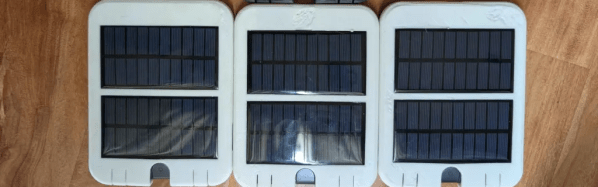
It looks like he’s got a pair of panels built into the 3D printed case. He recommends using any TP4056-based charger, and tying into the battery test points, not the 5 V supply. It won’t hurt anything if you do, apparently, but the device will think it’s plugged in an refuse to turn off the WiFi. That’s no big deal when you’ve got a continental power grid on the other end of the cable, but charging from a small panel on the back of the case doesn’t always give you enough juice to waste on unneeded radio activity. Especially indoors — these panels are apparently big enough to trickle-charge the device under artificial light, which is a nice, if doubtless slow feature.

The design is open source, and includes SketchUp design files as well as the exported .STL, so if you’ve got a hankering to edit this to fit a different e-book reader, you can. He also provides a handy-dandy guide to root this model of Nook, and if you’re on Hackaday we probably don’t need to explain why you might want to.

We’ve seen the Nook Simple Touch go some interesting places — like into the clouds as a glider computer — but solar power is a new hack for this device, at least on this site. We don’t know if [spiritplumber] has a green thumb, but he’s evidently got some environmental bones in his body: his last featured project was about improving quadcopter efficiency with a wing and a prayer.

2026 Green Powered Challenge: A Portable Solar Panel, Made Better

Many of us will have seen the portable solar panels offered on our favourite online purveyors of electronics, but some who have bought them remain unimpressed with their performance.  [t.oster92] had just such an issue, and concluded that since it had great dull-day performance, it wasn’t the panels themselves that were at fault. There followed a teardown and an investigation of the circuitry inside.

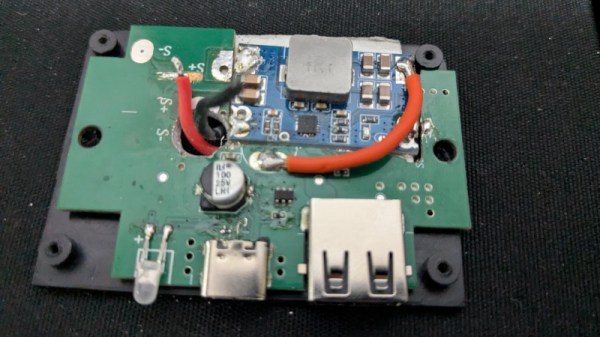
The panels fed a small PCB containing a buck converter, with an 8-pin SOIC carrying an untraceable part number. Some detective work revealed it was likely to be a rebadged version of a more common part, which exposed the problem as a converter without the rating to deliver the power it should. The solution, at least in part, was to replace it with a more powerful chip on a module and reap the benefits.

This would be the end of the story, but this is an ongoing project. Next up will be adding MPPT capability to extract the last bit of juice from those panels. That makes this one a story to keep an eye on, because we could all use a decent set of panels.

This hack is part of our 2026 Green Powered Challenge.

2026 Green Powered Challenge: Solar Powered Pi Hosts Websites In RAM

If you started with computers early enough, you’ll remember the importance of the RAMdisk concept: without a hard drive and with floppies slow and swapping constantly, everything had to live in RAM. That’s not done much these days, but [Quackieduckie]’s solar powered Pi Zero W web server has gone back to it to save its SD card.

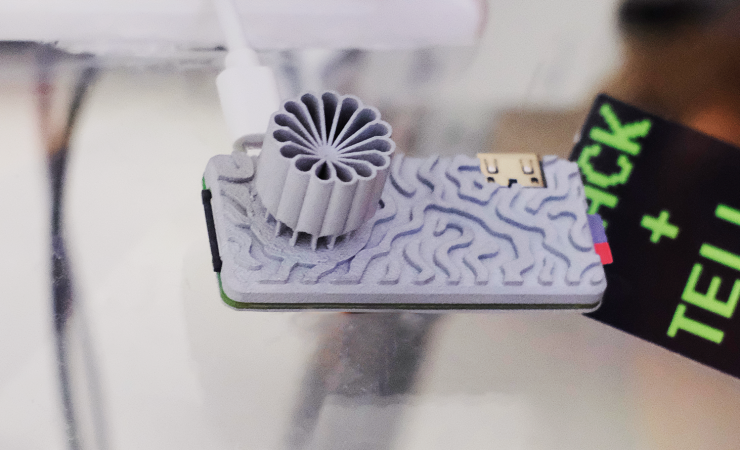
Sustainability and low power is the name of the game. Starting with a Pi Zero W means low power is the default; a an SLS-printed aluminum case that doubles as the heat sink– while looking quite snazzy–saves power that would otherwise be used for cooling. The STLs are available through the project page if you like the look and have a hankering for passively cooled Pi. Even under load [Quackieduckie] reports temperatures of just 29.9°C,  less than a degree over idle.

The software stack is of course key to a server, and here he’s using Alpine Linux running in “diskless mode”– that’s the equivalent of what us oldsters would think of as the RAMdisk. That’s not that unusual for servers, but we don’t see it much on these pages. It’s a minimal setup to save processing, and thus electrical power, with only a handful of services kept running: lighttpd, a lightweight webserver, and duckiebox, a python-based file server, along with SSHD and dchron; together they consume 27 MB of RAM, leaving the rest of the 512 MB DDR2 the Pi comes with to quickly serve up websites without the overhead of SD card access.

As a webserver, [Quackieduckie] tested it with 50 simultaneous connections, which would be rather a lot for most small, personal web sites, and while it did slow down to an average 1.3s per response that’s perfectly usable and faster than we’d have expected from this hardware. While the actual power consumption figures aren’t given, we know from experience it’s not going to be drawing more than a watt or so. With a reasonably sized battery and solar cell– [Quackieduckie] suggests 20W–it should run until the cows come home.

This isn’t the first solar-powered web server we’ve seen, but this one was submitted for the 2026 Green Powered Challenge, which runs until April 24th.

Solar Balconies Take Europe By Storm

Solar power has been around for a long time now. Once upon a time, it was mostly the preserve of research projects and large-scale municipal installations. Eventually, as the technology grew ever cheaper, rooftop solar came along, and cashed-up homeowners rushed to throw panels on their homes to slash their power bills and even make money in some cases.

Those in apartments or rented accommodations had largely been left out of the solar revolution. That was, until the advent of balcony solar. Popular in Germany, but little known in the rest of the world, the concept has brought home power generation to a larger market than ever.

Continue reading “Solar Balconies Take Europe By Storm”