
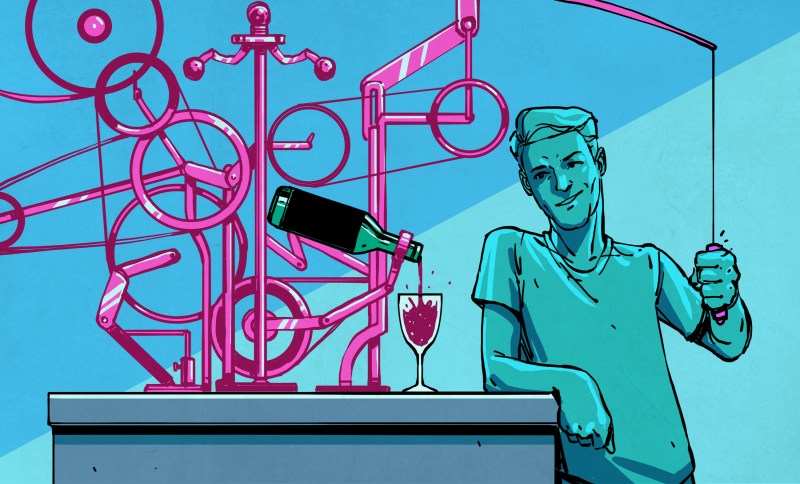
On Hackaday last week, and on the podcast, we were talking about one of the educational toys of yesteryear that launched a thousand careers, at least if the comment section is to be believed: the Radio Shack 200-in-1 electronics kit. The “toy” itself was basically a bunch of components with spring terminals, but the secret sauce was in in the instruction book, and maybe the marketing.
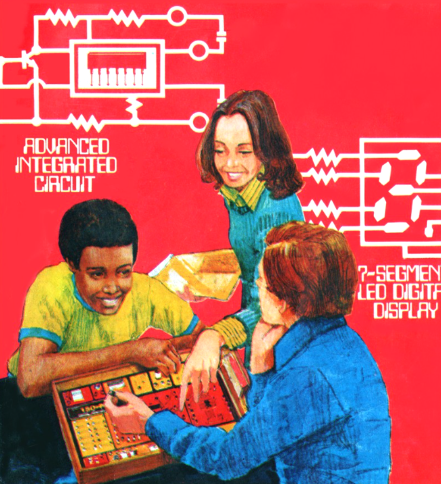 Tom had one of these when he was a kid, and told a great story about wanting it desperately based on the ads he had seen with kids Morse coding to each other. When he got the kit, and found out that “it was just a bunch of wires” he was fully pissed off. But he worked through the examples, learned some basic electronics, and the rest is history.
What I really love about this story is the siren’s call of a good project. Tom was pulled in, and maybe even fooled, by the advertising, but it probably changed his life. It’s funny how many of our folks can remember the first project that got them hooked as well. With me it was some simple audio effects pedals and then maybe later some simple BEAM robots, and for younger hackers maybe it was a 3D printer or Arduino project.
Digital or analog, the common ground here is that we all thought that some project was cool enough to warrant the sweat of learning enough to do it. Good instructions are helpful of course, and having the parts on hand never hurts. But it’s the promise of making something that you really want that I think underlies all good first projects. (And heck, every subsequent project as well.)
So while Tom, and a bunch of our readers, were looking back with nostalgia at the 200-in-1, I’m thinking about how many more than 200 projects I’ve seen made by our community, and even featured here on Hackaday, that are out there to provide the motivation to get someone started. Keep on hacking!










It didn’t help me that I was color blind, growing up with sickly parents who adopted me later in life. My Dad did have a few magazines, but he was a second shift railroad man–which meant he was at work when I was let out of school.
So I became a bookworm instead.
Since my folks were Depression babies…the youngest of their brothers and sisters–all my childhood memories were of endless trips to hospitals, nursing homes, and funeral homes.
That poisons the can-do right out of you.
If anything, I learned to HATE the sound of the rotary telephone ringing….I wanted to smash it, in that it seemed every fourth call or so would start my Mom to bawling over the latest disaster.
Instead of learning the wonders of electronics, you instead learn to look for the next shoe to drop. My folks were not the most-evolved-people…they loved Hee Haw and hated that I watched Star Trek…but they tried at least.
I lost them both in my 30s
Growing up to be self-aware into the 1990’s depression, when your parents couldn’t afford to buy any of the interesting toys, and then graduating for work into the 2008 economic crisis, kinda had the same effect. At an early age I remember thinking, “That’s so cool, but I’ll never have that.”
If you were rich, you had nintendos and commodore 64s, RC toys, the rest of us had a library card and a broken VCR that chewed up cassettes so the only two Disney animated films you could watch were both cut half-way through so you could at least play the other half to keep the kids quiet for half an hour. But, my parents still got me a physics experiment kit with a DIY DC motor and electrolysis experiments, etc. which included a plate of pure lead to make a battery. I learned to use the sowing machine because my older sisters would use it to make clothes, I learned to whittle a crossbow out of wood, play instruments though I wasn’t interested in music at that time, and I read a lot of illustrated encyclopaedia with cut-out views of all sorts of machinery.
Through books I gained enough of an understanding of electronics and logic circuits that I would take an electronics supplier catalogue and look through the application notes, and imagine what I could do with the stuff: one time I had the idea of an automated sluice gate controller that I could put on a small dam created by piling up dirt in the spring to block the waters from melting snow. On the back pages of the catalogue there was a listing for a programmable ROM chip you could order with the values burned in, so in my mind I created a state machine to program the operation without yet knowing what a state machine is. I imagined float switches and reed switches on the gate to keep the water level finely controlled, but then I realized you couldn’t just order one ROM chip, you had to order hundreds, and the rest of the parts would cost too much as well. Then there was the matter of, could I actually make it work? The answer was probably no, so I didn’t.
So, I went for the mechanical stuff instead, and finally got a hand-me-down computer to practice programming on, though then I found myself doing graphics and 3D modeling instead because that was more gratifying. I got into digital photography and art, though my major was mechanical engineering, but then at the last stages I got into analog electronics to solve the original problem of how to control stuff without relying on esoteric digital systems that seemed to go in and out of fashion the moment you learned how to use them. I was fascinated by the universal simple elegance of analog circuitry, so I played around with electronic music. None of that was useful because the knowledge was outdated, so I took up embedded systems and that was perhaps the right choice in the end. The order is a bit mixed, I did both on and off.
What finally got me a job was the combination of everything: the art and design for presentation and drafting, the music that gave insight into signals processing, the crafting skills, the training on mechanical engineering that gave science to the designs I made, the fascination of elegance in electronics which meant I could simplify a lot of stuff that seemed to stump others, and the early trials and errors in programming and digital logic that put me ahead of the other students. It’s not that I’m particularly good at any of the above, but through need and must it seems, where one skill or ability seems lacking the others have always provided the means to go forward and a shortcut around the things I can not.
It has never given me a can-do attitude, more of an “oh dear, how do I survive this?” with limited and unreliable means, without a clear path or convention to rely on. It has taught me that none of it truly matters, yet every experience is as useful as you make use of it, and you can’t tell in advance what use it will become.
How would you say this compares?
<3
I couldn’t appreciate that sentiment when I was younger, but I really, really can now.
I’ve done some programming for an ancient CPU as a hobby, learned about ARM assembly and different types of memory. Years later I work at a company where that knowledge is useful.
I’ve organized parties, years later I’m organizing a team. Try to do your best with the means you have, always try to learn, no matter what you do. And try to be a good teacher and give others the possibility to learn.
I am in awe of your accomplishments.
I am just an idea guy…in a word…worthless
I had the 150-in-1, pictured above. It didn’t have the plastic control panel on the front, just a wooden box. But it did have an IC chip and a seven segment LED. Unfortunately, I got bored with it after a few weeks. I didn’t have a supportive enough environment to let my imagination carry on. No proper work space, or interested adults around. Perhaps if I’d had access to a soldering iron and a good multimeter, I’d have been able to harvest components from all the discarded electronics I would routinely come across.
Of course my son had access to Snap Circuits and LittleBits. We put together a Useless box, and a robotic arm kit. I had him go hands on building his gaming PC. We have both an FDM, and a resin printer for electro mechanical interfaces. He routinely sees me diagnose and repair circuits, with meter, thermal camera, and iron. Yet, he exhibits no inclination to explore on his own, other than to put together pre-made kits with explicit instructions.
Today’s world is such a target rich environment, with so much instantly available information, that you have to be a resolute autist to be able to focus your energies on anything. There is always some easier form of low level dopamine screaming for attention out of the corner of your eye. Gaming and Social media, of course being the main culprits.
I suppose what we really need, is to create a gamified, socially interactive educational network, that is also a safe environment for the young, and freely available to the public. Matriculation through high score!
I fear for the future. My grandchildren, (If I ever get any) will be lucky to have George Jetson’s button pushing job. And Mr. Spacely won’t exist, other than an AI representation. The vast majority will be employed in low level, nonrepetitve, maintenance oriented, day labor, where it makes more economic sense than employing specialized robots.
Wow. Just meant to respond with an associated experience. So easily drawn astray!
Might be the age. I remember my father taking my lego blocks and putting LEDs inside to make flashing lights for a police car, so I could build one, and I didn’t think about the possibility of what more could be made that way. In hindsight, it feels as if the world then was a made place where things happen because they are just so, not because I had any personal agency over things with parents providing everything and telling everything I should do.
I am 😎
Luckily I went through my teenage years just before the whole “diagnosed autism” thing became fashionable so I never had my mind chemically castrated with “meds” or this whole “therapy” brainwashing nonsense.
I pity the younger generations though. So many potential scientists and engineers will have their minds dulled by their clueless parents early just to make them “behave” or “socialize”.
I wanted one but couldn’t afford it. So I built one out of offcuts of plywood, with a hinged sloping front and screw terminal blocks instead of springs. But I didn’t use it much.
But it set a pattern that has so often been true: building a thing is more fun and more instructive than actually using it once built!
I wish more people understood that.
I despise cost cutters…like Boeing’s CFO Debbie Hopkins who once said that they didn’t need engineers to build airplanes.
Besides it is engineers that can find ways to lower costs if given the chance–as here:
https://phys.org/news/2026-08-laser-aluminum-foil-terahertz-polarizers.html
I love stories like that…so tinkerers still matter.
I could not even get my locker’s combination lock to work at school, so I just lugged everything from room to room in a huge book satchel so I didn’t have to fool with it.
The wrong lesson.
You either master life or it masters you.
This is why I have about 20 hand assembled/built synth modules but I’m not very good at playing them. I’m better at playing ones I’ve built compared to ones I borrowed, because I built them. I know them in and out, but ones I’ve borrowed were almost never patched in. So I never really tell people I like to play modular synths, I tell them I like to build modular synths, and they’re almost always confused by that. Hah. To each their own.
“…and for younger hackers maybe it was a 3D printer or Arduino project.”
Well, thank you! As one who didn’t start 3D printing or electronics until I was in my 60s, its not very often I am called ‘young’! For me, my first real electronic project was a launch controller for my model rockets. I posted it to Instructables and my web site, and you can imagine my surprise when it showed up here on Hackaday (https://hackaday.com/2023/01/23/arduino-is-out-to-rocket-launch/).
One thing I do want to mention, as I recently went with my grandson as he is looking at colleges and engineering. I was talking with one of the professors in the aerospace program and commented that other than the electric motors, the model airplanes they were making looked very much like the ones I was building back in the 70s. He told me that one of the biggest problems they have with new students is that most don’t know to build anything. They are very good at working things out on the computer, but to make the transition from the computer plan to an actual object is really tough for them. He said 20-30 years ago, that wasn’t an issue.
So for all you parents out there, teach your kids how to build things. They might just thank you later.
Here is where GenX shines.
The Silent Generation and before were just trying to live. Today’s kids are on YouTube marveling at the music and films we grew up with–made possible by the fact that we didn’t have that or Smartphones as a distraction.
We had just enough science fiction and cartoons to inspire us without overloading us.
Being UTU, my Dad had six weeks paid vacation and I had the full three month summer off school to imagine, dream…and be free-range.
Kids are never bored. That’s actually a problem.
These are still being made by TroneX and Ive now got a few of these kits including one built in partnership with the University of Cambridge Sound Lab And the Japanese versions.
From the age of 7 through 13 in the 70’s I was lucky enough to be given one of these electronics labs , along with a chemistry set, a three inch refractor, several Meccano sets and the four volume International Encyclopedia of Science. They captured my imagination and leisure hours and guided many of my future interests. My local library’s SF section amplified those interests and by my mid teens I was set to science the shit out of life. Fast forward fifty years and I can look back and really appreciate the choices of things my family provided me with. One of which, the set of encyclopedias, I still have.
I was (back in 1989) wanting an original Apple Macintosh 5 years after introduction…
Compared with my PC clone: the Mac was lacking…
Come to 2026: one could make a pseudo-Mac with a full 16MB, 32k colors on an HD720 display, and with some other features. That is my current (one-man) project.
About “you have to want it”: I am going to share a little story.
I grew up in a remote farming village in Belgium. When I was 9, relentless nagging, begging and crying finally resulted me into getting a C64. The problem was: the C64 was grey import from Germany. With a German manual. And it came with no games, nor did I have friends with games. All I had was the BASIC boot prompt. Obviously, I didn’t speak any German; but it was clear to me that the gateway to the future was through the German manual. Libraries I had access to had nothing on computers. But with a dusty German dictionary and an unstoppable determination, I learned enough German to absorb every word in the manual and I eventually learned to program the machine.
The investment in time required was absurd. But I learned that the reward from doing absurdly hard things was high, so I became a microwave engineer. Electronics was hard, ultra high frequency RF was harder, so more rewarding, in my frame of reference.
There is no equivalent to such information scarcity these days, and I have no idea how I would have evolved as a person or professionally if things would have been just a fingertip away.
That’s an interesting question. I think the answer for me is that it moves the frame of reference, not the underlying drive. I think you learn to skip a lot of the lower level stuff because it isn’t necessary to accomplish something. So you focus on the higher level stuff which is where the challenge still remains. Being attracted to challenge doesn’t require starting banging rocks together or deciphering a foreign language. Maybe these are stages where some started, but modern systems still have limits where creativity begins and challenge can be found. These are the stages where I’m trying to get my own daughter to become inspired if she finds something interesting. She doesn’t need to reinvent the computer to get started.
One year a very prescient uncle gave me a no-name 50-in-1 electronic experimenters kit. It was based on two germanium transistors, a germanium diode, a relay, a meter, speaker and crystal earphone, resistors and caps, etc etc. I loved it to bits and learned lots from it.
But there were things that came before, too. Most notably a Remco crystal radio. I can remember my dad and I putting it together on the kitchen table and him running an aerial to the clothesline pole. Following that, a basic DC panel thing with a D cell and a few switches, light bulbs, and a buzzer.
I went on to learning more and building from scratch. And yes, these things led to a career or two. I know I had an aptitude, but I definitely benefited from growing up in a stable home, having funds for educational toys, and being given opportunities. These days I hang out occasionally at a maker-space, and I am seeing young people who like to learn, and to create and repair stuff.
I’ll add my own “old man” story to the mix. When I was a young teenager, I begged and pleaded for the 200-in-1 kit for xmas. It was only one of two presents that I vividly still remember getting (the other was my first bike). That kit brought me many hours of joy. I went on to have a varied career in electronics, radio and computers.
Thankfully, my generation had interesting toys like Lincoln Logs, Erector Set, etc. I even bought two second hand chemistry sets (I had a paper route – what’s an allowance?). It’s a shame that kids can’t have such creative toys/hobbys today. I don’t remember most people being as stupid then, as they are today. Now, get off my lawn :-)
I was also an avid reader on all topics. Science Fiction was a favorite, of course. I still have a sense of wonder and excitement when I read about some latest discovery or invention. I’ll stop learning new things when I’m dead.
“….. for younger hackers maybe it was a 3D printer or Arduino project”.
Sheeeet,,, I cobbled up my 1st Arduino Project 14 yrs ago at age 63, and was blown away at the possibilities (compared to my 1st CPU magic via the RCA 1802 in ’76).
The “siren’s call” never stopped.