
“There is a lack of dietary research into brain health, and our findings suggest that conventional dietary advice may be unfavorable to a genetically defined subgroup of the population. For those who are aware that they belong to this genetic risk group, the findings offer hope; the risk may be modifiable through lifestyle changes.”
Jakob Norgren, Karolinska Institute, March 19, 2026
The “conventional dietary advice,” to which the Swedish neurobiologist Jakob Norgren refers in the press release quoted above, is based on a simple proposition: “What’s good for the heart is good for the brain.” This seems perfectly reasonable, but it assumes, of course, that we know what’s good for the heart.
If Norgren’s latest research is any indication, we have the kind of dilemma that is the fodder for this newsletter: either the conventional wisdom is not true—heart and brain health go their separate ways for an uncomfortably large proportion of the population—or maybe our conception of a heart-healthy diet needs serious revision.
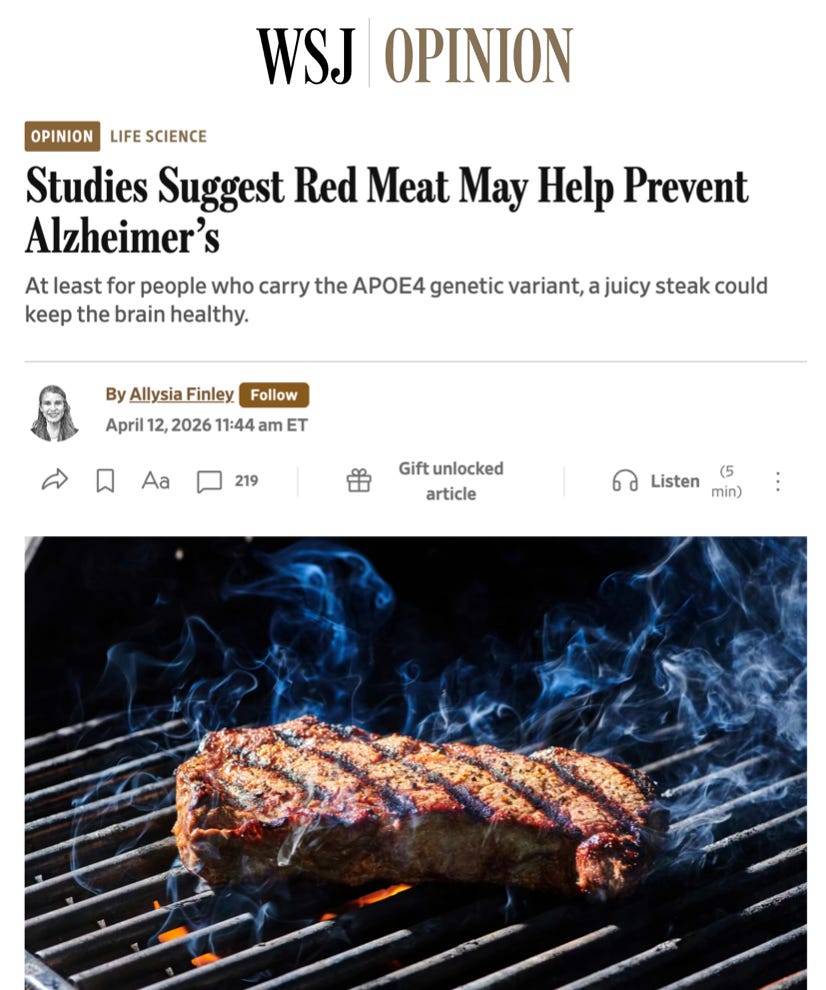
So what did Norgren and his (mostly) Swedish collaborators find? As a Wall Street Journal headline put it, “Red Meat May Help Prevent Alzheimer’s.”
The caveat: this seemed to be the case only for a particular genetic risk group—the 20 to 25 percent of the population who carry one or two copies of a gene called APOE4. The APOE gene comes in three common forms—E2, E3, and E4—of which E3 is the most common and considered the baseline for disease risk. Having one APOE4 gene will double or triple your risk of Alzheimer’s. Having two copies will increase it roughly 10-fold. It’s the single greatest genetic risk factor for the disease.
Norgren and his colleagues studied 2,100 elderly participants in the Swedish National Study on Aging and Care. They divided them into quintiles (fifths) of meat consumption. The lowest quintile—eating the least meat and carrying at least one copy of APOE4—had twice the risk of dementia compared with those carrying only APOE3. In the highest quintile, those eating the most meat, the elevated dementia risk and accelerated cognitive aging that typically come with APOE4 were absent.
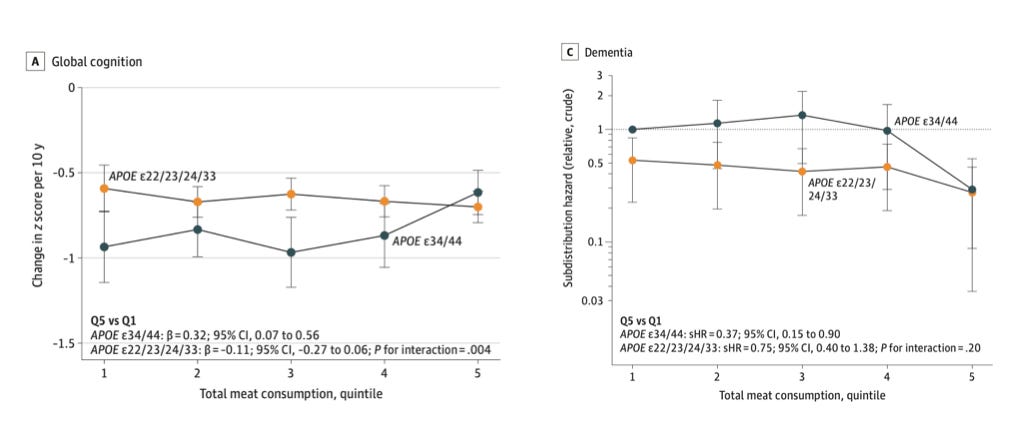
As Norgren et al noted, their observation aligns with what they call “underappreciated patterns” in research using the UK Biobank data and from Harvard’s Nurses’ Health Study (NHS) and Health Professionals Follow-up Study. The message out of those analyses was that meat consumption was associated with increased dementia risk and accelerated cognitive aging—bad things—but, as Norgen et al noted, not so in APOE4 carriers.
Here’s how Norgren and his colleagues described this evidence:
Intriguingly, among APOE4 carriers in the [Nurses’ Health Study] women aged 70 years and older, consuming one or more servings of unprocessed red meat compared with less than 0.50 servings had a cognitive advantage of the same magnitude as the disadvantage typically observed in APOE4 carriers vs noncarriers (approximately 3 years of cognitive aging). This parallels effect sizes observed in our cohort, where the expected excess risk among participants with APOE3/4 and APOE4/4 genotypes was absent in the highest quintile of meat consumption across global cognition, episodic memory (a hallmark feature of Alzheimer pathology) and dementia outcomes. Given that these genotypes account for approximately 70% of Alzheimer dementia cases in Northern Europe and North America, the absolute number of potentially preventable cases is substantial.
A vitally important point, though, is that meat consumption in the Swedish aging cohort was low across the board. Those in the lowest quintile consumed less than half a pound of meat per week, the equivalent of about three small servings. Those in the highest were eating a couple of pounds worth: the equivalent of one pound of steak, a couple of chicken thighs, and eight or nine strips of bacon per week.
Put simply, what a typical carnivore or keto devotee might eat in a day, these elderly, highest-quintile meat consumers in Sweden were eating in a week. Even the highest quintile of meat eaters in the Swedish cohort were, by our standards, occasional meat eaters.
This is what makes the flipside of the Swedish observation so critically important.
Yes, meat might be protective for those with the APOE4 variant, but that also means avoiding meat might increase risk. Norgren and his co-authors don’t say as much explicitly in their JAMA Open Network paper, nor does the Karolinska press release, but it’s the unavoidable implication: if high meat consumption is linked to “lower dementia risk” in a quarter of the population, then low meat consumption is linked to “higher” dementia risk in that same group.
It doesn’t mean the association is causal, but it suggests the possibility. Among the possible implications: at least one in five vegetarians and vegans is eating in a way that does more cognitive harm than good.
And what about the ubiquitous advice to eat a mostly plant-based diet? When the American Heart Association publishes nutrition guidelines, as it did last month (and I discussed in my previous post), and counsels a “shift from meat to plant sources” of protein, does that mean one in four of those who follow this advice are sacrificing their cognitive health for their heart health—assuming, once again, they’re actually benefiting their heart health in the first place?
A few media organizations covered the Karolinska research, most notably the Wall Street Journal, whose health reporter Allysia Finley deserves credit for doing so.1 But the WSJ coverage, as elsewhere, focused on who might benefit from eating more red meat rather than the thornier issue of who might be harmed by avoiding it. “The Heart Association’s recommendation to eat less red meat may be sound advice for people with high cholesterol caused by indulgent diets,” Finley wrote in the WSJ. “But a diet high in red meat may be better for the brains of APOE4 carriers.”
But if that’s a quarter of the population helped by red meat consumption, it’s also a quarter of the population potentially harmed by its avoidance. Should we all get our genes sequenced before embarking on the AHA version of a heart-healthy diet? Should we have our APOE variants assessed before deciding to eat mostly plants for ethical or environmental reasons?
“Readers can order an at-home test from any number of companies to screen for the APOE4 variant,” Finley notes in the WSJ—and you can sense her wrestling with cognitive dissonance as she does. She acknowledges the dissonance explicitly when she observes that APOE4 carriers who ate the most unprocessed meat in the Swedish study “were at significantly lower risk of dying over the study’s 15-year period and had lower cholesterol than carriers who ate less,” and then adds: “Go figure.”
She also writes that “Nutrition is complicated, and categorical recommendations—other than perhaps to avoid nutritionally devoid foods—would best be avoided by governments and health bodies.” But that horse hasn’t been anywhere near the barn since the 1970s.
So what do we do with this study and its implications? I’ve written many posts criticizing just this kind of nutritional epidemiology (here, here, and here), particularly the observations from the UK Biobank and Harvard studies in which plant-based diets are inevitably associated with better health. So it’s fair to ask: why should we pay any attention to this one?
One answer is that it agrees with my preconceptions about healthy eating, and I’m as prone to confirmation bias as anyone else. Luckily, there’s a better one. It speaks to both the intractable problems with nutritional epidemiology in general—what I’m going to call the anti-randomization issue, which I’ll get to below—and precisely those circumstances when we should take its observations seriously. In short, circumstances like this one.
Comments
Nothing yet. Say the first thing.
Sign in to join the conversation.