
…in 1943, John Forsythe, then a fledgling actor, had worked out what was considered by all who saw it a clever impersonation of [Humphrey] Bogart. On the set of Destination Tokyo, which was being made at Warners, Forsythe entertained some of his co-workers with the impersonation, and Cary Grant, the star of the picture, said, “Very good. Wait a minute and I’ll get Bogart, and let him see it.” He went over to where Action in the North Atlantic was being shot, while Forsythe tried to think of ways of vanishing from the face of the earth. In a few minutes Grant appeared with a faintly interested Bogart, and prodded Forsythe into repeating the impersonation. When it was over, Bogart sucked a tooth.
“One of us stinks,” he said, and walked away.
Nathaniel Benchley, “Here’s Looking at You, Kid,” The Atlantic, February 2005
I’ve remembered that Bogart story since I first read it in Benchley’s biography of Bogart back when the book was excerpted in The Atlantic. I retell it often, as I am here, because Bogart’s comment about Forsythe’s imitation—“One of us stinks”—is the single best description I’ve ever come across of the cognitive dissonance engendered when an outsider criticizes the research establishment.
The obvious implication: If it’s not the outsider who stinks, then it’s the establishment, which is why they become virtually incapable of accepting the critique on face value. That’s the cognitive dissonance.
It’s why challenging established scientific consensus rarely, if ever, succeeds. It’s why good scientists know enough to resist forming a consensus on any issue about which the evidence remains even slightly ambiguous. If they could still be wrong, the odds are all too good that they are. Science is said to be self-correcting, but that may be only in very specific circumstances (as I’ve discussed here)—ones that no longer apply to most modern medical science.
All of which brings us back to saturated fat, LDL cholesterol, and heart disease, the subjects of my last post. I was hoping to leave them behind, but they’ve remained stubbornly in the news this week. A few days after my post, the Australian journalist Maryanne Demasi asked in her Substack, MD Reports, the pithy question, “Why Won’t the Lipid Hypothesis Die?” I would have framed that question differently: “Assuming the lipid hypothesis is wrong, why won’t it die?” I’ll get to that answer below. This past Tuesday, the American Heart Association reaffirmed its commitment to the lipid hypothesis with publication of the latest edition of its “Dietary Guidance to Improve Cardiovascular Health.” The AHA describes this document as “A Scientific Statement,” apparently to convey the message that it is an unbiased assessment of the evidence. It is, in a word, science.
Maybe not. Or at least not good science.
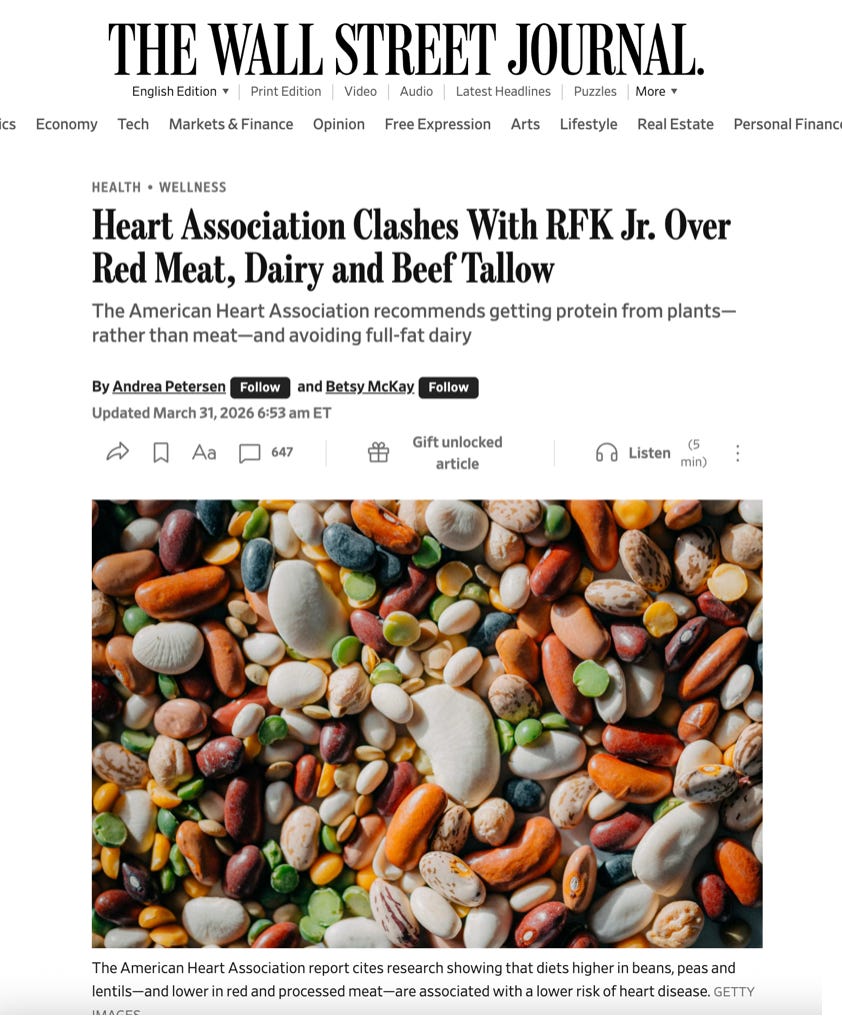
The AHA guidelines made the news because they contradict the latest U.S.D.A. Dietary Guidelines, which came to us courtesy of Robert F. Kennedy Jr. and his Make America Healthy Again initiative. Hence, the Wall Street Journal headline:
In short, the AHA is doubling down on the advice it’s been giving for decades.
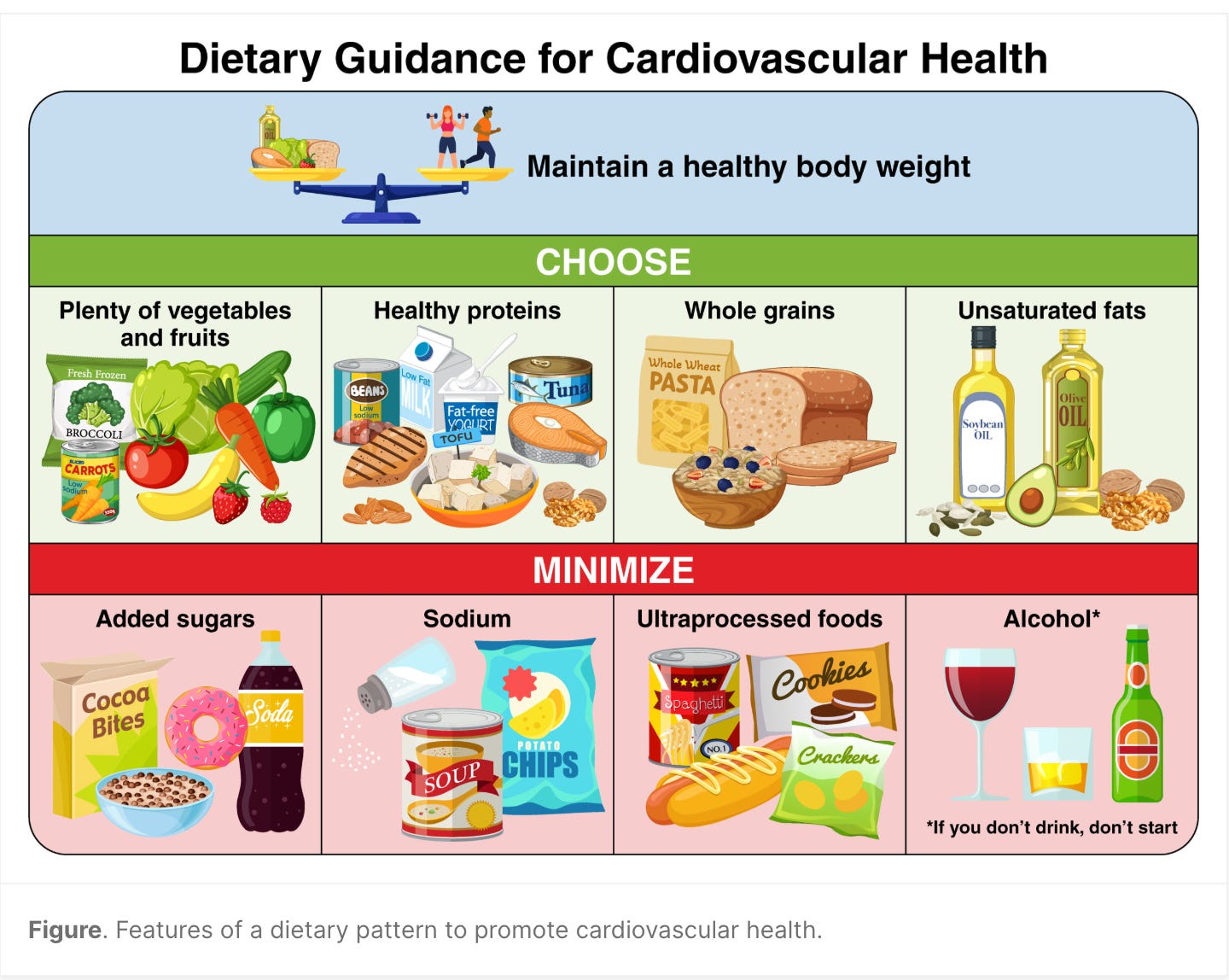
That Americans have gotten ever fatter and more diabetic in step with this dietary guidance is a regrettable reality the AHA implicitly chalks up to an unfortunate coincidence. It’s the RFK Jr./MAHA crowd that doesn’t, and has taken the nutritional 180 and aligned their thinking with, well, mine.
The obvious question is whether this reiteration of the guidelines adds any new evidence. We know the evidence has been controversial, or RFK Jr. et al. would not have been able to find respectable academic nutritionists to back their contrarian view, so why hasn’t the AHA budged?
Comments
Nothing yet. Say the first thing.
Sign in to join the conversation.