
I’ve been mired in the history of obesity science lately, so this week’s newsletter is a variation on what medical students might think of as a differential diagnosis quiz. The two cases, though, come from the medical journals of the 19th Century.
I’m going to let AI—Grok, specifically—do the job of telling us how well-trained professionals might have diagnosed these cases. It will stand in for the wisdom of the medical establishment and the med school professors.1
Here’s the first case, courtesy of an 1859 letter to The Lancet:
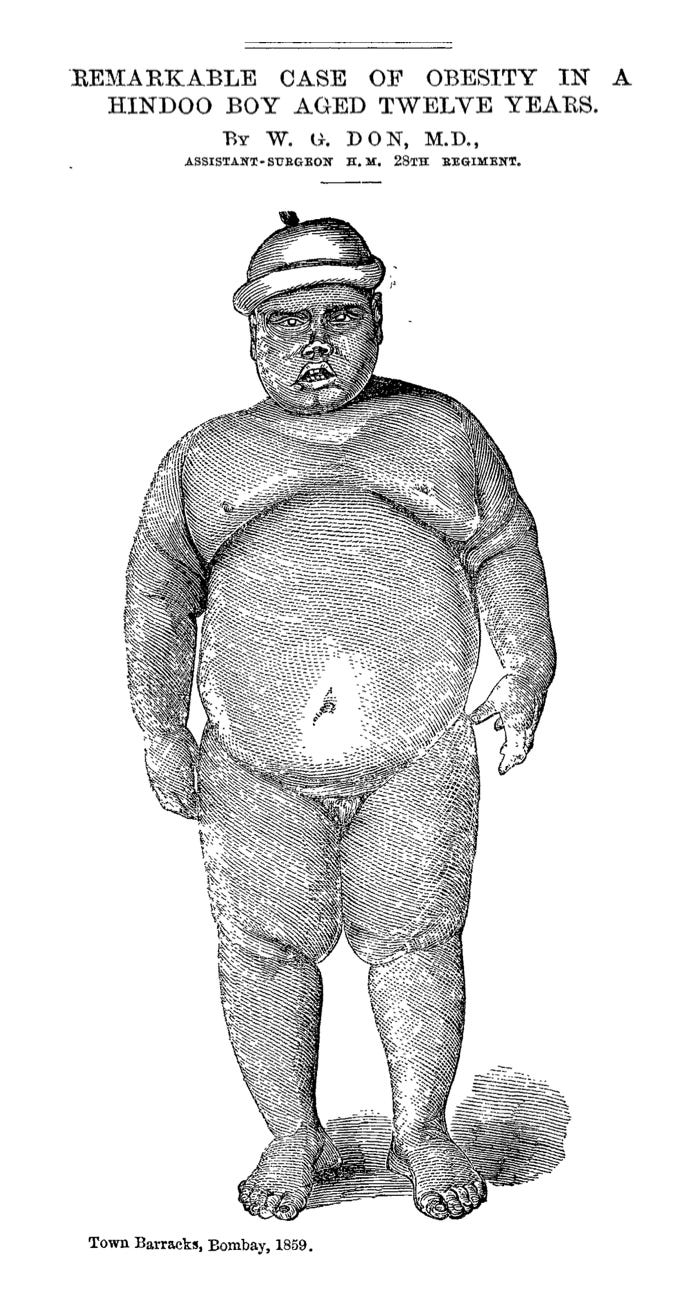
Not that it’s relevant to our diagnosis, but in the 1850s, Hindu was still occasionally spelled with two o’s, and Mumbai, where this child lived, was Bombay (as it would be until 1995). More to the point, the prominent medical journals would publish case studies and clinical observations because these were often all they had.
It was not unusual for the authors of these letters to be doctors or surgeons (considered the lesser of the two professions in those days) in the British military, as was the case here—W.G. Don of the 28th Regiment. These doctors could report on the unusual cases they observed on their postings in faraway corners of the British Empire.
Also interesting and a bit more relevant to our diagnostic exercise is that a degree of pediatric obesity that was considered “remarkable” in 1859 is not nearly so remarkable today.
The 12-year-old in the engraving (reproduced, Don writes, from a photo) was a half an inch over four feet tall, “about average height” for Indian boys his age, but weighed over 200 pounds. His name was Shakarm, and he had “attracted considerable notice” in Bombay because of his girth. He had been born in a village on the Southwest Coast of India. Both his parents had died several years earlier.
Don doesn’t say how Shakarm ended up in Bombay, but the boy was a “beggar living on the bounty of [its] many charitable citizens” when Don made his acquaintance. Shakarm became very fat in “his second year,” we’re told (although not how Don knew that), and that “the obesity has increased with his growth, year by year, till his whole body is now encased in an immense mass of solid adipose tissue, which hangs in pendulous folds over his chest and hips, and the flexures of his limbs.”
Don describes Shakarm’s appearance as “extremely odd” because of the obesity, and adds a diagnostic clue to the mechanism involved: his “genital organs” were undeveloped, and his testes were “very small.” Nonetheless, writes Don, Shakarm had “beautiful teeth and eyes, and is highly intelligent.” He also says that he “enjoys excellent health, and has a moderately good appetite, living chiefly on dhal (peas) and rice.”
Don suggests the case of the Hindu boy is “a very remarkable example of perverted nutrition,” but we don’t know what he means by that.
So let’s let Grok read the Lancet letter and then ask it: “Could you diagnose the 12-year-old in the 1859 case and tell me the likely reason why he’s so corpulent?”
Comments
Nothing yet. Say the first thing.
Sign in to join the conversation.