
Recently, Derek Thompson wrote a nice article about how the U.S. housing market has become “a total disaster” for young people. In it, he outlined how the housing crisis was seeded 50 years ago, and how events 20 years ago and 5 years ago helped accelerate it to where we are today.
I couldn’t help but notice that the U.S. obesity and metabolic health crisis has followed similar trends. I thought it would be useful to explain those here and to also appreciate the symmetry between our current population-level health situation and population-level housing situation.1 With obesity, the timing is very slightly adjusted: I would say there is a 70-year story, a 40-year story, a 20-year story, and a 5-year story.
We need to go back to the 1950s and 1960s to point out a couple of seismic events that occurred. First, heart disease was becoming a full-fledged epidemic, and awareness accelerated after President Eisenhower suffered a heart attack in 1955.
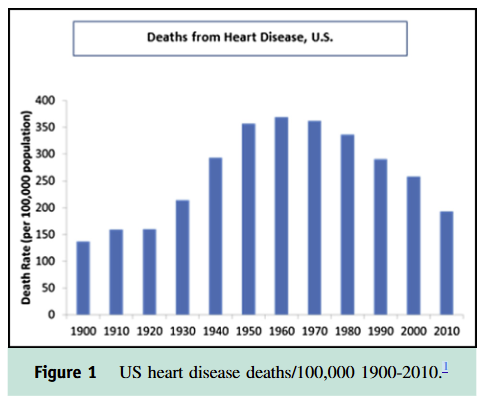
In an effort to quell the acceleration in heart disease, scientists kicked into high gear to try and figure out what was going on. Ancel Keys became a prominent voice against saturated fat, and in 1961, the American Heart Association officially recommended a diet low in saturated fat and high in polyunsaturated fats. The reasoning was that saturated fat elevated blood cholesterol levels, and elevated levels of cholesterol were correlated with heart attacks. That same year, Keys found himself on the cover of Time.2
The other major change in the 1960s was a surge in soybean production, spurred in part by agricultural technological change, but also by demand for polyunsaturated fats after the AHA’s recommendations. As a result, Americans started consuming soybean oil in historically eye-popping amounts.
Soybean oil’s rise drove an increase in partially hydrogenated polyunsaturated fats (most notably: soybean oil) as food producers came up with ways of obtaining the same texture and properties of saturated fats by artificially saturating them. As you probably know, partially hydrogenated vegetable oils are trans fats, which have been banned for the past decade.
In 1960, obesity rates were much lower than they are today (14%, compared to 41%). But the wheels were set in motion for a steady fattening of the American public. Those wheels got a push of acceleration in the early and mid-1980s as government interests aligned to produce the first Dietary Guidelines for Americans. This, and all following DGA installments, have communicated that eating saturated fat is bad for health, and that it should be replaced by starchy carbohydrates and plants.
One consistent recommendation of these nine guidelines has been that Americans reduce their dietary consumption of fat and animal products, including meat, dairy, and eggs and to increase their dietary consumption of carbohydrates and plant foods, including fruits, vegetables, and grains.3
I still remember seeing the Food Guide Pyramid for the first time in my 2nd grade health class. (I didn’t know that it was new to everybody else in the country, too.)
As with many things in life, there is path dependence, especially when government policy is concerned. Today’s DGA continues to recommend less than 10% of calories coming from saturated fat—an unchanged relic from the original version 40 years ago. That amounts to a limit of about 28g of saturated fat for a 2,500-calorie diet—less than ½ stick of butter, or less than ½ cup of heavy whipping cream.
You might think that the DGAs aren’t important and that no one pays any attention to them, but the fact is that school lunch and food assistance programs must comply with them. And agricultural subsidies are determined in part by them. And the form the basis of educating youngsters (like me, in 2nd grade).
From the mid-1990s to the mid-2000s, the dangers of trans fats became more generally recognized. This caused a substitution away from partially hydrogenated vegetable oils in many categories of processed foods.
But if saturated fat has always been recommended against, then what have processed foods pivoted towards? The answer is: more soybean oil!
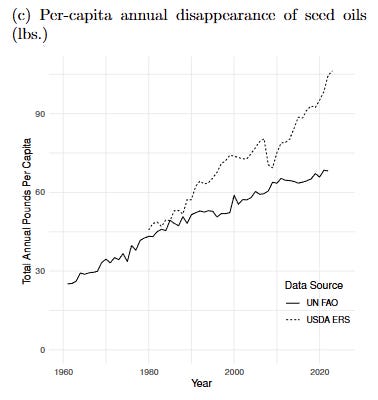
Regardless of which source you like, vegetable oils (primarily soybean oil) have continued to increase after the mid-2000s. Much of this, I believe, is due to innovation by food scientists, who have figured out how to achieve the properties of partial hydrogenation using only liquid vegetable oils.
As we pass the 5-year anniversary of COVID-19 lockdowns, obesity has continued to feature prominently, especially given its correlation with COVID-related mortality. At the same time, the adult obesity rate went down in 2024 for the first time in a while.

But, as I wrote, this overall rate masks considerable subgroup differences. In particular:
The heaviest Americans are getting heavier
Childhood obesity rates are still increasing
There have been sizable declines in obesity among 20-40 year olds
While there wasn’t a “COVID obesity bubble” like there was with housing, there has been a surge in innovation of GLP-1 Agonist drugs like Ozempic, Wegovy, etc. This has pushed obesity to be seen as yet another malady that pharmaceutical intervention can fix.
While GLP-1 drugs cause weight loss and also help with addiction and psychosis, there are also serious side effects: GI issues, loss of muscle mass, and even blindness.
I view the “original sin” of U.S. public health as the recommendation against saturated fat. Without this recommendation, McDonald’s would still fry in beef tallow. There wouldn’t have been a trans fat crisis, and there wouldn’t have been a subsequent pivot to more vegetable oils.
Just like with the housing market, it’s going to take a coordinated effort to unravel the knot that we’ve found ourselves in. But I don’t see any way to make real (read: non-pharmaceutical) headway without removing the recommendation to limit saturated fat. Nor are we going to get anywhere if we can’t agree that seed oils are actually harmful to health, something the AHA is never going to admit.
Blasbalg, Tanya L., Joseph R. Hibbeln, Christopher E. Ramsden, Sharon F. Majchrzak, and Robert R. Rawlings. “Changes in consumption of omega-3 and omega-6 fatty acids in the United States during the 20th century.” The American Journal of Clinical Nutrition 93, no. 5 (May 2011): 950-962. https://doi.org/10.3945/ajcn.110.006643.
Brownell, Kelly D., and Jennifer L. Pomeranz. “The Trans-Fat Ban — Food Regulation and Long-Term Health.” New England Journal of Medicine 370, no. 19 (May 8, 2014): 1773-1775. https://doi.org/10.1056/NEJMp1314072.
Dalen, James E., Joseph S. Alpert, Robert J. Goldberg, and Ronald S. Weinstein. “The Epidemic of the 20th Century: Coronary Heart Disease.” The American Journal of Medicine 127, no. 9 (September 2014): 807-812. https://doi.org/10.1016/j.amjmed.2014.04.015.
Ransom, Tyler and Tucker Goodrich. “Are Vegetable Seed Oils Fueling the Obesity Epidemic?” Unpublished manuscript. https://tyleransom.github.io/research/obesity-seed-oils.pdf
Of course, the general population-level statistics mask considerable heterogeneity. For instance, there are plenty of millennials and even Gen Zers who have made out like bandits on perfectly timing the housing market. Similarly, there are plenty of millennials and Gen Zers who are enjoying ideal physical and mental health. But the overall statistics indicate that these are more exceptions than the rule.
For an entertaining feud, consider reading Cate Shanahan’s Dark Calories which accuses the AHA of taking ≈$20m in today’s money from Procter & Gamble to fund their association. The AHA then went into PR damage-control and published their side of the story.
Comically, according to Wikipedia, the original draft of the first DGA included advice to eat less and move more, “recommending that Americans avoid becoming obese by consuming only as much energy as was expended and to reverse obesity by decreasing energy intake and increasing energy expenditure.” Calories In, Calories Out has always been the first stop on the Obesity Fighting Express!
No posts
Comments
Nothing yet. Say the first thing.
Sign in to join the conversation.