
If you’ve been reading this Substack for awhile, you know that making health lifestyle changes is a gradual and slowly evolving process. For example, it has been nearly 3 years since I first heard about seed oils being potentially problematic, and about 1½ years since I started reading heavily on the topic. I made several wholesale changes a little over a year ago once I realized that saturated fat is good.
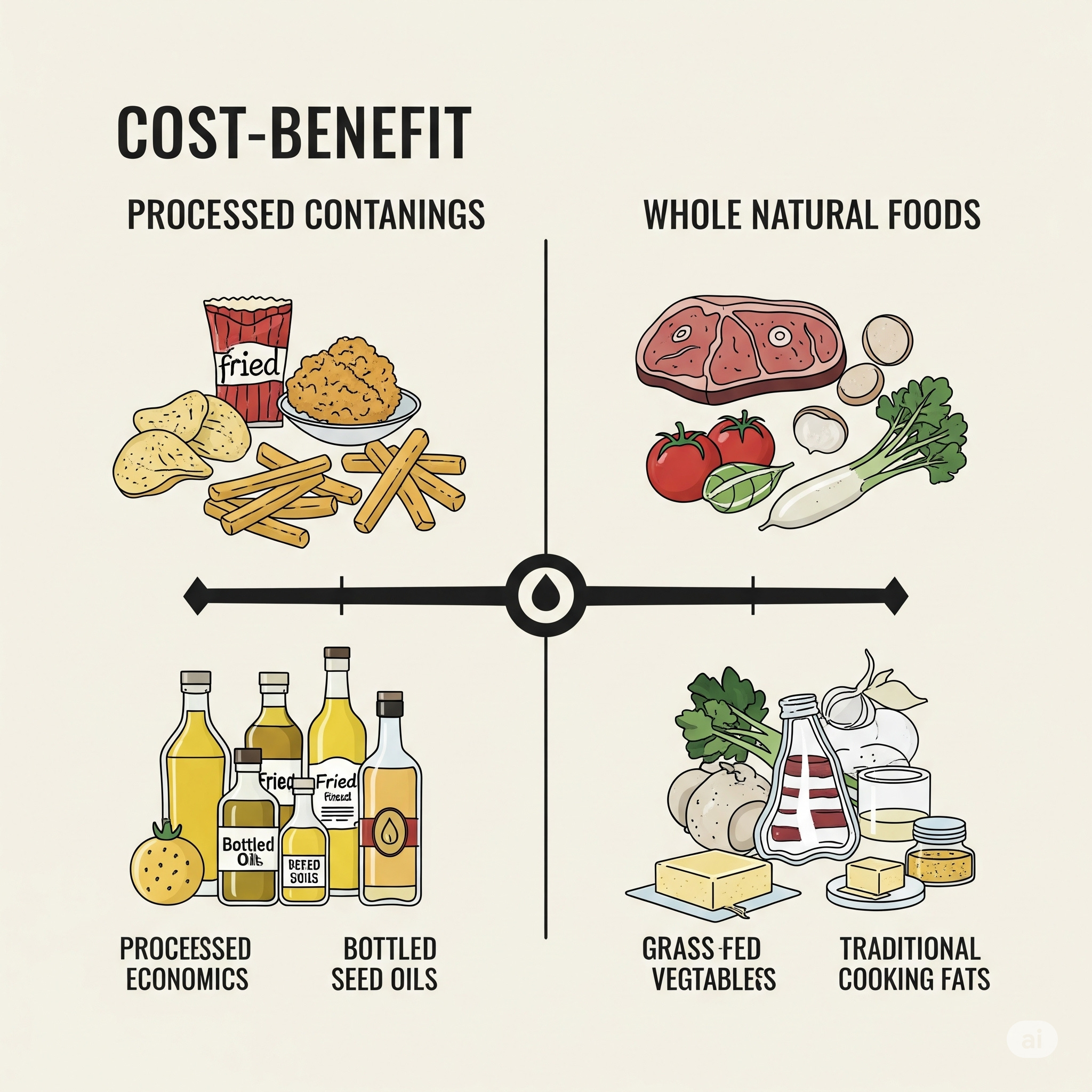
In this post, I take an economist’s approach to eliminating what some regard as the root of our food problems: excess linoleic acid. Why is an economist’s approach necessary? Because everyone has different dietary preferences and constraints, so a cost-benefit analysis could be fruitful (economists also refer to this as “thinking at the margin”). Moreover, the costs need not be strictly financial: if someone misses eating their favorite food, then that is also a type of “cost.”
This X post by @anabology is a good overview. In simpler terms, linoleic acid (LA), an omega-6 polyunsaturated fatty acid (PUFA), is a highly oxidizable dietary fat that is prevalent in the Standard American Diet.1 There are many ways in which an excess of it likely damages human health,2 including:
In terms of body fat composition, “you are what you eat,” meaning that eating more LA results in more LA being stored in your body—in fat cells, skin cells, blood cells, etc. This is problematic for several reasons:
LA-rich tissues are more susceptible to oxidation by the normal byproducts of cellular metabolism—Reactive Oxygen Species (ROS). This phenomenon is known as lipid peroxidation. As Nick Jikomes has written, lipid peroxidation is akin to dry brush being allowed to densely grow between houses and then being exposed to sparks from a power line. The ensuing “fire” in the body not only destroys cells, but it produces toxic “smoke” which spreads throughout the body, causing inflammation, cardiovascular plaque, neurodegeneration, DNA damage, and more.
UV exposure from the sun reacts with LA stored in skin cells, resulting in increased sunburn severity.
LA disrupts hunger and satiety signals in the endocannabinoid system, resulting in overeating.
Moreover, LA has a rather long half-life in the body, meaning that the adverse effects listed above are slow-developing. This also means that benefits from cutting out LA will also be slow-developing. Furthermore, fat loss liberates LA stored in body fat, which—in the short run—repeats the cycle of oxidation described above.
Loosely speaking, it’s fair to categorize LA sources into three groups (see here for a comprehensive list), in decreasing order of typical intake:
Indirect seed oils (in snack foods or baked goods)
Direct seed oils (in fried/sauteed foods or sauces/dressings)
Pork, poultry, eggs, and nuts (when fed a high-LA diet, monogastric animals [pigs, chickens], like humans, store the excess LA in their body fat)
(As a reminder, “seed oils” refer to the following: canola, corn, cottonseed, grapeseed, rice bran, safflower, soybean, and sunflower oils; peanut oil is debated but I would include it in the list. Other people doubt olive and avocado oils because they are frequently and secretly cut with canola or soybean oils.)
Along with prevalence, it’s also important to consider health damage when calculating the cost side of the ledger. For example, if LA from pork fat is particularly bad for our health, then this would make pork avoidance particularly beneficial (even if it makes up a relatively small part of the diet).
I’m not aware of any definitive studies that have compared health impacts of seed oils/linoleic acid from different sources, so the jury is still out, but based on oxidation potential, I would rank them as follows:
Direct seed oils in fried foods
Seed oils in bottles come pre-oxidized. But then they are heated and cooled repeatedly when deep frying. This creates toxic biproducts like aldehydes.
Indirect seed oils in processed foods
Bottled seed oils are used as raw ingredients and then re-heated in the baking process, creating additional oxidation problems.
Direct seed oils in sauces/dressings
“Cold” seed oils have only been oxidized once (in the process of creating the oil), so have fewer oxidation products than either of the other two sources above.
Pork, poultry, eggs, and nuts
These more “natural” forms of LA are likely the least problematic due to their “packaging” in the food matrix. For example, nuts contain vitamin E and other antioxidants that block the oxidation of LA.3 Still, these products are providing your body with LA that will then disrupt metabolism and fat storage processes.
With the above information, then, the following mitigation steps are available:
Don’t eat fried foods from restaurants
Don’t eat prepared snack foods (chips, pretzels, crackers, etc.) or store-bought baked goods (cookies, breads, etc.)
Order salads without dressings (or use homemade dressings without seed oils)
Only eat the meat of ruminant animals (cows, sheep, goats, deer, bison, etc.)
Don’t eat nuts or eggs (aside from macadamia nuts)
Optimal elimination of seed oils is thus a personal quest. Based on the ordering of the harms, what are the things you really enjoy eating and which items can you live without? A decent first take is to avoid all restaurant-fried foods and all store-bought snack foods and baked goods. Try that out for a few weeks and see how sustainable it is.
There is also a dosage question that can be answered by consulting the food label. If you see a seed oil at the very end of an ingredient list, and if you really like that food, then maybe keep it in the rotation.4
My own process has evolved quite slowly. My first exposure to seed oil harms came about 3 years ago, at which point I removed most store-bought snacks and baked goods and salad dressings, but still ate pork, chicken, nuts, and eggs fairly regularly, and didn't worry about restaurant-fried foods.
About a year ago, I made a point to eliminate all LA as much as possible. I haven't had any fried foods to speak of, and I've tried to only eat ruminant meat. I don't eat nuts except for macadamias. Eggs are a big question mark for me, since they have a lot of other good nutrients (like choline) alongside a hefty amount of omega-6 PUFAs. And, they're delicious. So I still eat these somewhat frequently (maybe once every week or two). I've shifted all of my fried foods to be made at home and fried in beef tallow, and it's absolutely delicious.5 I'm never going back to any other frying medium.
I've also enjoyed eating bread again, this time in sourdough form (all regular store-bought bread contains seed oils). A couple of grocery stores in town sell "4 ingredient" sourdough bread that is absolutely delicious, so I'll have it toasted with butter at least once a week. Finally, I have to shout out Experimental Fat Loss whose heavy cream diet has made me realize it's acceptable to drink heavy whipping cream straight from the container 😆.
The other part of mitigation is financial and time costs. I haven't tracked my budget too closely, but I wouldn't be surprised if the cost of my food went up by 50% or more. I also spend a boatload of time in the kitchen, cooking at least 45 minutes every day (and longer on the weekends). At the same time, I don't go out to eat at restaurants nearly as often, so that has reduced my food expenses.
I hope you've found some use for some of these ideas. The best way to move forward is to try out different things and see how you like them. The most important thing is to find something sustainable. Don't try to make wholesale changes all at once, since this is unlikely to be sustainable. Maybe you set a goal to cook at home one additional day per week than you currently do. Or maybe you substitute restaurant-fried foods for steamed vegetables whenever you go out.
Once you start noticing how ubiquitous seed oils are, it can be hard to maintain an optimistic outlook. But by making and sustaining marginal improvements to your diet over a long time, you'll see some surprising gains. Another thing you're likely to notice if you pursue this is that you'll lose your taste for the seed-oil-heavy foods you used to enjoy. Especially if you see beneficial health effects from making these changes.
“Highly oxidizable” here means “easily burnable” in the sense that dry kindling is “highly oxidizable.”
Hilariously, the Wikipedia entry for linoleic acid mentions none of this, instead focusing solely on the cholesterol-lowering effects of LA.
This is a source of contention among seed oil opponents. For example, Cate Shanhan claims that linoleic acid isn’t what makes seed oils bad. I think this is incorrect. But it makes sense to me that more “natural” forms of LA would be less harmful than the forms that come with other oxidized products.
For example, I still cook with garlic and ginger that comes in squeezable tubes. Both of these have canola oil in them, but they are so much more convenient than the alternatives that I don't mind because the dose is so small. As another example, I really like the combination of Medjool dates and almond butter. Fairly regularly I will eat a couple of these dates each stuffed with 1 tsp of almond butter, which ends up being about 1-2g of LA.
My favorite things to fry are shrimp, potatoes, and corn tortillas.
No posts
Comments
Nothing yet. Say the first thing.
Sign in to join the conversation.