
Here at The Spieler, we never miss an opportunity to fawn over The Elder Scrolls III: Morrowind whenever circumstances conspire to bring it back into the news, no matter how tenuously relevant or esoteric that news may be. Frequent readers are well aware that I consider Morrowind to be, in many respects, a high water mark for open-world RPGs of the Western tradition, and my esteem has only grown over the years as its fans continue to push it toward the original vision of its creators. But aside from love for the art and my inveterate nostalgia, one of the reasons I so like Morrowind as an analytical subject is that its ongoing popularity brings the shortcomings of the modern games industry into sharp relief. That a large, devoted community continues to play — and indeed develop — the game some two-and-a-half decades after its release is testament to the passion it inspires, and to the inability of any subsequent game to convincingly channel it.1
That brings us to the news I want to cover in this edition, which will doubtlessly be crowded out from the popular conscience by the Steam Machine’s disappointing launch price, GTA VI’s disappointing launch price, and whatever ridiculous fucking farce is being perpetrated this week over at Xbox HQ. You see, OpenMW — the fan-developed engine replacement and de-facto means of running Morrowind these days2 — just got a new major release, and it has implications stretching well beyond 2002’s greatest RPG. Consequential though this development is, the specifics are sufficiently mired in nerd-ass software jargon that I expect major publications will give it a pass, and so I might as well be the one to tell you about it. More importantly, though, it gestures at some reasons for optimism with regard to the near- to medium-term future of the games industry, and God knows we could all use some cause for hope in that arena. Let me tell you what’s new, then we’ll go over why I think it bodes well for the medium in this time of strife and horror.
A lot of the changes are primarily of interest to folks who are actively modding Morrowind, so I’ll restrict myself to the most immediately relevant bullets on the Version 0.51.0 changelog.
The headline feature is direct, runtime access to core game systems through a newly exposed scripting context that enables modders to adjust or replace game data immediately after it’s loaded. Or, in lay terms, core systems previously inaccessible to modders can now be modified, added to, or removed wholesale using the scripting tools with which those modders are already familiar. The most obvious utility this unlocks is the addition of gameplay effects that weren’t already undergirded by existing engine code. As a grossly oversimplified example: it was already possible to create a simple, Skyrim-like physics simulation for moving props, since the engine already knew how to manipulate objects in three-dimensional space and just needed to be told how to apply the relevant procedures to all the loose crap that fills Morrowind’s interiors. But it wasn’t possible to, say, create a custom spell effect, since the engine only knows how to produce those that were already present in the code.
But now, thanks to the addition of this Load context in the scripting API, the code to achieve novel effects can be read into the game at runtime. Hence, modders can now realize visions that previously required extension of the underlying engine. A number of modders have already demonstrated the potential of this expanded scripting context, perhaps most notably by implementing Tamriel Rebuilt’s custom spell effects — previously exclusive to the Morrowind Script Extender version of the mod — in OpenMW.
There have also been significant additions to the OpenMW Construction Set, or OpenMW-CS, the engine’s content editor built in the tradition of the Construction Sets that ship with Bethesda’s modern RPGs. It now supports vertex painting in the terrain editor, which essentially means that users can now modify the superficial appearance of level geometry without needing to draw up flat textures from scratch. This is described by the OpenMW team as “a huge step forward” in the process of eventually running games other than Morrowind on the engine, which transitions us nicely into our next section.
That OpenMW should one day become a platform for other games has long been a stated goal of the development team. I recognize that there’s a certain cognitive dissonance in the idea of developing an original project using a game engine named for the game it was intended to run, but it makes sense if you think about it: following over eighteen years of near-continuous work, it’s only sensible that all the tireless effort that went into the engine’s creation should pay dividends beyond the relatively narrow scope of running an ancient Bethesda RPG. And, as its scripting API becomes more capable and its editor more versatile, OpenMW is on the precipice of an era in which it could be a compelling engine choice for certain projects and teams. In effect, it’s building toward a state in which it could considerably accelerate the development of independent, budget-constrained games that’re scoped within the contours of Western RPGs.x
Now, I know what you’re thinking: why the hell would someone want to develop a game atop OpenMW-CS instead of, say, a general-purpose engine with a large and active ecosystem of developers like Godot or Unity? The short answer is that, given the right set of design goals, it could be vastly more resource- and labor-efficient to build a game using a suite of existing tools and mechanics rather than implementing it all from scratch. This concept of what are sometimes called “domain-specific” game engines is well precedented throughout the modern industry: RPG Maker remains an excellent choice for top-down, 2D JRPGs; Adventure Game Studio is arguably still unbeatable for point-and-click adventure games; new visual novels developed in Ren’Py are released every month; and, as I’ve explained in the past, there’s even a community of game devs using 1998’s Fallout 2 as an engine for original RPGs that benefit from Interplay’s game-mechanical inventory.
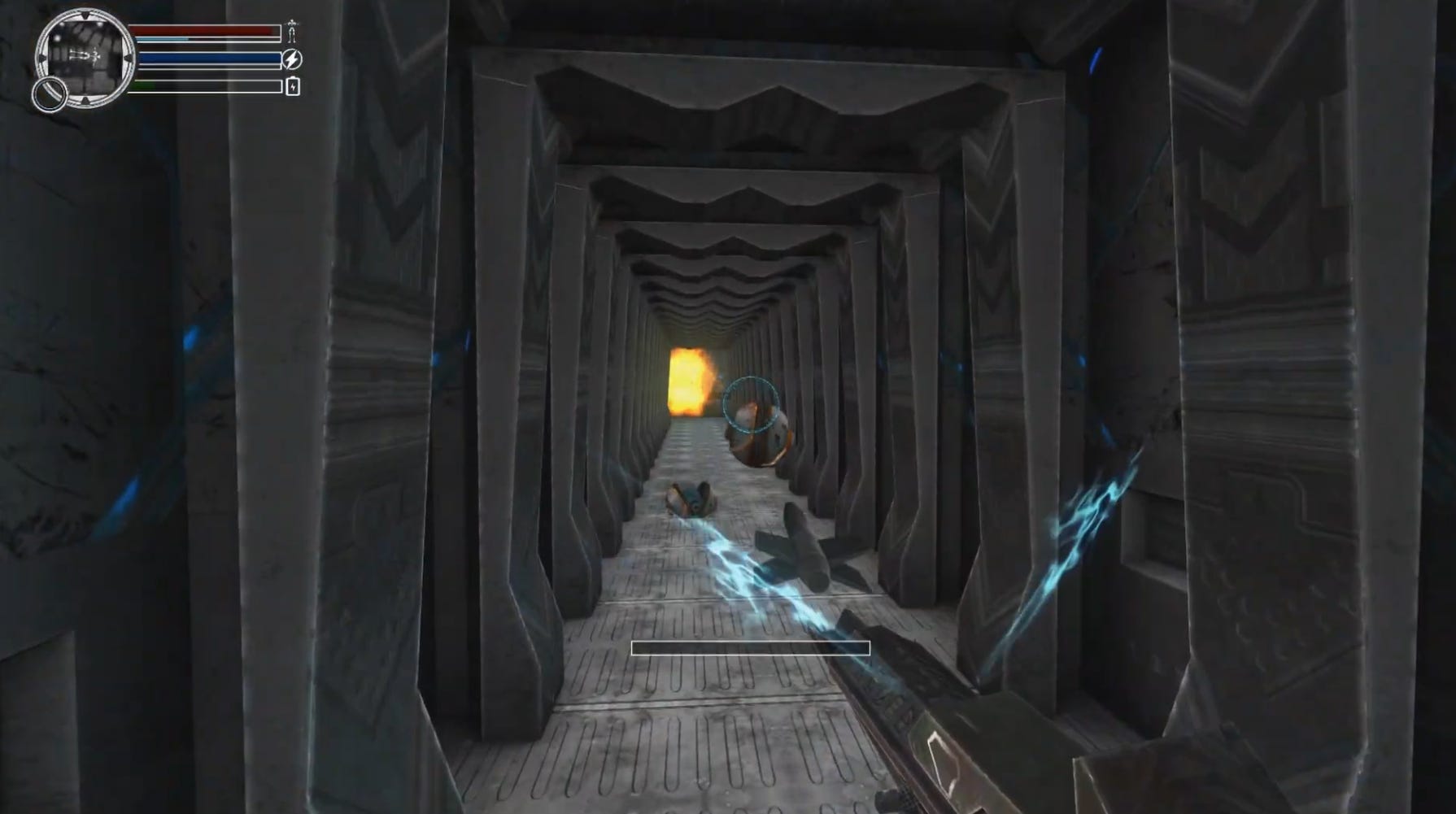
My point is that OpenMW-CS is on track to become a domain-specific engine for the efficient production of Bethesda-inspired RPGs with large, open worlds and deep roleplaying systems. It’s a famously difficult genre in which to develop, and designing such a game from whole cloth requires a deep pool of talent and a vast accumulation of institutional knowledge. Indeed, Bethesda itself built its reputation in the 2000s on the back of that talent and knowledge, pushed it about as far as it could go in the early 2010s, and then pissed it all away in the latter half of that decade when corporate-managerial fuckery drove out all the greybeards.
The promise of a notional domain-specific engine for open-world RPG development is to dramatically reduce the levels of expertise and capital required to ship such a project. With a bit of luck, OpenMW and other software in its vein may one day facilitate a whole crop of ambitious RPGs that push the boundaries of the medium, and do so without need for unobtainably expensive hardware or obeisance to the disinterested corporatism of modern studio design paradigms. I don’t suppose for a moment that the mythical Skyrim-killer will run on OpenMW, but I’m entirely ready to believe that free and accessible game-dev tooling of this sort will tangibly reduce the capabilities gap between ambitious indies and triple-A behemoths. And a good thing too, since those behemoths aren’t looking so hot lately.
I generally believe that the future of game design — at least in its capacity as an artform rather than a disposable instrument of shareholder profit — is in the hands of independent creators more so than those of studio-employed professionals. The crux of the matter is the growing misalignment of incentives: the suits who hold decision-making power at major game studios and their publishers are demonstrably disinterested in serving the core gaming audience in any capacity that doesn’t tangibly increase growth projections, while said audience is increasingly indignant about the brazen avarice that led to this state of affairs in the first place. I’ve argued before that the growth-oriented, hyper-corporatized shape of the contemporary triple-A industry, which conceives of video games as products rather than cultural artifacts, is categorically incapable of producing great artwork. So, unless and until priorities change, that responsibility falls to smaller studios and independent creators.
It’s reflective of the advancing trend toward deprofessionalization in popular game design. Major studios and their corporate parents seem to announce a new raft of layoffs practically every week, and the statistics speak for themselves. A job in high-level game development can no longer be considered a stable career even for the highly capable, and so it’s hardly surprising that huge swathes of the talent pool are reconsidering work at the major studios. A position at a Microsoft-owned studio, once a marker of tremendous industry prestige, is now more like a cause for sympathy. It draws eerie parallels with the parallel trend in Big Tech, where engineers who would once have killed for a job at Facebook or Amazon are now scrambling for off-ramps into other industries rather than persist in their literally dystopian work environments.
Now that we’re eight years out from the announcement of The Elder Scrolls VI and still lacking a single frame of gameplay, and further considering the fact that TES VI allegedly entered full production only recently,3 I think it’s fair to say that nothing of which Bethesda Softworks is capable could possibly live up to the expectations of its fans. And that’s to say nothing of the fact that essentially all of the talent responsible for Bethesda’s best work, including Morrowind and Skyrim, left the studio eons ago. There’s an entire confluence of circumstances that lead one to view modern Bethesda as an unworthy steward of its own legacy.
Of course, the Bethesda responsible for the legend-making disappointments of Fallout 76 and Starfield4 is only one data point among a larger industry trend. The seemingly endless cycle of layoffs, project cancellations, and outright closures of beloved studios infecting most of the big-money industry has produced a terrible crisis of institutional knowledge. This, combined with the persistent unavailability of high-spec gaming hardware, renders it hard to imagine an open-world RPG in the tradition of Morrowind/Oblivion/Skyrim finding a comparable audience. I mean, put it this way: in 2011, a curious onlooker with no gaming hardware could buy a copy of Skyrim and an Xbox to play it for less than $400, and there were plenty of folks who bought into the hype by precisely those means. Now, fifteen years later, you’d expect to pay at least twice that for a full-price game and the necessary hardware, and you couldn’t reasonably expect a top-of-the-line experience for less than four figures. Given all of that, it seems fitting to conclude with a few meditations on the burgeoning class of independent creators that promises to displace the rotund, shambling wraith once known as Western triple-A game development.
If the frontiers of modern game design continue to deprofessionalize — and, by extension, democratize — then the tooling and workflows available to smaller, independent outfits will naturally continue to evolve in capability and versatility. I see the continued evolution of OpenMW as emblematic of this progression, as well as a victory for indie developers its own right. But my excitement goes well beyond the admittedly limited use-cases for its specific innovations of late. What really excites me is the fact that, more than in any previous era, the creatives who are genuinely passionate about the art of game design are taking organized, enthusiastic steps to improve the circumstances underlying their creation.
There’s no particular reason to believe that the supply-side catastrophes by which the hobby’s cutting edge became inaccessibly expensive will abate any time soon. Maybe the speculative bubble propping up the ludicrously overleveraged consumption of computing hardware will one day burst with such spectacular force that the secondary market will flood with RAM sticks and GPUs, and we’ll all join one another in the land of milk and honey where ray-traced 3D graphics are considered an inalienable human right. Fingers crossed, I suppose. But in the meantime, we defenders of game design as an artform that can push the limits of human expression will have to turn elsewhere. We have hardworking and inspired folks like the OpenMW team to thank for giving us an elsewhere toward which to turn.
Thanks for reading to the end! This was definitely one of the more technically inclined newsletters I’ve written in awhile, so I appreciate your sticking it out. I’ve been playing the Super Redux-Redux mod for Hotline Miami lately, so next week’s edition will probably be about that — get yourself subscribed if you’re not already!
There are definitely a few modern games that convincingly recreate aspects of the Morrowind experience, but, as far as I’m concerned, nobody has yet captured its aura in any remotely holistic manner.
De-facto for most folks, anyway. Some enthusiasts still prefer to run Morrowind on original Bethesda tech so that they can run the Morrowind Script Extender (MWSE) for a more versatile modding experience. Although, as we’ll elucidate below, OpenMW is on the precipice of closing whatever gap remained between the two.
I’ll grant that Starfield is probably overhated, but it definitely failed to live up to popular expecatations. I’ll afford no such generosity to Fallout 76, though.
No posts
Comments
Nothing yet. Say the first thing.
Sign in to join the conversation.