
Well, word on the street is that the RAM crisis will continue unabated for the foreseeable future, seeing as major manufacturers are guzzling hyperscaler capex like so much Jonestown Kool-Aid. Meanwhile, their benefactors plot to rent computing hardware to the wretched menials, and their peers in triple-A games publishing lay off personnel as if by fetishistic compulsion. The Steam Machine costs more than the Manhattan Project, Rockstar is locking singleplayer content behind an additional tithe on top of GTA VI’s $80 MSRP, and all of the above is allegedly in service of progress. At times like these, one either throws up one’s hands and consents to appease the emotionless machinery of the tech industry, or else fortifies oneself in whatever territory remains uncolonized. The latter, of course, is why I was so heartened last week by all the progress being made on OpenMW.
See, when I called for optimism in our previous edition, I certainly wasn’t expecting that the high-level games industry would suddenly retreat from the cliff-edge of filthy excess. The silver lining of this naked anti-consumerism in the games industry is that it reliably stirs the wills of folks who still care about the medium for artistry’s sake, and enough of them remain that I can still feel a few warm rays of hope. So, until circumstances improve, damn the technopolized games industry and to hell with modernity in general. Let’s instead wallow in whatever is left untarnished by playing another fan-created reimagining of a game from ages ago.
For my part, I spent a lot of the past week or so playing the new Super Redux-Redux mod for 2012’s Hotline Miami, which was exactly the sign I needed in order to feel an iota of positivity in this era of shadows. No surprise, I suppose: Dennaton Games’ Hotline Miami was one of The Spieler’s earliest subjects, and for good reason. It was and remains one of the finest top-down shooters ever made, and its greatness shines through almost fifteen years of iterations and improvements upon its formula. For those of you unfamiliar with Hotline Miami’s conceit, I’ll explain it in two sentences: anonymous, drug-addicted mental case is wracked with guilt and trauma. Go murder a bunch of Russian mobsters about it.
It’s a simple, effective premise, and it’s supported by some kickass primary gameplay. Plenty of games released since then have refined various aspects of the core mechanics to a mirror sheen — OTXO, Intravenous, and the forthcoming Kusan: City of Wolves all come immediately to mind. HLM had plenty of rough edges and commensurate room for improvement, and these are just a few of the titles that’ve managed to essentially perfect its more underrealized aspects. Thing is, not one game released since Hotline Miami has credibly reproduced the aura that made it so popular in the first place, even including its own 2015 sequel.1 I wrote a whole-ass essay on the subject well over a year ago, and I’ll explain precisely what I believe contributed to that aura later on.
For now, suffice it to say that Hotline Miami was a product of its creators’ all-consuming commitment to their vision even while under tremendous pressure, and the result was a legendary artifact of modern gaming history that continues to heavily influence action games to this very day. Not unlike Morrowind, it continues to benefit from an active fanbase that may be smaller in number than it once was, but is nevertheless much greater in devotion. In the interest of contextualizing that devotion, let me give you a quick overview of what Hotline Miami development looks like all these years later.
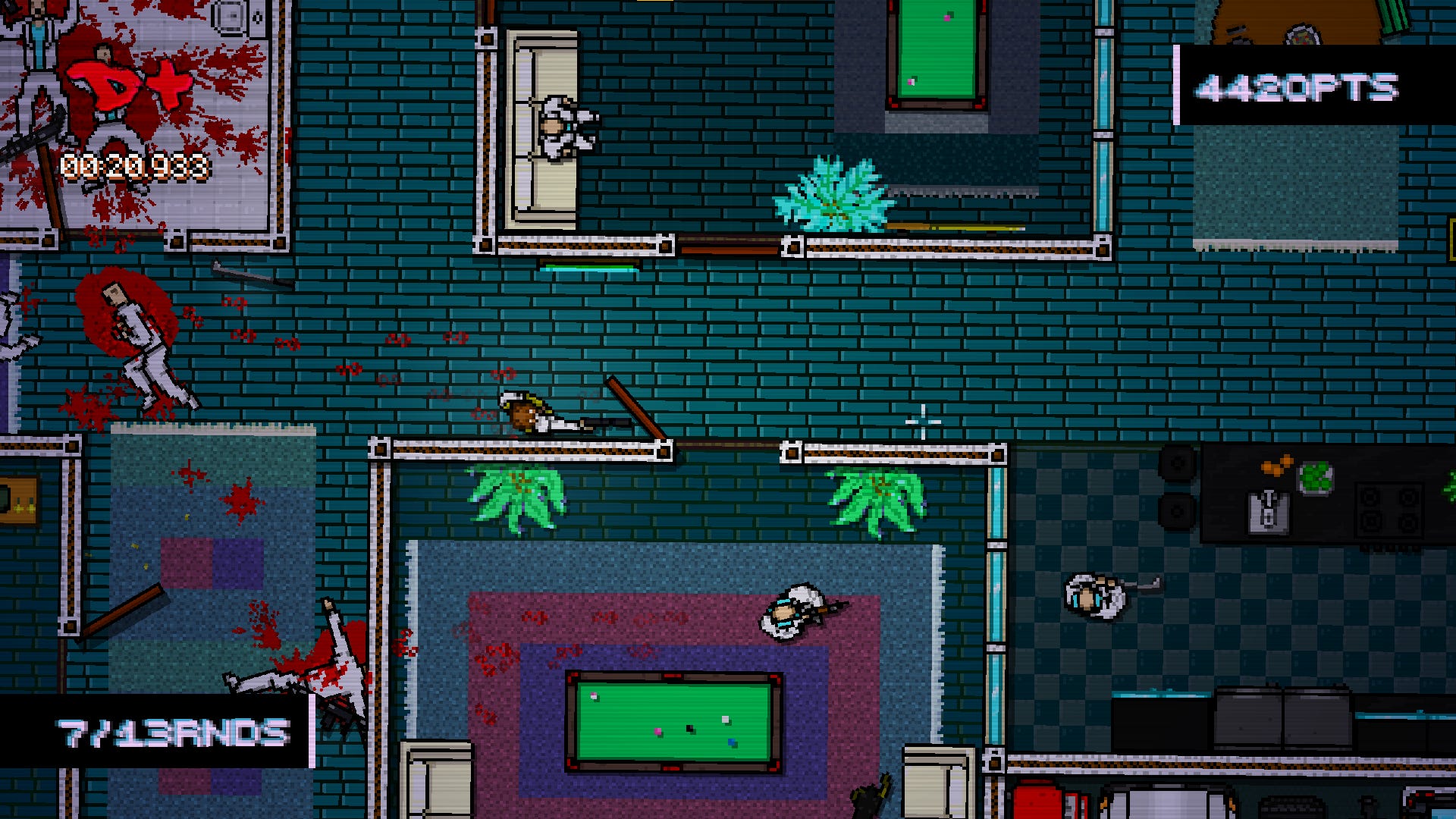
Several years ago, Hotline Miami’s original source code appeared on the Internet, alongside Dennaton Games’ informal blessing to use it for noncommercial purposes. A community fork of that code is presently maintained by an Uruguayan indie developer called Pi0h1, whose portfolio website was a real shot in the arm. “I believe that games are more than just entertainment,” reports a blurb on the About page. “[T]hey’re a form of art born from the unique and meaningful dialogue that occurs between the player and the game designer each time a game is played.”
God, is it ever refreshing to hear game developers say that out loud. Pi0h1 is an avowed Hotline superfan and purports to have begun an ambitious modding project awhile after HLM2 was released. Then aged only sixteen, and alongside a talented and interdisciplinary group of friends, Pi0h1 came up with a novel idea for differentiating their work from other HLM modding projects of the era: actually finishing and releasing the damn thing. This was the origin of Hotline Miami: Redux, which added a bevy of new features, exterminated a swarm of bugs, and appeared on track to march the triumphal 2012 classic into the new decade.
But, as is so often the case in our world of social inequity, Pi0h1’s hobbyist ambitions were checked by the realities of maturity — that is, focus had to shift toward professional work so that food might be kept on the table. So, although development on the Redux project was effectively suspended in 2023, work has continued on improving HLM’s ancient spaghetti-code to produce a more stable foundation for future development. Others took up the mantle, some of whom sought to complete the work that Pi0h1 had started. This bore fruit in late 2023, when a developer called Neon Dimensions released a project fittingly called Hotline Miami: Redux-Redux. It began by fixing a whole nest of bugs left over from Redux, and gradually worked toward completing the whole vision of the project.

Yet somehow, despite my avowed love for the game on which it’s based, I’d never actually tried Redux until very recently. What finally brought me into the light was the announcement of Hotline Miami: Super Redux-Redux, a global modification for R-R that, I believe, represents the current pinnacle of scalp-camera action gaming. I’m going to spend the next several hundred words trying to convince you of that, but you need not take my word for it, since you can play it for free even without a copy of the original. I mean, you really ought to own a copy of Hotline Miami — it’s cheap as shit, after all, and particularly so during the Steam Summer Sale — but Super Redux-Redux can optionally be downloaded as a modded repack of the community-maintained source code.
What follows is much praise of this latest and greatest modpack, but keep in mind that most of the features I discuss below are descended from Pi0h1’s work that predates this release by several years. Let it serve as a reminder that the passionate creatives who support these old games stand not only on the shoulders of the original developers, but also on those of the hardworking fans who came before. And with that little morsel of reverent contemplation out of the way, let’s talk about perpetrating psychotic, drug-addled killing sprees for awhile.
Back in April of last year, I wrote a retrospective on the aspects of design I understood as foundational to Hotline Miami’s remarkably endurant appeal. To quickly recap, those were: its addictive, tightly designed gameplay; its brilliant original soundtrack; its steadfast commitment to ludonarrative synchronicity2; and what I termed its “farcical-yet-meaningful” relationship to violence, by which I referred to how HLM uses absurdly over-the-top carnage as an instrument of both catharsis and self-introspection. I believe these are the qualities that keep the game so vertiginously elevated upon the imperial pedestal of indie royalty, and so any attempt at modernizing it for a new decade must enhance or at least retain said qualities. To pull it off would require a deep understanding and thorough (if not downright emotional) appreciation of the game’s underlying design principles.
I’m delighted to report that, for as much as Redux and Redux-Redux already exemplified the necessary pedigree, Super R-R is the most faithful and feature-packed reimagining of Hotline Miami yet made. If not for the fact that the 2012 original remains so valuable as a historical artifact, I’d call this new version the definitive way to experience the game.3 Have a look at the illustrative clip below, and then allow me to explain.
It all begins with a brand-new soundtrack by Russian artist Crypt Voice, which remixes tracks from the original score and contributes a few totally new ones. I’d describe it as the Hotline Miami OST, but with every knob cranked up: the bass is heavier, the synths are sharper, and the general character altogether more unrelenting. In combination with the new weapon sound effects, which aggressively reverberate just as one would expect of an assault weapon discharged in a domestic interior, the eardrums are positively saturated during the action of standard gameplay. Hotline Miami’s OST was, to my mind, already a Top-10 contender among all of video games, which is why I’m both pleased and astonished to find that the Super R-R soundtrack is somehow even better. This is one of those rare cases where I’ll beseech you to listen to the new score even if you have no intention of playing the game. Hell, listen to it even if you don’t play video games at all. It’s on all the digital streaming platforms, and I bet you could grind out some nutty PRs at the gym with this shit in your ears.
So, the game’s soundscape is roundly amplified, and the pattern continues with changes to primary gameplay. In addition to new, punchier sound effects for the weapons already implemented, there are several totally new tools of slaughter at your disposal. Most notable is a Kalashnikov that — and I don’t say this lightly — might be my new favorite AK in all of video gaming, and I must’ve equipped a hundred of the bastards. The roaring growl of its muzzle and the subtle screen-shake effect it produces as each round explodes therefrom produces one of the more violent firearms I’ve ever pretended to operate, and it somehow manages this effect in a pixel-art scalp-camera game built on fourteen-year-old tech.
Rounding out the systemic additions is a new, optional Hard Mode that adds more and/or scarier enemies to each level. Hotline Miami was already an extraordinarily tough customer back in 2012 — the player is vastly outnumbered in every combat encounter, and is killed in one hit from any attack. It was made accessible by the genius addition of instantaneous retries, which both enabled and encouraged players to bang their heads against the brick wall of HLM’s difficulty until, inevitably, its challenges were overcome. Even a player with mediocre reflexes or who’s inexperienced with twitchy action shooters can still beat the unmodded game with enough patience, simply by repeating each encounter and adding entropy to the system until random flailing eventually resolves into victory.
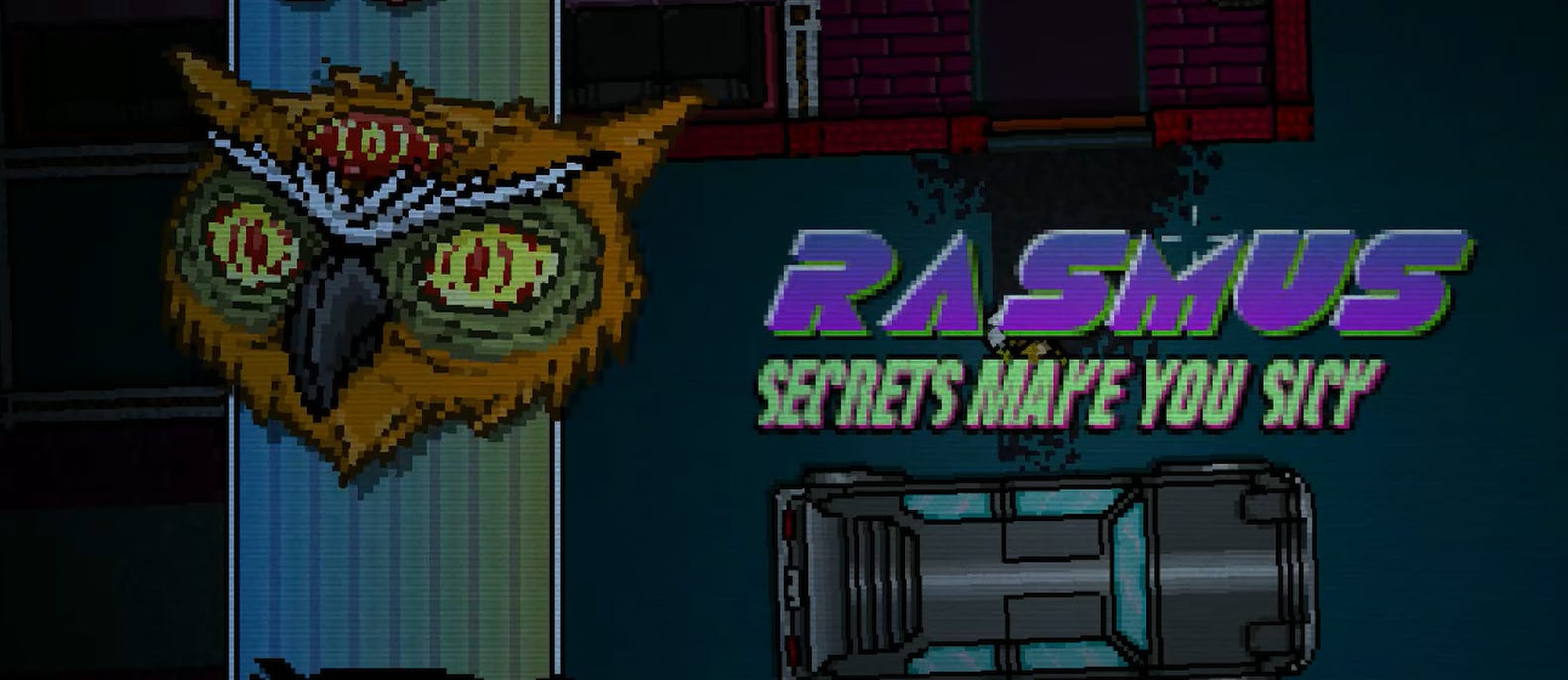
Super R-R, meanwhile, is not dicking around in the slightest. The Hard Mode versions of HLM’s tougher levels are more challenging than any sequences I’ve played in any other top-down action shooters, requiring careful strategization and flawless execution. The linchpin is the introduction of new enemy types: some are immune to melee attacks, others dodge gunfire, and many levels feature both. You’re compelled to vary your approach and are punished for hesitating, and the whole enterprise starts to feel like some kind of ultra-violent puzzle game in which you eventually discover the intended sequences of action. If you have fond memories of the dopamine hits from finally beating tough levels in Hotline Miami, then Super R-R’s Hard Mode should feel absolutely narcotic.
Finally, the Super R-R package contains some ancillary but welcome changes to the game’s presentation. Most immediately visible are unlockable, cosmetic reskins of the masks, all suitably gruesome. Also noteworthy is the addition of an all-new achievement system. Hotline Miami already had a set of official achievements, but the new system fills in some gaps in the old one by adding a robust selection of aspirational challenges. My favorite examples include those awarded for killing three enemies with a single thrown brick, completing a level using nothing but a dart, and completing the entire game without killing any dogs.
Oh, almost forgot: you can now pet the dogs instead of killing them as long as you’re wearing the Border Collie mask. Ten out of ten.
The games industry is in a very strange, uncomfortable place these days. High-level development and publishing were already in the midst of a period of creative degeneracy unprecedented in my lifetime. The corrupt bargains in the greater tech industry that have made hardware so difficult to obtain and which conspire to take personal computing out of the hands of consumers altogether are, of course, making an already bad situation dramatically worse. And, absent robust consumer protections or even the will to manifest them, there’s relatively little recourse available to us as ordinary consumers.
But although resisting the enshittification of the games industry is difficult, it’s by no means futile. I, for one, see no particular reason to meet the forces of avarice on their own cartoonishly lopsided terms — certainly not while talented people who love game design as an art are busying themselves with its defense through avenues that crass industrialism is powerless to frustrate. I reckon the most good we can do at this juncture is to lend our support to independent creatives and what few industry insiders are still defending those creatives, and to withhold it from the actors that seek to profit off of our mistreatment. Hang in there, believe that things will get better, and do what you can to help the folks who are defending what’s good and righteous in game design. And, for the love of God, play Hotline Miami: Super Redux-Redux. I’m sure you could use the catharsis at a moment like this.
Thanks for reading to the end! If you’ve played Super Redux-Redux or any other major modding projects for Hotline Miami (many of which I’ve yet to touch), I’d love to hear about your experiences in the comments. Next week’s subject is a work of true outsider art in modern game design — stay tuned, and get yourself subscribed if you aren’t yet!
I’m on the record as liking Hotline Miami 2: Wrong Number substantially less than its predecessor even though I’d probably call it a great game overall. I’ll probably write about my complicated feelings on it in greater detail one of these days, but not in this installment — we’re strictly about celebrating greatness this week.
For the uninitiated, this term refers to the correspondence between a game’s mechanics and the narrative it tells through them. Since writing that older essay, I’ve heard credible industry figures call this phenomenon “ludonarrative consonance” instead. I’ll stubbornly continue to use “synchronicity,” though.
I consider Hotline Miami absolutely unskippable for any serious student of indie game-dev history. But whomever is just looking for a fun shooter that lies beyond the cruel auspices of corporate publishing can skip right to this new version if they so wish.
No posts
Comments
Nothing yet. Say the first thing.
Sign in to join the conversation.