
As long-time readers are by now aware, I’m not all that plugged into Nintendo these days. I have neither a Switch 2 nor any near-term plans to get one, and I’ve never had a particularly strong attachment to its intellectual property in the first place beyond nostalgic memories of eras long past. Nonetheless, I maintain a professional curiosity in Nintendo’s output precisely because of its undeniable influence on the creative and practical directions of the broader games industry. And — as I’ve written before — I deeply respect Nintendo’s ongoing commitment to evolving and progressing the medium even as I criticize the nakedly avaricious business practices that’ve long characterized its corporate strategy. So, even though I seldom play the games, I do my best to keep an eye on what the Japanese Juggernaut is developing or publishing at any given time.
Enter this year’s Nintendo Direct, which exhibited a dense field of ports, remakes, and legacy sequelization of the sort we’ve come to expect from the ouroboros of contemporary triple-A publishing. As I review a list of all the announcements, I count somewhere between three and five new IPs (depending on how you define “new”) out of almost four-dozen reveals.1 This trend is no longer surprising to me, and it’s been going on long enough that we may as well call it a status-quo for the high-level games industry. It’s left to me, then, to sift through the latest batch of nostalgic retreads in search of anything that provokes an emotional reaction strong enough to break through the background haze of apathy and dread.
To be frank, I can’t say that any of it moved the needle all that much. In fact, the announcement that most caught my attention wasn’t in the English-language Direct at all, but was exclusive to the Japanese broadcast for reasons unclear. To wit, they announced the elaborately titled Touhou Koumakyou: New Classic – The Embodiment of Scarlet Devil, a remake of the sixth official Touhou game from 2002. When I read about it after the fact, I felt a pang of curiosity bordering on excitement that I practically never get from remakes. And, if the price is right and I happen to be in a generous mood on its September 10th launch date, the Steam version might even be a day-one purchase. I’ve had Touhou on my list of potential Spieler topics since before I even started the publication, and I guess this is the excuse I needed to finally stop putting it off.
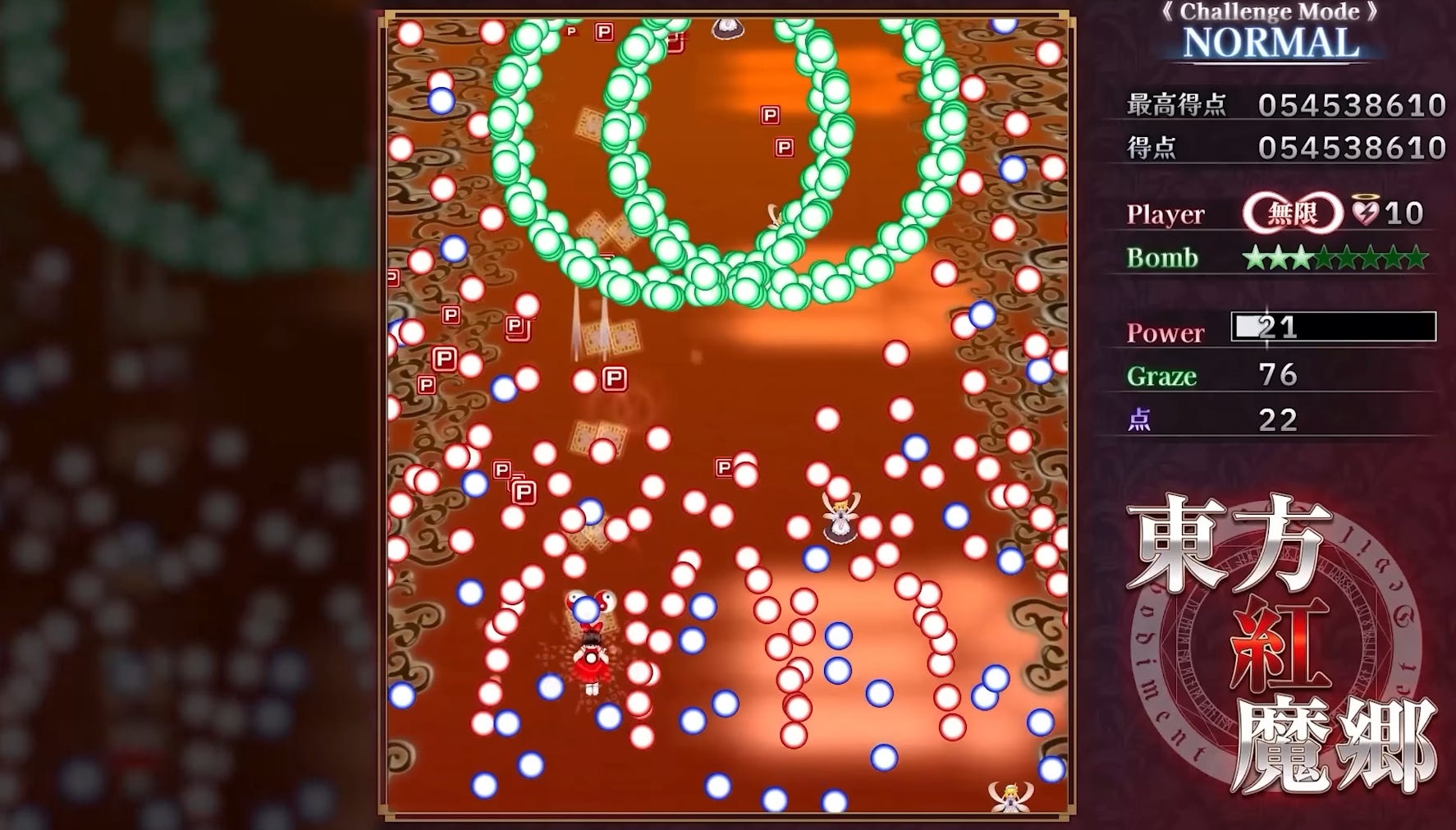
Thing is, the Touhou Project is a decades-old titan of grassroots fandom whose reach extends well beyond its already gargantuan library of official game releases. Aside from a staggering thirty-three2 official, first-party games released since 1997 by developer-composer Jun’ya “ZUN” Ōta, there exists a wealth of official works from other media that have explored and developed its fictional setting in obsessive detail. Additionally, thanks to one of the most generous fan content policies known to modern capitalism, there’s also an entire universe of free and commercial third-party content drawing upon the obsessions and creative energy of a nearly three-decade-old fandom.
And I, for my part, have experienced only a vanishingly tiny fraction of it all, hence my reticence to approach the topic thus far. But since they’re remaking Embodiment of Scarlet Devil, the only Touhou game I’ve finished, I figured I might as well analyze the source of my appreciation for the franchise even though I could barely be called so much as a casual fan. Crucially, one doesn’t need to dig very deep into this cartoonishly vast property to appreciate its cultural presence and ongoing impact. All of that is made apparent from outside observation alone, and that limited topic is what I’m interested in considering this week. Besides, it’s an excuse for a shorter installment that I could really use. As I write, I just returned home from an exhausting trip to Chicago for a funeral, and there’s not much left in the tank for careful organization or incisive commentary, so forgive the relative briefness of this edition.
My plan here is to give you a very brief, surface-level overview of the Touhou Project so that we’ll have a shared context for the concept I actually want to address, which is the extraordinary power of its fanbase’s creative freedom. One of these days, I’ll return to analyze the subject of bullet-hell games as a game design phenomenon. For now, though, we’ll keep it simple.
The Touhou Project is, in brief, a massively elaborate multimedia franchise defined above all by its core series of danmaku games. What’s a danmaku game? It’s a subgenre of shoot-’em-up games characterized by a ridiculous density of projectiles that the player is expected to dodge, hence the usual translation of “bullet-hell” that’s become standard among Anglophonic gamers. The sight of these games usually intimidates or terrifies the uninitiated, and for good reason. Look, here’s a clip of Embodiment of Scarlet Devil’s Stage 3 boss fight, which should give you a half-decent impression of both primary gameplay and general aesthetic:
I don’t want to spend too much time talking about bullet-hell gameplay in this particular newsletter, because it characterizes only a portion of the broader Touhou Project (albeit an indispensably significant portion) and I’d instead like to focus on the cultural positioning of the Project writ-large. So, let the following suffice for now: the appeal of a great bullet hell game is that, to play at all successfully, you need to involve your entire brain and dedicate all of your focus such that you fall into a trance-like state of absolute stimulation. While simultaneously pathing between projectiles, planning a path through those not yet arrived, and ensuring that the enemy remains in the path of your own shots, your every neuron feels saturated with activity. I’m not all that good3 at bullet-hell and so can speak only for myself, but I don’t think “addictive” is too strong a word for the effect it all achieves.
But standard-setting bullet-hell gameplay isn’t the only source of Touhou’s enduring popularity or of its audience’s rabid devotion. Of particular note is the music, all lovingly composed by the developer himself. ZUN, in addition to being an accomplished and highly prolific designer and developer of video games, is an extremely talented musician. Indeed, he’s reported in the past that his games were originally conceived as platforms for showing off his compositions. I positively adore this music and have done ever since I first got McRoll’d back in 2008.4 In fact, it’s probably accurate to say that I’ve spent more time listening to Touhou OSTs, fan music, and various remixes thereof than I’ve spent actually playing the damn things. Then, of course, there’s the remarkably elaborate fictional universe upon which the Touhou Project is built. I could spend an entire series of essays explaining the realm of Gensokyo, its history, and the dealings of its inhabitants if only my understanding were more than superficial.
Ultimately, though, what most interests me about Touhou is the intensity of its fandom. As I mentioned above, the Project is known for having one of the most permissive fan content policies in modern commercial media. In exchange for following a handful of eminently simple guidelines, you’re allowed to create, distribute, and even sell derivative works without so much as asking permission first. Over the decades, this has produced an immense body of fan-created art in almost every medium. There are games, of course — literally hundreds of them on Steam alone, including an extremely popular and successful metroidvania that’s made its creators an absolute packet. Beyond that, there’s 2D artwork, music, animation, physical craftwork, and enough literature to fill an entire library. Oh, and a great deal of hentai and miscellaneous pornography, but that’s neither here nor there.
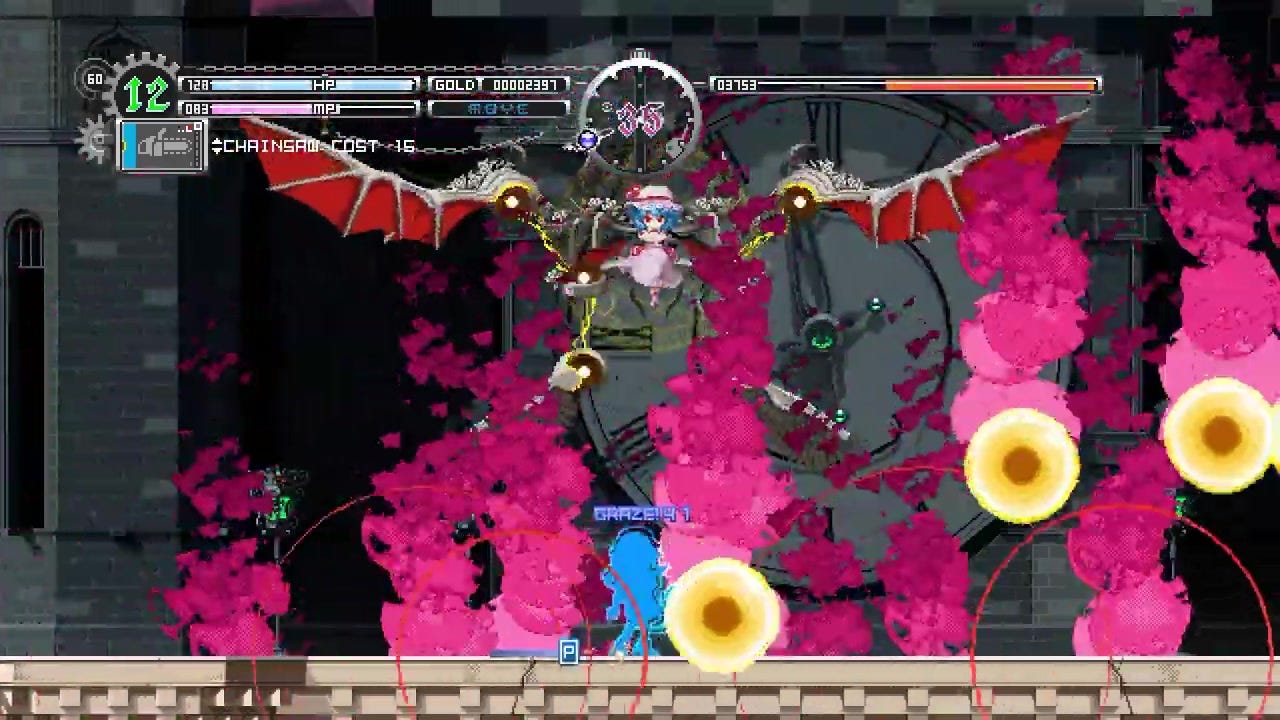
I don’t want to get too deep into the weeds, so let me wrap up for this week by saying that I wish more franchises would use Touhou’s exceptional generosity as a model for how to manage an intellectual property. The creative and commercial freedom afforded to the fanbase has led to varied and tremendous upsides for the Project. There’s the free advertising, of course — I myself learned about Touhou from a YouTube video almost twenty years ago, and that’s what eventually led me to give the games a try. Then there’s the practically autonomous community-building that this model facilitates, since it encourages the free transfer of ideas and cooperation between fans. And, perhaps most notably, it brings about contributions to the wider culture that extend well beyond the games and the other official media. Every so often, Touhou produces a cultural phenomenon like Bad Apple! or the aforementioned McRoll, capturing the attention of folks with no attachment to or awareness of the Touhou Project. Inevitably, many of them end up as fans themselves, and the cycle continues to propagate at an ever-increasing rate of growth.
Meanwhile, I can only come up with two downsides off the top of my head. The first is obvious: an IP that affords its fans this much creative freedom with its copyrighted material can’t possibly capture the maximum possible revenue from its exploitation, which is why I don’t expect we’ll ever see anything approaching this level of permission from the halls of modern, corporate game development. The second is even more obvious: if you forbid only “excessive sexual content that is considered unlawful” (as does the Touhou Project), then you’re inevitably going to end up with terabytes worth of Rule 34 content floating around the Internet, much of it grotesque. But that’s hardly unique to Touhou, now is it?
I don’t suppose that the forthcoming remake, or indeed the series of remakes that it doubtlessly portends, will dramatically change the character of the early-2000s games in question. But I do await with keen interest the effect they’ll have on the surrounding community once the Project’s most famous installments find their way into the hands of a new audience. It presents an opportunity for a glut of ambitious creatives to make names for themselves, and that would represent a welcome victory for the wider gaming culture. Fingers crossed.
Alright, that’s about all the bandwidth I’ve got for this week. Appreciate your reading to the end, and thanks for your patience with this abbreviated issue. If you’re interested in trying Touhou for yourself, I’ll echo the advice I was given and tell you to start with one of Embodiment of Scarlet Devil, Perfect Cherry Blossom, or Imperishable Night, respectively the sixth, seventh, and eighth official installments. Patched executables with English translations and modern quality-of-life features are easy to find if you look for them. And, if it matters to you, it’s my experience that they all work on Linux without significant friction if run through Wine.
At some point, I’ll want to return to the subject of Touhou and to the bullet-hell genre in general to more deeply explore what it can teach us about game design. In the meantime, keep your eyes peeled for next week’s edition, and thanks again for bearing with me through this shorter one. Have you played any Touhou games, or can you offer recommendations for relative newcomers? Let me know downstairs. I’d be particularly interested to hear from any of you who’ve played any of the fan games, and about your experiences with them — I really ought to get around to trying some for myself, and I have only the vaguest ideas of where to start. I’ll see ya next week.
I’m only counting reveals from the English-language broadcast here.
That number is the sum of twenty “mainline” games (the most recent of which was released last August) and thirteen spin-offs.
Danmaku veterans among you will notice that I’m already down a life midway through Stage 3 and haven’t used any bombs, which doesn’t bode well for the rest of this run. EoSD veterans in particular may correctly guess from my HiScore that I’ve never beaten the Extra State boss, either.
The music in that video is, in effect, a remix of the soundtrack to EoSD’s notoriously difficult Extra Stage boss.
No posts
Comments
Nothing yet. Say the first thing.
Sign in to join the conversation.