
“A tormented secret agent with emotional and psychological problems attempts to stop an international cyber attack. This dark emotional mystery intensifies as he is betrayed by those he trusts and loves.”
So reads the official synopsis for Dire Duplicity, the latest film by celebrated auteur director Neil Breen. I, for one, couldn’t be more excited for its post-theatrical release later this year. I adore the man’s filmography for the earnest sincerity in which every work is drenched, even though they all tend toward lifeless cinematography, schizophrenic editing, and script-writing that reliably triggers a combination of gleeful laughter and second-hand embarrassment for everyone involved. But you need only look just past those apparent defects to find a spark of visionary creativity that speaks truth to the cruel world that inspired it.
I’ve had Breen on the mind a lot these past couple of weeks, and not just because of the new film. See, a few weeks ago, noted games-writing peer Jim Mander got into my comment section and insisted I try a solo-developed game from the better part of a decade ago called The Slater. I did so as soon as the Steam Summer Sale brought its price down to a dollar and change, and the experience was unforgettable. If you re-read the synopsis for Dire Duplicity above, replacing “secret agent” with “former cop” and “cyber attack” with “designer drug trafficking ring,” you’ve got a more-or-less watertight summary of this truly mind-bending indie outing.
Released in 2018, The Slater was solo-developed by one Alessandro Laina, a mysterious creator about whom my research revealed nothing. All I can say with confidence is that his studio, Laina Interactive, is notable for developing and publishing this one game and nothing else. That it exists at all is impressive in its own right: video game development is taxing and laborious under the best circumstances, and the fact that a single man was able to realize so specific a vision — complete with a cast of (mostly) professional voice actors and an original musical score — is a remarkable feat regardless of the final product’s overall quality.
Incidentally, that overall quality is, by any standard measure… not so high. Let me be absolutely clear up front: from a game design perspective, The Slater is a thoroughly mediocre also-ran in its genre whose frequent and deliberate invocation of the mechanically superior Hitman franchise does it no favors; from a storytelling perspective, it’s derivative, disorganized, and shamelessly trope-driven almost to the point of self-parody; and from a technical perspective, it’s a poorly optimized freakshow that couldn’t reliably hold sixty frames per second on my hardware even though my PC was top-of-the-line when the game was new. In short, there’s practically nothing to recommend this game from a perspective of traditional criticism.
And yet, I devoured the entire thing in no time flat this past week. Like a Breen film, it’s unmistakably the work of an uncompromising auteur possessed by a very particular vision, and I can hardly think of a more suitable balm for the gruesome skin disease that is the modern games industry.
Allow me to briefly run you through The Slater’s gossamer-thin premise. The titular protagonist and player character is Mark Slater, a former police officer and violent, unrestrained psychopath who seeks extrajudicial revenge against the criminal underworld responsible for his father’s murder. Mark’s father, whom we meet in a flashback as a pair of exposed shoes under a tarp at a crime scene, apparently came too close to the truth of said underworld’s remarkably sophisticated trafficking ring. The son must complete the father’s unfinished work by destroying the traffickers’ means of production and slaughtering their entire leadership structure.
Over the course of the game’s six missions, Mark robs, murders, and scowls his way through a variety of colorful locales ranging from a classy resort hotel to the world’s stickiest fetish bar. We ought to talk about the practicalities of how it realizes its story through gameplay, and then I’ll tell you about everything that makes it stand out as a work of auteur creativity.

Here’s the short version: The Slater plays like a downmarket installment of IO Interactive’s venerable Hitman franchise, overflowing with evocations and callbacks thereto. Specifically, it plays like a first-person spin-off of Hitman: Contracts with a tiny fraction of the polish and about ten times the charm.1 One could reasonably call it an outright knockoff, but I can hardly call that a criticism — Hitman is a beloved franchise for good reason, and there’s no reason why IO ought to be the sole proprietor of its uniquely engaging blend of stealth and skullduggery.
The reason why the Hitman games — and, by extension, assassination games in general — are so enduringly popular should be fairly straightforward: the fantasy of infiltrating densely populated centers of intrigue and neutralizing high-value targets right under the noses of their protectors is an instantly compelling premise. In contrast to stealth-focused sneak-’em-ups like Splinter Cell or Thief, which are first and foremost about avoiding detection, Hitman and its derivatives are centered around social manipulation. Why skulk in the shadows to avoid patrolling guards when you could simply wait for one of them to go for a smoke, strangle him with piano wire, steal his clothes, and hide in plain sight among his fellows? If that doesn’t suffice to bring you right into the Big Bad’s tour bus, it should at least get you up into whichever clocktower or belfry is best positioned as a sniper’s nest.
So, as with Hitman, the foundation of The Slater’s stealth mechanics is the art of disguise. Mark shows up to every mission garbed in a nondescript leather jacket in which he rarely remains for long, for uniforms affording various levels of status and access are scattered throughout every level. Some are loose on hangers or stuffed into lockers, but most are worn by NPCs with mercifully short memories and alarming predispositions toward smoke- and piss-breaks.
And that’s just as it should be. Even in the first Hitman game from over twenty-five years ago, disguise was an important tool but never a panacea. Agent 47 could easily garotte a bodyguard and don his suit, but he’d then have to vigilantly avoid prolonged or reckless exposure to the dead man’s colleagues. The guards in Hitman games actually come across like security professionals in that they notice inconsistencies and investigate their suspicions. If you stole one of their uniforms and then calmly moved about the level while maintaining a safe distance from the others, your disguise would do its job. But if you ran around at full speed while climbing over railings and screeching like a gibbon, the guards would quite rightly assume something was amiss and draw their weapons.
Not so in The Slater, in which the right disguise is an utterly incontrovertible means of free access to a level’s most tightly secured zones. In general, you can ascertain the intended progression of a level by wandering around and taking note of every doorframe at which a pair of stern-looking toughs hold up their palms and warn you away, and then returning once you’ve found clothes that match their expectations. Guards have absolutely no ability to recognize familiar faces and will politely wave a properly disguised Mark straight through their checkpoints even if they angrily rebuked him earlier that same minute. One of many unintentionally hilarious aspects of The Slater is how quickly guards will go from “Area off limits! Get lost!” to “Long day, huh?” or “Hey, you look like you could use a lap-dance!” just as soon as the fit’s on point. Meanwhile, you’re free to sprint around secure areas, jumping on furniture and slamming into chance passersby, and no one will bat an eye. They will, however, turn their heads to face you even if you’re standing directly behind them. It’s the sole marker of intimidating vigilance that these NPCs have in them.
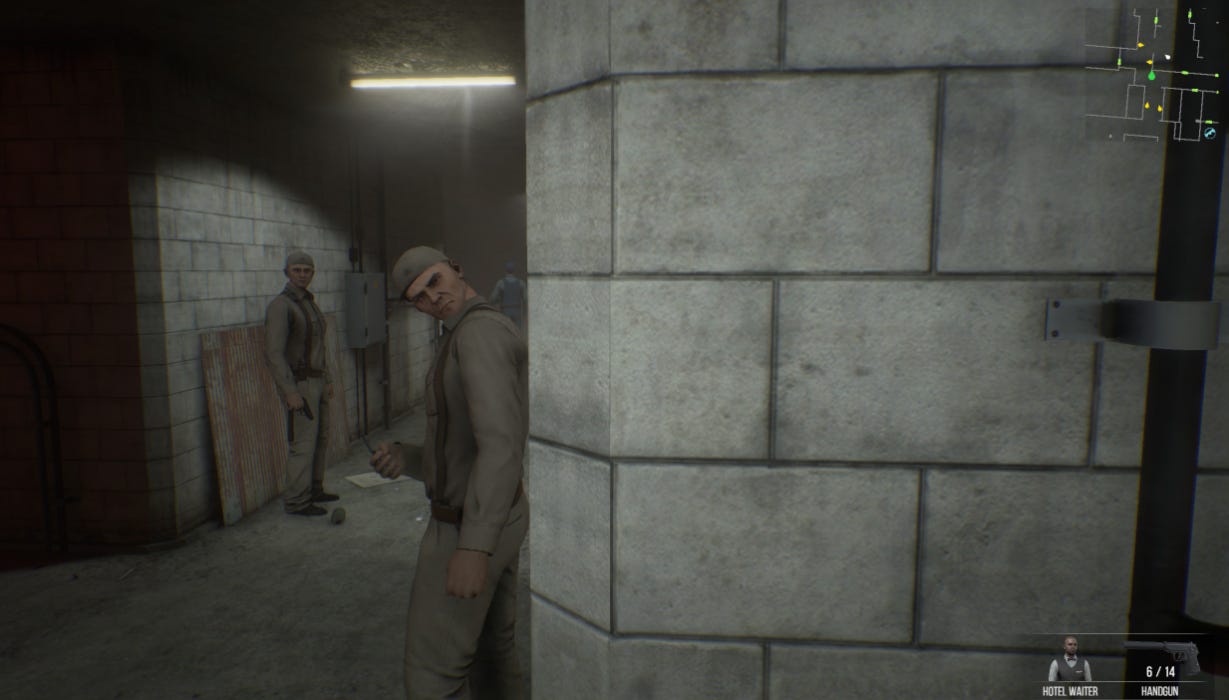
The only time when careful movement is called for is when Mark finds himself in a restricted area without the right disguise, which is very occasionally made possible by alternate passages through ventilation ducts or external windows. In these cases, being spotted is tantamount to an instant game-over and you may actually need to carefully time your movements while patrolling guards’ backs are turned. There were exactly three sequences in the entire game where I found myself doing this, and it so happens that they were the foremost gameplay highlights of the entire experience. Failure, though rare, is sharply discouraged by the inability to save progress during a mission — if you fail, you start over. Accordingly, The Slater genuinely can produce moments of rock-solid tension that get the heart racing and the palms sweating. The problem is that, during the sixty-to-ninety minutes between each of these tense encounters, there’s practically no feeling of jeopardy whatsoever.
The main issue is that Mark is only ever under threat while enemies are alerted, and alerts are supremely easy to avoid under most circumstances. You’re given a suppressed pistol in every mission whose report is quieter than a pin dropping onto a shag carpet, and even that gets hardly any use.2 With his bare hands, Mark can choke to death any person who comes within five feet. The process takes about three seconds, after which the body can be dumped in whichever dumpster, laundry hamper, or wardrobe happens to be nearby. The game is incredibly unsubtle about signposting which NPCs it expects you to choke out and where it expects you to do so — every single level features at least a few NPCs wearing valuable uniforms who step out for a smoke or a piss every two minutes, with such periodical regularity that you could set your watch to it. Invariably, the corner in which they do so prominently features a container suitable for hiding a cadaver. At most, you might need to wait a few seconds for some other nearby NPC to wander out of sight before rending your target’s neck.
But although the game sets up ample opportunities to murder conveniently dressed bystanders, and indeed doesn’t punish you in any way for taking advantage of those opportunities,3 every level can be finished without killing anyone but the specific targets you’re given at the beginning. Disguises necessary for level progression are always available on a hanger someplace, and whichever keycards or VIP badges are necessary to get you through critical checkpoints can be found on tabletops or janitorial carts. There’s no penalty for indiscriminate slaughter as long as you’re not caught in the act — for Mark Slater’s interpretation of “justice” is superlatively personal — but you’re awarded a bonus achievement for finishing a mission without catching extraneous bodies. For this reason, by far the most stimulating way to play the game is to treat each level like a sort of goon-themed puzzlebox that gradually unfolds itself as you bloodlessly accumulate useful inventory items.
This turns out to be very deliberate on the part of the developer, who gives it away on the game’s Steam store page. “The Slater is a story-driven first-person stealth-action-puzzle game,” he writes. “Think of your enemies as puzzle pieces. How do you get past the guards? Who do you kill and how?”
The biggest unanswered question I’m left with after finishing The Slater is whether its puzzle-like progression was intended from the beginning or simply a naturally emerging lampshade for the profoundly nonreactive enemy AI. Since nothing short of witnessing a corpse or having a gun pointed in their face will elicit a reaction from most NPCs, they come across less like people and more like fleshy set-dressing. It’s very rare for them even to communicate with one another. In one particularly hilarious moment, which I clip below, a womanizing target makes crass overtures at a pair of swimsuit-clad ladies who are programmatically incapable of dignifying him.
The bottom line is this: if you go into The Slater expecting a first-person Hitman game, you’re going to be sorely disappointed. The game’s many evocations and references of IO’s masterpieces are just that: surface-level allusions to a thematic inspiration that seldom add up to any material gameplay impact. But if instead you go in expecting an explorative puzzle game with minor stealth elements, it delivers fairly competently, and doesn’t overstay its welcome at a runtime of around four hours.4 With your expectations thus calibrated, you should be able to enjoy the singularly unique manner in which The Slater presents itself and its story.
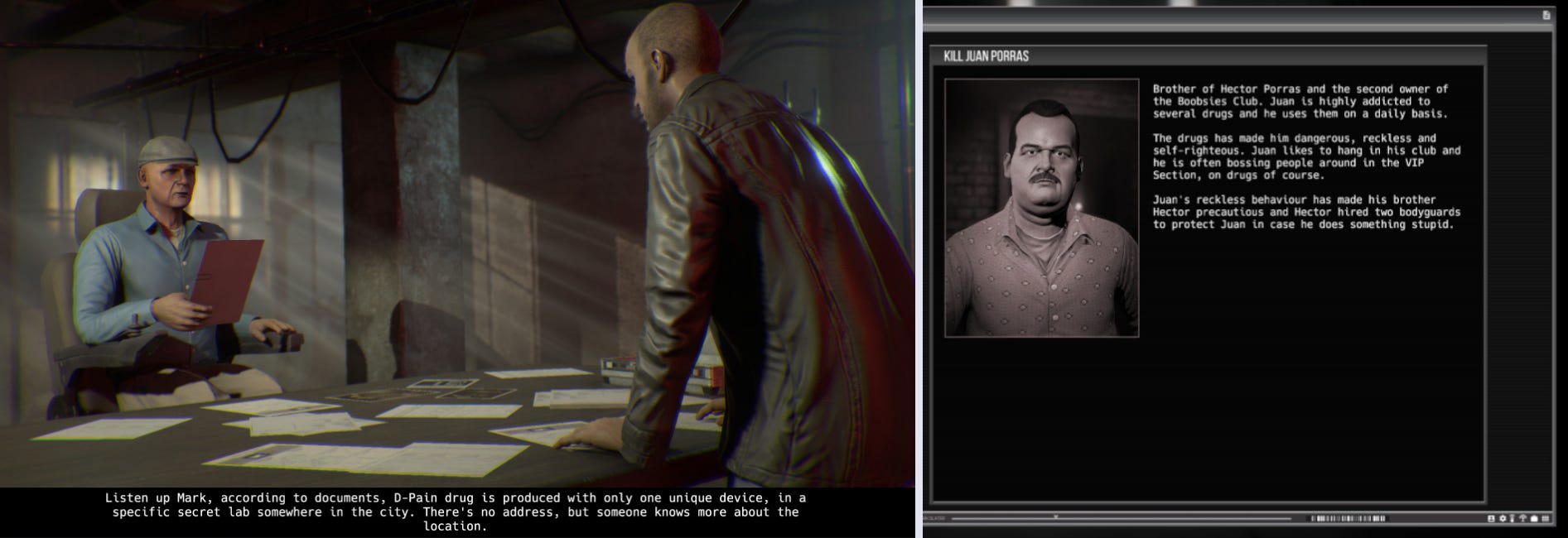
Graphically, The Slater is at the higher end of solo-developed Unity projects from the late 2010s. That is, it looks just about passable as long as you’re not looking too closely. Certain textures have mismatched resolutions and certain environments are bizarrely underlit, but almost nothing stood out as particularly bad. The major exception is the lip-syncing when characters deliver dialogue to camera, which is shockingly awful for 2018. I’m not exaggerating when I tell you that Deus Ex did a comparable-if-not-better job at matching characters’ lips to their syllables all the way back in 2000. Everybody flaps their jaws up and down like ventriloquist dolls, but I can hardly complain on account of how hilarious it makes the more serious, emotionally charged dialogues.
I can complain about its technical performance, which is remarkably inconsistent for a game developed before ray-traced graphics were commercially prominent. My PC is fitted with a GTX 1080, which was in the upper tier of consumer graphics hardware when I installed it in the year of this game’s release. But despite the game’s relatively simple 3D graphics and fairly uncomplicated environments, the damn thing was running loud and hot while occasionally dipping below thirty frames per second.
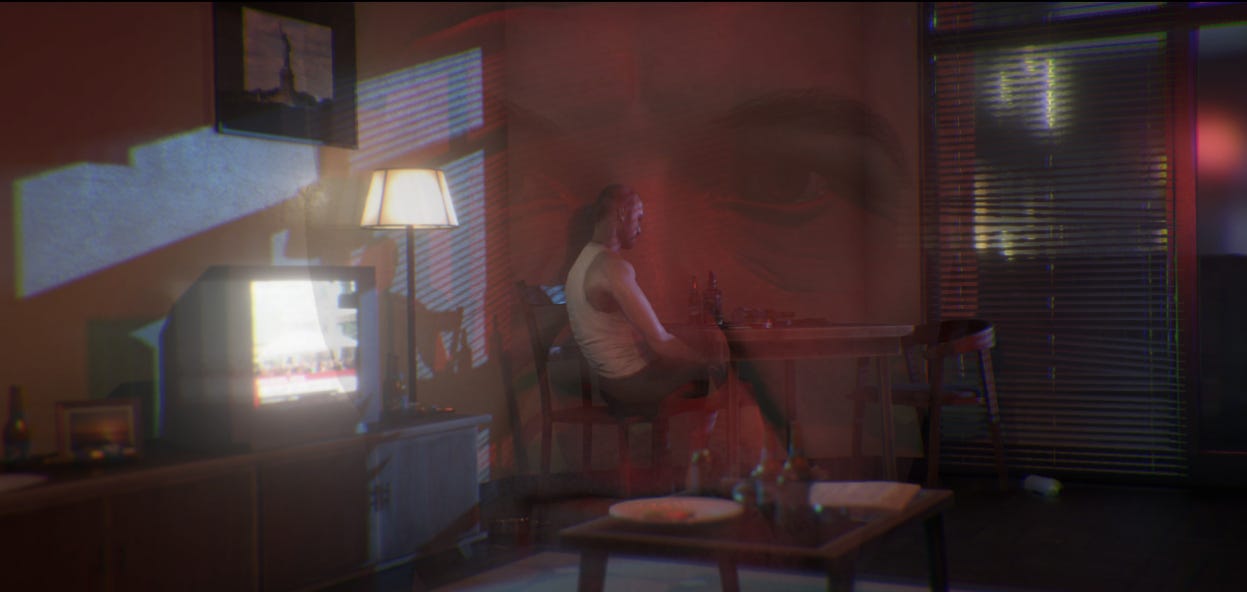
Speaking of loud and overheated hunks of emotionless hardware, let’s talk more about Mark Slater. I mentioned up top that he’s given a fairly bog-standard murdered father as his principal motivation, and that he was once a police officer. These details are just about all we’re given of Mark’s backstory, and so further analysis of his character requires information from the game’s cinematic cutscenes. I struggled for awhile trying to pithily encapsulate his character, and here’s what I came up with: you ever see those Crank movies starring Jason Statham? Slater is like Chev Chelios if he needed tranquilizers instead of adrenaline to stay alive. Mark’s affect is universally low, even when he finds himself at the limits of screaming emotion — he’s always either stone-faced and growling or stone-faced and brooding.
But it’s when we come to what passes for a plot that The Slater truly comes into its own as a video game that could’ve been directed by Neil Breen. Mark’s foremost objective in his revenge tour is to disrupt the production and sale of a designer drug called D-Pain, which his father was supposedly killed for investigating. The circumstances surrounding the trafficking ring are, to put it lightly, unbelievably contrived. Better still, its contrivances are answered with even greater contrivances as needed to progress the narrative. A spoiler-light example: in one mission, Mark steals the device used to manufacture the drug, which is postured as some kind of hyper-advanced triumph of underground science, irreplicable and irreplaceable on account of the expertise required to create it in the first place.5 But after Mark destroys it and kills the scientist who devised it, the story loses all its forward momentum and so has to invent a new character who’s suddenly capable of making a new one after all.
Actually, let me talk a little about the supporting cast. Mark, despite his persistent stone-facedness, is probably the biggest drop of personality in an ocean of utilitarian stock characters. But a few of them have a bit of flavor, and the voice-acting is deeply entertaining in spite of its roughness. Most of the actors are palpably trying their best to sell what little they’re given by a woefully undernourished script. A few of them favor various affectations in their performances that reliably veer into outright comedy: one VA, as an anonymous waiter standing in front of a bathroom mirror, loops through a motivational evocation of Travis Bickle; another portrays a mob boss and does a scuffed impression of Marlon Brando that had me in fucking stitches the first time I heard it. Seriously, imagine Don Corleone delivering these lines without the barest hint of irony:
The story itself is almost incoherent, and its main function is to provide narrative excuses for Mark to travel to interesting places and kill goofy criminals. It’s the sort of story I could spoil entirely without depriving you of anything, and the main reason I won’t be doing so is that I just can’t be bothered to recap the staid and insipid events leading up to Mark’s confrontation with the man who killed his father. As for the ending, even to call it a damp squib seems unfairly generous — there is absolutely no perceptible denouement for Mark Slater, who seems to be at a loss for what to do now that everyone even tangentially responsible for wronging him now lies decomposing in a laundry hamper someplace.
The script is, in a word, blisteringly trite. But its hackneyed clichés and stale reference points add up to something considerably greater than the sum of their parts. The Slater, while superficially generic in presentation, isn’t generic in the way that, say, AI-generated text tends to be. Instead of averaging safe and flavorless expressions into a whole that vaguely resembles human communication, it reads like a schlocky B-movie written by someone with bold ideas and a microscopic budget. I earnestly enjoyed it in precisely the same way as I earnestly enjoy Neil Breen’s filmmaking: at the core of the product, one hears the unmistakable voice of a human creative with a vision on which they won’t compromise. As a result, the wooden acting, trope-driven storytelling, and amateurish implementation of the supporting gameplay mechanics all come across as sincerely charming.
This all contributes to The Slater’s core appeal, which lies not in its overall structure but in the moment-to-moment experiences that compose it. For example, when Mark strode into a meeting with an old handler in the lead-up to the final mission, I had no reason to expect anything but dry context. But when, out of nowhere, Mark angrily demanded explosives and was responded to with “you are a seriously fucking crazy motherfucker,” I nearly fell out of my chair. That is an experience you simply can’t get from ultra-polished projects from major studios — not even the best Hitman game can replicate it.
It’s been a grueling month for the games industry amid the latest round of mass layoffs and yet more closures of beloved studios, hence The Spieler’s nearly single-minded focus on celebrating independent game design these past few weeks. The Slater is, in many ways, an ideal capstone following our discussions of enormous, multidisciplinary fandoms and strides in accessible tools for game production: it’s a confident and uncompromising work that, despite a cavalcade of enormously under-realized parts, comprises a whole that I found alternately charming and hilarious throughout. I think its retail price of ten dollars is a little steep for the four-ish hours of entertainment on offer, but its sale price of $1.49 makes it an easy recommendation for any gamer with the right sense of humor.
I have no idea what became of Alessandro Laina after The Slater — his socials are barren and his trail cold, so I’m not holding my breath for a follow-up. But even if we never again hear from Laina Interactive, we ought not forget its solitary opus. More than ever before, the games industry is in dire need of fearless, intrepid creatives who are prepared to see their visions through to realization even in the face of obstacles that profit-focused studios would consider insurmountable. If you’re in it for the love of the art, you can’t possibly fail.
Thanks for reading to the end! I originally planned on a briefer installment this week, naively thinking that I wouldn’t get much material out of The Slater. I was clearly wrong on that account, and I do genuinely recommend it to any lover of outsider indie game design with a couple bucks and a few hours to spare. Shout-out to Jim for the excellent recommendation, and I’ll see ya next week.
When The Slater was released, IO’s World of Assassination trilogy was still on its first game, with the second in its final stage of development.
I think I shot three guys in this entire game. Everyone else got their necks wrung.
Actually, one of the very first things the tutorial instructs you to do is to murder a drug-addicted transient in order to steal his keys.
I completed all six missions in about four-and-a-half hours, totally unaided. A more careful player, or one working from a walkthrough, could probably blitz through it in three hours and change.
I get a very generically anti-drug message from The Slater’s writing, and it gives the impression that its writer was either 1) totally ignorant as to how drug trafficking goes down in the real world or 2) entirely unwilling to make concessions to reality where so doing would get in the way of the story he wanted to tell. In either case, God bless the man.
No posts
Comments
Nothing yet. Say the first thing.
Sign in to join the conversation.