
This awards season was harder to read than usual, and not just because I was observing it from outside of the circle, but because it was a genuine enigma; campaigns operating on entirely different timelines and strategic logics, studios managing internal instability without losing external momentum and how awards themselves are being repositioned within platform ecosystems.
The result is not just a different set of winners, but a different understanding of how value is created, sustained, and recognised across the industry.
The biggest story in Hollywood isn’t just the $110.9 billion Paramount–Skydance and Warner Bros. Discovery deal. For me, it’s what was also happening while that deal was being negotiated.
Warner Bros. entered this awards season in the middle of corporate upheaval, that would ultimately reshape its own future, while simultaneously running two of its most successful Oscar campaigns in years. It won eleven Oscars (one of its strongest performances in recent memory) while, in parallel, preparing to become a completely different brand and organisation entirely.
The studio ran two Best Picture campaigns for One Battle After Another and Sinners, without either losing momentum. That level of coordination, during a merger, not only impressed me, but also points to something more structural: campaigning has become resilient enough to operate completely independently of corporate structure.
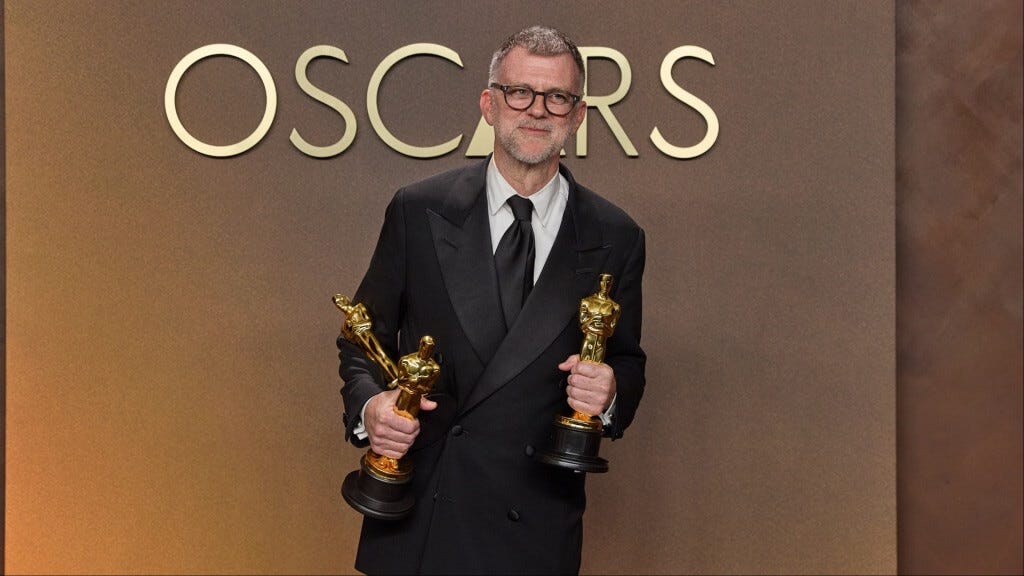
One Battle After Another was positioned within a recognisable awards tradition; the auteur project and the sense of inevitability around Paul Thomas Anderson’s work, which spoke directly to the directing and editing branches, to voters who prioritise formal control and authorship. And Sinners, by contrast, was never framed as a conventional “Academy film.” It was positioned as a cultural moment, operating on a scale that went beyond its award categories. Together, they demonstrated that awards campaigns can now operate with a degree of separation from the studios that house them. Creative momentum and corporate stability are no longer moving in sync.
If the merger goes through later this year, the pressure point shifts to television. Combining CBS Studios, Paramount TV, Warner Bros. TV and HBO creates an unprecedented volume of prestige programming competing for the same internal resources, attention, and campaign spend.
Awards success has always depended on focus; clear priorities and budgets. Consolidation could fragment that focus, and introduce competing internal agendas, and force decisions about which shows get prioritised and which talent are worth backing all the way.
What Warner Bros. did with One Battle After Another and Sinners shows this can work, but at a much larger scale the pressure shifts to decision-making, what criteria determines which titles and projects move forward, and on what basis.
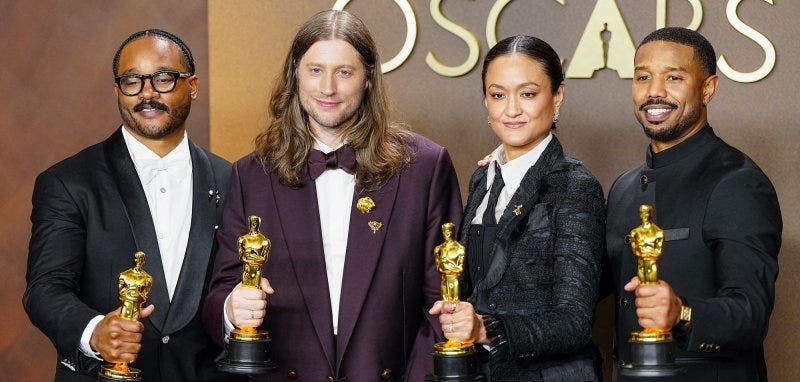
It’s easy to read Sinners as a near-miss. It gained sixteen nominations, more than any film in Academy history and walked away with four wins.
The campaign always behaved like it was redefining what success looks like, and so the wins themselves mattered; Best Actor for Michael B Jordan, and historic wins for Cinematography for Autumn Durald Arkapaw (the first woman and woman of colour to recieve this award), and (the first Black filmmaker to win) Original Screenplay for Ryan Coogler, as well as the live ceremony tribute, bringing together Shaboozey, Brittany Howard, Bobby Rush and Misty Copeland, turning the film into something that felt bigger than the awards themselves; a cultural moment.
Campaigns are no longer just about persuading voters; they are about repositioning a film within the broader cultural and institutional memory of the industry.
The Academy’s new mandatory viewing rule also played a role here. Films that might previously have been overlooked — especially in craft categories — were harder to ignore.
What Sinners demonstrates is a model where the endpoint is not just the win itself, but where the film lands culturally, and how long that position holds.

The repositioning of awards ceremonies onto streaming platforms and digital ecosystems is often discussed as a matter of distribution, but that framing doesn’t fully capture what is actually changing beneath the surface.
With the SAG Awards now on Netflix and the Oscars moving to YouTube, these ceremonies are no longer just industry-facing events designed to recognise achievement within a closed system, they are being reshaped into ongoing content moments that are expected to travel, circulate, and generate engagement long after the live broadcast has finished.
Awards campaigns are no longer being judged solely on how they land with voters in the room, but on how effectively they travel once they leave it, which fundamentally changes what is being prioritised at every stage of the process. A speech, a performance, or even a narrative arc within a campaign now has to function as both a persuasion tool for voters and an external piece of sharable content, capable of reinforcing the film’s positioning across platforms. That shift means that campaigns that succeed are not just the ones that win votes, but the ones that control the narrative before, during, and after the moment itself, which also carries long-term implications for how films, talent, and even studios are remembered once the season has passed.
Campaigns are being designed to function both within the room and beyond it, ensuring that they can hold attention once they are removed from their original context.
I finally saw Hamilton in the West End.
What stayed with me wasn’t just the scale, but the pacing, language, performance, I can understand the cultural phenomenon it has caused. I’ve been looping the soundtrack since, partly because its become an earworm.
I also binged Heated Rivalry, which is a reminder of how well character-driven storytelling can cut through when it’s allowed to be specific and slightly unpolished in the right places.
On a typical rainy Sunday, I enjoyed People We Meet on Vacation, which delivered exactly what it needed to; a clean, well-paced romcom that understands tone, and good-old romance tropes.
I caught a BAFTA preview screening of the BBC’s Half Man, written by the multi award-winning Richard Gadd, which I’m still thinking about. It sits in that uncomfortable space between performance and confession, where the line between narrative and lived experience is deliberately blurred. Curious to see how it sustains that across the series.
Outside of screen time, I’ve fallen into a slower morning rhythm, using a gifted moka pot to make an espresso. I have a Nespresso machine and the Starbucks app, I’ve become accustomed to instant coffee, however, what my moka pot does, is draw my attention whilst I wait for it to brew, and in this time I’m able to bookmark and read a few articles to help start my day. It’s a small shift, but it changes how the day begins. Less haste, more considered, which, increasingly, feels like the point.
No posts
Comments
Nothing yet. Say the first thing.
Sign in to join the conversation.