
Every May, the United States pauses to do something we don’t do nearly enough the rest of the year: talk honestly about mental health.
Mental Health Awareness Month has been observed in the United States since 1949 — making it one of the longest-running public health awareness campaigns in American history. Over 75 years, it has helped shift how people thinks, speaks, and legislates around mental illness. And yet, we still have a long way to go.
This year’s official theme, chosen by Mental Health America, is More Good Days, Together. It’s an invitation for individuals and communities to reflect on what a “good day” means to them, and to use that insight to build more of them, for everyone. It’s a deceptively simple idea with profound implications.
At TMind AI, we spend every day thinking about the people who help others have more good days: the therapists, social workers, and counselors in training who are preparing to sit with some of the hardest human moments imaginable. We think mental health awareness starts with building more and better-trained clinicians. But it starts, even before that, with understanding why this month exists at all.
Mental Health Awareness Month traces its origin to a single man’s experience of suffering, and his refusal to let that suffering be invisible.
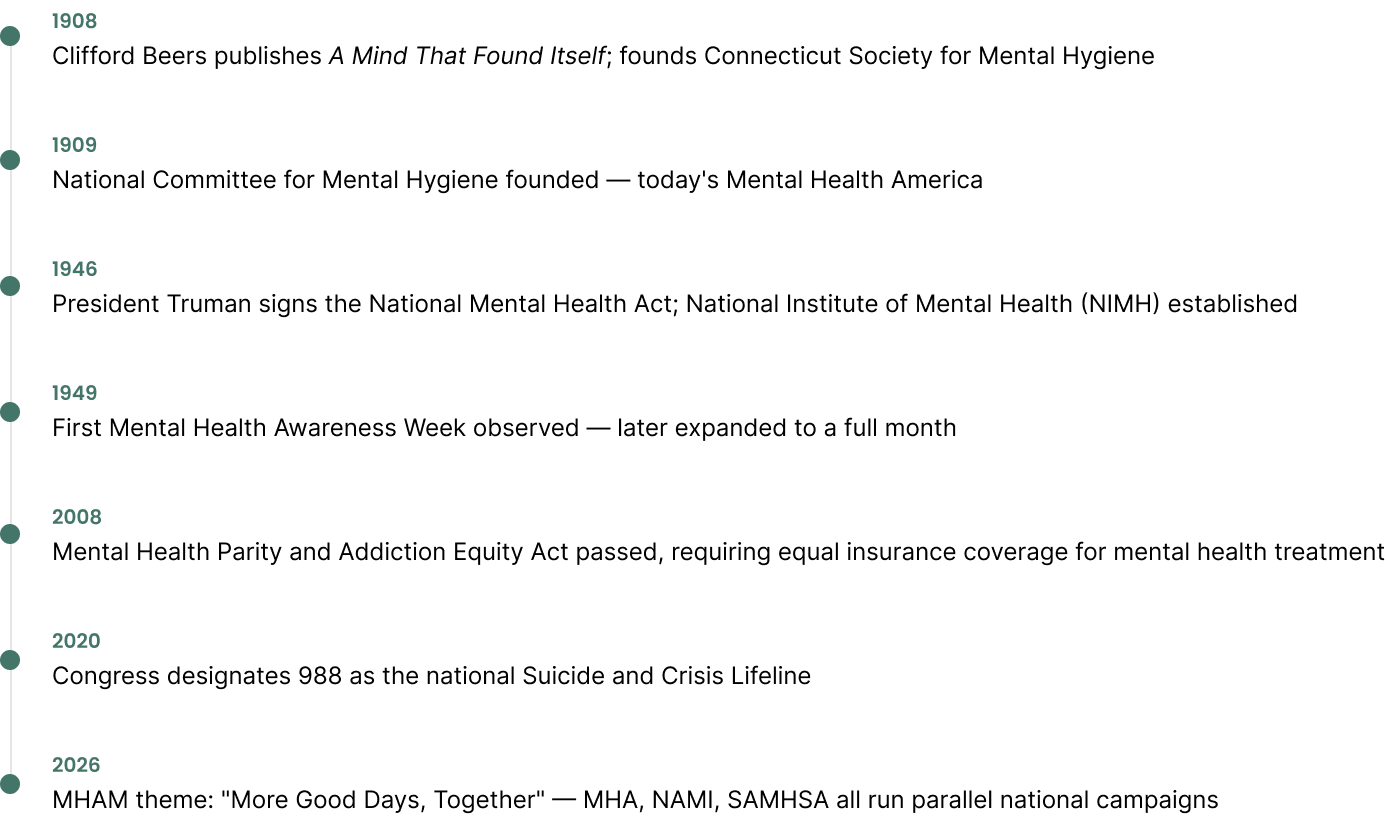
Clifford Whittingham Beers was born in New Haven, Connecticut in 1876. After a series of mental health crises, he was involuntarily committed to psychiatric institutions multiple times. What he witnessed inside those institutions — the abuse, the neglect, the dehumanization of people in mental distress — compelled him to write about it. His 1908 memoir, A Mind That Found Itself, became a landmark in American mental health history.
Beers went on to found the Connecticut Society for Mental Hygiene in 1908, and in 1909 established the National Committee for Mental Hygiene — the organization now known as Mental Health America (MHA). Four decades later, in 1949, MHA launched the first official Mental Health Awareness Week in collaboration with the Jaycees. That week eventually grew into the month-long observance we recognize today.
Some might ask: after 75+ years of awareness campaigns, do we still need a dedicated month? The numbers answer that question plainly.

The stigma surrounding mental illness is still one of the most significant barriers to people seeking care. Awareness campaigns — when done thoughtfully — measurably change that.
A 2024 systematic review found that authentic mental health portrayals in media made people significantly more willing to seek help and support others. Public stigma toward depression dropped by 18% between 2006 and 2018, a shift researchers credit in part to increased public discourse.
Awareness is not just symbolic. It is a precondition for access, legislation, and care.
The United States has made meaningful, if imperfect, progress on mental health policy over the past several decades. Here are some of the landmark moments:
The National Mental Health Act (1946) was the first major federal investment in mental health research and treatment, establishing the framework that led to NIMH. The Community Mental Health Services Block Grant expanded funding to states for community-based care. The Mental Health Parity and Addiction Equity Act of 2008 was a watershed — requiring insurers to cover mental health treatment on equal terms with physical health care, expanding access to millions of Americans.
The Affordable Care Act extended coverage to approximately 30 million previously uninsured Americans, with an estimated 11 million gaining access to mental health and substance use services. And in 2020, Congress designated 988 as the national Suicide and Crisis Lifeline, a single, easy-to-remember number that has since handled millions of calls from people in crisis.
At the grassroots level, organizations like NAMI (National Alliance on Mental Illness), Mental Health America, and Substance Abuse and Mental Health Services Administration (SAMHSA) have built the infrastructure of community-level support (peer groups, free screenings, education programs, and annual observances) that have made mental health a household conversation rather than a private shame.
Awareness is most meaningful when it moves from passive to active. Here are concrete ways to engage with Mental Health Awareness Month this May — whether you’re a clinician, a student, an educator, or simply someone who cares.






We built Tmind AI because we believe the mental health crisis in America is, in part, a training crisis. There aren’t enough clinicians. And the ones we’re training often don’t get enough practice before they’re expected to help real people through their hardest moments.
Mental Health Awareness Month is not just a campaign for us. It’s the reason we show up to work. Every student who practices with an AI client on our platform is one step closer to being the kind of clinician who can make someone’s day genuinely better.
More good days, together. That’s what we’re working toward too.
If you’re in crisis or need support right now: call or text 988 to reach the Suicide and Crisis Lifeline, available 24/7.
Sources:
National Alliance on Mental Illness. (2025). Mental health by the numbers. https://www.nami.org/mental-health-by-the-numbers/
Mental Health America. (2026). 2026 theme announcement: More good days, together. https://mhanational.org/news/more-good-days-together-2026-theme-announcement/
Philip S. Wang, Maria Angermeyer, Ronald C. Kessler, et al. (2004). Delays in initial treatment contact after first onset of mental disorders in the National Comorbidity Survey Replication. Archives of General Psychiatry, 62(6), 603–613. https://pmc.ncbi.nlm.nih.gov/articles/PMC1361004/
National Alliance on Mental Illness. (2021). World Mental Health Day: Increasing access, research, hope. https://www.nami.org/Blogs/From-the-CEO/October-2021/World-Mental-Health-Day-Increasing-Access-Research-Hope
Mental Health America. (2025). MHA kicks off 2025 Mental Health Month. https://mhanational.org/news/mha-kicks-off-2025-mental-health-month/
Mental Health America. (2024). Lessons from MHA screening. https://mhanational.org/lessons-from-mha-screening/
Bernice A. Pescosolido, et al. (2021). Trends in public stigma of mental illness in the U.S., 1996–2018. JAMA Network Open, 4(12), e2140202. https://pubmed.ncbi.nlm.nih.gov/34932103/
Comments
Nothing yet. Say the first thing.
Sign in to join the conversation.