
Every May, the mental health community marks Mental Health Awareness Month with campaigns, statistics, and calls to action. All of it matters.
But some of the most meaningful shifts in how people understand mental illness (the ones that move the needle on stigma, help-seeking, and empathy) have come from something quieter: a darkened theater, a couch, a film that made someone feel less alone.
Research consistently shows that authentic mental health portrayals in film improve public attitudes toward help-seeking and reduce social stigma. Stories travel differently than facts. They bypass the places where defensiveness lives.
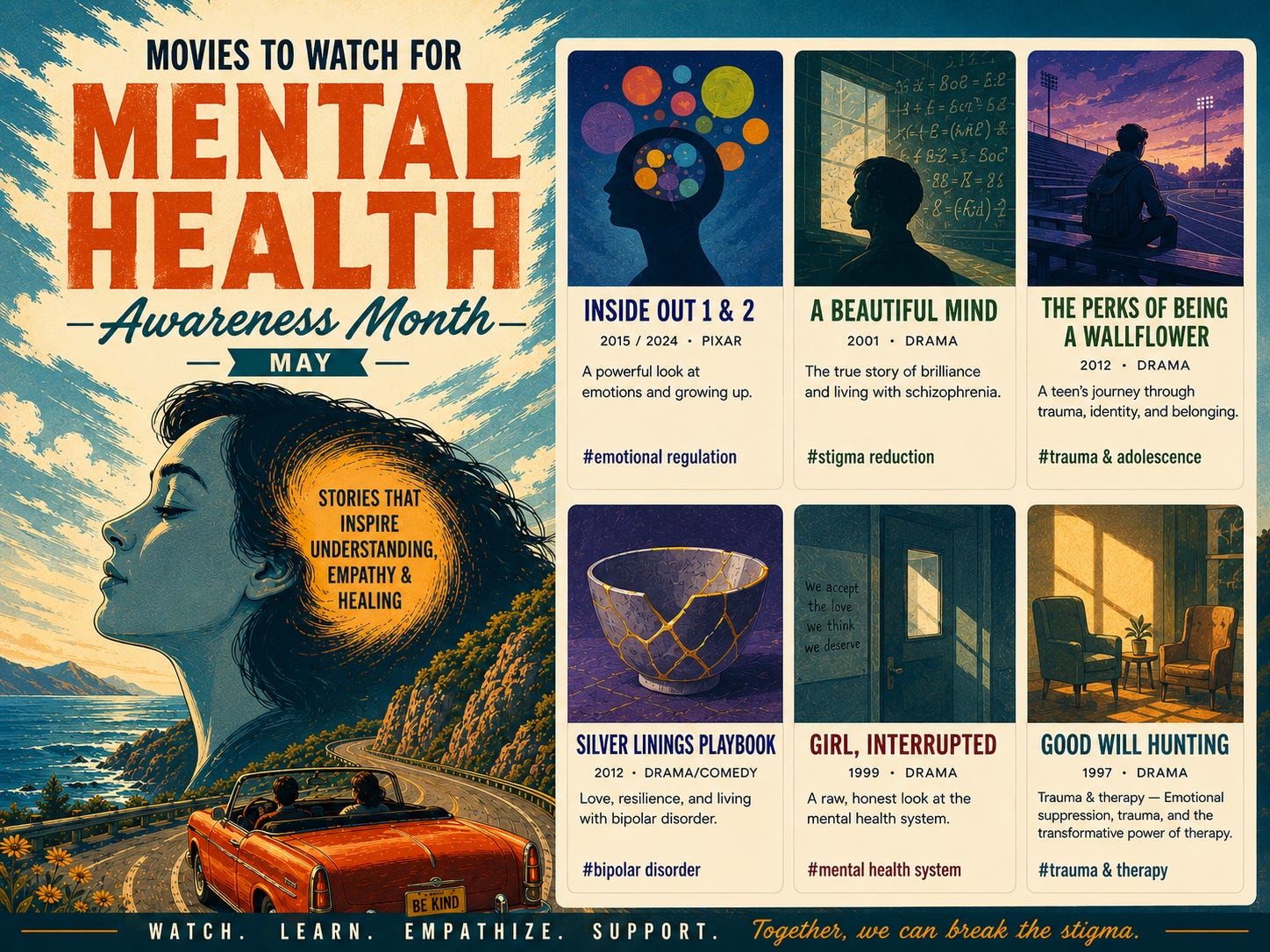
This May, we want to share six films we believe every person who cares about mental health should have seen. Not because they’re perfect clinical documents, but because they’re honest. Because they humanize conditions that are still too often reduced to caricature. And because they start conversations that even the best clinical session sometimes can’t.
Theme: Emotional regulation, growing up, and the complexity of feelings
Few films have done more to give emotional literacy to an entire generation than Pixar’s Inside Out, and its 2024 sequel deepened the argument.
The original film personified core emotions inside the mind of an 11-year-old navigating a major life transition. The sequel introduced Anxiety as a character — one who is not a villain, but a protector who spirals out of control when she takes over. That nuance matters. Anxiety isn’t framed as something to be eliminated. It’s a part of us doing its job too loudly.
For clinicians and educators, both films have become genuine teaching tools. Social work programs, CBT and DBT practitioners, and school counselors have used Inside Out to help clients (especially children and adolescents) build emotional vocabulary for experiences they couldn’t otherwise articulate.
Why we recommend it: It meets people where they are. It doesn’t require clinical language to be clinically valuable.
Theme: Schizophrenia, recovery, and the limits of perception
Ron Howard’s A Beautiful Mind follows John Nash, a mathematical genius whose undiagnosed schizophrenia shapes, and nearly destroys his life, his relationships, and his sense of reality.
The film is worth watching for many reasons, but one stands out: it invites viewers inside a subjective experience that is almost impossible to explain from the outside. Nash’s hallucinations are presented as real (we experience them as real) and only gradually does the truth become visible. It is one of the most effective depictions of psychosis ever put on screen.
The film also refuses to offer a clean recovery narrative. Nash’s journey is long, nonlinear, and marked by trade-offs. He manages his condition rather than defeating it. That distinction — management, adaptation, and continued contribution to the world — is a message that still needs repeating.
Why we recommend it: It challenges the dangerous and unpredictable stereotype of schizophrenia, and centers dignity and resilience instead.
Theme: Trauma, PTSD, and belonging in adolescence
Based on Stephen Chbosky’s acclaimed novel, The Perks of Being a Wallflower follows Charlie, a freshman navigating high school while living with unprocessed childhood trauma. The film is careful about what it reveals and when, and that pacing is deliberate. It mirrors the way trauma actually surfaces in clinical settings: not all at once, but in fragments, over time, triggered by connection.
The film handles abuse, PTSD, dissociation, and the hunger for belonging with unusual care. It doesn’t sensationalize. It observes.
It has been widely used in clinical training environments to open conversations about trauma-informed care, the protective function of peer relationships, and the way adolescents communicate distress sideways, through behavior, withdrawal, and indirect disclosure, rather than directly.
Why we recommend it: It is one of the most accurate portrayals of adolescent trauma and recovery in mainstream film. It models what it looks like when a young person is finally believed.
Theme: Bipolar disorder, love, and what recovery actually looks like
David O. Russell’s Silver Linings Playbook was praised by clinicians and advocates alike for something rare: depicting bipolar disorder with warmth, specificity, and a refusal to flatten the person into their diagnosis.
Pat Solitano is neither a hero in recovery nor a cautionary tale. He is a complicated person in a complicated family, trying to rebuild a life after psychiatric hospitalization. His impulsivity, his grandiosity, his grief, and his hope are all present at the same time. So is his intelligence, his humor, and his capacity for genuine connection.
The film also portrays family dynamics around mental illness honestly — the fear, the enabling, the love that coexists with exhaustion. For clinicians who work with families, that dimension alone makes it worth the two hours.
Why we recommend it: It is one of the most clinically accurate portrayals of bipolar disorder in popular film, and it challenges the narrative that mental illness must be tragic to be taken seriously.
Theme: Identity, BPD, and the mental health system
Based on Susanna Kaysen’s memoir about her two-year psychiatric hospitalization in the late 1960s, Girl, Interrupted is one of the most direct films ever made about life inside the mental health system — and about the experience of being a young woman whose distress is too easily pathologized.
The film raises questions that are still clinically and ethically alive:
Who defines what is “well”?
What does the system do to people who need help but don’t fit the expected patient role?
What does it mean to be institutionalized during the years you’re supposed to be forming an identity?
Kaysen’s borderline personality disorder diagnosis is treated not as a destination but as a beginning of a longer, more complex story. The film is far from a celebration of the system, but it also doesn’t dismiss the people working inside it.
Why we recommend it: It opens necessary conversations about the ethics of care, the history of psychiatry, and the particular ways women’s mental health has been misunderstood and mismanaged.
Theme: Trauma, emotional suppression, and the transformative power of therapy
Good Will Hunting is, at its core, a film about what it takes to let someone help you.
Will Hunting is a 20-year-old janitor at MIT, a self-taught mathematical prodigy from South Boston with an IQ that could take him anywhere, and a trauma history that keeps him exactly where he is. He is brilliant, funny, perceptive, and completely defended. He has learned that the safest move in any relationship is to burn it before it can disappoint him.
The therapeutic relationship between Will and Sean Maguire (Robin Williams) is one of the most examined in clinical training. It models rupture and repair. It models the therapist’s own humanity as a tool rather than a liability. It models patience, the willingness to sit with a client who pushes back hard, who tests, who deflects, and who eventually, in the right conditions, shows up.
The scene where Sean repeats “it’s not your fault” has been shown in classrooms, supervision sessions, and continuing education trainings for nearly thirty years. It earns it every time.
Why we recommend it: It is the film about therapy. Not because it’s technically perfect — there are plenty of boundary concerns worth discussing — but because it captures what is actually at stake in the clinical relationship better than almost any other piece of popular media.
None of them offer easy resolutions.
None of them reduce mental illness to a plot device or a character flaw.
Each of them asks the audience to sit inside an experience that is not their own, and to come out the other side with more understanding than they brought in.
That is what good storytelling does. And this May, when we talk about mental health awareness, we think it’s worth remembering that awareness isn’t just about data and access (though those matter enormously). It’s also about imagination, about cultivating the capacity to understand experiences that look nothing like your own.
These films help. 😃💚
At TMind AI, we build tools for mental health practitioners — AI-simulated client sessions for clinical training, supervision support, and professional development. We believe the best clinicians are those who practice deliberately, reflect honestly, and never stop learning. If you’re a clinical student, associate, or educator, we’d love to show you what we’re building!
Comments
Nothing yet. Say the first thing.
Sign in to join the conversation.