
There’s a moment every counseling student knows.
You’re sitting in class, annotating a case study from your CBT textbook. The client profile is detailed. The presenting problem is clear. The intervention makes logical sense — cognitively, theoretically, structurally. You highlight the key technique, nod to yourself, and move on.
Then you sit across from a real person.
And suddenly, everything you understood so cleanly on the page becomes harder to hold.
This is the gap.
Not a knowledge gap. You did the reading.
Not a motivation gap. You genuinely want to help.
It’s a translation gap. The space between knowing a clinical skill and being able to use it, in the moment, with a real person, when it actually matters.
Mark, an MSW student at York University, knew this gap well.
CBT is one of the most evidence-based, widely-used therapeutic modalities in existence. Its techniques are well-documented. Its case formulations are structured. Compared to many other approaches, it’s almost... learnable from a book.
And yet.
The cognitive restructuring that reads clearly in a chapter becomes slippery when a client is in distress. The Socratic questioning that looks elegant in a transcript is harder to time when you’re tracking affect, maintaining presence, and managing your own anxiety as a new practitioner. The techniques don’t disappear, but in the room, they feel further away than they did on the page.
Mark was in his practicum. He was working through a CBT textbook with a detailed client case study (specific symptoms, thought patterns, and behavioral presentation). He understood the case intellectually. But he wanted to practice with it, not just study it.
The problem: there’s no client in a textbook.
What Mark did next was surprisingly simple, but the results weren’t.
He used TMind AI to build a virtual client based on his textbook case. He created the client with details: the presenting problem, the cognitive distortions, the behavioral patterns, the history. Within minutes, he had an AI-simulated client that embodied the case he’d been studying.
Then he started practicing.
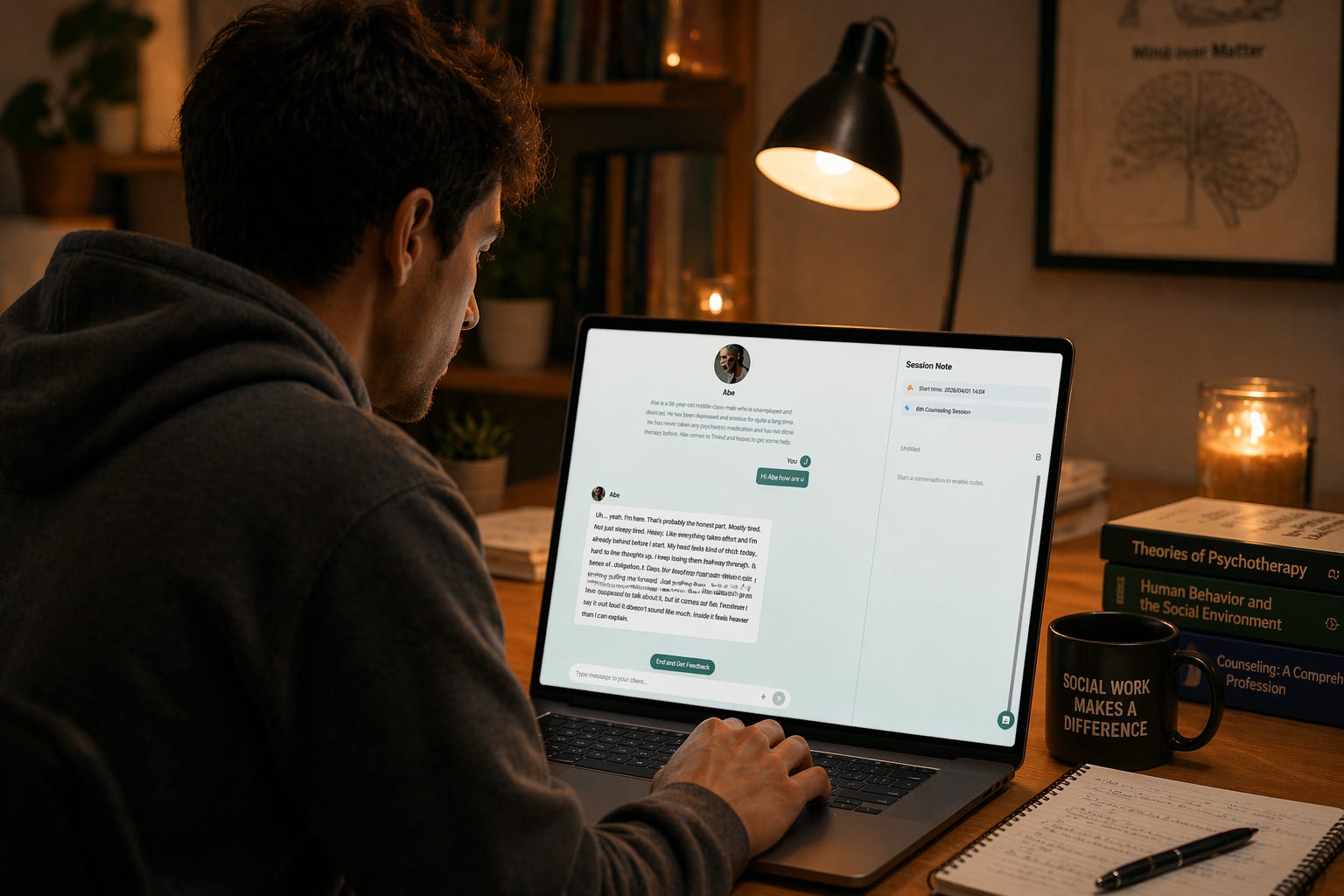
Not reading about CBT. Not watching a demonstration. Actually DOING it!
Asking questions, observing how the client responded, adjusting his approach, making mistakes, and trying again. He could pause. Restart. Run the session a different way. There were no real-world stakes, but there was real cognitive and emotional work happening.
He tested different entry points into the cognitive restructuring conversation. He explored what happened when he moved too fast and pushed for insight before the client felt heard. He noticed how the dynamic shifted when he stayed with the emotion longer before introducing any reframe.
After each session, he reviewed his evaluation, not from a supervisor, but from a template tied to CBT competencies: active listening, reflection, Socratic technique, therapeutic presence. He could see not just what he did, but where he got in his own way.
By the end of his practicum, something had shifted.
Mark wasn’t just more technically skilled. He felt like a therapist.
Mark’s experience points to something we know from motor learning, surgical training, and flight simulation, but have been slow to apply in clinical education:
Deliberate practice requires repetition with feedback in a low-stakes environment.

You don’t learn to land a plane by reading about turbulence. You don’t develop clinical presence by highlighting a textbook. You need reps. And in clinical training, reps are hard to come by, because every rep involves a real person, in real pain, with real stakes.
The supervised hours model is essential, but it can only give you so much. You spend weeks between sessions processing what happened. You get feedback in retrospect. You’re learning, but slowly, because the practice environment itself is constrained.
AI simulation changes that equation. It doesn’t replace the real thing. It prepares you for it.
A few things that made the difference for Mark, and can for any counseling student:
1. Ground your practice in something concrete.
Mark didn’t create a random client. He modeled one from a case study he was already working to understand. The familiarity gave his practice focus and made the feedback land harder.
🙂 Try it: take a client profile from your coursework and build it into a simulation.
2. Treat each session as a deliberate rehearsal.
Don’t just chat with the AI client. Set an intention. Choose one skill you’re working on. Maybe it’s staying curious longer before reframing, or reflecting emotional content more precisely, or tolerating silence. Practice that one thing, and notice what gets in the way.
3. Use your evaluation as a mirror, not a grade.
The post-session feedback isn’t there to tell you whether you passed. It’s data. Look at where you consistently underperform. That’s where your growth edge is. If your empathy scores are high but your technique application scores aren’t, you know what to work on next.
4. Repeat the same scenario more than once.
This is the step students most often skip. Run the same session twice. Approach it differently. See what changes. That variation — the space between your first attempt and your second, is where real learning happens.
The translation gap between theory and clinical skill isn’t a character flaw. It’s not about intelligence or dedication. It’s structural — a problem of practice volume and feedback access that the traditional model of clinical training hasn’t fully solved.
For most of history, the only way to close it was time. Years of supervised hours. Accumulated experience. Confidence built slowly through real sessions and real mistakes, with real clients absorbing the cost of your learning curve.
That’s still part of the process. But it doesn’t have to be the whole path.
Mark graduated from his practicum with something that used to take practitioners much longer to develop: a felt sense of what he’s doing in the room, and why. Not just the theory — the practice.
He got there by practicing. A lot. With an AI client modeled after a textbook case.
If you’re a counseling student working through a case study right now, you could do the same!
TMind AI is a clinical training platform for counseling students and mental health practitioners. Try it free at tmind.ai.
Watch Mark’s story: youtu.be/foVqHQF_qCo
Comments
Nothing yet. Say the first thing.
Sign in to join the conversation.