
📌In a Nutshell:
The way an organisation lets people go determines whether the people who stay still believe in the place they are staying
Companies plan redundancies around the people leaving. The damage lands on the people who stay — predictably, invisibly, and at a cost that never appears on the spreadsheet that justified the cuts
Why mass layoffs fail to deliver what they promised far more often than leadership expects — and what the research says is actually driving that failure
How survivor syndrome works as a mechanism, not a mood, and why that distinction changes everything about how organisations should respond to it
What surviving employees are silently measuring in the weeks and months after a restructuring — and how those judgements shape what the organisation gets from them next
Why the most expensive decisions in a redundancy process are rarely the ones that appear on any cost analysis
What the research says organisations should actually do differently — before, during, and after a restructuring — and why most never do it
Why Mass Layoffs Fail More Often Than Leaders Expect
Survivor Syndrome: The Cost No One Sees Coming
The Psychological Contract: Why Trust Collapses After Layoffs
From Disengagement to Burnout: What Layoffs Do to the People Who Stay
How Surviving Employees Judge Whether a Layoff Was Fair
Why Communication After a Layoff Determines Whether Trust Survives
Why the Manager — Not HR — Must Deliver the News
What Organisations Should Do Differently Before, During and After a Layoff
Final Thoughts: The Bill Always Arrives — The Question Is Who Pays It
Key Takeaways
Next on The Workforce Lens
Further Reading
Somewhere between the board presentation and the announcement, organisations convince themselves that the hard part is the decision. Cascio’s foundational research on downsizing outcomes says otherwise — the anticipated financial benefits frequently do not materialise, the cost line stays stubbornly high, and the gap between what was modelled and what actually happened can almost always be traced back to the same place: the people factor gets addressed last. Sometimes not at all.
That single failure explains most of what follows.
💡 Related read:
Mass Layoffs: What the Research Says About Fairness, Trust and Getting It Right
Discover why mass layoffs often fail to deliver financial benefits, how poor procedural justice erodes trust, and the research-backed steps leaders must take to limit long-term damage
The people who leave take up most of the attention. The people who stay are where the real story is.
Joel Brockner at Columbia Business School spent nearly two decades tracking what happens to those who remain after a round of layoffs — across industries, geographies, and organisational scales — and the finding does not shift: survivors do not simply carry on. Psychological burden increases and does not resolve on its own timeline. The risk that survivors leave quietly, on their own terms, without warning, rises in ways most managers never see coming. The emotional range runs wider than most organisations account for — guilt at being spared, anxiety about the next round, grief for colleagues who are gone, and a distrust of leadership that can sit inside an organisation for years with nobody naming it.
The most uncomfortable part of Brockner’s work for any leadership team is also the most consistent finding across it. Organisations reduce headcount to improve performance. The evidence says they frequently damage it instead.
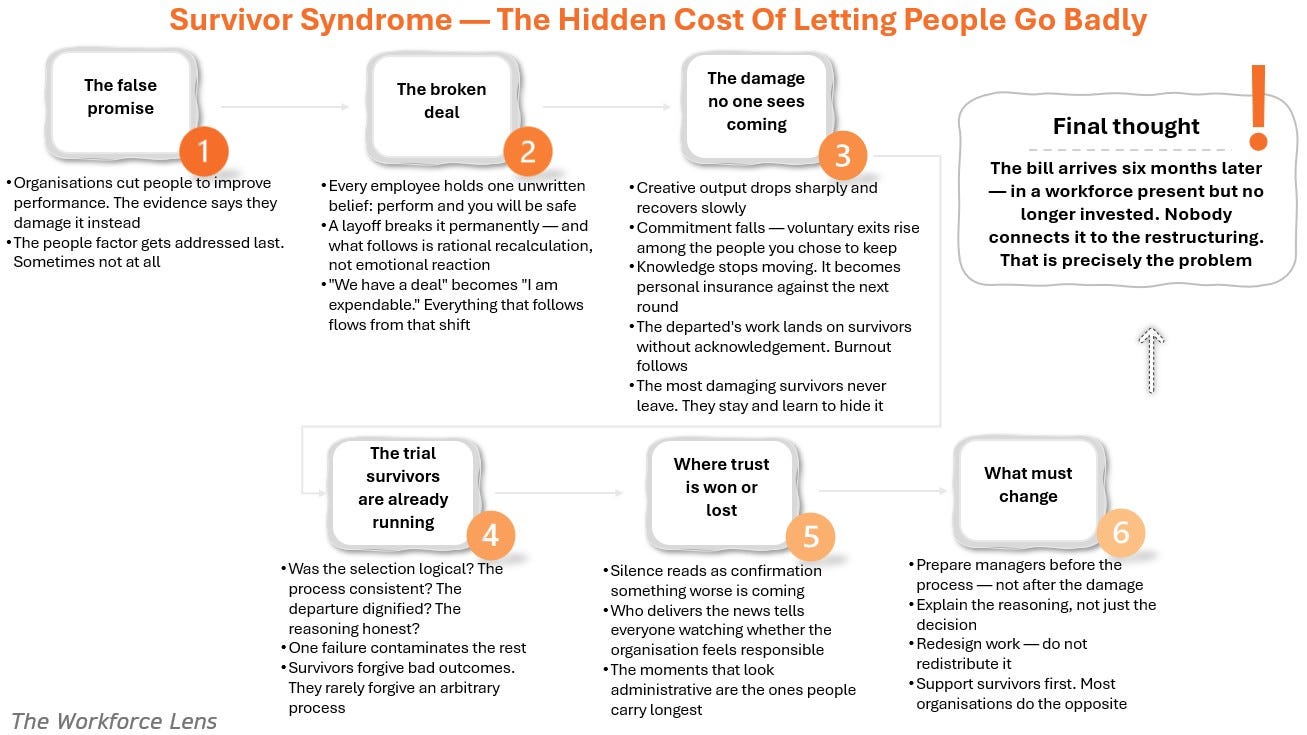
What makes survivor syndrome so resistant to easy fixes is that it is not a mood problem. It runs along a specific, predictable chain — and understanding that chain is the only way to interrupt it.
Every employee carries an implicit belief that loyalty and performance will be met with security and fair treatment — never written down, never discussed, but operating as the foundational assumption underneath the employment relationship in every organisation regardless of how well or badly it treats people. Organisational psychologists call it the psychological contract.
A mass layoff breaks that contract, and once broken, something fundamental shifts in how employees understand where they stand. It is not just that people are sad; they have done the math and realized the company does not have their back anymore. Internal calculation moves from “we have a deal” to “I am expendable,” and everything that follows flows from that single recalibration. Distrust of leadership is the logical consequence. So is disengagement. Both take months to shift — and only shift when the organisation’s behaviour gives people a genuine reason to revise their assessment. Sometimes considerably longer.
A team lunch does not touch that. A town hall does not either.
Start with creativity, because it is where the damage is least expected. Amabile and Conti tracked what happens to creative work during and after downsizing — the deterioration is sharp, and it persists well beyond the restructuring period itself. An organisation that has just cut headcount is simultaneously asking fewer people to produce more. The conditions required for that are exactly what downsizing destroys.
Commitment follows a measurable trajectory. Research published in the SA Journal of Industrial Psychology found a 13.5% drop in organisational commitment following a layoff, and employees with low commitment are 2.5 times more likely to leave voluntarily — which means the organisation has lost headcount involuntarily and is now at elevated risk of losing more among the people it specifically chose to keep.
Something subtler happens to knowledge. When uncertainty rises, it becomes individual leverage, and employees who are uncertain whether they are next begin protecting what makes them difficult to replace. Research published in the International Journal of Environmental Research and Public Health identified this as a measurable outcome of downsizing: silos form at exactly the moment the organisation needs to run efficiently with fewer people.
Workload redistribution is where the second crisis begins. When headcount falls, the work does not — it lands on the people who remain, usually without renegotiation or acknowledgement, and burnout follows. Burnout produces the voluntary turnover the organisation was cutting costs to avoid. One problem quietly generates another.
Perhaps the hardest effect to detect is also the most damaging. Many survivors do not leave. In uncertain labour markets they stay and disengage, and research from the Stockholm School of Economics found that workers actively disguise that disengagement to avoid becoming targets in the next round. Managers miss it. The organisation concludes it has stabilised when it has not.
And then there is the health picture, which rarely appears in any post-restructuring review. Survivors report elevated rates of stress, anxiety and emotional exhaustion, and studies have recorded increased consumption of psychotropic medication among remaining workers following mass layoffs — predictable outcomes of a process most organisations run without any plan for the people left behind.
Nobody briefs survivors on what to look for. They do it anyway.
Jerald Greenberg’s organisational justice framework, developed in 1990 and extended by Bies and Moag, identifies four dimensions along which the assessment runs — and it runs simultaneously across all four, whether leadership is aware of it or not.
Were the cuts fairly distributed, did the selection make sense or did it feel political? Was the process consistent, or were exceptions made for the right relationships? Were people treated with genuine dignity, including how they left the building? Were they given honest explanations, or language carefully drafted to say as little as possible?
These four do not operate independently, and an organisation that handles three well while failing the fourth will feel the consequences across all of them. A generous severance package means little if the process felt opaque. A clear rationale counts for nothing if people were escorted out without being allowed to say goodbye.
The finding that surprises most leadership teams: survivors can accept bad outcomes if the process felt fair. Outcomes that felt arbitrary are rarely forgiven, even when the financial terms were generous.
Communication is where the mechanism can be interrupted — and the evidence is specific about what that actually requires in practice. Honest, regular, direct contact between managers and the people they are responsible for, sustained throughout the process and well into the months after it concludes. The format matters less than the consistency and honesty of it.
Most corporate communication after a layoff is, frankly, insulting. It is too polished, too late, and too defensive.
When managers go quiet — usually because they are uncertain or uncomfortable — employees fill that silence with speculation, and rumour trends toward worst-case. Anxiety compounds, and the silence intended to buy time accelerates the distrust it was meant to avoid.
Brockner’s work is direct on this point. Regular check-ins and transparent acknowledgement of what is not yet known significantly maintained fairness perceptions among survivors even after genuinely difficult decisions — which challenges the assumption that layoffs inevitably destroy trust. They do not have to. What destroys trust is evasion, and the consistent failure to treat employees as people who deserve an honest account of what happened and why.
The question of who sits across the table matters more than most organisations realise when they are planning the logistics of a restructuring.
König and colleagues, writing in the Journal of Business Ethics, found that employees strongly prefer to hear from their direct manager — and when the conversation is delegated to a consultant or an HR specialist brought in for the occasion, perceived psychological contract breach increases for the person leaving and for every survivor watching how it is handled. The message received is that the organisation does not feel responsible for what it is doing. Yes the research says managers should deliver the news. But let’s be honest: it is the most gut-wrenching part of the job, and most of us would rather hide in a broom closet than look a friend in the eye and tell them they are redundant. That is why training managers in structured bad-news delivery, drawing on healthcare communication principles and organisational justice theory, measurably reduced negative outcomes for both recipients and observers. The skill is learnable, the investment is modest, and outsourcing that conversation remains one of the most expensive decisions an organisation makes during a restructuring — one that appears on no cost analysis.
Most organisations know what good looks like here. They simply do not do it.
The single most skipped step is preparing the manager before the process begins. Training in structured bad-news delivery produces measurable differences in outcomes — for the person receiving the news and for every survivor watching how it is handled. It costs a fraction of what a badly handled process generates afterwards, and most organisations skip it entirely in favour of preparing the paperwork.
Explaining the reasoning behind a decision matters as much as the decision itself. Survivors assess whether a process was fair largely on whether they were given an honest, credible account of why it happened. Without that account, even a financially generous process feels arbitrary.
The details that look administrative are the ones people remember longest. How someone leaves the building, what is said to the colleagues who remain, what the reference policy is — these land harder and stay longer than any announcement.
The direct manager delivers the news. Handing that conversation to HR or a consultant brought in to absorb the discomfort sends a precise message to everyone watching: the organisation does not feel responsible for what it is doing. That message is expensive and permanent.
Caring for survivors is where most organisations stop short at exactly the wrong moment. Workload redistribution, honest communication about what comes next, genuine access to support — these are not afterthoughts. Employee assistance programmes are routinely offered to those leaving and rarely to those staying, which is precisely the wrong way around. Where survivors retain some agency over how their work is restructured, the intensity of the syndrome reduces measurably.
The true cost of a poorly handled layoff does not appear on the spreadsheet that justified the cuts. That spreadsheet is a snapshot of a moment. The reality is a slow-motion collapse that begins months later. It shows up in a workforce that is physically present but no longer invested. These are people who have done the math and realized their loyalty was a one-way street. By the time the productivity dip or the talent drain becomes visible, leadership has usually moved on. They rarely connect the dots back to the day they broke the psychological contract.
Across decades of research, the finding is consistent: organizations that treat departing employees with dignity and procedural fairness recover faster. They retain the institutional knowledge that makes performance possible because the people who stayed were watching. They saw how their friends were treated. They used that as a blueprint for their own future commitment.
Survivor syndrome is not an unavoidable tragedy, but it is a predictable outcome of choosing administrative ease over human responsibility. The interventions are well-documented. What is consistently lacking is the organizational will to apply them before the damage is done.
The way an organization says goodbye is the last thing an employee remembers. It is the story they tell the next person who asks. The bill for a layoff always arrives. If an organization does not pay it upfront with empathy and effort, it will pay it later with interest in the form of a broken culture.
The financial case for cutting rarely survives contact with the actual cost of cutting badly
Survivor syndrome runs along a specific, predictable chain. Once the implicit employment deal visibly collapses, employees recalibrate rationally — and that recalibration drives everything that follows
The most damaging effects are the least visible: knowledge that stops moving, effort that quietly withdraws, talent that leaves on its own terms months after the restructuring closed
Survivors are continuously assessing whether what happened was fair — and a single failure in that assessment spreads across the rest of their judgement about the organisation
Every degree of distance between the manager and the redundancy conversation increases the cost of the process
Most organisations stop paying attention to their people at exactly the moment those people need it most
How an organisation handles the people it loses determines what it gets from the people it keeps
The MIT Iceberg Index has done something genuinely difficult: it has made the invisible measurable, translating 32,000 skills and 151 million workers into a single coherent picture of where AI capability and human labour already overlap. But a map, however precise, is only as useful as the decisions it informs.
The next article moves from measurement to response. We examine how employers are beginning to redesign work around the cognitive tasks that AI demonstrably cannot replicate, what it means in practice for organisations operating in sectors the index identifies as most exposed — finance, administration, professional services — and why the gap between AI’s technical capability and its actual deployment in the workforce is the most consequential variable that almost nobody is tracking seriously. Three states co-authored the index and are already using it to shape workforce policy. The rest of the country, and much of the world, is still calibrating to indicators the research shows are pointing in the wrong direction.
The $1.2 trillion in wage exposure is not a forecast of what will be lost. It is a measurement of where the decisions that matter most urgently need to be made.
For understanding why flawed motivation systems erode trust and performance after tough organisational changes, “When motivation systems demotivate: why engagement fades and how to restore it“ reveals the common design flaws that quietly undermine employee effort and offers research-backed fixes to rebuild genuine commitment.
For addressing retention challenges when employee expectations clash with organisational realities post-restructuring, “Retention strategies for real workplaces: coping with unmet employee demands“ reveals practical tactics to bridge the gap between promises and delivery, preventing talent drain through targeted flexibility and communication.
For tackling disengagement trends that intensify after workforce shocks like layoffs, “Quiet quitting in the AI era: how to prevent disengagement and boost employee motivation“ reveals how AI-driven workplaces amplify withdrawal risks and provides strategies to reignite motivation through trust and clear purpose.
Remote Work Laws You Cannot Ignore: A Global Guide to Compliance
Remote Work in Transition: Benefits, Challenges, and Employee Preferences
How AI is reshaping entry-level careers: risks, skills, and strategies

Thanks for reading The Workforce Lens’s Substack! This post is public so feel free to share it.
Preserving Employee Dignity during the Termination Interview: An Empirical Examination on JSTOR
Layoffs, Job Insecurity, and Survivors’ Work Effort: Evidence of an Inverted-U Relationship on JSTOR
The Experiences of Layoff Survivors: Navigating Organizational Justice in Times of Crisis
Layoff Agency: A Theoretical Framework | Download Scientific Diagram
Dealing with “survivor syndrome” - hhs.se - Stockholm School of Economics
Vol. 152, No. 4, November 2018 of Journal of Business Ethics on JSTOR
Organizational Justice: Yesterday, Today, and Tomorrow - Jerald Greenberg, 1990
Changes in the Work Environment for Creativity during Downsizing on JSTOR
Vol. 129, No. 2, June 2015 of Journal of Business Ethics on JSTOR
Comments
Nothing yet. Say the first thing.
Sign in to join the conversation.