
📌In a Nutshell:
The way you let people go determines whether the people who stay still believe in the place they are staying.
Most organisations approach a mass layoff as a financial decision with a human dimension. The research suggests it is the other way around — and the cost of getting that wrong rarely shows up where anyone is looking.
Why mass layoffs fail people and organisations at the same time — and what connects those two failures
What it actually takes to treat people with dignity at scale, when hundreds of decisions are being made simultaneously under pressure
How the choices made before anyone is told — about org design, selection, legal obligations — determine whether the human part can even be done well
What the people leaving, the people staying, and the outside world all see — and why they are all watching the same thing
Why fairness in this context is not a value statement but a set of specific, executable behaviours that either happen or do not
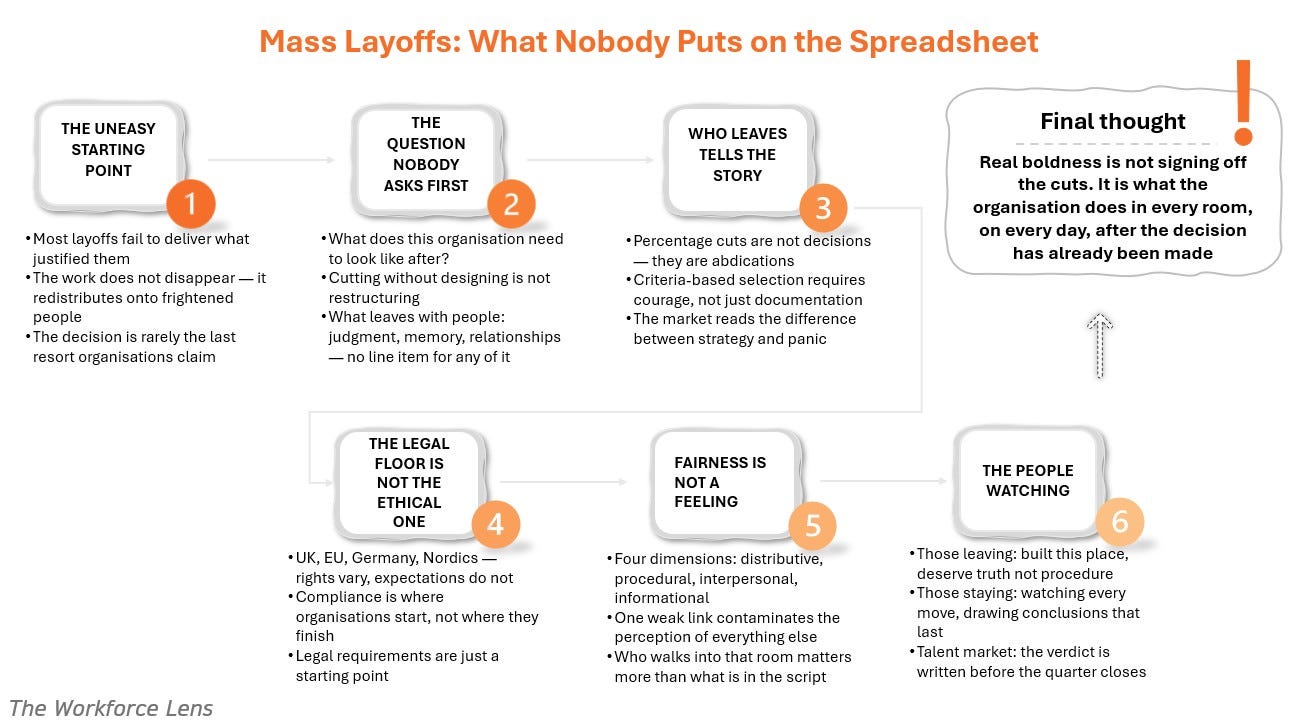
Mass Layoffs: What the Research Says About Fairness, Trust and Getting It Right
Why Mass Layoffs Fail More Often Than Leaders Expect
The Decisions That Have to Happen Before Anyone Is Called Into a Room
When It Becomes Real: How to Execute With Fairness at Scale
When the Formal Process Ends — and What Begins
Final Thoughts: What No Spreadsheet Ever Captured
Key Takeaways
Next on The Workforce Lens
Further Reading
Lately you cannot open the news without seeing it. Amazon cutting thousands. Meta doing another round. Google, again. Tech, finance, media, professional services — the headlines land so regularly now that most of us have developed a kind of numbness to them, a way of reading “12,000 roles eliminated” and moving on to the next story without fully registering what that means for the people who got the call that morning.
I have been on the inside of this. Not at those companies — I saw it up close in a British organisation, sitting on the management side of a process that affected hundreds of people, watching something that had been planned in boardrooms and presented in slides turn into something completely different the moment it became real. What struck me then, and has stayed with me since, is how little the quality of the strategic decision mattered compared to the quality of every choice made in executing it. The room. The words. Who walked in. Whether the person across the table felt like a human being or a line item.
That experience, combined with watching wave after wave of layoffs dominate headlines over the past few years, is what pushed me to write this. Not to litigate whether the decisions were right. But to examine what the research actually says about how to do this in a way that is honest, fair, and survivable — for the people leaving and the organisation they leave behind.
Mass layoffs are not exceptional events anymore. They are a recurring feature of organisational life. And they are among the most consistently mismanaged things organisations do.
The argument this piece makes is simple: most mass layoffs fail to deliver what they promised, which means how you run the process is not a secondary concern. It is the whole game. The mechanism that determines whether anything comes out intact on the other side is fairness — not as a principle statement framed in a policy document, rather as a specific set of behaviours that organisations either execute or do not.
💡 Related read:
The “Great Resignation” in Europe: What really happened and what is next?
Unpack Europe’s nuanced Great Resignation story—burnout, surging quits, labor shortages—and what leaders must prioritise next for retention, engagement, and stability amid economic shifts.
Start with the numbers, because they matter for everything that follows. Cascio’s foundational 1993 synthesis — still the bedrock reference in downsizing research — found that in many firms the anticipated economic benefits of mass layoffs simply do not develop. Expense ratios stay stubbornly high. Productivity, rather than lifting, often dips as institutional knowledge walks out the door alongside the people who held it. Stock prices, contrary to the model, frequently stagnate or fall. The mechanism behind this is not mysterious: when you reduce headcount without a clear plan for how work gets done afterward, you do not eliminate the work. You redistribute it onto people who are already stretched, who are now also frightened, and who are watching very carefully to see whether the organisation they stayed in deserves their effort.
This matters not because the financial case for restructuring is never valid. Sometimes it is. But the organisations that go into this process believing the hard part is the decision, and that execution is a logistics exercise, tend to discover too late that the reverse is true. The decision is the easy part. What follows is where it either holds together or falls apart.
The single most common structural failure in mass layoffs is that organisations decide how many people to cut before they have decided what the organisation needs to look like after. These are not the same question, and conflating them produces both bad selection decisions and bad outcomes.
A workforce reduction driven by a headcount target — cut fifteen percent, find the people to make that number work — produces fundamentally different results than one driven by organisational design. What does the business need to do in eighteen months that it cannot do today? Which capabilities are genuinely critical to that? Where is the work actually going, and who will do it? These questions, answered before any selection begins, give the process a logic that holds up under scrutiny. Without them, you are left defending decisions that were made backwards, and the people evaluating them — those leaving, those staying, the market — can feel that.
This also means the conversation has to happen across leadership, not just in finance or HR. The people who understand what capability actually looks like in practice need to be in the room before the selection criteria are written, not brought in to validate decisions already made.
Once the organisational design question has been answered, selection becomes a great deal more defensible. Cascio, Young and Morris (1997), examining financial consequences of employment-change decisions across major corporations, found that short-run financial improvements are more likely when cuts are part of genuine strategic repositioning rather than uniform headcount reduction. The market reads the difference. So do employees.
Across-the-board percentage cuts — ten percent from every department, applied uniformly — are perceived as arbitrary precisely because they are arbitrary. They make no distinction between the person the organisation cannot afford to lose and the one it has been meaning to address for two years. The organisation loses critical capability invisibly, distributed across dozens of decisions that were never actually decisions at all. Criteria-based selection, grounded in the organisational design work done beforehand, is significantly harder to execute. It requires documentation, consistency, and the courage to defend specific choices in individual conversations. On every fairness dimension the research measures, though, it outperforms the alternative — and it leaves the organisation with the people it genuinely needs.
Every jurisdiction with employment law of any seriousness imposes obligations on organisations conducting mass redundancies, and the specifics vary considerably. In the United Kingdom, collective consultation is legally required, with a minimum 45-day consultation period where 100 or more redundancies are proposed — not a courtesy, a statutory requirement, with meaningful consequences for organisations that skip it. The EU Collective Redundancies Directive sets minimum standards across member states, though several countries impose significantly stronger protections: In Germany, organisations with a works council may need to negotiate an Interessenausgleich and, where required, a Sozialplan, which can address severance and other mitigation measures. France, the Netherlands, and the Nordic countries each have their own frameworks, most of them more demanding than a British or American HR professional might expect.
The legal requirements define the minimum and definitely are not a guide to what good looks like. An organisation that treats compliance as the finish line has misunderstood the assignment.
Colquitt et al. (2001), synthesising 183 studies over 25 years of organisational justice research, identified four dimensions through which people assess whether a process was handled fairly. In a mass layoff, everyone runs this assessment simultaneously — those leaving, those staying, those watching from outside — and their conclusions shape legal exposure, organisational culture, and trust in leadership for years afterward.
Distributive justice asks whether the cuts were fairly distributed. Did the right people go? Was the selection defensible, and could it be explained to the people who remained without prompting cynicism?
Procedural justice asks whether the process was consistent. Were the same criteria applied across the organisation, without exceptions carved out for people with the right relationships or the right seniority?
Interpersonal justice asks whether people were treated with genuine dignity in every individual conversation — not as a category or a headcount reduction, but as a person.
Informational justice asks whether people received honest, timely, substantive explanations — not language carefully drafted by legal to minimise liability while saying as little as possible.
These four do not operate as a checklist where passing three out of four is good enough. A fair selection delivered through a degrading process still causes serious damage. A dignified conversation cannot compensate for arbitrary criteria. The research is consistent that a weak point in the process can substantially shape overall fairness perceptions.
Brockner and colleagues, across more than a decade of research spanning industries and geographies, documented the communication variables that most reliably predict how people experience a layoff and what they carry forward from it.
Who delivers the news matters enormously, and organisations consistently underestimate this. Receiving notification from a manager who knows you — someone with genuine authority over the decision and a real working history with the person across from them — produces measurably different outcomes than hearing it from an HR representative you have met twice, or a consultant brought in specifically for the process, or a letter. The latter options do not simply perform less well. They actively damage fairness perceptions and generate legal and reputational risk that compounds over time. In large, global, and remote organisations, manager-delivered conversations are often coordinated simultaneously with a broader communication to prevent information leaking unevenly through the organisation. That coordination is a practical necessity. The quality, preparation, and humanity of the manager conversation itself sits in a different category entirely.
What gets said in that conversation matters just as much. Explanations that are vague, formulaic, or clearly designed to avoid accountability — “we are repositioning for the future,” “this is about the business, not about your performance” delivered without any specifics — do not soften the blow. They harden it. Brockner’s research shows that meaningful justification, even for genuinely terrible news, significantly reduces negative reactions, not because people become happy about what happened, but because they feel respected enough to be told the truth. When leadership genuinely does not yet know what comes next on severance, timelines, or references, saying so directly is better received than filling that silence with reassurance nobody believes. Credibility, once spent on vague optimism, does not come back.
Outplacement services, counselling access, extended benefits, and honest, generous references are not gestures of goodwill. They are the practical expression of interpersonal and procedural fairness for the people exiting the organisation. In many jurisdictions, elements of this are legally required — but as noted, the legal floor is not a design brief.
Cascio and Wynn’s 2004 analysis of gaps between research and practice in downsizing found that organisations managing the process most effectively actively delivered support rather than announcing it. The difference matters more than it sounds. A page on the intranet listing available resources is not outplacement. A structured programme, actively introduced, with real access to counselling, career coaching, and sustained communication through the transition period is. People who have just been told they are losing their jobs are not well-positioned to navigate a list of links. The support has to come to them.
The people who remain in the organisation benefit from communication and visibility throughout the process — rather than a single announcement followed by silence while managers deal with individual conversations. Silence in the gap between announcement and completion is not neutral. It fills immediately with rumour, anxiety, and speculation, and the conclusions people reach in that period are rarely the ones the organisation would choose for them.
What does the organisation need from them during this period? Honest answers about timelines. Clarity about their own roles where that exists. Acknowledgment of uncertainty where it does not. Regular contact from their direct managers — not corporate updates, actual conversations. People who feel informed and visible during a layoff process are significantly more likely to maintain their performance and commitment than those left to make sense of events on their own. The research on survivor reactions is consistent on this: the quality of communication during the process shapes outcomes as much as anything that happens after it concludes.
The months following a mass layoff are a period of acute organisational vulnerability that most leadership teams underestimate. Those who stayed are doing more work, often in roles that have been stretched to absorb responsibilities that used to belong to colleagues. They are also watching how the organisation behaves now that the pressure of the event itself has passed — whether the promises made during the process are kept, whether the leadership that presided over the layoff has learned anything visible from it, whether the culture has shifted in ways that feel safe or precarious.
Survivor research documents a consistent pattern: reduced trust, elevated anxiety, declining commitment, and in many cases elevated turnover in the twelve to eighteen months following a poorly handled layoff. The performance cost of this is real and largely invisible on the same spreadsheet that tracked the cost savings. Organisations that invest in visible follow-through — keeping commitments made during the process, being honest about what the restructuring was supposed to achieve and whether it is working, creating genuine space for people to process what happened — recover faster and more completely than those that treat the conclusion of the formal process as the end of the story.
A mass layoff is visible in ways that most other organisational decisions are not. How it was handled will be discussed, posted, and remembered — by the people who left, by the people who stayed, and by the people in the talent market who will decide whether this is an organisation worth joining. The reputational consequences of a badly managed process extend well beyond the event itself, into hiring, into retention, and into the willingness of communities and partners to extend goodwill to the organisation in the future.
None of this is an argument for treating the process as a reputation management exercise. The organisations that come through mass layoffs with their reputations intact are not the ones that managed the optics most carefully. They are the ones that treated the people involved — leaving and staying — with genuine respect throughout, and whose conduct during the process was consistent with what they said they valued before it started.
Layoffs are rarely the last resort organisations claim them to be. They surface when the numbers demand it, sometimes when leadership has run out of better ideas. What they are not, ever, is straightforward — because the people being asked to leave often built the thing that is now releasing them, and that fact sits in the room whether anyone names it or not.
The decision alone fractures something that took years to build. People trusted their managers, believed that the direction they were asked to work toward was the right one, gave their effort and expertise to something they thought was worth it. When the announcement comes, that faith cracks — not necessarily into anger, but into a new kind of watchfulness. People start reading emails differently, measuring what is said against what is done, looking for evidence of who this organisation actually is underneath the language it uses about itself.
What looks like a cost-cutting exercise on a spreadsheet rarely accounts for what actually leaves — not just headcount, but judgment, relationships, institutional memory accumulated over years that has no line item and no replacement plan. Whether it was worth it is a question most organisations stop asking too early, usually around the time the quarter closes. The ones left behind carry the answer for much longer.
Those who are let go built this place. They showed up, contributed, often believed in it. That deserves something in return — not sentiment, not a farewell lunch, but genuine honesty, real care, and the basic respect of being treated as a person at the moment they are most exposed. Organisations that understand this do not do it because it protects their reputation, though it does. They do it because it is what they owe.
Delivering all of this well, at the moment the organisation is at its most pressured and most watched, requires something that no process document can substitute for. It requires an organisation that was already strong enough to be honest, already coherent enough to act consistently across every level, already mature enough to know that real boldness here is not in the decision. It is in what comes after it.
The moment you decide who goes, you have already decided who stays — and whether they will trust you enough to rebuild
Most layoffs are designed around a number. The ones that work are designed around a future
Dignity at scale is harder than dignity in a single conversation — but the standard does not change because the number did
What the organisation owes departing employees and what it owes surviving ones are not separate obligations. They are the same one, seen from two sides
The financial case for cutting rarely survives contact with the actual cost of cutting badly
In the next piece we will focus on what happens inside the organisation after a mass layoff — the part that rarely makes the headlines and that most leadership teams underestimate — what the research on survivor syndrome actually shows about the people who stayed, why they are often more at risk than anyone acknowledges, and what organisations consistently get wrong in the months that follow. Reduced creativity, hidden disengagement, voluntary exits that nobody saw coming. The irony at the centre of it all: companies cut people to improve performance, and frequently damage performance in the process.
For proactive prevention of layoff fallout, “Building Business Resilience: Why Strategic Workforce Planning is Your Crisis Insurance“ shows how forward-looking talent alignment and cross-functional forecasting build organisational agility, reduce skill gaps, and turn workforce readiness into a strategic buffer against disruption.
On the hidden costs of workforce instability for leavers, “The Gig Economy and Older Workers: Opportunity or Unfair Struggle?“ exposes how gig flexibility often delivers financial precarity, benefit gaps, and isolation—echoing the support shortfalls that erode trust in redundancy processes.
To rebuild fairness perceptions post-layoff, “From Secret Salaries to Transparent Pay: Why It Gives You a Competitive Edge“ demonstrates how pay openness fosters trust, cuts turnover, and complies with EU directives, strengthening retention among wary survivors
Remote Work Laws You Cannot Ignore: A Global Guide to Compliance
Remote Work in Transition: Benefits, Challenges, and Employee Preferences
How AI is reshaping entry-level careers: risks, skills, and strategies

Thanks for reading The Workforce Lens’s Substack! This post is public so feel free to share it.
Cascio, W.F. (1993). Downsizing: What do we know? What have we learned? Academy of Management Executive
Cascio, W.F. & Wynn, P. (2004). Managing a Downsizing Process. Human Resource Management
Cascio, W.F., Young, C.E. & Morris, J.R. (1997). Financial Consequences of Employment-Change Decisions in Major U.S. Corporations. Academy of Management Journal
Colquitt, J.A., Conlon, D.E., Wesson, M.J., Porter, C.O. & Ng, K.Y. (2001). Justice at the Millennium: A Meta-Analytic Review of 25 Years of Organizational Justice Research. Journal of Applied Psychology
Brockner, J., Konovsky, M., Cooper-Schneider, R., Folger, R., Martin, C. & Bies, R.J. (1994). Interactive Effects of Procedural Justice and Outcome Negativity on Victims and Survivors of Job Loss. Academy of Management Journal
Brockner, J., DeWitt, R., Grover, S. & Reed, T. (1990). When it is especially important to explain why. Journal of Experimental Social Psychology
Brockner, J., Grover, S., Reed, T., DeWitt, R. & O’Malley, M. (1987). Survivors’ Reactions to Layoffs: We Get By With a Little Help From Our Friends. Administrative Science Quarterly
Grubb, W.L. (2006). Procedural Justice and Layoff Survivors’ Commitment: A Quantitative Review. Psychological Reports
Comments
Nothing yet. Say the first thing.
Sign in to join the conversation.