
📌In a Nutshell:
Most decisions are calibrated to where AI is visible, while the real shift is already embedded in how work is structured at the skill level, which means the response is being designed for a signal that captures only a fraction of the change underway
Workforce planning is facing a measurement problem it has not yet admitted to itself. The gap between where AI adoption is visible and where AI capability actually sits across the economy is large enough to make most current responses structurally inadequate. The Iceberg Index maps that gap at the skill level, across every state and sector, and what it finds changes the terms of the conversation entirely.
Why the data governments use to track AI’s impact on work is structurally blind to most of what is actually happening
How AI is changing jobs without eliminating them, and why that makes it harder to see and harder to respond to
Why two people with the same job title can be in completely different positions when it comes to AI exposure
Why geography is not the variable that matters, and which one is
What task redesign actually means in practice, and why AI training alone does not solve the problem
Why current workforce planning, education systems, and regional investment strategies are all calibrated to the wrong signal
The Signal Everyone Trusts Is Capturing One Fifth of the Problem
Technical Exposure Is Not the Same as Job Loss
How the Model Sees What Labour Statistics Cannot
The Transformation That Does Not Show Up in Headcount
The Implications Are Uncomfortable Across the Board
Final Thoughts: The Measurement Exists. The Question Is Whether the Response Will Catch Up
Key Takeaways
Next on The Workforce Lens
Further Reading
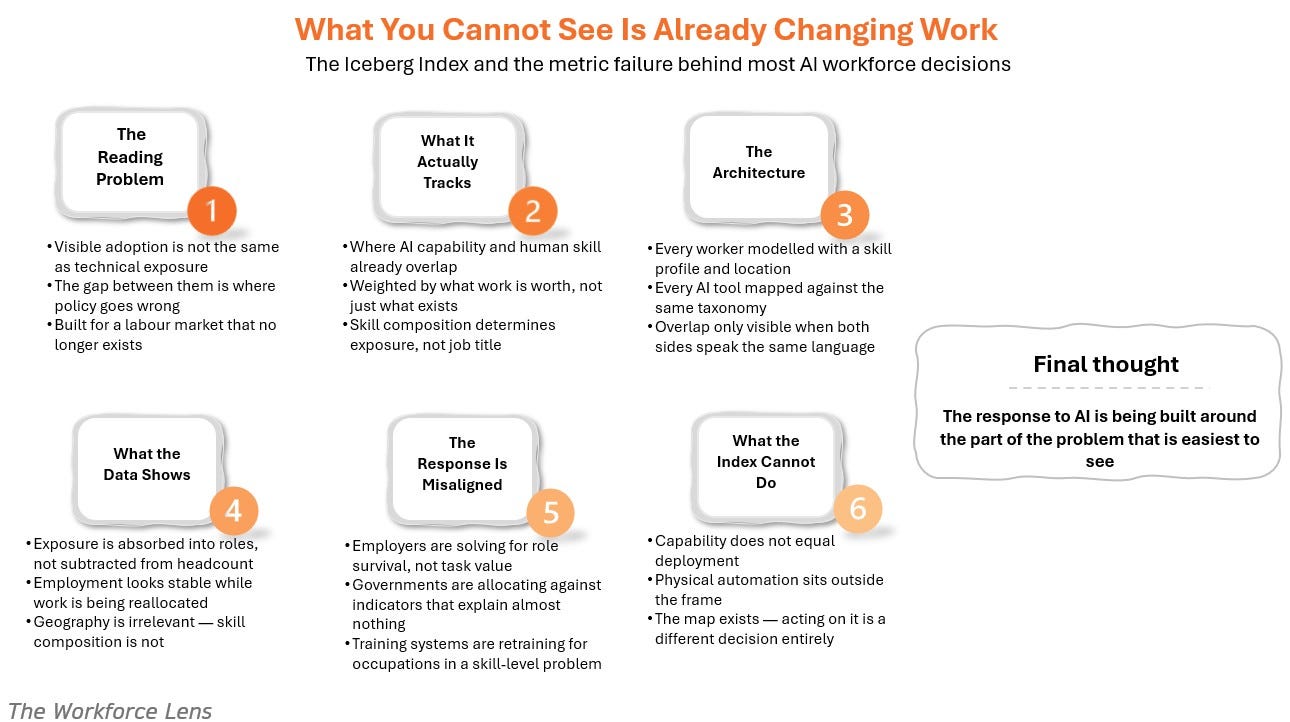
Start with what the data actually shows. The share of U.S. wage value where AI adoption is currently visible sits at 2.2%, concentrated in technology occupations — software engineers, data scientists, technical programme managers. That is the Surface Index. Governments cite it, analysts track it, and workforce planning is largely built around it. What is wrong about it?
The problem is that 2.2% is measuring the wrong thing. When you map what existing AI tools can already do across administrative work, financial services, professional services — the functions that keep every organisation operational regardless of sector — the exposure figure becomes 11.7% of the U.S. workforce, approximately $1.2 trillion in wages. Spread across all states, not clustered on the coasts, and concentrated precisely in the kinds of roles that have never featured in a single serious conversation about automation risk.
Governments and employers are currently making investment decisions, setting training priorities, and allocating regional development funding based on a signal that accounts for roughly one fifth of actual technical exposure. The tools they are using were designed for a labour market where disruption showed up in unemployment figures with enough lead time to respond. AI moves differently. It enters workflows quietly, compresses task portfolios gradually, and by the time the standard indicators register anything meaningful, the window for proactive response has usually already closed.
The Iceberg Index was built to shift that. Not by predicting outcomes, but by mapping where human skill and AI capability already overlap at a granularity — 923 occupations, 3,000 counties, more than 32,000 distinct skills — that makes it possible to see the structural exposure before it becomes a labour market event.
💡 Related read:
How AI is reshaping entry-level careers: risks, skills, and strategies
Discover how AI is automating routine entry-level tasks, the critical skills gap it creates, and actionable strategies for organisations to adapt junior roles and prepare new talent for an AI-transformed workforce.
The index measures one thing: the share of wage value within any given occupation that AI systems can already perform, based on what existing tools have demonstrated they can do. Not projections or firm-level deployment decisions. Current, demonstrated technical capability, mapped against how work is actually structured across the economy.
The paper draws an analogy to earthquake risk zoning that is worth taking seriously. A seismic map does not tell you when the ground moves or how much damage results. It tells you where the structural conditions for disruption already exist. The Iceberg Index does the same for labour markets, and I find this analogy particularly interesting. It identifies where AI capability and human skill already overlap. What firms decide to do with that information, how fast adoption spreads, how workers adapt, how regulators respond — none of that is inside the model. The index stops at the capability map and is explicit about why.
The design choice that actually matters is the decision to measure at the skill level rather than the occupation level. Two people with the same job title, at the same firm, earning the same salary, can face completely different levels of exposure depending on what they actually spend their time doing. One processes documents, coordinates schedules, handles routine correspondence. The other spends the same hours negotiating, reading situations that require judgement accumulated over years, managing relationships where the stakes are high enough that the other party needs a human in the room. An occupation-level measure assigns them identical risk. A skill-level measure tells a completely different story for each of them, and that difference is precisely where workforce planning either gets it right or wastes its resources.
The framework constructs a digital twin of the U.S. labour market. One hundred and fifty-one million workers represented as autonomous agents, each carrying a skill profile, an occupation, a location. Spread across 923 occupations and 3,000 counties, covering more than 32,000 distinct skills drawn from standardised occupational taxonomies. On the other side of the model sits a catalogue of over 13,000 AI tools — copilots, workflow automation systems, language model interfaces — mapped onto the same skill taxonomy. The reason for using identical categories on both sides is simple: you cannot measure overlap between two things unless you are describing them in the same language.
The simulations run on ORNL’s Frontier supercomputer using MIT’s Large Population Models framework, a system originally built for national security modelling. That infrastructure matters because the index is not producing sector-level averages. It is running skill-by-skill comparisons across millions of workers in thousands of counties at the same time, which requires computational capacity that most research frameworks cannot approach.
Two things the index does not do. It does not cover physical automation through robotics, which means the exposure figures for manufacturing, construction, and agriculture are conservative relative to where those sectors are likely to land as robotic capability develops. And it measures technical capability, not adoption. The gap between what AI tools can do and what firms have chosen to deploy is substantial and varies considerably by sector, regulatory environment, and organisational readiness. Technical exposure becoming actual workforce impact requires a chain of decisions — by firms, regulators, workers, and institutions — that the index does not attempt to model. It maps the starting conditions. Everything after that is contingent.
Exposure does not announce itself. It does not arrive as redundancy notices or sector-wide layoffs in the kinds of occupations that make the news. What the index tracks is quieter and, for that reason, considerably harder to respond to. AI systems absorb the routine cognitive and administrative components of a role incrementally, while the person in that role stays employed, their title unchanged, their presence in the headcount data identical to the year before. The work has changed, but the statistics have not.
The paper points to sectors where this is already observable. Financial institutions running AI across document processing and analytical workflows. Healthcare systems automating the administrative load so that clinical staff can direct more time toward patients. Logistics operations using AI to optimise fulfilment at a granularity that human coordinators could not sustain. Manufacturing facilities integrating AI into quality control while the humans around those systems shift toward coordination, oversight, and the judgement calls the AI cannot make. In every case, employment levels may look stable. What is happening underneath is a reallocation of what human labour is actually for inside those organisations.
Two validation results from the paper are relevant here. Skill-based occupational embeddings achieve 85% recall in predicting observed career transitions — meaning the model’s picture of occupational similarity through shared skills corresponds closely to how workers actually move between jobs in the real world. The Surface measure shows 69% geographic agreement with AI usage data from the Anthropic Economic Index, which tracks real deployment patterns across millions of users. Both results point in the same direction: the framework is measuring something that reflects actual labour market structure, not a theoretical construction that looks clean on paper.
Geography compounds the problem. Exposure under the full index runs across all states, including regions that have never appeared in serious policy discussions about automation risk. The assumption that this is primarily a coastal, technology-sector phenomenon is not supported by the data. More importantly, location turns out to be a less useful variable than measurement level. Occupation-based analysis produces a single exposure figure for a job title regardless of what the people in that job actually do day to day. Two workers in the same role, at the same firm, in the same city can face completely different levels of risk depending on their actual skill composition. Aggregate at the occupation level and that variation disappears entirely, taking with it the information that would actually be useful for targeting a response.
For employers, the uncomfortable part is not the exposure figures. It is what they imply about the standard response. When organisations face automation risk, the instinct is to preserve headcount, invest in AI literacy training, and identify adjacent roles that displaced workers might move into. These are not unreasonable responses. They are just answers to the wrong question. The index points toward task redesign as the lever that actually matters. As AI absorbs the routine cognitive and administrative dimensions of professional work, the relevant question is not whether a given role survives but which parts of it remain worth paying a human to do, and whether the organisation has deliberately restructured workflows around those parts. A workforce that has completed AI training but whose day-to-day tasks remain identical is not meaningfully less exposed than before. Familiarity with the tools is not the same as being positioned to do what the tools cannot.
Governments face a version of the same misalignment, operating at a larger scale and with higher stakes. The policy instruments currently used to allocate workforce investment, direct regional development funding, and design reskilling programmes are calibrated to visible adoption signals. GDP figures, income data, unemployment rates. The paper finds these explain less than 5% of the variation in Iceberg Index scores across states. The implication is that billions in public investment are being allocated based on indicators that have almost no predictive relationship to where technical exposure is actually concentrated. The index offers county-level targeting and skill-level granularity, and critically, the ability to simulate the effects of different interventions before committing resources to them. Whether the institutions responsible for these decisions have the appetite to retool their planning processes around a different set of signals is an open question.
For education and training systems, the shift from occupation to skill as the unit of analysis is not a methodological refinement. It changes what effective preparation actually looks like. Occupational retraining programmes move people from one job category to another. They do not necessarily address the skill-level variation that determines exposure within a single role. Two people in the same occupation, facing different levels of risk because of differences in what they actually do, will not be equally served by a programme designed around their shared job title. The skills that remain differentially valuable as AI capability expands — judgement, coordination, the kind of human-facing work that requires reading a situation rather than processing it — are not well captured by occupational frameworks. Training systems that cannot aim at that level of precision will consistently allocate effort to the wrong places.
The central claim of the Iceberg Index is not that AI will destroy the labour market. It is that the labour market transformation already underway is significantly larger than the signal most decision-makers are using to track it.
The visible disruption — layoffs in technology roles, compressed demand for junior programmers, restructuring announcements at firms that made AI a headline — is real. It is also a fraction of what the index measures. Beneath it sits approximately $1.2 trillion in wage exposure distributed across every state, every income level, and sectors that have never appeared in a serious conversation about automation risk. The cognitive and administrative work that holds organisations together. Roles that do not read as technology jobs but that are, skill by skill, increasingly within reach of what current tools can do.
What makes this a planning problem rather than just an academic finding is the timing. The decisions that determine how well a workforce, a region, or an institution navigates this transition are being made now, under conditions where the standard indicators are pointing at roughly one fifth of actual exposure. Investment priorities are being set. Training programmes are being designed. Regional development strategies are being locked in. All of it calibrated to the surface signal.
The index does not resolve that problem by itself. But it does make the gap between what is visible and what is structurally present impossible to ignore for anyone willing to look at the data carefully. That is, in the end, what a measurement correction is for. Now, what you will do about it?
The most consequential AI-driven changes in the labour market will not show up in unemployment data until long after the decisions that could have addressed them have already been made
Measuring exposure at the occupation level is not just imprecise — it actively obscures the variation that determines whether a workforce strategy will work or miss entirely
The standard policy response to automation risk — retraining, adjacent role identification, AI literacy — addresses the symptoms of the wrong diagnosis
Technical capability and actual adoption are two different things, and conflating them has produced a generation of workforce strategies built on the assumption that what has not yet been deployed does not yet matter
The geographic distribution of AI exposure means that the regions with the least preparation are not necessarily the ones receiving the most attention
A measurement correction is only useful if the institutions relying on the old measurement are willing to change what they do with it — and that is the part the index cannot solve
We talk a lot about where people work. We almost never talk about what actually happens when managers can’t see them work. My next piece digs into the real reason hybrid employees get passed over for promotions — and it’s not about productivity. It’s about how our brains fill in the gaps when information disappears. Spoiler: it’s not pretty, and it’s not random in who it hurts most.
For navigating AI’s hidden workforce exposure, “AIs impact on jobs: what the data actually shows beyond the headlines“ reveals the 11.7% wage exposure gap versus visible 2.2% adoption, exposing why occupation-level metrics mislead and task redesign must lead responses.
For understanding wage dynamics in skill-exposed roles, “How AI remodels wages: who benefits, who risks stagnation, and what it means for the future of work“ uncovers compression patterns across regions that demand proactive planning beyond surface adoption stats.
For mapping future career evolution, “How the structure of future careers will look in an AI-heavy labour market“ charts structural shifts and adaptation strategies that align with Iceberg Index measurement realities.
Remote Work Laws You Cannot Ignore: A Global Guide to Compliance
Remote Work in Transition: Benefits, Challenges, and Employee Preferences
How AI is reshaping entry-level careers: risks, skills, and strategies

Thanks for reading The Workforce Lens’s Substack! This post is public so feel free to share it.
Comments
Nothing yet. Say the first thing.
Sign in to join the conversation.