
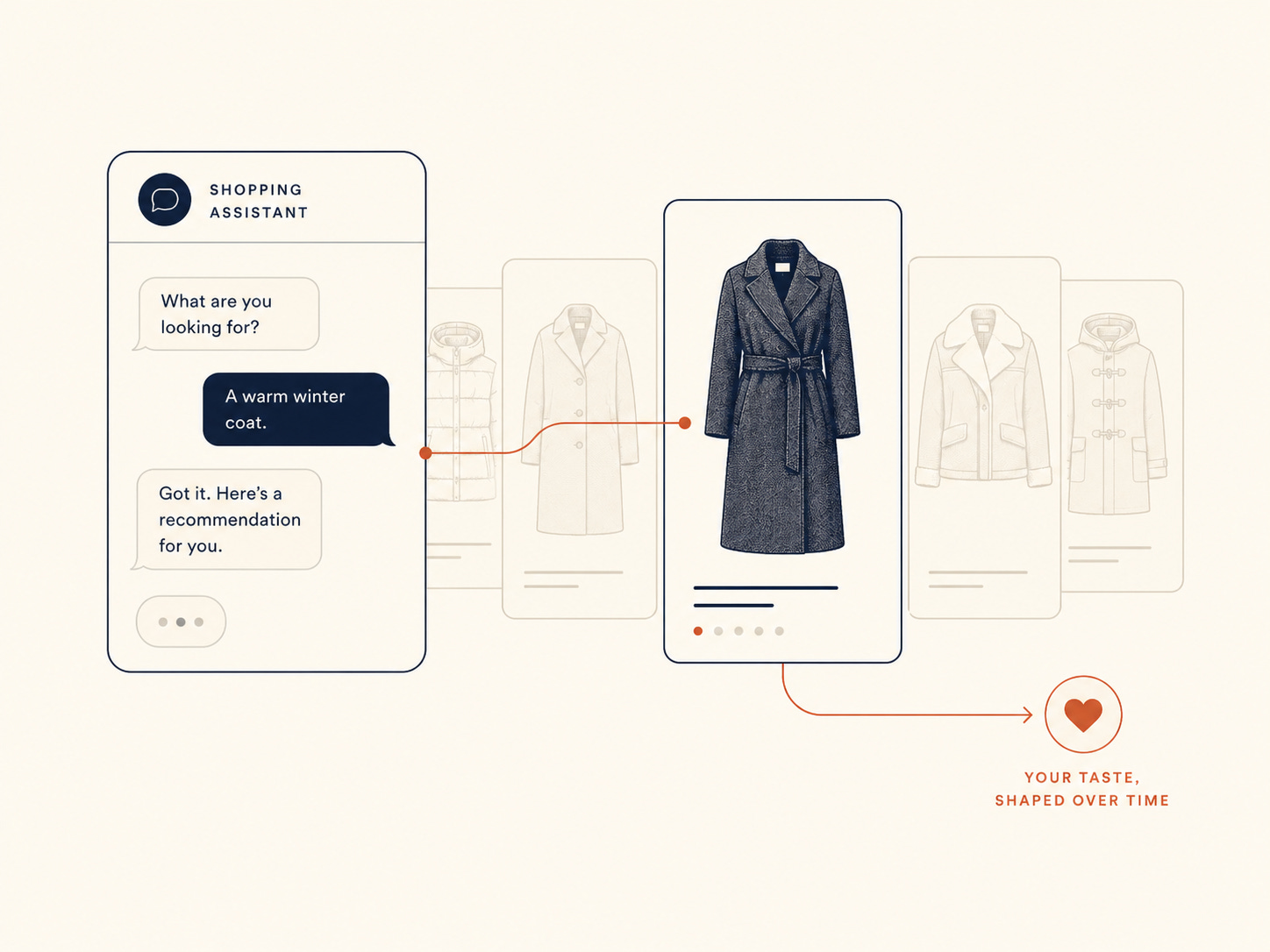
You tell a shopping agent you need a winter coat. It asks a question or two, weighs a set of options you never see, and comes back with one. You buy it, you wear it all season, and you like it. Here is the question that should nag and somehow doesn’t: do you like the coat because it suits you, or because it is the one you were handed and then wore forty times? You cannot answer that. The reason you cannot is what this piece is about.
None of this is speculative any more. Perplexity has let subscribers research and buy inside its app since late 2024, a checkout step arrived inside ChatGPT in 2025, and Amazon’s shopping assistant now buys on a customer’s behalf, on other retailers’ sites as well as its own. The buying layer is still early and uneven, but the recommendation layer beneath it is already how many of us decide. For fifteen years the worry about these systems was that they showed us a narrow slice of the world. The worry for the next fifteen is stranger and harder to see. It is not that the system limits what you choose from. It is that it has a hand in what you come to want.
The comfortable model of taste goes like this: I have preferences, stored somewhere inside me, and a good recommendation engine’s job is to discover them and serve them back. Comfortable, and mostly wrong.
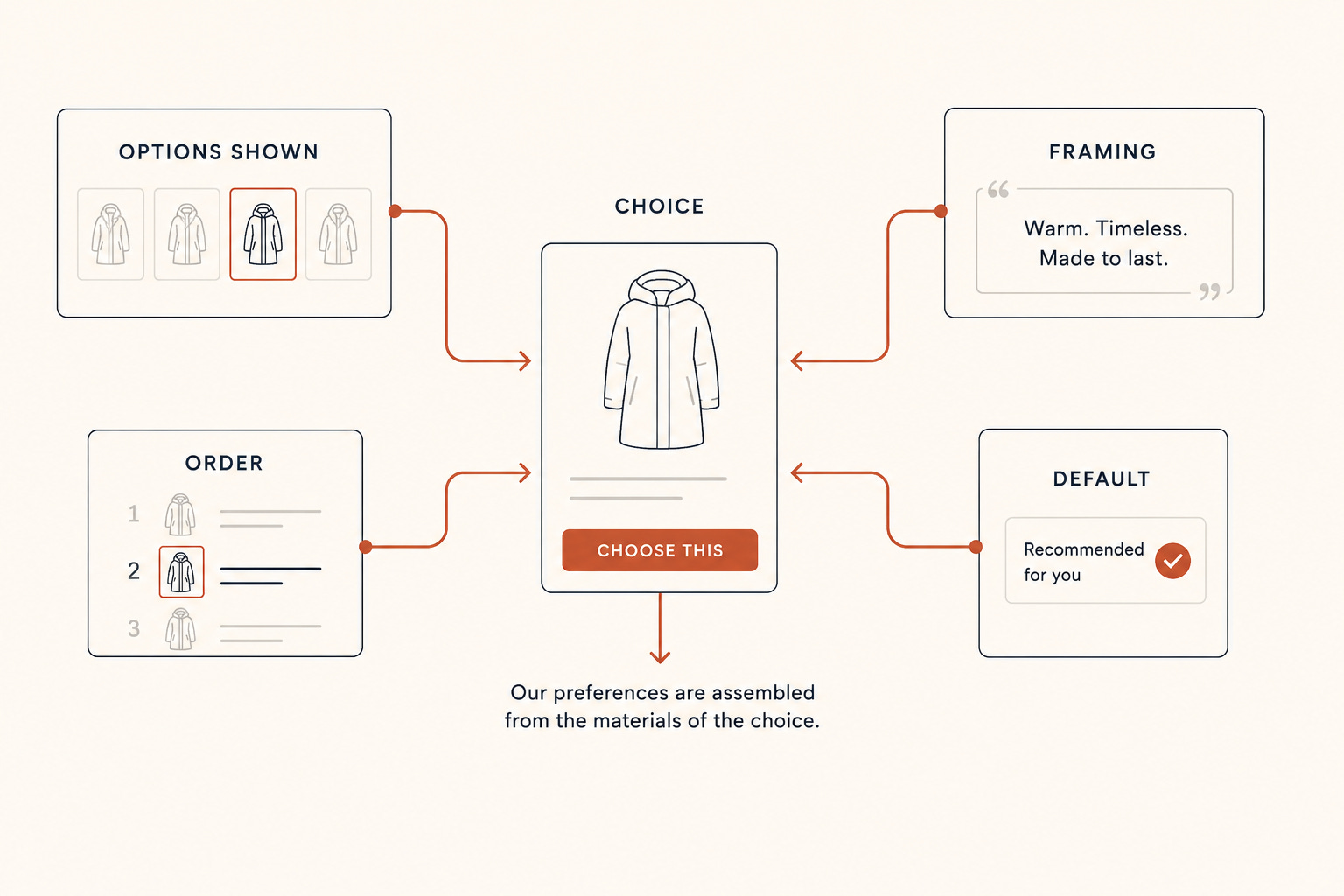
Decades of work in judgement and decision-making suggest that preferences are not filed away waiting to be looked up. They are assembled on the spot, out of whatever material is available at the moment of choosing. Lichtenstein and Slovic called this the construction of preference. The demonstration that made the case is small. Ask people to choose between two bets and they pick one. Ask them instead to put a price on each, and they often rank them the other way. If a stable preference were simply being read off, the order could not flip with the question.
If preference is built rather than retrieved, the raw materials matter enormously. Whoever supplies the options, the framing, the ordering, and the default is supplying part of the answer. That is a manageable arrangement when the supplier is a shop window you can see and appraise. It is a different matter when the supplier is an intermediary whose reasoning you never watch.
The most reliable finding in this territory is also the least intuitive. Merely encountering something, with no reward attached and no reason to care, makes you like it more. Zajonc named it the mere exposure effect, and it has survived close to sixty years of scrutiny. Bornstein’s meta-analysis of more than two hundred separate effects confirmed the pattern holds across faces, words, shapes, and sounds.
Why it happens is where it becomes useful. The leading account is that repetition makes a thing easier for the mind to process, and that we misread that ease. The fluency registers as a faint positive feeling, and we assign the feeling to the thing itself rather than to the familiarity. We conclude that we like it. Bornstein and D’Agostino called this the perceptual fluency and attribution model.
Now, the detail that should concern anyone delegating their choices. The misattribution has a built-in correction, and the correction has a precise trigger. When people recognize that they have seen something before, they discount the familiarity: they correctly attribute the ease to prior contact, and the borrowed liking drains away. When they cannot recall the encounter, there is nothing to assign the feeling to except genuine preference, so genuine preference is what it becomes. In controlled tests, exposures brief enough to escape awareness produced larger effects than exposures long enough to notice.
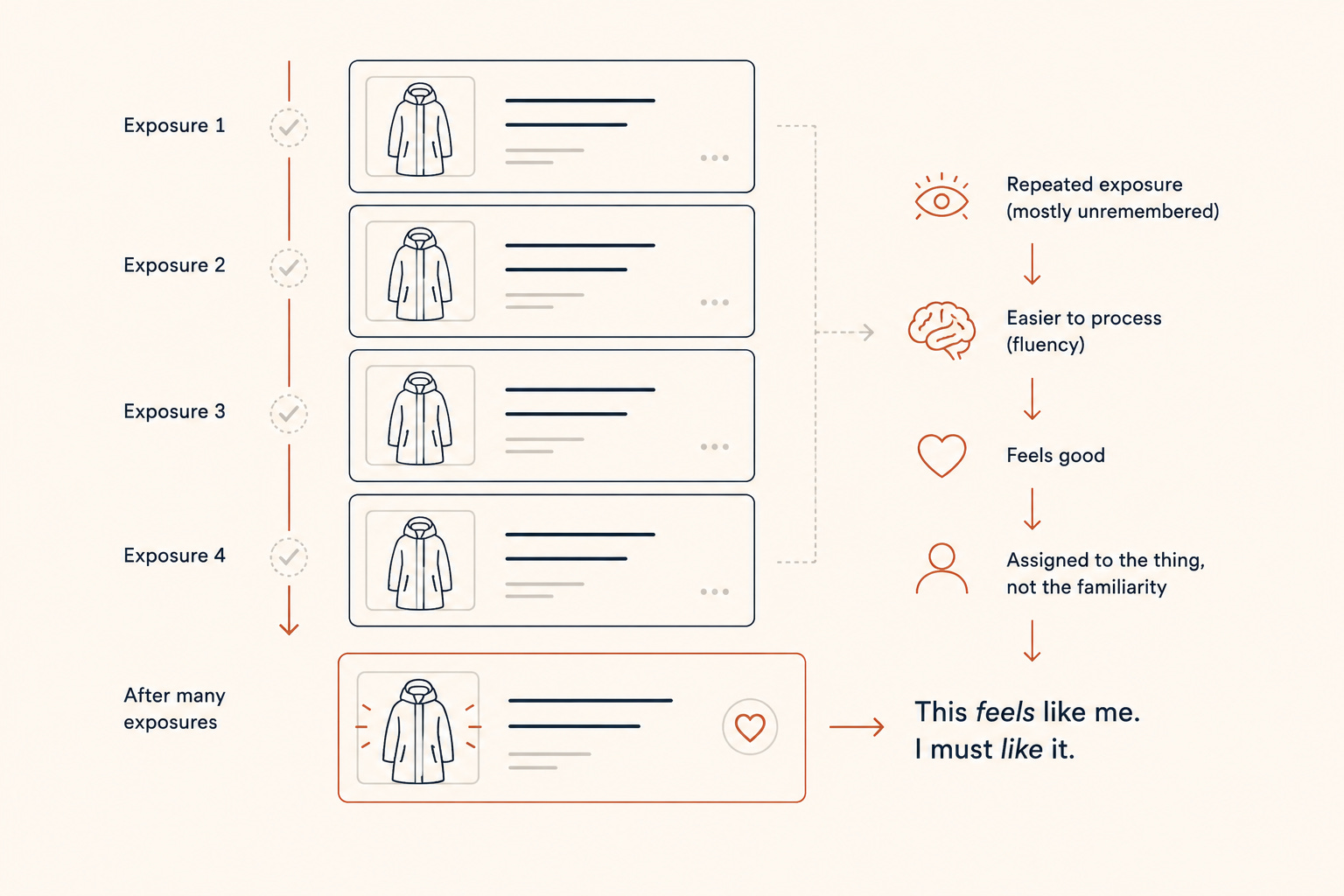
Notice what the trigger requires. Discounting fires on the recognition of a specific prior encounter: this shape, seen before. A general belief that one is being influenced does nothing, because there is no particular exposure to attach the correction to. This is why ordinary algorithm literacy (the knowing joke that the feed “gets me”) offers no protection at all. Knowing in the abstract that you are being shaped gives you nothing concrete to discount. The correction needs episodes, and an algorithmic feed (ambient, continuous, almost entirely unremembered) leaves none behind, whether by intent or by accident. The one mechanism that would let you catch the influence is precisely the mechanism the format defeats.
A caveat, because the argument should not claim more than the evidence supports. The laboratory effect concerns simple stimuli repeated identically a handful of times; Bornstein’s own analysis found it weakens as stimuli grow complex and repetitions pile up, and overexposure can tip liking into boredom. A feed serves something different: enormous repetition of similar-but-varied material over months. Extending the finding from one setting to the other is a reasonable inference, and the fluency mechanism supports it. It is still an inference, not a proven law. The lab establishes the direction of the force and the conditions that hide it. The magnitude in the wild is an open question.
What would the force look like from the inside, if it were operating? It would look like nothing. The liking would arrive feeling native, presenting itself as taste rather than as training, with no thread back to the exposures that built it. That is broadly what shows up in my own research practice: asked why they prefer something a system has quietly been feeding them, people’s explanations thin out to “it’s just what I like” or “it feels right”. Honesty requires saying what this does and does not show. Psychologists have known since Nisbett and Wilson’s classic work on introspection that people are poor narrators of their own preferences generally, so the thinned-out answer is the human default, not a smoking gun. The thin answers can’t prove the mechanism is at work. They are, though, exactly what it would produce: an influence that leaves the person with nothing to report.
One more qualification. The misattribution account is influential but not settled. A rival explanation, uncertainty reduction, holds that we prefer the familiar simply because familiarity is reassuring. It has a point in its favour: the effect persists even when people are fully aware of the repetition, which strict misattribution struggles to explain. For the practical claim here, the winner of that debate does not matter. Under either account, repeated ambient exposure moves what you like, and it moves it beneath the level at which you could narrate the change.
So far the influence runs one way: the system shapes you. The complication is that you shape it back, and the two of you settle into a loop. The engine recommends, you engage with a fraction of what it shows, it reads that engagement as evidence of preference, and it serves more of the same. Researchers call these feedback loops. The modelling of them, much of it done in simulation rather than in the field, deserves to be held loosely, but it points somewhere counter-intuitive.
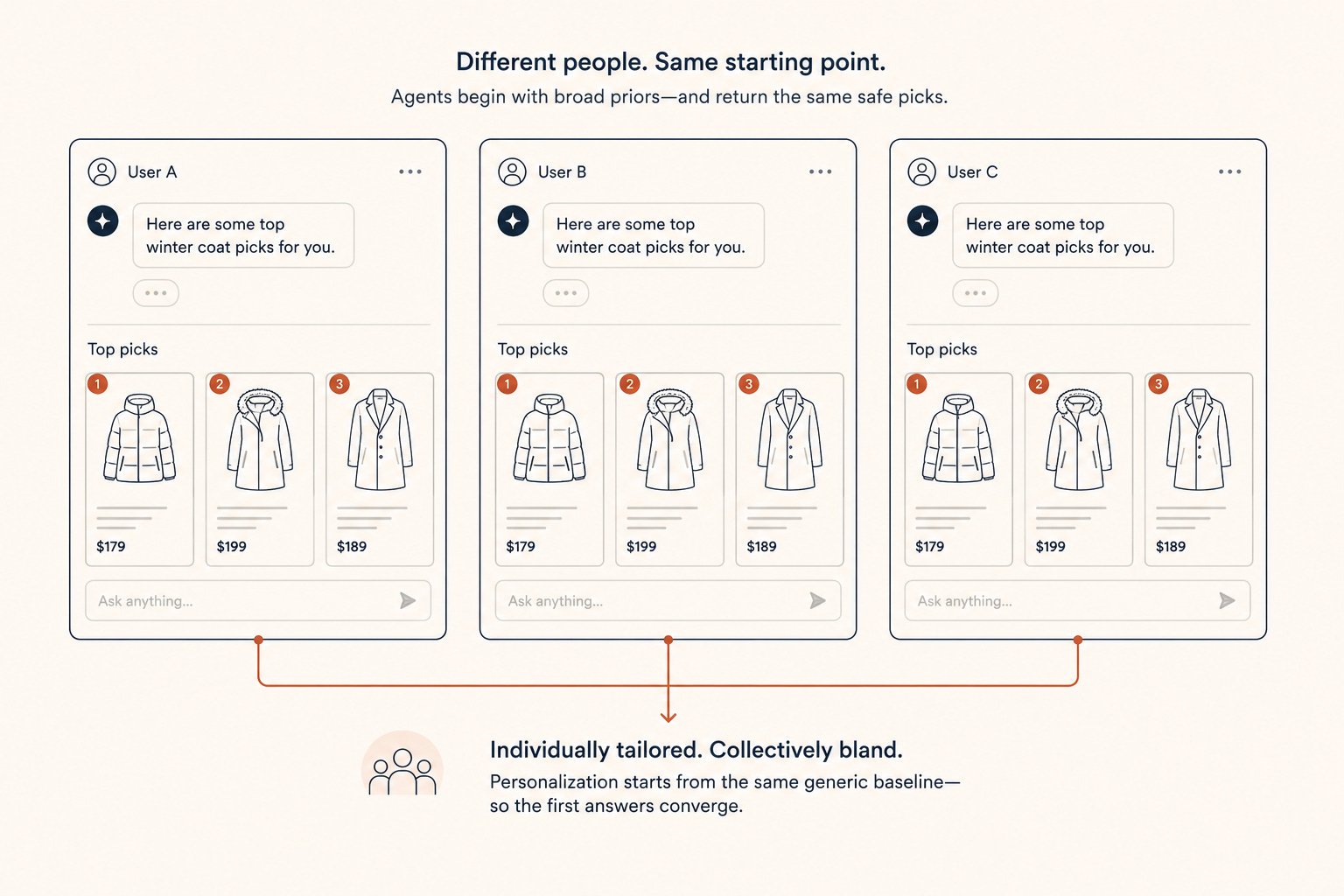
The obvious fear is the closing bubble: the loop narrows until you are shown a single thing. Recent work on a large retail dataset found something odder than that. The loop can widen the variety an individual sees while reducing variety across people. Your own feed feels rich and particular to you; it is also quietly converging with everyone else’s. Demand concentrates on the same winners. In the researchers’ terms, sustained exposure shapes preferences rather than merely reflecting them. The product of the loop is not a narrower you. It is a you that increasingly resembles the average of everyone delegating to the same system.
And if preferences are constructed from the materials at hand, then what the loop starts from matters. The present moment offers an unusually clean glimpse. When journalists asked the leading shopping assistants what to buy a mother for Christmas, the picks came back generic and interchangeable across assistants. To be fair, these were cold starts, agents answering with little personal context, so they are not evidence of a loop that has already converged. They are something arguably more consequential: a photograph of the starting materials. Every consumer who begins delegating today starts from that same generic baseline, and the loop personalises outward from it, each engagement read as preference and fed back. Personal variety layered over a common foundation is precisely the shape the simulations keep finding. Multiply that across a market projected to redirect trillions in spending by the end of the decade, and that common starting point becomes the texture of what people actually own.
A slower cost sits underneath. As we hand discovery and evaluation to an intermediary, the faculties we would otherwise use to notice any of this (comparison, scrutiny, the patience to weigh an option for ourselves) get less and less exercise. Scholars mapping what they term the delegate economy warn that the muscles of critical evaluation and personal judgement may weaken from disuse. The capacity to detect the authorship erodes at the same time, and for the same reason, as the capacity to resist it.
The industry’s defence is a single sentence: we just give people what they want. If the argument here holds, that sentence loses its footing, because the want is no longer wholly the person’s. The company has had a hand in authoring the very thing it then claims to be neutrally serving.
The other side deserves a proper hearing, because it has a real case. All curation shapes taste. A bookseller who hands you the right novel, a friend with better records, a city that raises you among a particular kind of building: each of these authors your preferences too, and we do not call any of them manipulation. Taste has always been made partly from the outside. What, other than sheer scale, is different now?
Two things. The first is attribution. When a mentor shapes your taste you can point to the mentor. The influence is legible, and because it is legible you can accept it, argue with it, or walk away from it. Algorithmic shaping runs through the one channel (unremembered exposure) that is built to stop you from ever pointing to it. The second is whose interest the shaping serves. The bookseller who steers you well is, at least some of the time, serving your taste. A bookseller has margins to think of too, so the difference is one of degree. But degree is doing real work here. A recommendation engine optimises for its operator’s objective, whether that is engagement, margin, or inventory to move, at a scale and persistence no shopkeeper ever managed. Your preference is the instrument, not the aim. Shaping someone’s taste in their interest is teaching. Shaping it in your own, without their knowledge, through a channel they cannot inspect, is something else. The question this publication keeps circling back to sits exactly on that line.
For product and design teams, the shift is less a technical brief than a matter of what you agree to measure and reveal. Four pairings.
Behavioural concept: construction of preference. Stop treating engagement as revealed preference. Every click you log is partly a signal of what the person wanted and partly an echo of what you chose to show them. Treat it as a clean readout of taste and you build your own influence into the model, then call it truth.
Behavioural concept: fluency misattribution. Build in recognition. Discounting fires only on recognisable, specific exposures. Surfacing why someone is seeing something, and how often, supplies the episodes the correction needs and hands a piece of authorship back. A system confident it is serving real preferences has no reason to fear showing its work.
Behavioural concept: feedback loops. Measure convergence, not just satisfaction. Individual engagement can climb while your whole user base narrows toward the same handful of outcomes. Track collective diversity as a first-class metric and inject deliberate exploration, or you will optimise a population into sameness and read the rising numbers as success.
Behavioural concept: delegation atrophy. Design for preserved agency. Frictionless delegation is the easy win and the long-term trap. The products that age well will keep the user’s own judgement in occasional use, not quietly retire it.
Return to the coat. The unsettling thing was never that the agent chose badly. It very likely chose well. The unsettling thing is that “it suits me” has become a sentence you can no longer test. Preference used to feel like the one possession that was unarguably yours, reported from the inside, authored by you and no one else. Delegated at scale, it becomes something you cannot fully account for, assembled in part by a system whose reasoning you never saw and whose exposures you never counted.
None of this is an argument against curation, which at its best is a genuine gift. It is an argument for keeping hold of the question. The next time something feels exactly, effortlessly like you, sit for a moment with the small suspicion that you might be right, or that you might simply be looking at something you were shown often enough to mistake for yourself. Noticing will not tell you which of those it is. But the noticing is the part that is still, unambiguously, yours.
What I’m turning over next: if agents are becoming the ones who shop, then the persuasion aimed at shoppers is quietly being rebuilt to aim at them instead. Which parts of the old playbook stop working on a machine, and which parts work far better, is the subject I want to take up in the next piece.
Further reading: Repriced Overnight — the companion piece on how the same fluency that makes a system feel effortless quietly resets what we think good software is worth.
Want to share your thoughts? Feel free to share them in the comments section below or on social media.
No posts
Comments
Nothing yet. Say the first thing.
Sign in to join the conversation.