

The fastest way to lose a good employee is to tell them, in public and beyond argument, exactly how good they are, and then offer them less than that.
This week a 22-year-old is living that sentence out in front of everyone. A few weeks ago Jalen Duren was voted one of the best centres in basketball, an honour decided by people paid to judge precisely that. A few days ago, his team slid their opening contract offer across the table. By the accounts that have leaked, he found it underwhelming, and he has begun, quietly, to look at the door. As I write this, he is unsigned, and the league’s free-agency window is about to open.
You do not need to follow basketball to recognize the shape of his week, because some version of it has probably happened down the hall from you. The dependable one on your team, the colleague who quietly holds things together, finds out what someone less capable is paid. Nothing dramatic follows. They still show up, still hit their numbers. But the unpaid extra work, the staying late, the mentoring, the covering for a teammate, begins to thin, and within a year they are gone. You are left with a question you can’t answer: was it the pay, or would they have drifted anyway?
In an ordinary office, you genuinely cannot know, because the two facts you would need are the two every office hides: what everyone earns, and exactly how well each person performs. This is the strange gift of professional basketball. Both numbers are nailed to the wall. Every salary is public to the dollar, every contribution logged in obsessive detail. It is the same human drama playing out in your workplace, but staged in a room with the lights turned all the way up. And this year, the lighting is especially harsh, because a tightened salary cap has made paying your best people as little as they will accept less a temptation than a governing strategy. So it is the ideal place to ask a question that reaches well past sport. When you get a strong performer cheap, what are you actually buying?
Start with the case against my own argument, because it is strong. Most pay gaps are fine. A steep hierarchy that richly rewards the best is not a flaw; it is frequently the point, and economists have a name for the upside: tournament theory, the idea that a big prize at the top pulls more out of everyone below. In basketball, the evidence broadly supports it. One careful study found that pay dispersion, which genuinely tracks performance, lifts output for the team and the individual alike. If the franchise player earns five times what a role player earns, the role player does not seethe. He expected it.
So this is not a complaint about inequality. The entire argument lives in a far narrower country: not the gap that performance explains, but the gap it can’t.
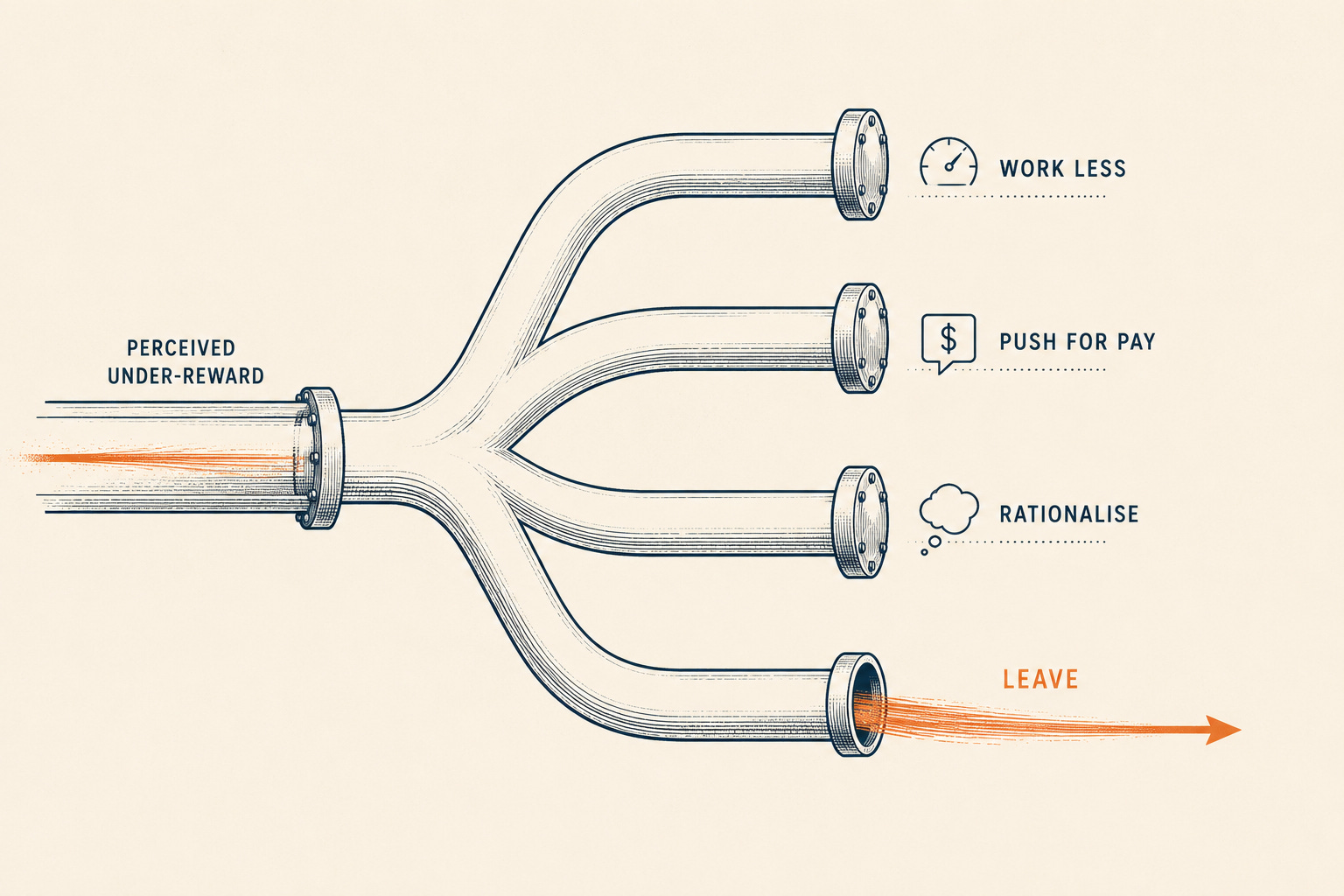
When a gap can’t be explained, something shifts, and it follows a pattern psychologists mapped decades ago. Under John Stacey Adams’s equity theory, a person who senses they are under-rewarded against a comparable peer feels a tension they are driven to resolve, and they have a fixed menu of ways to do it: work less, push for more pay, talk themselves out of it, or leave. Which option they reach for depends almost entirely on which one is open to them.
Here, a fair objection deserves answering before we lean on the basketball too hard. NBA players are not typical workers. They are wealthy, unionized, on guaranteed contracts, and the league is no one’s idea of a normal workplace. But it was never meant to be representative. It is meant to be legible. It is the rare room where pay and performance are both fully visible, which lets us watch a mechanism that runs almost everywhere and is observable almost nowhere. Your office is in the same room. Someone just dimmed the lights.
And the grievance does not land evenly, which is the part most people miss. The reason a superstar’s discount is painless is that salary is only a sliver of his income. The ten biggest names earn hundreds of millions off the court in a single year, and only seventeen players in the whole league have their own signature shoe. For everyone beneath that line, the picture inverts. By one veteran agent’s estimate, all but a few players draw virtually their entire income from the team contract, and a former executive concedes the open secret: a star will accept a smaller offer precisely because his sponsors quietly cover the difference.
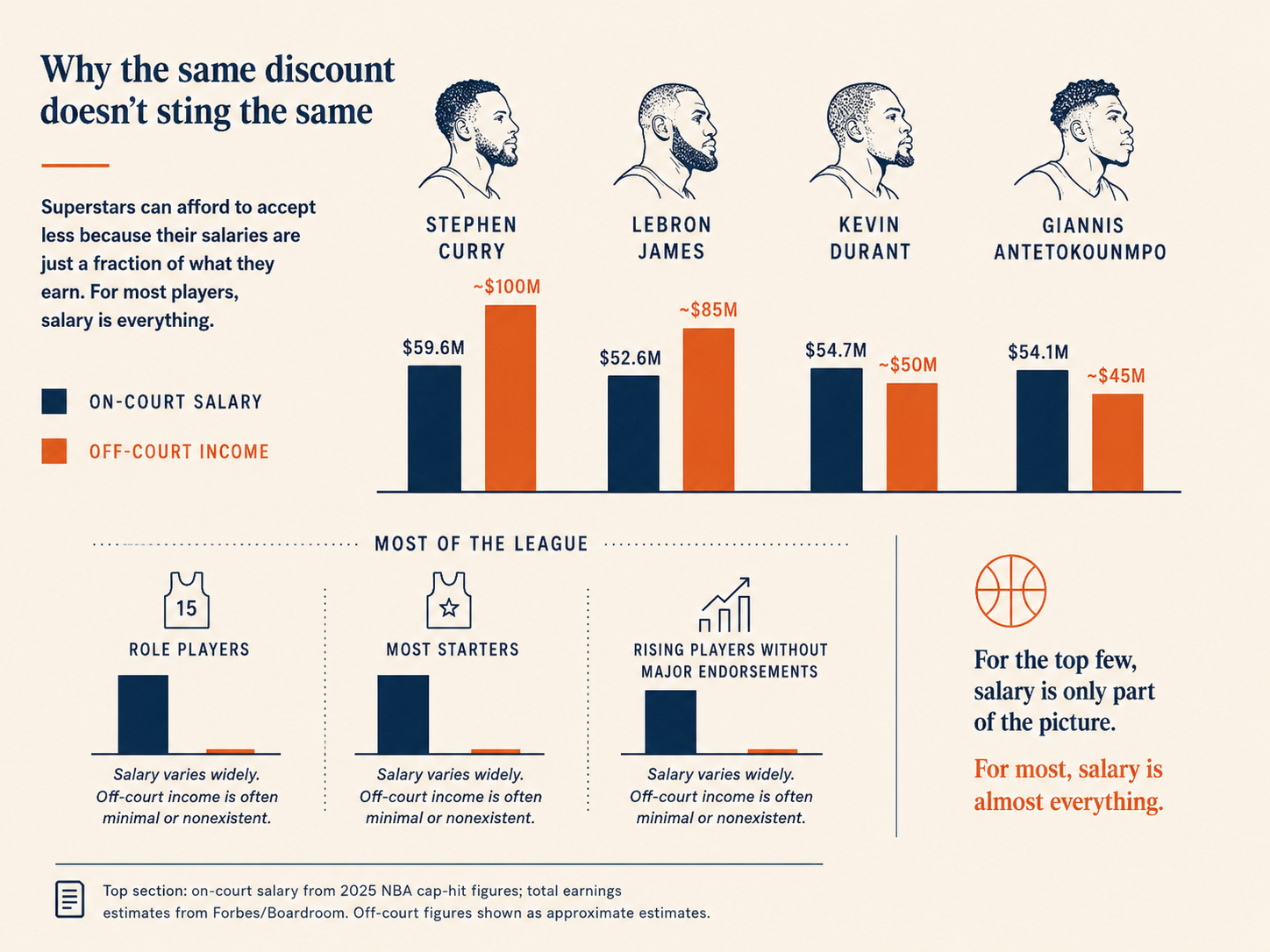
The young centre still chasing his first big payday has no such cushion. Neither does your dependable colleague. For them, the number on the contract is the whole story, and a gap they can’t explain is a gap with nothing to soften it. The person most exposed to under-reward is never the famous one. It is the good, rising, salary-dependent one, whose pay is the entirety of what the work gives back.
It is tempting to assume the underpaid performer simply tries less, and there is a tidy story for it. Effort drifts toward whatever is individually counted and away from the quiet work nobody is paid for. Players in the last year of a contract, with a payday in view, reliably raise their visible production, which suggests effort does flow toward what gets compensated.
But honesty beats a tidy story. At the individual level the evidence that underpaid players visibly play worse is thin, and one of the better studies finds individual performance roughly unrelated to the unexplained part of pay gaps. So I won’t claim it. What the data actually shows is not someone sulking in plain sight. It is two quieter things, and they cost far more.
The first is coordination. A 2026 study in the journal Human Performance examined eleven seasons of NBA teams and asked what happens when the pay gaps among a team’s five core players can’t be justified by how those players perform. Effort, measured through rebounding and loose balls recovered, was not the casualty. Coordination was. Teams carrying unexplained gaps among their best players defended worse together and won less, and the damage ran through the connective tissue, the synchronized, hard-to-credit work that turns five individuals into a team. The study’s lead author frames the fairness test simply: a gap that reflects performance provokes nothing, because a bench player never expected to earn what the franchise player earns. It is the gap that performance can’t justify that corrodes the cooperation no box score records.
Back in your office, the dependable one isn’t sulking either. She has simply stopped volunteering for the work that never had her name on it. The handover she used to smooth, the new hire she used to quietly coach, the cross-team favour she used to do without being asked. None of it shows up as a missed target. All of it shows up, eventually, in everyone around her moving a half-step slower.
The second cost, and the larger one, is exit. This is where the evidence is softest, so the honesty has to be loudest, and rather than rest on a single study, it is better to notice where several independent vantage points land. The theory predicts it: leaving is one of the menu’s four options, and often the only one a contract-bound employee fully controls. The workplace research supports it: under-reward tends to predict not a drop in performance but an intention to quit, carried through ordinary dissatisfaction. And the basketball study’s own author, unprompted, arrives in the same place, warning that when a company lets experienced people fall behind newer hires, discontent builds and they grow more inclined to walk. Three different angles, one direction. The underpaid high performer is a flight risk long before they are ever a performance problem.
One last case, and the least rigorous kind: my own. Years ago, in advertising, I stumbled onto one of those published salary benchmarks and saw, in a single line, that my pay sat well below the average for the work I was doing. My effort didn’t dip. I was still chasing top marks in every review. What changed was quieter. I stopped waiting for opportunities and started hunting them, treating the role as a fixed term to serve before leaving for somewhere my work might be priced closer to its worth. The reviews stayed strong, the raises stayed slight, and I left convinced I was otherwise wasting whatever I had. Nothing in my output would have warned them. The number I had seen had already decided it.
Which brings us back to Jalen Duren, standing at the door as the window opens. He is an illustration, not a proof, and the honest version says so out loud: his case is tangled with a real dispute over a shaky playoff run and the leverage rules of his contract, so he shows the shape of the thing rather than its cause. But the shape is unmistakable. The objective accolade, the offer that reads as an insult against it, the immediate drift toward the exit.
A claim worth trusting should say what would break it. Two findings would. If clean causal data showed that under-reward does not actually drive people out once you account for fit, market and ordinary churn, the exit argument collapses into coincidence. And if unexplained pay gaps turned out not to erode coordination after all, the team-level cost goes with it. Neither has happened, but both are exactly where a skeptic should push, and the argument is only worth holding because it is willing to lose there.
Turn the lights back down to office levels, where pay is murky, and performance is a matter of opinion, and the same machinery runs unseen. Senior people can absorb a below-market offer because, like the superstar, they are paid in other currencies: equity, title, profile, and the standing option to leave well. The rising specialist three rungs down is paid in salary and little else, sees the gap that an offhand comment or an open spreadsheet has made plain, and holds exactly one lever.
The trap for managers is generalizing from the wrong example. Watching a valued senior colleague accept less and stay, they conclude that loyalty beats money, and they press the same discount on someone whose entire compensation is the figure they just shaved. The senior person was made whole elsewhere. The junior one was simply underpaid, and unlike the senior one, she noticed.
A few moves follow, less technical than perceptual.
Know the benchmark you install. The moment pay becomes visible, you have set the reference point people measure themselves against. Decide what it is before the rumour mill decides for you.
Discount the discount. When someone takes less and stays, ask what else they are paid in before you treat it as proof the lever works. The more diversified their rewards, the less their example travels.
Instrument the invisible. The costs here hide in the connective work and in retention, not in individual output. If your dashboard shows only the last of those, it is blind to exactly where the bill lands.
Close the gap before you expose it. A pay difference that reads as earned provokes nothing. The same difference, unexplained and visible, converts a private grievance into a measured, contagious one. Transparency without alignment is not fairness. It is a lit fuse.
I don’t know what happens to Jalen Duren. By the time you read this he may have re-signed, all grievance forgotten in a flurry of guaranteed millions, or he may be somewhere else entirely, and the team that drafted and developed him left wondering where the value went. Here is the unsettling part. Even in the one workplace built for clarity, even with every number nailed to the wall and the lights turned all the way up, we still can’t fully tell whether he is leaving because he was wronged or simply because he had a poor spring and wanted more. The motives blur even here.
So consider how blind you are to the same question about your own best people, in a building where the lights are low and the numbers are a rumour. The fantasy of the bargain hire is that you have banked the difference between what someone is worth and what you talked them into accepting. Sometimes you have. But part of that surplus was never yours to keep. It was only unpriced, sitting in the cooperation that thins when a gap can’t be justified and in the loyalty that quietly expires. Basketball doesn’t invent this dynamic. It just turns the lights up bright enough to read the bill before it comes due. In your office, the bill arrives all the same, posted to an account you weren’t watching.
What I’m turning over next: if an unexplained gap is the thing that corrodes, then pay transparency without pay alignment may do more harm than the secrecy it replaced. I want to look at whether the open-salary movement is quietly creating the exact grievance it set out to cure.
Further reading: Repriced Overnight — the companion piece on how a reference point you never agreed to can quietly reprice something whose value never changed. This article is that mechanism pointed at a salary.
Want to share your thoughts? Feel free to share them in the comments section below or on social media.
No posts
Comments
Nothing yet. Say the first thing.
Sign in to join the conversation.