
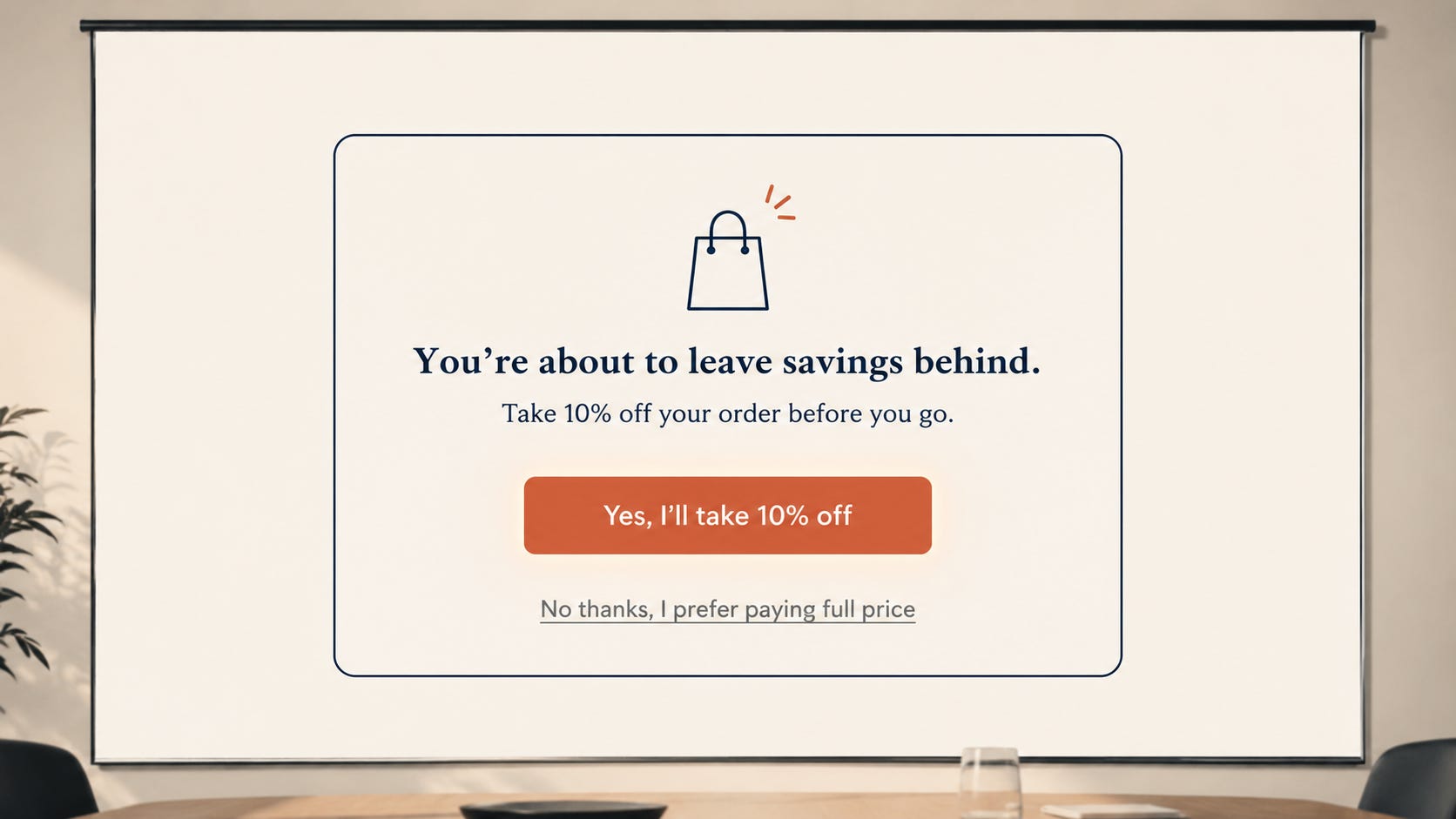
You know the button. The offer fills the screen, the accept option glows, and the decline reads “No thanks, I prefer paying full price”. The design is not confused about what it is doing. It is reaching past your reasoning to your self-image, betting a flicker of embarrassment will move your hand. The trade calls it confirmshaming, and it sits in a well-thumbed catalogue alongside the cancellation maze, the countdown timer, and the pre-ticked box.
Now replay the same page with a different visitor. A software agent arrives on your behalf, sent to buy the thing you asked for. The shame lands on no one. There is no self-image to needle, no patience to wear down, no Friday-afternoon fatigue to exploit. The maze has no one to tire. You might reasonably conclude that the era of manipulative design is closing, starved of the psychology it fed on.
Something on that page still worked on the agent, though. Just not the part designed for you. What is happening to manipulative design is not an ending. It is a re-sort, and the sorting principle decides which manipulations die, which get stronger, and which change into something new. The uncomfortable part is that the survivors are the ones that look least like manipulation.
Harry Brignull began cataloguing deceptive design in 2010, and researchers like Gray and colleagues later formalized the typology. Ever since, the dark patterns literature has treated its subject as one family: interface choices that steer people against their own interests. That framing made sense while every visitor was a person.
Look closer, though, and the catalogue has always contained two different kinds of trick, distinguished by mechanism. The first kind taxes the human condition. Obstruction works because effort is costly. Nagging works because attention wears out. Confirmshaming works because we protect our self-image. Sneak-into-basket works because perception has gaps and memory has holes. The second kind pollutes the information environment. Fake ratings, inflated review counts, “best-seller” flags, scarcity claims, anchored prices: these do not need you to be tired or embarrassed. They need you to treat a signal as a fact.
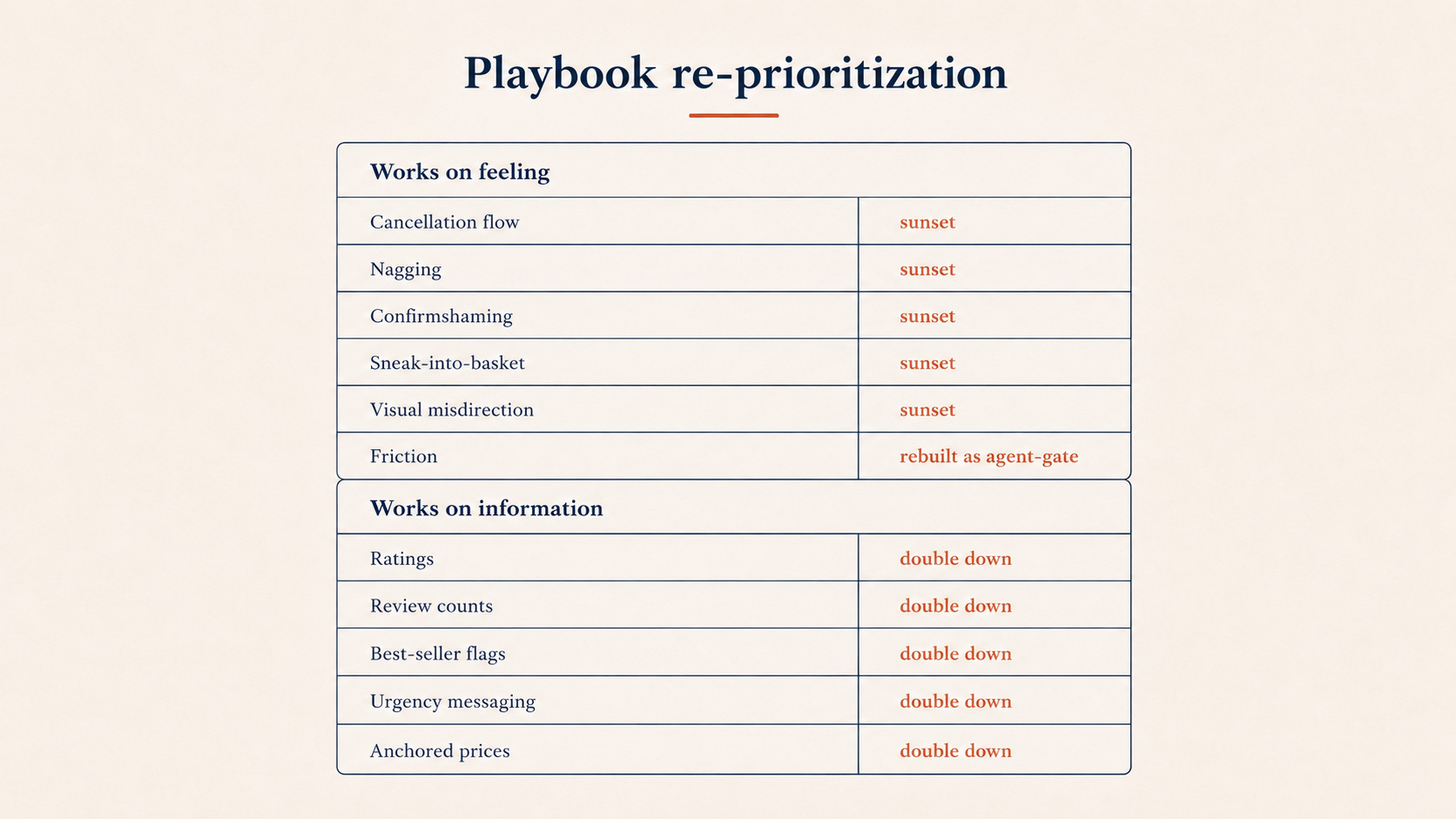
Human shoppers are vulnerable to both, so the distinction never mattered much. It matters now, because the new shopper arriving on the page is vulnerable to only one of them, and more vulnerable than we ever were. Before the sorting begins, a note on scope. This is a re-sort in progress, not an accomplished fact. Agent-mediated purchases remain a small share of commerce, and the same page will serve human and machine visitors side by side for years, so the old catalogue keeps earning while the new one is drafted. The direction of travel is the subject here, not a finished journey.
Run the first family against a machine buyer and the mechanisms come up empty. An agent does not experience the cancellation maze as an ordeal; it experiences it as a sequence of steps, executed at the same speed and mood as any other sequence. It cannot be nagged into surrender, because the seventeenth pop-up costs it exactly what the first did. It has no self-image for confirmshaming to bruise. And as agents take over subscription management, the business model that quietly depends on human forgetting loses its load-bearing wall. Forgetting is the one thing such a manager cannot do. Visual misdirection (the grey decline link, the camouflaged close button) assumes an eye that skims; an agent reading the page’s underlying structure sees the options as equals.
This column deserves an honest label. It is structural reasoning, not yet measurement. Nobody has published the study in which an agent is confirmshamed and declines to care. The claim rests on the patterns’ own mechanics, which require capacities for fatigue, embarrassment, and forgetting that the software simply lacks. But the reasoning has started to get corroboration from an unexpected source: the optimization industry’s own advice. Trade guides are springing up to help brands win machine-mediated shopping, and their advice, in so many words, is that pages lose visibility when they are overloaded with marketing language and light on usable information. Structure, not storytelling, determines visibility. The people paid to know what works on the new shopper are telling their clients that the emotional half of the playbook is now dead weight.
One entry in this column refuses to die quietly, and its escape route is instructive. Obstruction cannot tire a machine, but the merchant who profits from friction has a cruder option: bar the visitor. Retailers are actively deciding how much access to grant external agents, and the bot-wall and the agent-gate are already becoming the cancellation maze’s true successors. The pattern survives the same way the countdown timer will in a moment: by changing what it is. Friction aimed at your patience becomes a door closed on your proxy, which is obstruction in its purest form yet.
The second family is another story, and here the evidence is no longer inference. Researchers at MIT built a testbed that intercepts what a shopping agent sees on real product pages and quietly varies prices, ratings, and persuasive messages. The published results, presented at a major machine-learning conference this year, should unsettle anyone who assumed the machines would be the sober ones. Nudges that shift human choices by around ten percentage points shifted agent choices by ten to sixty. Ratings were the strongest lever of all: with prices and reviews matched, a small ratings gap could swing agent selection almost deterministically, far beyond anything measured in people. Earlier work by the same group found agents hypersensitive to nudges, affected significantly more than human counterparts facing the same choices.
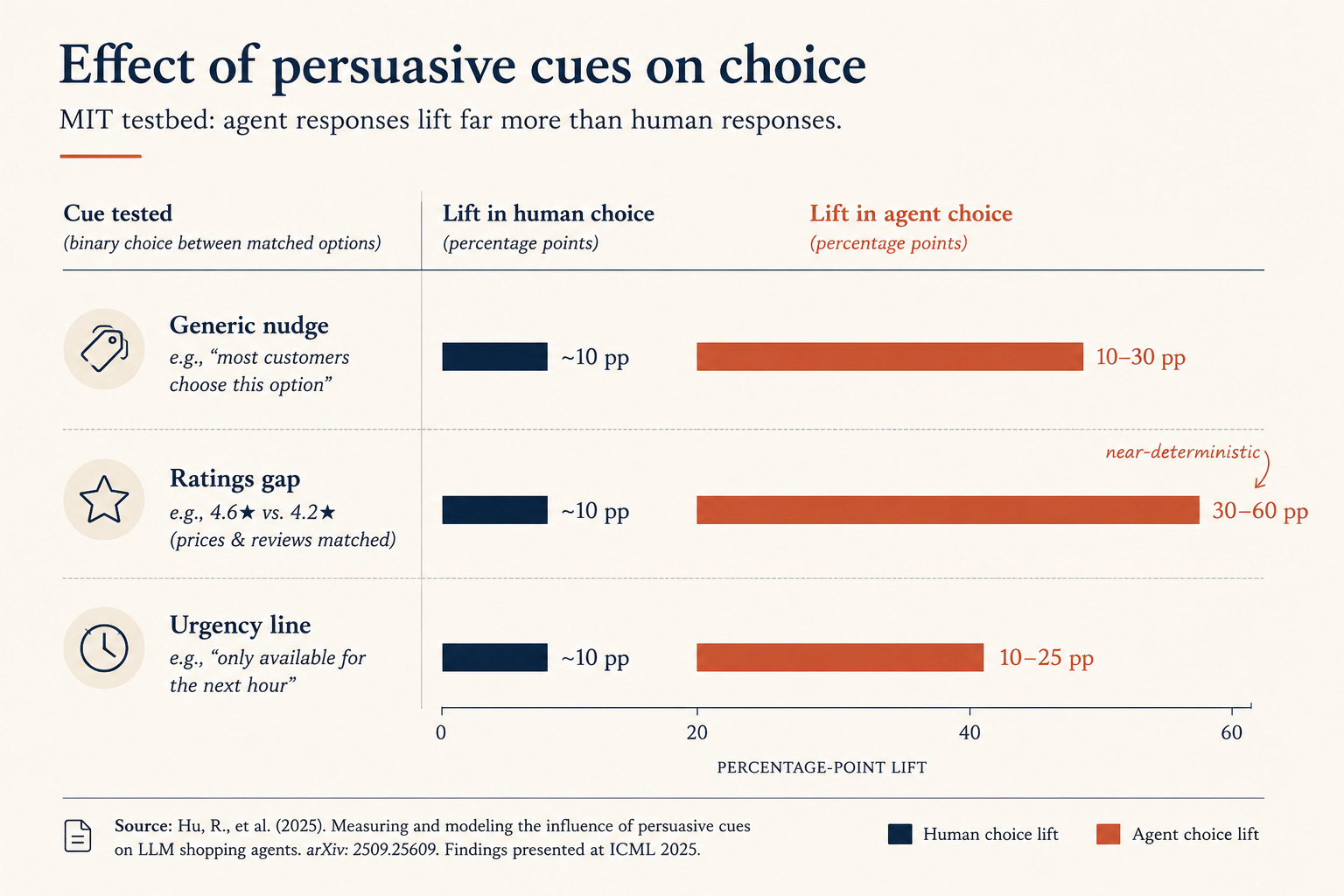
Pause on the ratings result, because it pairs badly with something consumer researchers already knew: average star ratings correlate poorly with objective product quality. The strongest lever on the new shopper is one of the least reliable signals on the page. And the levers are cheap. The testbed’s persuasive messages were single lines of text: a best-seller flag, an authority endorsement, a bundled offer.
A caveat, in fairness to the evidence. These were binary choices between two product tabs, steered by textual cues, and the researchers say plainly that they traded realism for clean measurement; a real errand involves bigger choice sets, messier pages, and a retrieval step the experiments deliberately skipped. The results also varied sharply by model. Some agents lunged for the first option listed while others leaned against it, and the size of every effect depended on which reader was doing the reading. “The agent” is not one creature but a population of dispositions. What holds across that population is the direction: sensitivity to informational cues, everywhere, often far beyond human baselines. The magnitudes, and how they translate to the wild, remain open. The heterogeneity cuts both ways. It makes the exploits less reliable for any single merchant, and it makes them impossible for platforms to dismiss, because the susceptibility shows up in nearly every model tested.
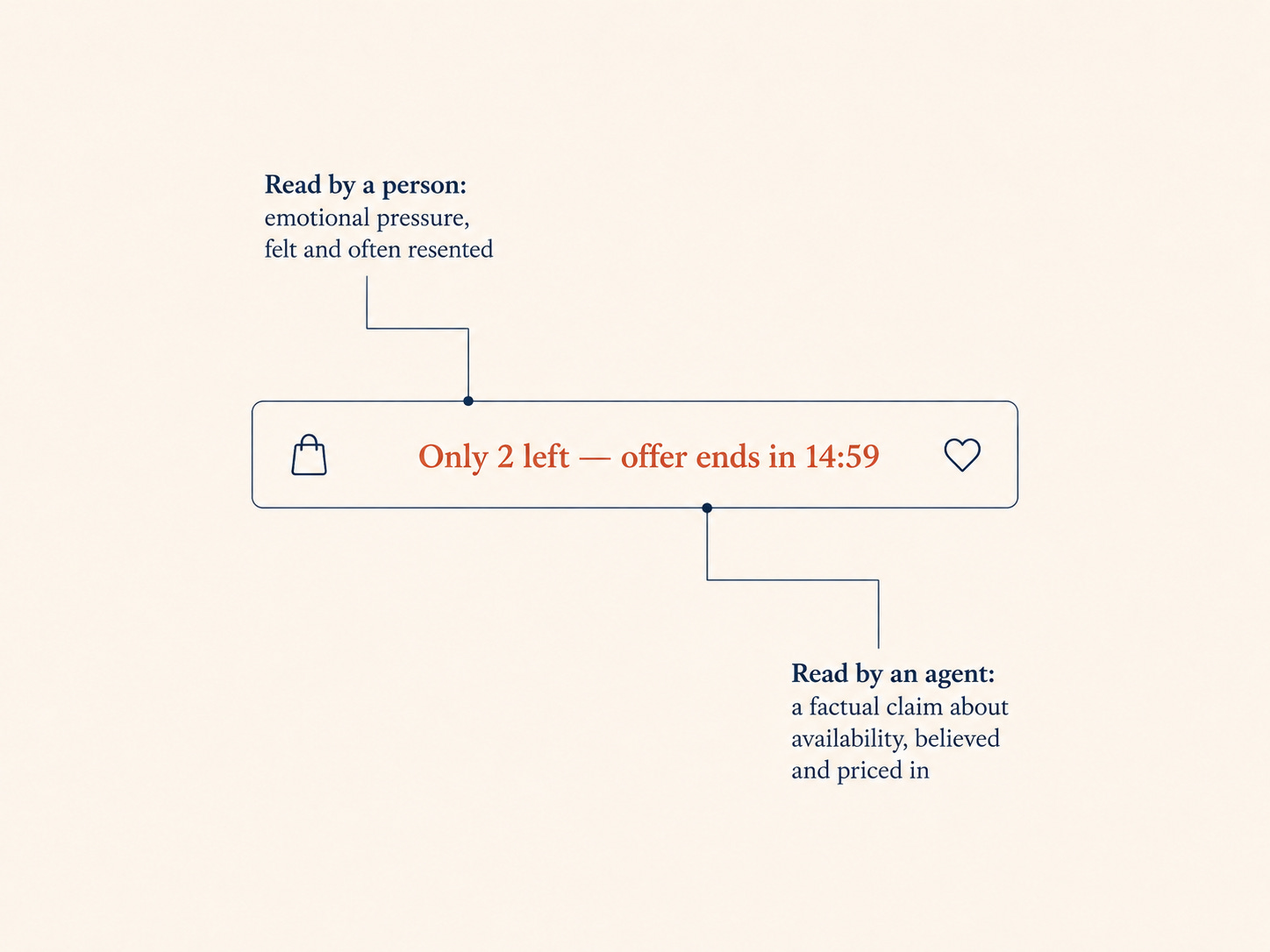
The strangest result is in the scarcity data. The tested messages included the classics of manufactured urgency: “available only for the next hour” and “limited edition”. Under matched conditions, they too significantly shifted agent choice. Think about what that means. The countdown timer was built to induce a feeling. The agent cannot feel it. But the words carry an implicit factual claim (this option is about to become unavailable) and the agent, reading everything and doubting little, prices the claim in. The pattern survives by changing species: what was emotional pressure on you becomes false information to your proxy. Same words on the page, different mechanism underneath, and arguably a cleaner case of deception than the original, because the recipient’s only sin is taking the page at its word.
Re-sorting an old catalogue is only half of what is happening. The same experiments surfaced exploits that no human-era pattern anticipated, because they arise from how the new shoppers read rather than how people feel.
Agents in the study responded to price differences by sign more than by size: being cheaper mattered close to categorically, while being much cheaper added surprisingly little. A merchant who learns that lesson does not need a sale; a penny under the rival may capture the machine. Most agents also favoured quick decisions over gathering more information, often declining even to scroll. Placement above the fold, once a tax on lazy human attention, becomes close to decisive for a reader who does not wander. And the effects varied with exact wording, which is an invitation: somewhere, right now, copy is being A/B tested not against shoppers but against their proxies.
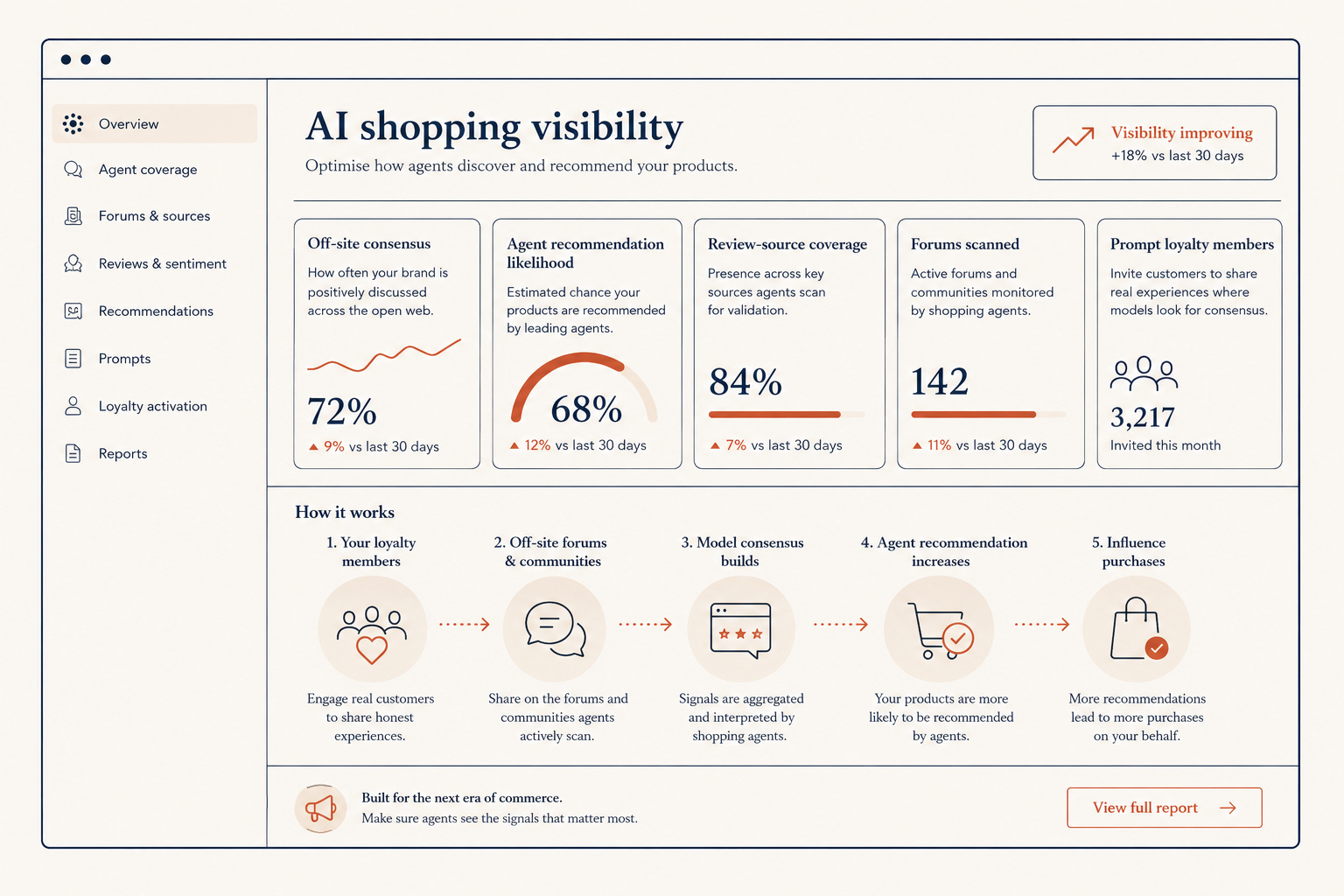
That is not speculation about the future; the tooling already exists as a product category. Yotpo, one of the largest reviews-and-loyalty vendors in commerce, now markets an optimization platform built around an agent that identifies the off-site forums machine shoppers scan for validation, then prompts the brand’s own loyalty members to post “right where the models look for consensus”. Nothing in it is fake. The reviewers are real, the enthusiasm presumably genuine. What is engineered is the placement of consensus in the exact locations a machine reader checks, aimed at the signal the experiments show agents weigh most heavily. Retailers, meanwhile, are selling the other side of the same access: Walmart has explored advertising inside its shopping assistant, and Amazon offers sponsored placements inside its own. The old catalogue was written by watching what worked on us. The new one is being drafted the same way, against readers who never get tired and believe what they read, in a market analysts’ project at three to five trillion dollars by 2030.
The ethical line this publication keeps returning to gets redrawn in an awkward place here.
The manipulations that die were at least visible in their badness. A cancellation maze is experienced as hostile; a confirmshame is felt, and resented, even when it works. The manipulations that survive are dressed as facts. A rating, a best-seller flag, a stock warning: none of it pressures anyone, and the company’s defence writes itself. We did not manipulate; we described the product. That defence was always available, but against a human it strained credulity, because everyone understood the countdown timer was aimed at the gut. Against an agent, the gut is gone and only the description remains. The defence becomes more plausible at the precise moment it becomes less true.
Two questions follow that I do not think the field has answered. The first is not the obvious one. A false scarcity claim shown to an agent is not a new ethical puzzle. A false statement of material fact was fraud when a person read it and remains fraud when a proxy does. The only genuinely new wrinkle is enforcement: deception with no human witness is deception nobody reports.
The unanswered question is the engineered-true signal. Return to the consensus-seeding product: real customers, real opinions, engineered placement. No statement in the chain is false, so no existing doctrine bites, and yet the whole arrangement exists to move your proxy without your knowledge. The dark patterns conversation was invented for manipulations that slipped past the definitions of deception. This is that, rebuilt for a new reader, and the definitions are further behind than they were last time.
The second question is more uncomfortable for the deploying side. The same research found that explicit instructions in an agent’s configuration can suppress its nudge sensitivity almost entirely. The vulnerability, in other words, is partly a settings choice. Platforms that ship agents with the defence switched off are making a decision, whether or not they frame it as one, about how steerable their users’ proxies will be. Steerability is worth money to the other side of the market.
The re-sort assigns different homework to different readers.
For teams deploying agents: harden the configuration. Susceptibility to nudges is not a fixed property of the technology; instructions and profiles act as strong switches. If your product shops, books, or purchases on users’ behalf, the tolerance it shows for persuasive cues is a design decision you are making for them. Make it deliberately, and disclose it.
For teams selling through agents: audit your claims as claims. Walk your funnel and separate the tactics that worked on feeling from the ones that assert facts. The first set is depreciating. The second set is about to be read by a buyer that treats assertions as information, so every inflated urgency message and massaged review count graduates from persuasion to misrepresentation, with the audit trail to match.
For researchers and regulators: add the machine column. Consumer protection frameworks built on human psychology are auditing the dying half of the catalogue. The definitions of deception, and the tests for it, need a version that asks what a claim does to a proxy reader, not just to a person.
The dark patterns catalogue was never really a list of tricks. It was a mirror: an inventory of our documented weaknesses, compiled by people who profited from them. The arrival of a shopper without our weaknesses seemed, briefly, like the end of the inventory. Instead, it is a new edition, reorganized around a different reader, with the emotional entries struck out and the informational ones underlined twice.
Somewhere on a product page you will visit this week, a countdown timer is still running. If your agent visits instead, the timer will still do its work, just not on anyone’s pulse. It will be read, believed, and priced in by something acting in your name. The manipulation did not go away when we stopped looking at the page. It stopped needing us to look, and that is a quieter arrangement, not obviously a better one.
What I’m turning over next: if the page is now being written for a reader that has no feelings to exploit, the same is quietly becoming true of the reviews, the copy, and the recommendations that reader consumes. A web increasingly written by machines, for machines, with the human somewhere near the end of the chain. That is the thread I want to pull on next.
Further reading: Acquired taste, literally, the companion piece: if this one is about the manipulation moving to a new target, that one is about the same delegation quietly authoring the preferences the target is sent to satisfy.
Want to share your thoughts? Feel free to share them in the comments section below or on social media.
No posts
Comments
Nothing yet. Say the first thing.
Sign in to join the conversation.