
School holidays are upon us and, like many families, we took the opportunity to get away for a few days. This time it was a short trip aboard the Disney Adventure Cruise.
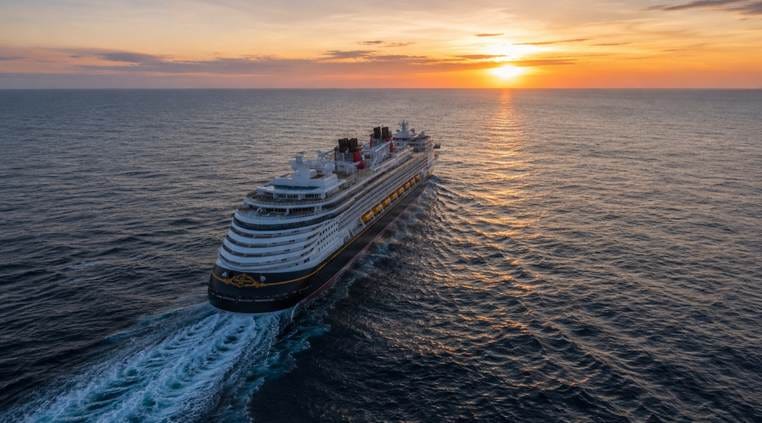
The children loved it. There was a dinner where their own drawings came alive on the walls, the character meet-and-greets, and the curious ritual of “pixie dusting”, where families decorated cabin doors and left anonymous gifts for one another. Not to mention the evening shows, which transported audiences into magical worlds where age seemed briefly irrelevant.
What impressed was how consistently the experience was curated. From the performers to the crew, everyone seemed to understand their role in sustaining the illusion. Disney delivered exactly what it had promised. No surprise there.
The surprise was something else.
It was hard not to notice how many of the grandparents on board seemed just as captivated as their grandchildren. The hold Disney has on people has always crossed demographic lines, and perhaps I am only registering it now because the cruise format puts it on display. Cruises have always concentrated older travelers, and the Disney version is no exception.
Three generations often sat together at meals and shows. The grandparents were not chaperones to the families through an experience designed for the children. They were active participants in their own right, queuing for characters, applauding loudly during performances, and lingering in places I had assumed they would wait outside.
What fascinates me is how a 1928 mouse, and the characters who have joined him since, can still hold three generations all at once.
But it all began to make a little more sense when we caught the aptly named finale performance, “Remember”.
The title carries an echo of "Remember Me", the song at the emotional core of “Coco”, which serves as one of the show's emotional anchors. The connection feels fitting, as both the song and the performance are about memory, family and the threads that bind one generation to the next.
I do not wish to spoil the show for anyone planning to take the cruise, so I will describe it only in broad strokes.
A newer character has lost her memory, and an older companion who had curated Disney’s century, walks her through the classic songs and animated stories that will revive her. The newer generation becomes caretaker of the older inheritance, and the narrative advances by rediscovering that inheritance one piece at a time.
It felt like the show was running in two directions at once.
For children with no prior relationship to Disney’s older catalogue, the classics are introduced through contemporary characters they already know and trust.
For grandparents, the process runs in reverse. Songs that had once soundtracked their own childhoods lend emotional credibility to the newer generation of characters. Instead of being displaced by the new stories, the old ones are being used to introduce and endorse them.
More than just preserving old intellectual property, Disney is using old emotional capital to finance the acceptance of new emotional capital.
The classics were not relics being preserved for nostalgia’s sake. They remained the foundation upon which each new generation of stories was being built.
It felt as though the entire show had been built around a single idea.
To remember.
And therein lay the genius.
Disney was not merely helping people remember. It was using memory to connect one generation’s attachment to the next.
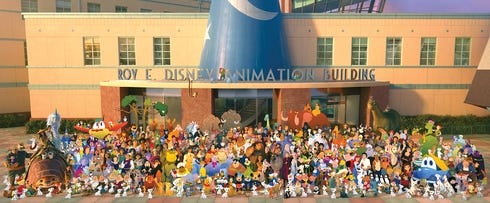
There was no notion of “This is the Disney of the past”, “Grandparent’s Disney”, “That is the Disney of now”, “Your kids’ Disney”. There was only one Disney, and both ends of the audience were being shown they belonged inside it. Witnessing that mechanism work on myself, it is hard not to be in awe of their craft.
When you see the show that way, it becomes difficult to think of Disney’s success as just the sum of its physical assets. The theatre, the costumes, the ship, are all ultimately balance sheet items that will eventually depreciate. The theatre will be refurbished, the costumes will fray, and the ship itself will one day be replaced.
The characters however do not live on the balance sheet. Yet they are also, by any measure, the most valuable thing Disney owns. Their stories outlasted every executive who has managed them, and will continue to outlast them from here. They define Disney’s immortality.
But even the character is a manifestation of something deeper. The magic that worked on both the grandparents and small children in that theatre, was an insight about how people work. That has continued to remain valuable for the better part of a century, and appears to become more valuable as each new cohort is initiated into it.
The non-negotiable tenet we live by as investors is that the value of any asset is the present value of its future cash flows. No doubt that is true but in cases like this it is also incomplete. The cash flows of a Disney ship can be estimated, and they will be priced into the asset after disclosure. What is much harder to price is the durability of the insight that allows the ship, and the next ship, and the ship after that, to keep generating the cash flows in the first place. The physical assets can decay but the vitality that animates and gives them life will not.
If most commercial insights fade with the moment that produced them, but a rare few keep working across generations, what is it that lets those few outlive their creators, their original format and the audience that first discovered them? That made me dig through Disney’s history for an answer.
If Disney’s hold on people lives in the experience, then this is where I think it all starts.
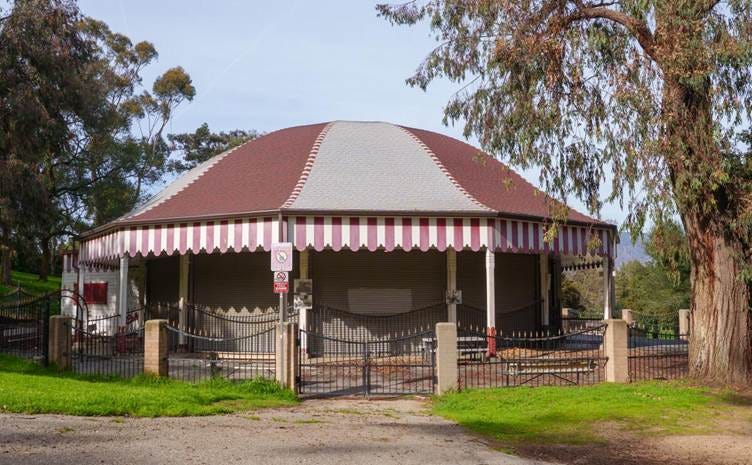
Walt Disney used to take his daughters to Griffith Park in Los Angeles on weekends. They would ride the merry-go-round while he sat nearby watching. Years later, when asked where Disneyland had come from, he traced the idea back to an ordinary observation.
Parents and children, he felt, needed a place where they could enjoy something together.
That simple observation eventually became Disneyland. In many ways, the entire Disney empire is the continued expression of that insight. The rides, the parks, and the films are just the visible forms. What truly sustains them is something Walt noticed. People find meaning in experiences that can be shared across generations.
Walt’s noticing was one thing. Acting on it before anyone else could see what he was seeing was another. The financing of Disneyland makes that painfully clear. When Walt tried to finance Disneyland in the early 1950s, many financiers refused, and the project looked speculative and difficult to justify.
He summed it up well. Dreams offer too little collateral.
The skepticism was natural. Collateral is tangible. It can be touched and counted. Insight lives in someone’s head, ahead of any evidence the world has produced. The theme park could be appraised. The devotion of the families who would one day fill the park was something only Walt could price because pricing it required the same insight the bank was being asked to lend against.
The challenge for the capital allocator is that money generally arrives after the insight has been proven, while the largest rewards belong to those willing to act on it beforehand.
Walt had to demonstrate the truth of his own observation by underwriting it personally, against his life insurance and his second home, before any serious capital would follow him into Anaheim.
What fascinated me more was something I discovered while reading an essay by the paleontologist Stephen Jay Gould.
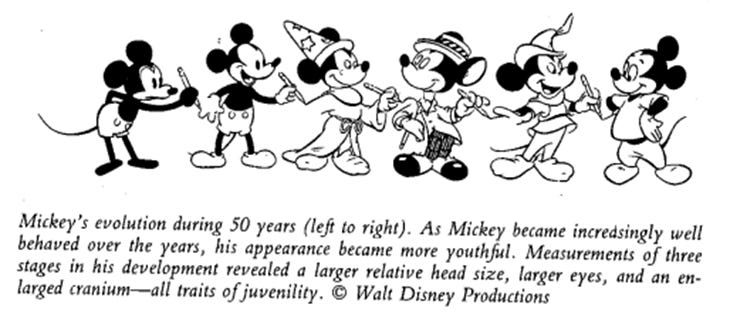
Gould examined how Mickey Mouse had been redrawn over time. Decade by decade, Mickey became softer, friendlier, and more childlike. His eyes grew larger. His face became rounder.
He increasingly resembled the features human beings instinctively associate with infants.
The animators were merely responding, frame by frame, to what audiences seemed to want. But in doing so, they unconsciously moved toward something much deeper, rendering characteristics our species are naturally predisposed to find endearing.
That explains what I saw on the ship. Grandparent and grandchild may have been responding to different memories but those memories drew on the same underlying human instincts. Disney had discovered something fundamental about people that does not change from one generation to the next. Once an insight of that kind has been found, it can be carried into form after form and grown with each new audience.
No one could have described it better than Warren Buffett when discussing his early investment in Disney in 1966.
The accounting of the time treated old films as wasting assets, and the studio’s library was carried at almost nothing on the balance sheet. Buffett saw differently. Every few years a new generation of children arrived with no memory of the previous release, which meant the same film could be sold to them again at almost no marginal cost. The assets were deemed finite to the accountants, while the audience was actually continually renewing itself.
His analogy was that Disney’s film library resembled an oil well where the oil somehow seeped back into the ground. The oil returns because the parent who once grew up on the library now wants the next generation to feel what they once felt. The library’s customers become its distribution, in every household, in every generation, at no cost to the company.
A genuine insight behaves a little like a soul. The forms it inhabits change but the insight remains.
What Walt Disney conceived nearly a century ago has lived as hand-drawn animation, television, theme parks, streaming, and now a cruise ship sailing out of Singapore. Each incarnation appeared new. The soul was the same.
Investing often comes down to recognizing the soul before the market becomes distracted by the next body it will inhabit.
Most investment analysis focuses on financials and those things do matter. But extraordinary long-term outcomes are often produced by businesses that seem to have discovered something deeper about human nature. Insights that can survive successive technologies, management teams, and product cycles.
This is what I am trying to do with the Insight Series. Nothing here is a pitch on Disney as a security. What I am after is the insight that built the company, and what that insight can be distilled into for use elsewhere. The challenge will be distinguishing genuine insight from temporary circumstance or luck.
Disney just happens to be an exemplar of how rich such an insight can be when it is correct because the timelessness is by now visibly palpable. Three living generations can share the same theatre. Most of the time the signal will likely be far weaker. The insight is younger, the test of time is incomplete, and the verdict is still ahead.
Reflecting on Disney's history left me with some thoughts on what distinguishes timeless insights from a passing circumstances.
Enduring businesses often seem to be built upon insights into something invariant in human nature rather than something contingent on a technology or a moment. Families wanting to share experiences across generations has been true since cave fires.
The strongest ideas are remarkably portable. They can move from one medium to another without losing their potency. Each transition would have killed an idea bound to its medium. The ones that survive are the ones where the medium is incidental and the insight is the payload. A timeless insight survives the next platform shift, and the one after that.
Timeless insights have compounding economics. Some assets deepen rather than deplete as they are used. A patent erodes from the day it is filed. Mickey accumulates value on the day a new child meets him.
Durable franchises usually rest on foundations that predate commerce itself. Mickey works because of how human nervous systems respond to infant features. Coca-Cola works because of ritual. Hermès works because of status signaling. The deeper the roots run into psychology, anthropology or biology, the more cautious we should be about dismissing them as temporary phenomena.
The hardest characteristic to evaluate is that the most valuable insights are often illegible to the frameworks of their day. Walt could not raise capital because dreams offered little collateral. Disney’s film library was carried at zero. Microsoft’s cloud transition looked, for a time, like deterioration rather than progress. The most consequential insights are often least visible to the metrics investors rely upon. By the time they are obvious, much of the value has already been recognized.
A fair objection to all of this is that Disney’s generational appeal has not come for free. The characters have been refreshed across decades. The parks are constantly renewed. Every new attraction and format is in some sense, an act of cultivation.
This is not saying a timeless insight is a perpetual motion machine. More like fertile ground that rewards continued cultivation. Both are required. Many companies invest heavily in cultivation and fail because the ground itself is barren. Others inherit fertile ground and gradually exhaust it through neglect. The exceptional franchises appear to have both.
This is what the Insight Series is about.
Not predicting which company will win next quarter, but building a deeper catalogue of insights about human behaviour, incentives, markets and institutions. The wider that repertoire becomes, the more often one begins to recognize familiar patterns appearing in unfamiliar places.
And occasionally, when the pattern appears before the market has fully recognized it, that understanding can be put to profitable use.
I’m sharing information here to educate and inform, not to provide financial or investment advice. Like any other personal financial matter, your own due diligence is paramount.
Comments
Nothing yet. Say the first thing.
Sign in to join the conversation.