
It is the best of times for drone economy investing, and it is the worst.
The theme is becoming central to how modern militaries think about war, but it no longer feels early in public markets.
One way to make sense of the drone moment is to stop thinking first about platforms and start thinking about attrition math. For much of the post Cold War period, militaries optimized around expensive, high end platforms. Small numbers of very capable aircraft, ships and systems not meant to be traded away lightly. If you were losing many of them, something had already gone very wrong.
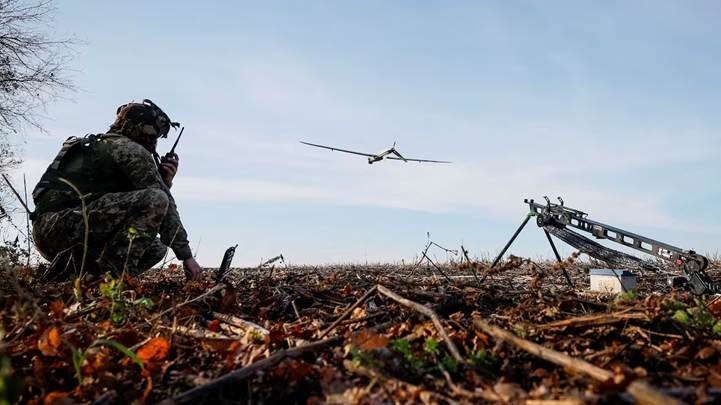
Ukraine drags military planning back toward a harsher reality. In a grinding war of attrition, systems are lost constantly. Drones, sensors, vehicles and communications nodes are used, detected, jammed, destroyed and replaced. Every battlefield system has to clear a basic test. It must be something you can lose in large numbers and still keep fighting.
That is where drones change the equation.
The first change is replaceable mass. Drones can be dispersed, consumed and replaced. Instead of concentrating capability in a small number of precious platforms, militaries can spread capability across many cheaper systems and accept losses as part of the operating model.
The second change is asymmetry. Drones allow a weaker force to impose costs on a stronger opponent without matching its budget, industrial base or platform sophistication. A modest piece of hardware and some code can threaten assets that cost orders of magnitude more.
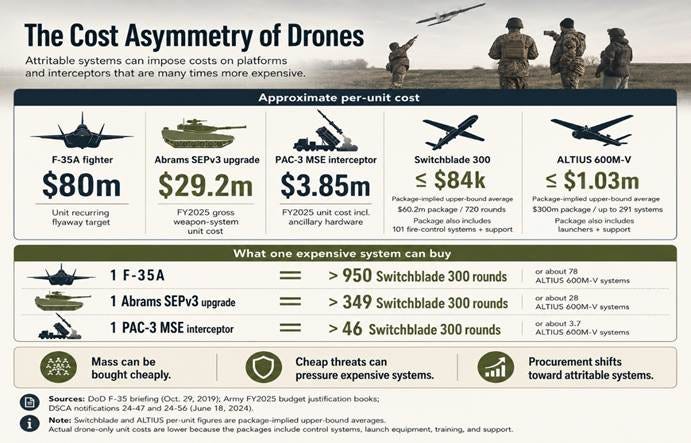
That kind of cost‑exchange curve is hard for militaries to ignore. When something cheap can occasionally disable or expose something expensive, the risk calculus changes. Commanders have to assume they will be seen more often, targeted more cheaply and forced to move differently.
Put attrition and asymmetry together, and drones start to look less like a niche category and more like a natural response to the modern battlefield. The best returns are often earned while that transition is still playing out, before a handful of contractors become the default choices.
The problem is that many of the obvious names are now priced as if that phase is already behind them.
If you have spent the last two years watching the clearest drone and autonomy beneficiaries compound, and felt a mix of regret and resignation about missing them, this piece is written from the same place.
The easy names have run. The most visible public winners now trade at valuations that already reflect a great deal of expected success. The single most consequential company in the space remains private. Buying the leaders today often means inheriting someone else’s earlier conviction at a price set after the market has already discovered the theme. That does not mean the work is over. It means the work has to become more discriminating.
Alongside the obvious winners sit a set of smaller companies exposed to the same procurement shift. They are harder to value because they are small, thinly covered, volatile and often tied to procurement details that many investors likely do not follow closely.
A press release can move the stock sharply higher. A lack of follow up news can give the move back. The business is not mature enough yet to stabilize the share price.
That is where both mistakes and opportunities appear. The market can overpay for strategic relevance before the revenue arrives. It can also ignore small suppliers sitting inside parts of the stack that later become more important than expected.
This post is about two defense‑tech microcaps that operate in adjacent control layers of the drone stack.
I took interest in them because they are not just vague drone economy stories. Both occupy parts of the stack that should matter more as procurement moves from experimentation to scale.
One is trying to move beyond autonomy software into the harder problem of turning mission coordination, integration with existing command systems and production readiness into a deployable capability that can anchor entire drone or robotic programs, not just single vehicles.
The other is trying to solve for trust. How unmanned systems communicate, stay secure, remain compliant and keep operating when conditions deteriorate. It sells modules and software that embed into other people’s platforms, rather than fielding its own airframes.
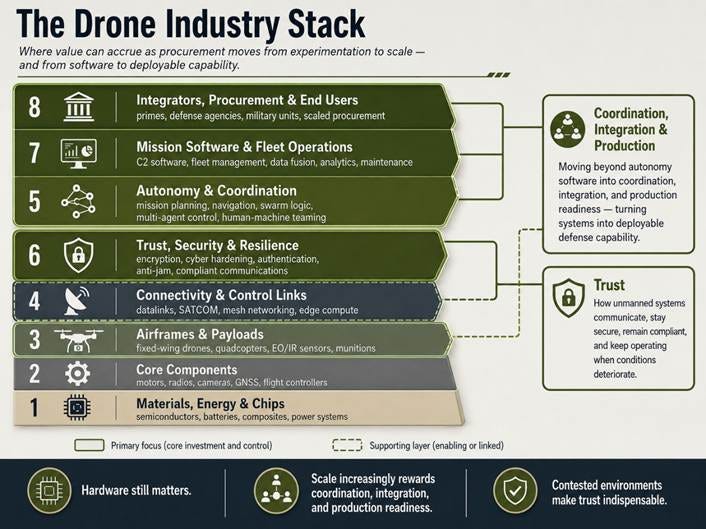
As militaries shift from buying drones to fielding drone systems, the larger share of the economics is likely to accrue to those systems that can be coordinated, integrated, secured and operated under stress.
Airframes and munitions are capital‑intensive and tend to earn lower hardware‑style margins, while autonomy, mission coordination and secure‑communications layers can be reused across fleets and programs with software‑like economics. Once a control layer is validated, each additional platform that adopts it adds more high margin revenue than building one more airframe.
That is why they are the two names I pull out of the broader drone basket.
Just as importantly, both have near term test points. That is what separates them from many smaller defense‑tech stories. These are not companies asking investors to wait indefinitely for a future that may or may not arrive. Each has identifiable developments over the next few quarters that should tell us whether the market is paying for substance or simply paying for exposure to the theme.
That makes them worth studying. Unfortunately, the work led to a less convenient conclusion than I expected. I wanted to put capital behind the drone transition. Instead, the valuation math forced a more cautious approach, as the prices already ask investors to believe a lot.
One of the two is a walk away for me at the current price. The opportunity is significant, but too much of the valuation appears to depend on a difficult outcome arriving on time.
The other has more ways to win. Its business model looks more like Riken Keiki or Mirion than a typical drone OEM. An embedded supplier whose TAM grows as the underlying industry scales, not as any one platform wins. You will rarely see it named directly in a contract award. Its products sit inside larger platforms whose customers keep supplier relationships confidential, so you have to piece the story together from design‑win disclosures and order announcements. But the current price already gives it credit for some of that conversion.
That does not make the exercise wasted. In markets like this, FOMO is expensive. A powerful transition can be real and still be dangerous to buy badly. The more important task is to have a method. To ask where value accrues, what probability the stock already prices, whether the company has enough runway to be wrong for a while, and whether there are enough paths forward to justify the risk.
What follows is the company specific work behind that method. The valuation ladders, the implied probability math, and the price ranges where I would be willing, or unwilling, to underwrite each name.
The rest of this deep dive is for paid subscribers.
The market does not lack information. It lacks attention directed at the right places. This publication searches for underfollowed companies, neglected bottlenecks and catalysts whose significance may not yet be reflected in the price.
Paid subscribers receive 3 to 4 deep dives each month, covering:
specific equity opportunities;
variant-perception frameworks through The Insight Series;
the complete research archive.
The aim is not to give you more market commentary. It is to help you see a small number of important things more clearly.
$10/month or $100/year.
Comments
Nothing yet. Say the first thing.
Sign in to join the conversation.