
Alto was created by order in council, not by statute. Three orders signed on March 24, 2022 set up VIA HFR as a subsidiary of VIA Rail and applied most of the Crown corporation rules to it, while carving out the provisions that would have made its directors Governor in Council appointees.
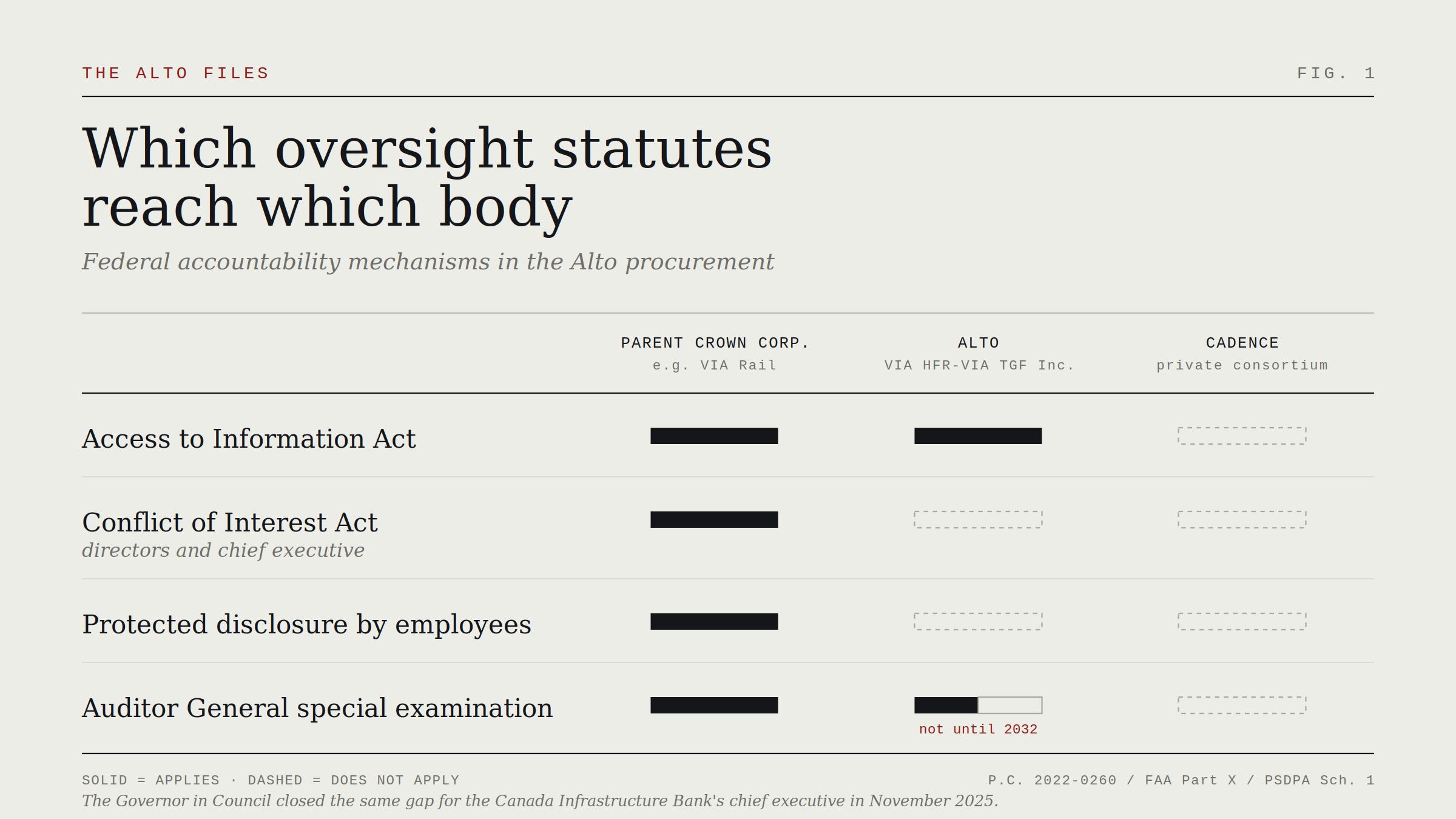
That carve-out appears to put Alto's board and chief executive outside the Conflict of Interest Act. Its directors are appointed by VIA Rail, not by the Governor in Council. On Treasury Board's test, that means no filing with the Ethics Commissioner, no public declaration, and no external disclosed screen. Whatever conflict of interest policy applies inside Alto has never been published.
The government knows how to close that gap. In November 2025 it brought the chief executive of the Canada Infrastructure Bank inside the Act by naming him in an order in council. It has not done the same for Alto's chair or chief executive.
Alto's chair acted as counsel for SNC-Lavalin in 2018, in the matter concerning that company's continued eligibility for federal contracts, and had previously chaired the Ontario transit agency that awarded the same company a $5.3 billion contract. Alto's chief executive arrived from the Montreal Port Authority three weeks after a personal phone number reached him from an unknown CDPQ sender.
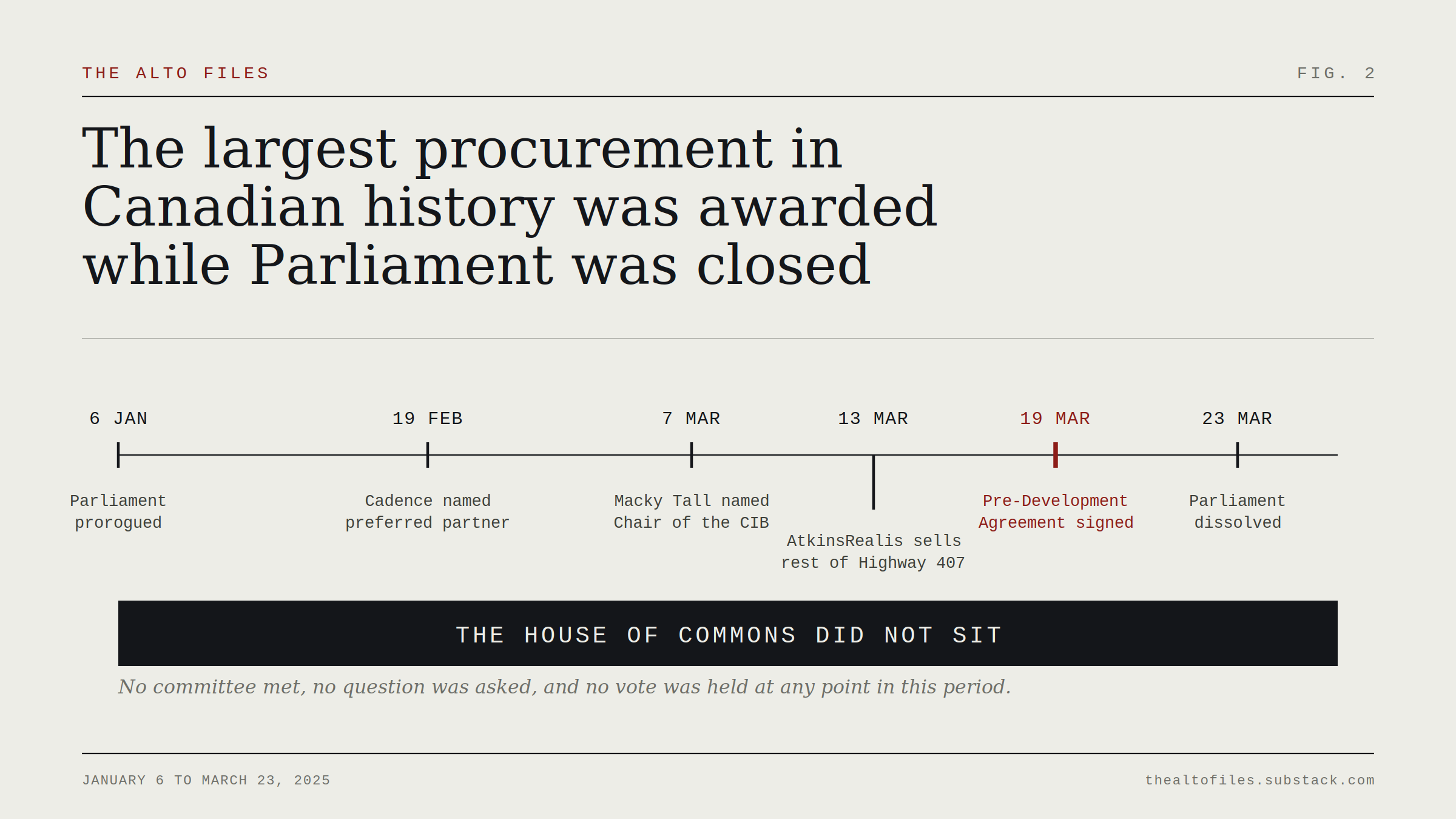
Parliament did not sit during the decision. From the announcement of the preferred proponent on February 19, 2025 to the signing of the Pre-Development Agreement on March 19, the House was prorogued, and it was dissolved four days later.
Conflicts are now adjudicated by the consortium itself. Cadence's published procurement documents let it decide, at its sole discretion and to its own satisfaction, whether a supplier's conflicts can be managed. The fairness monitor is retained by Cadence. The Government of Canada has no stated role, and no access to information statute reaches any of it.
Everything below is drawn from a government document, a public filing, a report of an officer of Parliament, or a company announcement. This is not an article about whether anyone behaved improperly. It is an article about whether anyone independent is in a position to ever find that out.
The largest infrastructure procurement in Canadian history is being delivered by a Crown corporation created by order in council rather than by statute, co-founded by an institution whose own investment mandate is set by ministerial letter, and awarded to a private consortium whose members share owners. This raises many questions about conflicts, transparency and accountability.
Taken one at a time, the arrangements in this file are unremarkable. A pension fund holding just under twenty per cent of an engineering firm is a passive investment, not control. A law firm's chair making representations to government on a client's behalf is counsel doing what counsel does. An executive moving from a port authority to a rail corporation is a career. An infrastructure investor recruiting from the sector it invests in is ordinary practice. Rail engineering is a small global market, and overlap is expected.
Most of these relationships are not hidden but a conflict of interest regime does not exist to establish that a relationship exists, because relationships always exist. Independent regimes exist so that someone independent looks at a relationship, applies a published standard, and records a decision. Follow that question through this file and the answer keeps changing. For some of it an officer of Parliament had jurisdiction. For some, a Crown corporation board can adjudicate a complaint about its own chief executive. For the part that matters most, a private consortium decides at its sole discretion, and no federal statute reaches it at all.
It is hard not to think that relationships this interwoven have something to do with the government's reluctance to cancel this project, or to return it to what it was originally supposed to be: a modest, affordable improvement to passenger rail in the corridor that could have been delivered quickly and at far less expense.
Two things happened in 2015 that would eventually meet.
The first was in Quebec City. Philippe Couillard of the Liberal Party of Quebec had been premier since April 2014, and on June 12, 2015 his government passed Act 38, permitting the CDPQ to be entrusted with the management and delivery of infrastructure projects and to hold full authority over projects entrusted to it. CDPQ created CDPQ Infra the following month. Michael Sabia, then CDPQ's chief executive, became chairman of its board. Macky Tall became its president and managing director. External counsel would later describe the REM, the vehicle's first project, as Quebec's first public-public partnership, with CDPQ simultaneously owner and primary investor.
The second thing happened in Ottawa. That same year VIA Rail submitted its high frequency rail proposal, with a Class 3 business case and visual survey work already conducted, as I have written previously. The work had started under Prime Minister Stephen Harper and the Conservative Party of Canada. It was expressly not a high speed rail project, and speeds were capped to ensure there could be at-grade crossings and to control costs.
Ten years later, the first of those two would be delivering the second, transformed almost beyond recognition.
The federal Liberal Party won the election of October 19, 2015 with a majority, and Justin Trudeau was sworn in as Prime Minister on November 4. On December 14, the new Finance Minister Bill Morneau announced an Advisory Council on Economic Growth. He named Dominic Barton, global managing director of McKinsey, as its chair on February 22, 2016, and its fourteen members the following month. Michael Sabia was among them, while chief executive of CDPQ.
The Council released its first wave of recommendations on October 20, 2016. The infrastructure memo, Unleashing Productivity Through Infrastructure, proposed creating a Canadian Infrastructure Development Bank to leverage institutional capital and deliver more than $200 billion of projects over ten years. Those recommendations fed Morneau's fiscal update of November 1, which announced the creation of the Canada Infrastructure Bank. The Canada Infrastructure Bank Act received royal assent on June 22, 2017 as part of that year's budget implementation bill rather than as stand-alone legislation.
Institutional capital was not only the intended source of the money. Two of the people recommending the mechanism ran, or had run, two of the largest institutional investors in the country, and were therefore describing a vehicle their own institutions could expect to transact with directly.
While the CIB was being legislated, the advisory work was already circulating between the two projects.
CDPQ Infra appointed Steer, then Steer Davies Gleave, to produce investment-grade ridership forecasts for the REM, with a preliminary report in November 2016 and the full report in February 2017. In the same period the firm produced Ontario's preliminary business case for high-speed rail on the Toronto-Windsor corridor, retained through the Ministry of Transportation for David Collenette as special advisor. That study costed a 300 km/h scenario against a 250 km/h scenario and published both. Steer would go on to do the ridership forecast for the Alto project as well.
Federally, records released under A-2016-00827 show that by February 2017 CIBC Capital Markets, engaged by Canada Development Investment Corporation, was advising on equity and privatization structures for VIA's high frequency rail project under the codenames Project Longbow and Project Arrow. The work included a market sounding of investors and contractors, among them SNC-Lavalin, and case studies of comparable projects. One was the REM.
The advice at that stage was cautionary. WSP produced a 31-item risk register, and both WSP and CIBC flagged that VIA's ridership and revenue projections appeared inflated and the captured market too large. Market participants were unwilling to take revenue, land acquisition, environmental or utilities risk, and preferred availability payments. CIBC recommended Canada obtain full land acquisition details before any funding arrangement.
The following month the pension fund and the engineering firm became financially entangled. In March 2017, CDPQ committed roughly $1.9 billion to finance SNC-Lavalin's $3.6 billion acquisition of WS Atkins: a $1.5 billion non-recourse loan to the entity holding SNC-Lavalin's interest in Highway 407 ETR, and $400 million in privately placed subscription receipts. CDPQ was SNC-Lavalin's largest shareholder. Its stake rose on closing.
Under an Investor's Rights Agreement, CDPQ held what the company's filings call the repurchase right: the right to require the company to buy back shares from CDPQ in order to keep its proportionate holding as close as possible to, without exceeding, 19.9 per cent of the issued and outstanding common shares.
SNC-Lavalin was charged in February 2015 over its conduct in Libya. From February 2016, as the Ontario Court of Appeal later recorded, it lobbied the federal government to amend the Criminal Code to create a way for a company facing criminal charges to avoid trial.
On February 22, 2018 the government announced it would do so. Five days later Budget 2018 was tabled, and on March 27 the measure appeared as Division 20 of Part 6 of Bill C-74, the Budget Implementation Act, 2018, No. 1. It was the second time in as many years that a substantive change in the law travelled inside a budget bill. It would not be the last. The law came into force on September 19.
The new Part XXII.1, headed "Remediation Agreements", lets a prosecutor negotiate an agreement with an organization accused of an offence of an economic character. The prosecution is stayed if the organization complies with terms that typically include an admission, a financial penalty, restitution and an independent compliance monitor. A prosecutor may weigh the national economic interest, except where the alleged offence is bribery of a foreign public official, an exception the OECD Anti-Bribery Convention requires, and exactly what SNC-Lavalin was accused of.
What made the regime urgent for this company was the alternative, and the alternative was a significant procurement consequence. A conviction for fraud or bribery meant likely debarment from federal contracting for five to ten years under the government's integrity regime. The eligibility of a future bidder on federal work was, in that sense, the subject of the legislative change.
The CIB opened for business and went straight to Montreal. In August 2018 its investment memorandum for the REM, released under A-2020-005, recorded a $1.283 billion commitment to a CDPQ Infra project. It was the CIB's first rail investment.
Two details in that memo caught my eye. The first is pricing. The benchmarking table set returns at 6.1 to 6.3 per cent for the project, 8.7 per cent unlevered for CDPQ Infra, 3.90 per cent for Quebec, and 1 per cent for ten years rising to 3 per cent for five for the CIB. Interest is paid in kind for the first decade. The federal lender took the lowest return of any participant and deferred cash receipt for ten years, while the private sponsor held priority returns. At the time, investments of this kind went to cabinet for approval. That requirement was removed in 2021.
The second is governance. The memo named CDPQ Infra's board, Sabia as president of the board and Tall as chief executive, and states that the project does not benefit from an independent board or executive team. The CIB identified the absence of independent governance in its counterparty and proceeded anyway. Nothing in the disclosed record shows that finding being escalated, conditioned or externally reviewed. The investment lead was Bruno Guilmette. The team included Divya Shah. Both names return later.
That autumn the CIB was also talking to everyone about the rail corridor. Its executive meeting logs, disclosed incidentally in a release scoped to SNC-Lavalin rather than to rail, record meetings with VIA Rail on August 1, September 18, and November 9 and 22; Transport Canada on October 11, 14, 22 and November 23; CDPQ on October 16; and Arup on November 26.
SNC-Lavalin sought a remediation agreement, but the Director of Public Prosecutions declined to invite it to negotiate. What the company did next is on the public record because the Ethics Commissioner put it there, and that is worth noticing on its own: it is one of the few episodes in this account where an officer of Parliament had jurisdiction over anything.
Paragraph 22 of the Trudeau II Report records that on or around October 14, 2018, Scott Brison, President of the Treasury Board, was speaking with Kevin Lynch and Robert Prichard, whom the Commissioner describes as "legal counsel for SNC-Lavalin", on an unrelated matter. During that conversation the two explained the company's position on remediation agreements. Brison understood that its representatives were approaching other Cabinet ministers at the same time. He thought the concerns appeared sensible. He contacted the Attorney General that same day. Reporting at the report's release records further approaches to Brison in October and November.
Prichard was then chair of Torys LLP, the firm retained by SNC-Lavalin. Lynch was BMO's vice-chair, chair of SNC-Lavalin's board, and a former Clerk of the Privy Council. Separately that autumn, Frank Iacobucci of Torys, acting for the company, prepared a legal opinion on the legitimacy of the Attorney General intervening, and commissioned a second from John Major. Both reached the Prime Minister's Office.
The Commissioner's jurisdiction covered the Prime Minister. An independent investigation record exists accordingly.
On Monday, January 28, 2019 at 11:32 a.m., Riccardo Cosentino, Vice President Investment Development Capital at SNC-Lavalin, emailed Divya Shah at the CIB. The subject line reads "Integrated Rail-Property Development Model". The body of the email and any attachments were withheld in the ATIP disclosure.
An integrated rail-property development model sounds a lot like land value capture or transit oriented development. This is the only record in my collection of a private party pitching a delivery model to the CIB before the Joint Project Office existed, five months before the federal funding commitment and eight months before the office was created.
Ten days later, on February 7, 2019, the Globe and Mail first broke the SNC-Lavalin affair.
The very next day, February 8, the CIB and Ernst & Young completed a market sounding scoring 28 global entities for the high frequency rail project. SNC-Lavalin is marked yes on all four scope columns, construction, operations, systems and controls, and integrated, plus integrated equity, plus greenfield risk. On the participants' own self-reported capabilities, it is the most completely capable single entity on the list. Only four entities are marked as able to carry rail revenue risk: Keolis, CDPQ, RBC and Sumitomo.
The company seeking the remediation agreement had, as its largest shareholder, a public pension manager. What that shareholder said in public during the affair is on the record, and it was said by the same person who had sat on the council that recommended creating the Canada Infrastructure Bank, and who would later chair it.
CDPQ's position had been public since March 2017, when it announced the WS Atkins financing under the heading that it was supporting SNC-Lavalin's global expansion projects. Sabia's statement described CDPQ as a long-term partner that had worked with the company for years and would continue to do so, and framed the transaction as capable of making SNC-Lavalin one of the leading engineering firms in the world.
In February 2019, days after the affair became public, Sabia said the pension fund would "be a rock" for SNC-Lavalin, and that it was prepared to increase its stake if no technical barrier prevented it. The largest shareholder of a company under criminal prosecution was publicly offering to buy more of it if necessary.
That shareholder's exposure was not only equity. CDPQ held the near-twenty-per-cent shareholding, pinned there by contract, and separately a $400 million loan facility to the company. It also had the 407 ETR security from the 2017 financing. A conviction, and the debarment from federal contracting that would likely have followed it, would have reached all of those positions.
It is worth noting what the company itself was arguing at the time. A presentation SNC-Lavalin prepared for prosecutors in September 2018 stated that criminal prosecution would likely have very negative consequences for employees, shareholders and pensioners, among others. The largest of those shareholders was an institution that manages money for public pension plans.
The support was not unconditional, and by 2019 it was audibly strained. In August 2019 Sabia used the release of CDPQ's half-year results to say publicly that the company had to move quickly and focus on execution. SNC-Lavalin's shares fell to their lowest level in almost fifteen years the following day. CDPQ had booked a loss of roughly $700 million on the position in the first six months of that year. That October, CDPQ issued a statement saying it continued to believe the company could be a successful global business with the necessary changes to strategy and execution, and that it would follow its decisions closely in the weeks ahead.
In August 2019, Commissioner Dion found that the Prime Minister had contravened the Conflict of Interest Act.
Weeks later the rail project acquired an institutional home. On September 4, 2019 the CIB and VIA Rail executed a joint venture agreement establishing the Joint Project Office: CIB contribution $54.4 million, VIA $3.1 million, against $71.1 million announced. The disclosed copy of the agreement is unsigned and every task-level figure is redacted.
The federal election of October 21, 2019 returned a Liberal minority government. In December the criminal matter was resolved through a guilty plea that avoided a bribery conviction.
Then, on February 18, 2020, Robert Prichard emailed Paul Rochon, Deputy Minister of Finance, copying the Deputy Minister of Infrastructure, about the removal of the CIB's chief executive. Writing from his Torys address, Prichard reported that the CIB's board had met at noon and asked for the government's note on process, specifically the steps that would follow the board's recommendation. Rochon replied that afternoon. Prichard later circulated the resulting news releases to the CIB's directors.
Two months after that, in April 2020, Michael Sabia was named the CIB's Chair-Designate. The government release quoted the Finance Minister praising his infrastructure financing record at CDPQ. The Canadian Press tied the appointment back to the advisory council that had recommended creating the CIB. By December, Sabia had moved within government again, to become Deputy Minister of Finance.
In March 2021 the Parliamentary Budget Officer reported that the CIB had committed roughly $4 billion, 11.5 per cent of its envelope, and had leveraged no private investment in any signed project. The government's answer was that CDPQ counted as private. The Budget Officer applied Statistics Canada's definition, under which public pension funds are government entities.
That disagreement is not a technicality. It goes to whether the institution was doing the thing it was created to do, and the two federal bodies looking at the same portfolio could not agree on the answer.
The high frequency rail project was publicly announced on July 6, 2021. Parliament was dissolved on August 15 and the election held on September 20, returning another Liberal minority.
Eight weeks after that vote, on November 15, 2021, the Deputy Ministers' Oversight Committee endorsed a pre-development partnership approach, six outcome-based Minimum Essential Requirements to be finalised with bidder comments, and a conclusion that there was value in leaving degrees of freedom for the private developer.
Those degrees of freedom went straight into the market documents. The Request for Expressions of Interest issued on March 10, 2022 described project outcomes as not intended to act as a constraint. Fifty-four firms responded, CDPQ Infra among them. Twelve days later the Liberals signed a supply and confidence agreement with the New Democratic Party.
Two weeks before that, on March 24, 2022, three orders in council had set up the corporate vehicle, and they are the most consequential documents in this article. P.C. 2022-0259 is a directive under section 89 of the Financial Administration Act, made on the Minister of Transport's recommendation after consulting VIA Rail's board, directing VIA Rail to procure the incorporation under the Canada Business Corporations Act of a wholly-owned subsidiary, yet to be named, whose mandate is to develop and implement the High Frequency Rail project. P.C. 2022-0260 applies Part X of the Financial Administration Act to that subsidiary as though it were a parent Crown corporation, with exceptions. P.C. 2022-0261 completes the set.
The exceptions are the point, and I return to them at the end.
In May the Commons Standing Committee on Transport, Infrastructure and Communities tabled its third report, recommending that the CIB be abolished. The government tabled its response that September and declined to do so.
Five years to the day after the Canada Infrastructure Bank Act received royal assent, on June 22, 2022, the designated Minister commenced the statutory review the Act requires every five years. The resulting report records that more than eighty organizations were engaged between November 2022 and April 2023. Among them: the CDPQ, SNC-Lavalin Group Inc., the Bank of Montreal, Infrastructure Ontario, Arup Canada, AECOM Canada and CIBC. More than forty written submissions were received, including one from the CIB itself and one from Jim Leech, the former special advisor to the Prime Minister on the CIB. The supporting research was commissioned from Deloitte, Ernst & Young and KPMG. The review concluded that the legislation was appropriate and that no amendments were necessary. Its annex on advisory work lists high frequency rail, with CIB participation of up to $55 million, alongside Transport Canada, VIA Rail and Infrastructure Canada.
This was the one scheduled, statutory occasion on which the framework governing the CIB was to be examined. The parties consulted included its largest counterparties. The outcome was that nothing required changing.
On November 10 a REM Lessons Learned presentation went to the deputy ministers as a delivery-model precedent for high frequency rail. The REM was a CDPQ project.
VIA HFR was incorporated on November 29, 2022. It would begin operating under the name Alto in February 2025.
Two weeks after incorporation, on December 13, 2022, Robert Prichard was appointed Chair of its board by VIA Rail, its shareholder, rather than by the Governor in Council. Annual remuneration $120,000, three-year term.
I cannot seem to find any evidence of an open call or competition for either the CEO or Chair roles. Both men seem to have been selected and both would have been well known to the government.
Prichard’s appointment was not his first transit chairmanship. Ontario named Prichard in March 2009 to oversee the merger of GO Transit and Metrolinx; he served as Metrolinx president and chief executive from 2009 to 2010, and as chairman of its board from 2010 to 2018. He resigned from Metrolinx in July 2018, hours after the incoming Progressive Conservative government's throne speech, saying the election of a new government made it the right time for a change of leadership.
During that chairmanship, in July 2015, Metrolinx and Infrastructure Ontario awarded the Eglinton Crosstown LRT contract, then valued at roughly $5.3 billion, to Crosslinx Transit Solutions, a consortium of ACS-Dragados, Aecon, EllisDon and SNC-Lavalin. Infrastructure Ontario ran the procurement, overseen by a third-party fairness advisor. Three years later Prichard would be described by the Ethics Commissioner as legal counsel for one of those four members. Four years after that he would chair the Crown corporation procuring the country's largest rail project, with the same company on the winning bid.
Around this period, CDPQ Infra paid SYSTRA Canada to peer-review the ridership forecast Steer had produced for REM de l'Est, building an independent model to compare methodologies and results. SYSTRA Canada was at the same time part of the AECOM-SYSTRA consortium delivering engineering and station design on that same project. Reviewer and supplier, same project, same client. The reviewer was retained by the party whose forecast was under review.
Martin Imbleau had been President and Chief Executive Officer of the Montreal Port Authority since 2020. Correspondence between the Port Authority and CDPQ, released informally under Port file 2025-03, covers April 2021 to August 2023 in twelve pages, severed in part. Most of it is routine: an introduction proposed in April 2021 between a CDPQ Infra contact and the Port's new chief executive, framed on the newly public alignment of the REM de l'Est and its intersection with the Notre-Dame truck corridor; scheduling; an article forwarded with congratulations.
The Port also had a live relationship with the institution that had co-founded the rail project. The CIB legislative review's annex on advisory and project-development work lists a port terminal project, with CIB participation of up to $300 million and the Montreal Port Authority as partner. That engagement ran while Imbleau led the Port.
Meanwhile the Crown corporation was preparing to hire. On July 12, 2023 Transport Canada prepared a briefing note for the Minister titled VIA HFR CEO Compensation, reference XM-2023-527552. The title is disclosed. The text is not. On July 19, seven weeks before the chief executive started, the corporation contracted Korn Ferry for $270,250 worth of talent recruitment services.
The day after that, on July 20, the government announced the three qualified respondents to the Request for Qualifications. One was Cadence, led by CDPQ Infra.
On August 17 the last document in the Port ATIP file transmits a personal email address and a mobile number to Imbleau. Both are redacted. As is the identity of whoever sent the email but it came from a CDPQ address.
On September 8, 2023 Imbleau was publicly announced as the chief executive of the Crown corporation, twenty-eight days after Cadence qualified as a bidder, and twenty-two days after the personal contact information from someone at CDPQ was passed to him at the Port. Five days later, SNC-Lavalin renamed itself.
A chief executive appointed by a board rather than by the Governor in Council is, on Treasury Board's guidance, outside the Conflict of Interest Act. There is accordingly no filing with the Ethics Commissioner, no public declaration, and no external screen that covers Alto’s CEO.
The Request for Proposals launched on October 13, requiring each qualified bidder to develop two solutions: one capped at 200 km/h, and one incorporating higher speeds.
Thirteen days later, the House of Commons voted to concur in the committee report recommending that the CIB be abolished. Concurrence is not legislation: the CIB exists by statute, and only a statute can undo it. No one tried to pass legislation. The CIB continued to exist despite a majority of elected officials expressing dissatisfaction with its existence.
On November 14, Imbleau attended a Chamber of Commerce lunch featuring Michael Sabia, by then chief executive at Hydro Quebec (the utility that will supply some of the power to Alto's first phase).
On March 13, 2024, during the board build-out, Alto contracted Les Viner Professional Corporation for strategic advisory services. The value is $17,246.25, roughly $15,000 before tax. Les Viner is the former Managing Partner of Torys LLP. Alto's chair is Torys' non-executive chairman.
The firm itself is also counsel to Alto. Torys’ directory submissions record it acting for VIA HFR on securing project approvals, including under the federal impact assessment regime, and on the design and implementation of Indigenous consultation and engagement for the Toronto–Québec City network. Alto’s chief legal officer also identifies Tory’s as their legal counsel in an article with Lexpert, a legal trade publication. We do not know how much money Tory’s has been paid and I don’t know if a non-executive chairman is compensated as a partner based on business brought in to the firm.
A law firm acting for a corporation whose board its chairman sits on is not unusual but is not a recommended practice by those interested in legal ethics and conflicts of interest. In the ordinary case it is managed by recusal from the retainer decision, a recorded declaration, and a published policy setting the standard. Here, none of those three is visible to the public. Because of the FAA carve-out, the chair files nothing with the Ethics Commissioner, no external screen exists, and whatever the board did about the retainer is recorded only in a policy that has never been published. The relationship is disclosed on the firm’s website; the decision to enter into it is not disclosed anywhere.
Proposals for the RFP were due on July 24, 2024, and evaluation ran through September. The commercial proposal and the integrated assessment carried 30 points each of 120, and the alternative solution with lower journey time carried a possible 15 points, the same points used to score the base solution.
Evaluation concluded in December. Any conflict declarations and how they were resolved is unknown.
On January 6, 2025 Trudeau announced his resignation and Parliament was prorogued until March 24. Prorogation ends a session. No committees meet, and legislation dies on the Order Paper.
Six weeks into that silence, on February 19, the government announced Cadence as preferred private developer partner. Cadence has six named members. CDPQ Infra is wholly owned by CDPQ. CDPQ was then the largest shareholder of SNC-Lavalin, under its new name. Keolis is 70 per cent SNCF and 30 per cent CDPQ. SYSTRA is 20 per cent SNCF. SNCF Voyageurs is the fifth. Air Canada, the sixth, was at that point the only member with no direct ownership tie to the others.
On March 7, Macky Tall was appointed Chairperson of the CIB by Order in Council P.C. 2025-0342, made under subsections 8(3) and 12(2) of the Canada Infrastructure Bank Act, to hold office during pleasure for a term of four years, with remuneration comprising an annual retainer in the range of $85,000 to $100,000. The government's appointment backgrounder describes him as founding Chair and CEO of CDPQ Infra. His term runs to 2029. The Alto co-development phase runs from 2025 to 2029.
Two features of that order are worth noting. Section 8(3) places no cap on the length of a Chair's term, so four years was a choice rather than a maximum. And "during pleasure" means the appointment may be revoked at any time, without cause, throughout the period in which the corridor is being designed. Unlike Alto's board, a Governor in Council appointee of this kind is within the Conflict of Interest Act, and the Ethics Commissioner has jurisdiction.
On March 9 Carney won the Liberal leadership. On March 14 Carney was sworn in as Prime Minister. On March 19 the Pre-Development Agreement was signed. On March 23, the day before the prorogued session was to resume, Carney asked the Governor General to dissolve Parliament, and the writs issued for an election on April 28. It returned a Liberal minority. The Carney government reached majority status on April 13, 2026 after floor crossings and by-elections.
From the announcement of the preferred proponent through the execution of the agreement for the largest infrastructure procurement in Canadian history, Parliament did not sit and its committees did not meet. The one form of oversight that operates by asking questions in public was unavailable for the entire period in which the decision was made and implemented.
Co-development on the Alto project began on April 1, 2025. Three months later the fund that owns the lead member of the winning consortium supplied the two most senior unelected officials in the country.
On July 7, 2025 Michael Sabia became Clerk of the Privy Council, the most senior position in the Canadian public service. He had led CDPQ for eleven years. The same day, Marc-Andre Blanchard became Chief of Staff to the Prime Minister. Blanchard had been Executive Vice-President and Head of CDPQ Global since September 2020, where he led a government relations division formed to support CDPQ's investment teams and partners worldwide, and Global Head of Sustainability from 2022.
Seven weeks after the Clerk took office, on August 29, 2025, the government created the Major Projects Office. It is not a department of its own. Its parent department is the Privy Council Office, the minister responsible is Dominic LeBlanc, and its chief executive is Dawn Farrell, formerly chair of the Trans Mountain Corporation. A separate order in council set her salary range at $577,000 to $679,000. A new body coordinating the financing and federal approval of the country's largest projects was placed inside the department the Clerk heads.
On September 11, 2025, LeBlanc announced the referral of the Montreal port container terminal project to the Major Projects Office, one of the first tranche. The proponent was the Montreal Port Authority, the organization Alto's chief executive led until 2023.
On October 15, 2025 Transport Canada published the final report of its real-time assurance engagement on the rail procurement. It reported difficulty mapping intended project outcomes to the actual procurement documents. On the same date, the Minister of Industry was briefed for a meeting with CDPQ chief executive Charles Emond.
On November 19, Sabia appeared before the Commons ethics committee during its study of the Conflict of Interest Act. He described his role administering the Prime Minister's conflict of interest screen, one of two unelected officials who do so. Those two officials are himself and Blanchard. He cautioned that over-correcting ethics rules could deter talented people from entering public service.
In February 2026, the Minister's Statement of Priorities and Accountabilities raised the CIB's capital envelope from $35 billion to $45 billion and added a fourth investment priority that had never appeared in a CIB mandate letter before: artificial intelligence and digital infrastructure. No amendment to the Canada Infrastructure Bank Act was required, and none was made. None was required for any of the earlier expansions either, and the CIB's own legislative review describes the existing legislative framework as having enabled it to respond to that evolution. The review also records the governance change that makes a ministerial letter consequential: a shift from project-level government oversight to portfolio-level oversight, enabling the board to approve investments within priority sectors established by the Government. That is the same change that removed the cabinet approval which had applied to the REM investment in 2018.
There is an executive step, and it is on the record. Section 16 of the Act and subsection 122(1) of the Financial Administration Act require the CIB's corporate plan to be approved by the Governor in Council, and on April 23, 2026 it was, for the 2026-27 to 2030-31 planning period (P.C. 2026-0384). Only a summary of that plan is published. No bill was introduced and no vote was held.
What a rail corridor has to do with a data centre mandate is a separate article.
In April 2026 the Prime Minister announced the start of construction on the $2.4 billion Montreal Port terminal expansion.
This week the Globe and Mail recorded the Major Project Office’s account of the port project. Answering criticism that its first tranche contained projects already close to advancing without it, Farrell is quoted in the Globe and Mail as telling a parliamentary committee that "the project was not going to happen" and there had been no money for it, and that her first month in the job was spent working with the port team to find financing so the waterworks could start.
The same article reports that the business community has concerns about the lack of transparency about how the Major Projects Office operates. I certainly agree with that observation.
That is where the helpful documentary trail ends, and not by accident.
The record changes significantly after April 1, 2025. Before February 2025, the documents show a government deliberating. After it, they show a government administering, while the substance moves inside a private consortium that no access to information statute reaches.
Cadence is not subject to the Access to Information Act. The government-held versions of the same material are withheld under sections 20(1)(b) and (c) and 18(b). The bid documents, the evaluation scores of the losing bidders, the costed base and alternative solutions, the co-development deliverables and the interim business case are all unavailable to the public.
Cadence does publish some documents, if you know where to find them on procurement websites, and what they publish sets out who adjudicates conflicts and ethical issues from here on.
On July 28, 2025 it issued an Expression of Interest for an Independent Design Verifier, with the request for proposals following on August 25. The procurement ran under CDPQ Infra's procurement policy and Supplier Code of Conduct, not federal rules. Section 1.5 makes eligibility conditional on meeting Cadence Rail's conflict of interest conditions. Section 8 allows Cadence Rail to exclude a bidder where it deems a conflict cannot be managed to its complete satisfaction. Appendix A, section C requires disclosure of all business relationships with Alto, CDPQ Infra and any Cadence member, then leaves it to Cadence to determine at its sole discretion whether mitigation or ethical walls suffice. The fairness monitor is also retained by Cadence. Confidentiality undertakings run five years and require a bidder to notify Cadence before any legally compelled disclosure. Quebec civil law governs disputes, with exclusive jurisdiction in Montreal. The role being procured on those terms is the Independent Design Verifier, whose function is to check that Cadence's design work complies with the project requirements.
The same standard now extends to the construction itself. On June 23, 2026 Cadence published an advance market notice for the central segment, Ottawa to Montreal, on SEAO under CDPQ Infra's account. It sets out the work package structure for the first phase: rolling stock, signalling and systems integration, the depot, stations at Ottawa, Laval and Montreal, a Montreal tunnel, an Ottawa River bridge, requires structures in Quebec, civil works, and a test track. Seventeen or more lots, with expressions of interest rolling out from summer 2026 to summer 2028. The entity that will contract directly with every supplier and contractor during construction, InfraCo, is described in the notice as piloted by CDPQ Infra.
On conflicts, the notice provides that suppliers and contractors may be permitted to participate subject to compliance, "a la satisfaction de Cadence", with the applicable conflict of interest rules, including the establishment and maintenance of appropriate mitigation measures such as ethical walls and separate teams. The same standard and the same vocabulary as the verifier procurement, now applied to the entire construction programme rather than to a single contract. The Government of Canada and Alto have no stated role in those determinations.
The notice adds that resources will be assigned to examining business relationships and conflicts of interest during both the procurement processes and project delivery, and that evaluation committees will be constituted independently of one another. On consortium composition it states that, without limiting the scope of its discretion, Cadence contemplates restricting consortiums to two or three entities to avoid excessive market consolidation limiting competition. No lot is open for bidding yet. As of today, Cadence's procurement portal lists a single item, the notice itself, closing December 23, 2026.
Both documents are public and I have posted copies: the Independent Design Verifier expression of interest and the advance market notice. Expressions of interest are also published on MERX and SEAO. The requests for proposals themselves are not public. Section 4 of the verifier document records that its RFP package went out only through Aconex, Cadence's secure document system, to bidders who had signed a declaration of interest and, of course, a non-disclosure agreement.
A fair question at this point is what would actually happen if someone with statutory powers examined all of this and did not like what they found.
There is a recent answer.
Sustainable Development Technology Canada was a foundation rather than a Crown corporation, so the comparison is imperfect, but the question the Auditor General asked in Report 6 of June 2024 is precisely the one that matters here: whether the organization managed public funds in accordance with its contribution agreements and, importantly, its legislative mandate.
The findings were that $59 million went to ten ineligible projects; that ninety approval decisions, representing nearly $76 million in funding, were connected to circumstances where the foundation's own conflict of interest policies were not followed; and that the board did not ensure compliance with the enabling statute, which required a member council of fifteen and which the board had supported reducing to two.
The consequences are instructive. On the day the audit was published, the Minister of Industry announced that the foundation would be dissolved and its programs folded into the National Research Council within a year. In July 2024 the Ethics Commissioner found that the former chair had contravened the Conflict of Interest Act by failing to recuse herself from decisions benefiting organizations she was tied to, including pandemic relief approved for a company she led. Notably, her practice of abstaining from votes rather than recusing herself was held to fall short of the Act. Abstention was not enough.
So the remedy for an entity found to have operated outside its mandate in that instance was institutional dissolution and a personal ethics finding, arrived at years after the decisions, leaving every actual transaction intact. Three things made even that possible: employees who disclosed, a committee that held hearings, and an auditor with a mandate-compliance question.
Alto was mandated to build a high frequency railroad. Somehow a high speed rail Project emerged. There was no investigation of how that happened. A mandate letter was simply delivered the day before the agreement launching the co-development stage was signed.
Alto lacks accountability measures due to its structure, despite it being declared an agent of the crown tasked with nearly $100 Billion worth of public spending.
Alto was incorporated under the Canada Business Corporations Act as a wholly owned subsidiary of VIA Rail. Under P.C. 2022-0260 it must comply with Part X of the Financial Administration Act as though it were a parent Crown corporation, except for sections 104.1, 105, 106, 107 and 108. Those are the provisions governing the board. Section 105 provides that directors of a parent Crown corporation are appointed by the appropriate Minister with the approval of the Governor in Council. Section 104.1 defines the chairperson and chief executive officer as officer-directors. Sections 107 and 108 deal with resignations and remuneration. All of it is carved out. Alto's directors are appointed by its shareholder, VIA Rail.
The Conflict of Interest Act only applies to Governor in Council appointments. Treasury Board's guidance for Crown corporations states the test: Crown corporation directors and chief executive officers who are Governor in Council appointees, or ministerial appointees with Governor in Council approval, are designated as public office holders or reporting public office holders, and status depends on the method of appointment. Alto's directors and chief executive are neither. The Act that produced the finding against SDTC's former chair, and the finding in the SNC-Lavalin affair, does not reach the board or chief executive of Alto at all. Whatever conflict of interest regime governs Alto's directors and chair is internal to Alto, and it has never been published.
That gap is not hypothetical or meaningless. It’s possible for the government to close it. On November 13, 2025, on the recommendation of the Prime Minister, the Governor in Council designated the chief executive of the Canada Infrastructure Bank as a public office holder under subsection 62.2(1) of the Conflict of Interest Act, and as a reporting public office holder under subsection 62.2(2) (P.C. 2025-0804). A designation of that kind is only necessary where a person is not otherwise covered. The mechanism exists, it was used for another federal infrastructure entity nine months ago, and it has not been used for the chair or the chief executive of Alto.
The whistleblower route closes the same way. The Public Servants Disclosure Protection Act applies to the departments and portions of the federal public administration named in Schedules I to V of the Financial Administration Act, and to the Crown corporations and other public bodies set out in its own Schedule 1. That schedule lists eight bodies, and Alto is not among them. VIA Rail is captured because it is a parent Crown corporation in Schedule III of the Financial Administration Act. Alto, as a subsidiary, appears in no schedule of its own.
What does reach Alto is access to information, and the Auditor General's special examination, required at least once every ten years for a corporation subject to Part X. Alto was incorporated in November 2022. The co-development phase ends in 2029. Ten years from incorporation is 2032. The Auditor General completed a special examination of VIA Rail in 2026, finding that improvements were needed in board governance, strategic planning and risk management while concluding the corporation was well managed overall. Alto entered that audit only through VIA Rail's support role.
A Crown corporation was created by order in council without the appointment provisions that would have brought its directors within the Conflict of Interest Act. A federal investor's priorities are set by ministerial letter rather than by legislation, and its board invests within them without project-level approval. A private consortium determines conflicts among its own members and suppliers at its sole discretion, under a policy the Government of Canada does not administer and the public cannot see.
Each of those removed a point at which someone independent would have looked, applied a published standard, and recorded a decision. They were adopted at different times, by different instruments, for different stated reasons. They accumulated on the same project to create a zone of secrecy and gaps in accountability on a project described as the largest infrastructure investment in decades.
The council that recommended creating the Canada Infrastructure Bank included the chief executive of the pension fund whose subsidiary received its first rail investment, on terms under which the CIB took the lowest return of any participant and recorded the absence of independent governance in its counterparty. That same person, as chief executive of the pension fund, publicly backed the engineering company at the height of its prosecution and offered to increase the stake. He later chaired the CIB, then ran Finance, then Hydro-Quebec, and is now Clerk of the Privy Council. The founding head of that subsidiary now chairs the CIB, appointed twelve days before the agreement was signed and during a prorogation of parliament. The CIB's REM investment team supplied the officer who later ran its rail file.
When the Act creating the CIB came up for its five-year statutory review, the pension fund and the engineering company were among the parties consulted, and the conclusion was that nothing needed to change even though a committee of parliament and parliament itself had voted to abolish the agency. Maybe they should have included the public or the members of parliament in the review and not business interests who the CIB could give money to or partner with.
The chair of Alto acted as counsel for one of Candence’s member's predecessors, in a matter about that company's continued eligibility for federal contracts, and had previously chaired the Ontario transit agency that awarded that same company a $5.3 billion contract. His law firm also does work for Alto but we don’t know the value of that work or how he’s compensated for bringing it in, if at all.
Alto’s chief executive arrived from a port authority whose correspondence with the pension fund ends, three weeks before his appointment, with a personal phone number.
Neither the chair or CEO of Alto are covered by the federal conflict of interest statute.
And the two most senior unelected officials serving the Prime Minister both came from that same pension fund and started on the same day. Both are subject to the Conflict of Interest Act, and one of them administers the Prime Minister's screen under it. That is the one set of relationships in this account with a published mechanism attached to it, which is why it is the one you have already read about in the news.
All of this raises more questions than answers. Unfortunately, nobody with independence seems to have a mandate to look into it. Some of my questions are:
What conflict of interest policies are followed by Alto’s Board and how has the chair managed his relationship with various parties?
If the Conflict of Interest Act does not apply to Alto's directors and CEO, what regime, if any, does? Who administers it, what does it require in place of recusal, and why has it never been published?
Why hasn’t Alto's chair or chief executive been designated under section 62.2 of the Conflict of Interest Act, as was done for the chief executive of the Canada Infrastructure Bank in November 2025?
Did CDPQ, or anyone acting for it, make any representation to a minister, ministerial staff or official concerning the remediation agreement or the prosecution of SNC-Lavalin? Was that conduct considered in any conflict of interest assessment during the Alto qualification or selection? How was the consortium’a scores impacted by SNC’s past ethical issues?
On whose instructions was Prichard writing to the Deputy Minister of Finance in February 2020, and was Torys retained by the CIB's board at that time? Is it still? How are those relationships managed?
How does the clerk of the privy council manage his potential conflicts given that Alto gets support from the major projects office that lives under his department? Who within government manages that conflict screen given all the connections with CDPQ among the senior public service? Who is monitoring the Alto project and its conflicts objectively?
Unfortunately, nobody seems to have the independent mandate to answer those questions.
No posts
Comments
Nothing yet. Say the first thing.
Sign in to join the conversation.