
On July 24, 2026, it was reported that Canada had rejected the Billy Bishop jet expansion “at this time”. Within days, Queen's Park was reported to be rethinking its support for Alto, Canada's $90-billion high-speed rail project. The Toronto Star broke it. CBC confirmed it with two sources. By August 4 the framing had moved from "reconsidering" to "threatening to withdraw."
Withdraw from what commitment, exactly?
The document
On March 17, 2026, an official at Housing, Infrastructure and Communities prepared a Protected B briefing note, WebCIMS #86846. The Deputy Minister signed it on March 31, 2026 — the day after Premier Ford and Prime Minister Carney signed the Canada–Ontario Partnership to Build.
Page 249 of the release has the heading: "Ontario Deal." After a passage severed under sections 21(1)(a) and 21(1)(b) of the Access to Information Act, it reads:
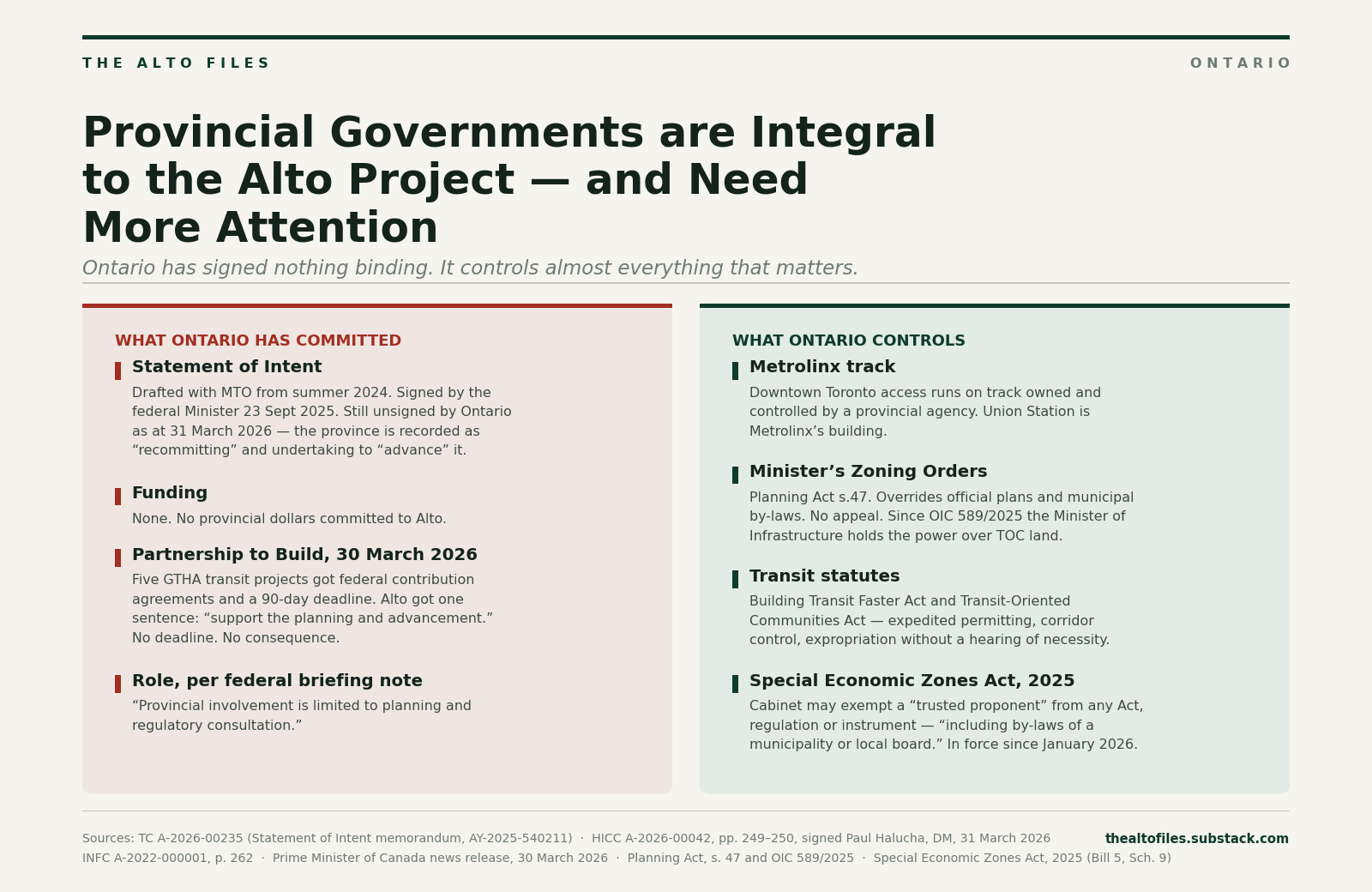
Through the Canada–Ontario Partnership to Build agreement, Ontario is recommitting to the Alto initiative and will advance a Statement of Intent signalling the common benefits of the HSR Initiative, as well as the signing parties' intention to continue to support its planning and design phase.
“Will advance”. Future tense, in the last week of March 2026.
That matters because of what came immediately beforehand. Transport Canada began drafting an Ontario Statement of Intent with the Ministry of Transportation as far back as the summer of 2024. A separate memorandum — record AY-2025-540211, released this month as A-2026-00235 — took that draft through the department's full approval chain in September 2025: Senior General Counsel Nathalie Sarault on the 17th, Assistant Deputy Minister of Major Projects Vincent Robitaille on the 18th, the Deputy Minister on the 22nd, and the Minister of Transport on the 23rd.
The federal side signed. Eighteen months after drafting began, and six months after the Minister put his name to it, Ontario still had not as far as the public record shows.
The Partnership to Build is mostly a housing agreement: $8.8 billion over ten years in federal and provincial money to lower municipal development charges, plus an HST rebate on new construction. Transit rides along at the back.
Six transit items are listed. Five of them — the Ontario Line, the Eglinton Crosstown West Extension, the Scarborough Subway Extension, the Yonge North Subway Extension and the Hamilton LRT — come with federal contribution agreements, and the two governments gave themselves 90 days to conclude them.
The sixth is Alto. In the Prime Minister's press release, the entire commitment is to "support the planning and advancement of the Alto HSR initiative" along the Toronto–Québec City corridor. Ontario's version of the announcement adds that the parties commit to working collaboratively toward the same end.
No money. No deadline. No deadline for a contribution agreement. No measurable obligation, and no consequence for failing to meet one. Five transit projects got instruments; Alto got a sentence.
The signed agreement has not been published, if it has been signed. What exists publicly is the announcement language above, on both governments' websites.
That is the instrument through which, one day later, a federal deputy minister recorded Ontario as "recommitting."
The second word on that page deserves as much attention as the first.
You do not recommit to something unless your commitment lapsed. That is a federal deputy minister's own characterization, in a document he signed, of where Ontario stood in March 2026 — four months before anyone had heard anything about a reciprocity deal over an island airport.
If Ontario's commitment had already weakened by the winter of 2026, then the July fracture is not the story. It is the visible surface of something that had been happening quietly earlier, and the Billy Bishop decision is when it became public, not the original cause for concern.
The same page records what Ontario's role actually is: "Provincial involvement is limited to planning and regulatory consultation." No funding. No delivery role. No equity. Ontario is not a partner. It is just another consultee that had been asked to sign a non-binding letter, and hadn't. In that regard, it’s not all that different from some municipalities, although I expect Ontario has signed an NDA.
There is a second set of documents that explains how Ontario came to be at the table at all — and it is not the story the federal government or the Ontario government has told the public.
In February 2024, Alto's communications director Éric Milette sent Chief Executive Martin Imbleau a presentation for the Minister of Transport. It was about the project's renaming. One slide is titled "The Addition of Speed Generates Positive Reactions." Under the heading "Elected officials," the fourth bullet reads:
Discussions with political leaders such as Quebec Premier François Legault and Ontario Premier Doug Ford have provided overwhelmingly positive feedback and support after our focus on speed and reliability.
The same slide reappears months later in August 2024, in a deck prepared for Alto's Board of Directors.
Two slides earlier, the February deck sets out what "our focus on speed" meant:
During fall of 2023, we have asked the bidders to propose a second option without speed limitations. Concurrently, we shifted our efforts to focus on rapidity.
So: in the autumn of 2023, Alto asked the three bidding consortia to price a version of the railway with no speed ceiling, and simultaneously rebuilt its own public messaging around speed. By early 2024 it was telling the Minister that this repositioning is what had brought the Premier of Ontario onside.
The accompanying rationale memo is blunter about why the change was needed. The concept of high frequency, it says, "faces strong opposition," with "widespread disinterest and dissatisfaction associated with the term," while "discourse related to higher speed are met with openness." Project awareness, it notes, was "relatively low, especially in Ontario". That was offered as the reason to “rebrand immediately”, before more people learned what the project was.
By August 2024 the instruction to the Board is explicit: "We must continue to shift away from the high frequency narrative to keep the public and stakeholders engaged."
The change to high-speed seems, at least in part, to have been a marketing initiative, rather than a technical recommendation.
Here is why all of this matters beyond Ontario.
In February 2025, Christiane Fox — then Deputy Clerk of the Privy Council and Deputy Minister of Intergovernmental Affairs — briefed a minister on how the project came to change from high frequency rail to high speed rail.
Her account in that memo was that the bidders drove it: all three consortia came forward with more ambitious designs, higher speeds, new alignments, and “third-party analysis subsequently found the high-speed option delivered greater benefits”. I’ve asked for that third party analysis and it has not yet been produced to me. Transport Canada directed me to the Privy Council’s office as somehow they did not have it. I’m waiting for the Privy Council’s response.
Alto's records show Alto itself asking for the speed-focused option in the autumn of 2023 based on the initial public’s reaction to the project while at the same time reorganising its communications, its brand and its political outreach all around the concept of speed.
Those are two different accounts of who drove a decision that added tens of billions of dollars and decades more construction time to a public project. one explanation came from the Privy Council’s office in 2025, the other comes from Alto and government departments.
A 2022 Infrastructure Canada deck, prepared for a Deputy Ministers Oversight Committee, sets out a problem:
HFR will need to access downtown stations in major urban centres such as Toronto, Montreal and Quebec City and the intercity route using tracks owned and controlled by CN, CP, Metrolinx, Quebec Gatineau Railway, Exo or CDPQ Infra.
Metrolinx is a provincial agency. Downtown Toronto access runs through track Ontario controls. That is leverage.
The second thing Ontario has comes from the constitution: land use planning law — a provincial responsibility that is usually delegated to municipalities, although Premier Ford has been known to fiddle in areas that were traditionally municipal business (especially in Toronto).
The railway itself is beyond both municipal and provincial reach. A federally regulated railway undertaking falls under sections 92(10)(a) and 91(29) of the Constitution Act, 1867, and interjurisdictional immunity and federal Crown immunity do the rest. No council or province is going to zone a corridor eyed by the federal government out of existence.
Station-area and transit-oriented development lands are treated very differently. Those are ordinary real estate developments, governed by Ontario's Planning Act. Records released in A-2026-00042 show the Co-Development Phase work plan includes “identifying zoning changes needed” around potential stations, and “seeking consensus on location-specific plans and targets”. The federal value-capture model — the part that is supposed to help pay for this — runs on municipal upzoning that Canada cannot compel but that the provinces can. To get what it needs out of land development and keep the project on time, it needs municipal cooperation to push aside pesky municipalities and their residents.
Ontario has recently instituted three mechanisms to override municipalities. It would be fascinating to research whether any of these mechanisms were put in place specifically in consultation with the federal government, although I likely don’t have time to dig into that. Real journalists could.
Minister's zoning orders. Section 47 of the Planning Act lets the Minister zone land directly, overriding an official plan and a municipal by-law, with no appeal. Bill 17, the Protect Ontario by Building Faster and Smarter Act, 2025, expanded the power to impose conditions on the use of land and buildings. By Order in Council 589/2025, made 8 May 2025, the Minister of Infrastructure (not only the Minister of Municipal Affairs and Housing) can issue these orders over land designated under the transit-oriented communities regime.
The transit statutes. The Building Transit Faster Act, 2020 and the Transit-Oriented Communities Act, 2020 give the province expedited permitting, corridor control, utility relocation and expropriation powers, and Bill 17 widened both from four named priority projects to “provincial” transit projects generally, including the GO network. The catch, and it matters: a provincial transit project is defined by reference to what Metrolinx has authority to carry out. Alto is a federal Crown project. On its face these statutes do not capture it — but they do capture the GO and Metrolinx infrastructure an Alto station would sit inside, and Union Station is Metrolinx's building. The legislation could also be amended to include federal works.
Special economic zones. The Special Economic Zones Act, 2025, Schedule 9 of Bill 5, is the widest of the three. Cabinet may designate any area of the province a special economic zone. This is a similar idea that has popped up in Federal legislation for major projects. The Minister of Economic Development may designate "trusted proponents" and "designated projects." Cabinet may then exempt them from requirements under any Act, regulation or instrument — "including by-laws of a municipality or local board" — and may extinguish certain lawsuits and causes of action entirely. The enabling regulation took effect at the start of 2026, just as Alto was rolling out public consultations.
So when the federal work plan says the parties will "seek consensus" with municipalities on zoning around stations, it is worth knowing that Ontario does not need agreement from its municipalities. It has at least three ways to simply decide on its own how communities throughout eastern Ontario are dealt with.
That is why we need to focus on the provinces.
Ontario's leverage over Alto is not really its enthusiasm. It is that the province is the only government that can deliver the land-use side of this project — and the only one that can quietly, or loudly, decline to.
Quebec's toolkit is narrower but not empty.
Sections 158 to 165 of the Loi sur l'aménagement et l'urbanisme allow the government, by decree, to declare a zone d'intervention spéciale — a special intervention zone in which the government sets the applicable planning rules over the heads of the municipality and the regional county municipality. The process requires a draft decree published in the Gazette officielle and a consultation, but the decision is Cabinet's.
There is also a precedent for doing it project by project. The Loi concernant l'accélération de certains projets d'infrastructure, adopted in December 2020, set aside municipal planning conformity for the projects listed in its Annex I: the responsible body notifies the municipality, and if the municipality declines to issue permits, a public declaration of the project makes it conform. Public consultation and referendum approval do not apply. The same statute also created a stripped-down expropriation route applicable to provincial projects.
Alto is not on that list as of today. The list was fixed in 2020 and has roughly 180 projects. But the statute is the template, and adding a project to a list is a much smaller legislative act than building a new regime.
Two smaller items from the same March 2026 note are both worth watching.
The delivery model, it says, "was originally designed to transfer construction risk to the private partner, Cadence" — and then the rest of the paragraph is redacted. Originally designed is not idle phrasing on a page signed by a deputy minister. Something changed, and the reader is not permitted to know what it was, only that it impacts who holds the construction risk.
The Ontario Statement of Intent itself — Annex A of the September 2025 memorandum, pages 5 to 8 — was withheld in full under sections 14 and 21(1)(a) and (c). A released portion of that same memorandum states that both the Ontario and Quebec Statements were to be made public after signature. They have not been published and there has been no strong announcement from Ontario backing the project.
Ontario Statement of Intent memorandum, AY-2025-540211, released as TC A-2026-00235
HICC A-2026-00042, briefing note WebCIMS #86846, pages 249–250
TC A-2025-00025, naming and rebranding disclosure package, pages 32, 34, 36, 52, 53
INFC A-2022-000001, Deputy Ministers Oversight Committee deck, pages 259–262
No posts
Comments
Nothing yet. Say the first thing.
Sign in to join the conversation.