
What you need to know
Alto is a passenger railway in public, and at least four other things in the documents. Freight capacity relief, fibre, energy corridor, and station-area land. Only the first has been explained to the public.
Alto commissioned and published a report saying the project frees CN’s mainline for 55 per cent freight growth over thirty years and defers capital investment CN would otherwise have to fund itself. The report does not put a dollar figure on that benefit, and nobody has said whether the public got anything for it.
VIA and CN have been fighting over exactly that question since 2018. VIA asked the federal regulator in June 2023 to impose a track access agreement, telling it that negotiation with CN appeared doomed to fail. No decision has been published. The government announced Alto in February 2025.
Budget 2025 committed to a “dig once” policy putting fibre optic lines into nation building projects. Alto is referred to the Major Projects Office. The policy says nothing about who owns the fibre, who may lease it, or who profits.
The national AI strategy commits Canada to expanding coast to coast fibre to link sovereign compute. No route. No ownership model. No access framework.
Canada has built fibre in rail corridors before. CN granted access in the 1990s, kept the land, and the asset ended up with a US listed company. CN discloses no revenue from it.
Metrolinx has required leasable communications conduit in its rail corridors by written engineering standard since 2018. Alto’s chair ran Metrolinx for nine years. Whether that practice carried across is an open question.
Schedule 1 of the Building Canada Act is empty. Nothing has been designated, including Alto. That matters because the Act’s mandatory disclosure regime, including publication of cost estimates and of reasons where departmental advice was rejected, is triggered only by listing. Parliament legislated the transparency. It has never operated.
Canada spent eight years and forty peer reviewed studies on shared infrastructure corridors. The research concluded that pre-approved rights of way are the element communities reject, and recommended a government “assembler” that holds corridor land and auctions access to recover value for the public.
The European Union has legislated what Canada has not: mandatory access to railway ducts and masts, published route data, and an independent dispute mechanism, in force since November 2025.
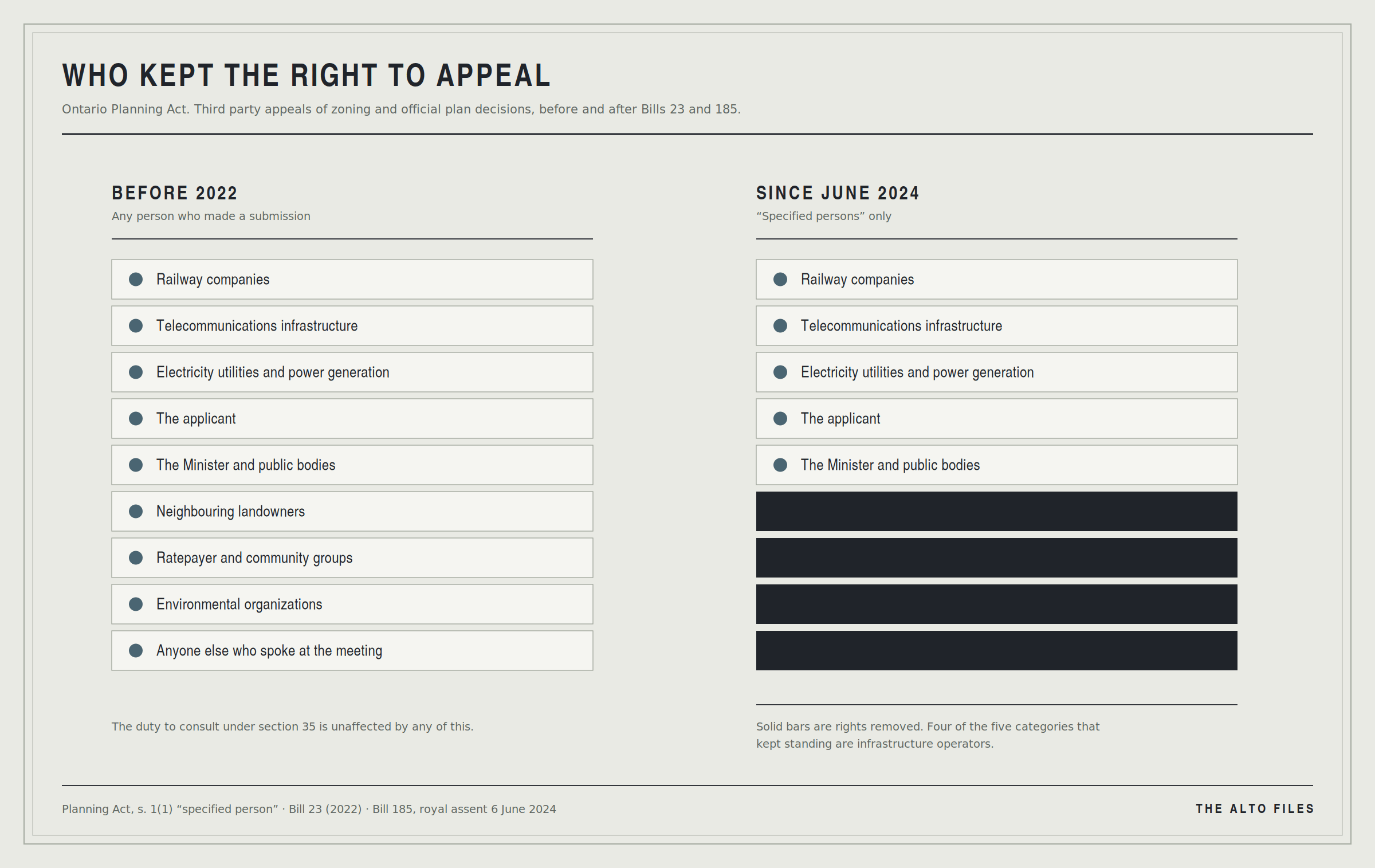
Ontario’s new data centre framework does not contain the word corridor, and treats municipal zoning as a staffing burden in a footnote. Third party appeal rights for the public were removed in 2024 but railways and telecom companies kept theirs.
None of this proves or even implies a hidden plan. What it shows is that four government strategies point at the same strip of land, and the records that would show whether anyone connected them are withheld or redacted.
Alto is presented as a passenger railway. The government has published four separate strategies in the past ten months that each depend on a corridor, and has withheld most of the documents that would show whether they are connected.
Everything below is drawn from a government document, a public filing, a regulatory record, an audit office report, peer reviewed research, or a company announcement.
In June I asked a narrow question about the Alto corridor: who owns the fibre and the other ancillary rights in a publicly funded rail right of way. I have spent two months on it and the question has grown.
The answer I have arrived at is not that there is a secret plan. It is something more mundane and, I think, probably more troubling. Four federal and provincial policy streams have converged on requiring a single strip of land, none of the documents governing them mention each other, and the records that would likely show whether anyone in government has connected them are almost entirely withheld or heavily redacted.
What follows is an attempt to set out everything the corridor may be asked to do, beyond just a place to carry passengers by train.
Why isn’t the government or the media talking about it?
Across roughly ninety access to information releases that I have catalogued, the recurring feature is not any sort of deliberate falsehood. It is differential disclosure to different audiences and withheld information.
The same project is described one way to Parliament, another way to a board, another way to municipalities, a different way to business audiences or possible investors, and another way to the public. The differences are not random.
I have written before about specific instances. The board documents describing a Stakeholder Capture Plan and an Indigenous Relations Capture Plan, using language that has never appeared in any public communication. The internal strategy documents with names like Pumpkin and Judo. The sentences removed between drafts of a chief executive briefing deck. The cost estimates that continue to be withheld under section 18(b) of the Access to Information Act even when the government and Alto have published a public number for the cost estimate and has repeated it consistently.
Add to that the Major Projects Office project pipeline, released this month with the substance withheld under sections 14, 15(1), 20(1)(c), 21(1)(a), (b) and (c), 23 and 69(1)(g). The immaterial covering email survived though. The list of what the federal government is fast tracking, and how those projects were ranked as against each other, does not. The public doesn’t get to know that, apparently.
And there is a fourth kind of gap, which I only found this week: transparency that Parliament legislated and that has never been switched on. I set it out below in the section on the Building Canada Act.
This article does not attempt to establish that there is a plan for the corridor that is being concealed. Governments withhold information for reasons that are lawful and sometimes sound. Cabinet confidence is a real privilege that exists in Canada, but it is not supposed to attach to matters being actively worked on across countless government departments.
The purpose of this article is to show that the public cannot verify the government's reasons for building Alto, and after literally months of reading probably tens of thousands of pages of government documents neither can I. I know something is being redacted repeatedly. I do not know what it is.
But when four government strategies point at requiring a similarly described corridor and the connecting documents are mostly redacted, the honest position is that we do not know, and that we have not been given the means to find out. That is a trust problem regardless of what the withheld pages actually say. It is not a hallmark of a properly functioning democratic government.
So read the rest of this as an inventory of what the corridor could do, drawn entirely from documents that are public, with the most important information gaps noted.
The stated reason is passenger rail service. That reason is real. The quality of our passenger rail service is poor and performance is unreliable due to freight traffic priority. Canada is the only G7 country without high-speed rail, the Quebec City to Windsor corridor carries the country's densest travel demand, and VIA's on-time performance on borrowed track collapsed to 30 per cent in early 2025, from 72 per cent the year before.
But it is not the only reason, and the others are documented.
Alto's commissioned report says the project relieves CN's mainline for 55 per cent freight growth over thirty years. That defers capital investment CN would otherwise have to fund itself, while making rail-adjacent parcels along CN's corridor more attractive for industrial development.
The federal government has committed to installing fibre in nation-building corridors under a “dig-once” policy, to expanding coast-to-coast fibre to link sovereign compute, to doubling the electricity grid, and to prioritising energy corridors through the same office now handling Alto.
The project's co-development work plan contemplates municipal zoning changes around stations to support land value capture. The Government of Canada is building a thousand-kilometre publicly owned right of way through the most valuable land in the country, and a passenger railway is one of at least four things that corridor is capable of carrying.
Whether anyone in Ottawa has considered those four things together, I cannot tell you, because the records that would show it are not public or are behind redactions.
That is the point.
Our democracy is not functional if the public and the media do not have access to information that would help us understand what it is the government is doing.
This is the most concrete of the non-passenger rationales, and I did not have to infer it. It is not redacted. Alto commissioned it, and published it on its website.
In June 2026 Alto released High-Speed Rail and Freight Capacity: Potential Freight Benefits of Alto, prepared by the Ottawa consultancy CPCS (who I understand from speaking to rail-people is a trusted consultant). The report carries the usual disclaimer that the opinions are the author's and do not necessarily reflect Alto's views, and that the analysis is order of magnitude and directional (my dedicated readers may recognize that phrasing).
The report discusses that between Toronto and Montreal, passenger trains run on CN owned track, and the mix of passenger and freight trains is close to fifty fifty. CN runs about eight to thirteen freight trains daily on that segment, and three to five between Montreal and Quebec City.
In 2023 roughly $80 billion of freight moved through the Toronto to Montreal corridor, which the report equates to 2.8 per cent of Canada's GDP. Of that, about $50 billion moved on the CN mainline, the same line VIA operates on. That is 18 per cent of total Canadian rail flows by shipment value and 11 per cent by tonnage, which tells you the corridor carries higher value goods than the national average.
The commodity breakdown is the trade diversification argument in a nutshell. Ten per cent of Canada's potash exports, worth $12.4 billion. Four per cent of rail borne wheat. Five per cent of the crude oil and gas consumed in Quebec and Atlantic Canada, providing resilience to pipelines. Ten per cent of forest products produced in Quebec and Atlantic Canada. Seventeen per cent of Quebec's industrial output of metals, plastics and chemicals, and 35 per cent of its metals exports, worth $17 billion. And $42 billion of mixed and high value freight, described as a critical link in the coast to coast intermodal network connecting to East Coast ports.
I haven't bothered double-checking any of the numbers as that's not the point.
Now the conclusion. The report says it would be reasonable to "protect sufficient capacity for 55% higher freight volumes in the Toronto–Montréal corridor" over the next thirty years, and that accommodating that growth without degrading passenger service would imply significant investment even in the absence of Alto. Absent Alto, the capacity to carry 55 per cent more freight on CN's mainline would have to be built, and CN is a private company that would ordinarily need to acquire land and build it.
With Alto, the public builds a separate $60 billion to $90 billion corridor, passenger trains largely vacate CN's line, and the investment CN would have needed is deferred or avoided entirely.
The report is candid that this is a benefit it is counting: Alto may help avoid or defer infrastructure investments in the shared corridor. This is a benefit to CN, a private company.
It also anticipates that removing passenger conflicts may induce new freight demand, and that building a separate line may signal to industry that rail adjacent parcels along the CN corridor have become more desirable and valuable for industrial development.
That last point deserves attention from anyone following the land value capture thread. The report is describing land value uplift accruing along CN's corridor, created by public spending on a different corridor, captured by nobody in particular.
The strategic benefits section is more explicit. Alto brings resilience, because a disruption on one line no longer forces passenger, CN and CPKC traffic into a single corridor, as happened during the 2020 blockades east of Toronto (in one of the very regions this corridor will also pass through). Alto supports trade diversification, the report says, because the ability to count on two dedicated east west freight lines is expected to be a selling point in attracting investment for new export industries.
Two dedicated east-west freight lines. In a document about a passenger railway.
A public project can have private beneficiaries and still be worth building. But the freight case has never been made to the public as a reason for Alto from the government's mouth. At least not to communities in eastern Ontario. It was made in a consultant's report posted to a website in June, and it is a substantial part of the answer to why a government would spend this kind of money.
Why hasn’t it said so?
Note also what the report does not say. It does not quantify the value of the deferred CN investment. It does not say whether CN has agreed to anything in exchange. It does not address whether the public captures any part of the benefit it is conferring at all.
There is a further piece of context that the freight report does not mention, and it is on the public record in a live regulatory proceeding.
VIA and CN have been in open conflict over exactly this question, who pays for corridor capacity, for years. VIA's track access contract with CN expired in 2018 and was extended temporarily eight times.
On June 2, 2023 VIA applied to the Canadian Transportation Agency to have a new agreement imposed, seeking more trains on the Quebec City to Windsor corridor, better on-time performance, and what it described as more reasonable rates. In its submission VIA told the regulator that "continued attempts at negotiating with CN appear doomed to fail."
The application was brought under section 152.1 of the Canada Transportation Act, which allows the Agency to decide the matter in a contract dispute between a public passenger service provider and a railway company after reasonable efforts to resolve it have failed.
VIA's filing records its corridor on-time performance falling from 84 per cent in 2011 to 56 per cent in 2022. It reached 30 per cent by the first quarter of 2025. VIA told the regulator that its captive client status and CN's quasi-monopolistic position allow the railway to prioritise its own locomotives, and that this is by far the most significant cause of VIA's delays on CN infrastructure.
CN's public response framed the dispute precisely as a question of who bears the cost. Its spokesperson said the pending dispute was the result of VIA looking for improved performance at a “lower cost to itself”, with increased costs to CN to maintain dedicated track routes for passenger needs.
CN also said it continues to support the development of dedicated rail infrastructure that would address those needs while preserving freight railways' ability to support the growing needs of the Canadian economy. That is CN, in late 2024, saying it supports someone else building a dedicated passenger line.
The contract expired in 2018. Eight extensions followed. VIA applied to the regulator in June 2023 saying negotiation is hopeless. On February 19, 2025 the federal government announces it is proceeding with Alto. In June 2026 Alto publishes a report explaining that the project relieves CN's mainline and defers capital investment CN would otherwise have needed.
I am not saying Alto was built to end a regulatory dispute. That would be a much larger claim than the record supports, and the passenger rail argument for a dedicated line predates the dispute by decades.
What I am saying is that a commercial argument the Crown corporation appeared to be losing was resolved, in substance, by a public decision to spend tens of billions of dollars building a second corridor, and that this sequence has not been described to the public in those terms by anyone.
As of writing I can find no published Agency decision on the application, and no announcement that it has been discontinued. The Agency's rail news page carries no reference to it. CN's submission remains subject to a confidentiality request. If the application has been withdrawn, the date of withdrawal relative to February 19, 2025 would be worth knowing.
I asked in June who owns the fibre in a publicly built corridor. Since then the federal government has answered the second half of that question without addressing the first.
Budget 2025. In November 2025 the government committed to "coordinated installation of fibre optic lines as part of the development of major projects" of "national significance", under a new dig once policy for nation building projects.
Alto is a nation building project in the government's language. It was among the initial projects referred to the Major Projects Office in September 2025, and the MPO's own project page still records its status as referred for consideration.
So a federal dig once policy for major projects of national significance points directly at a 1,000 kilometre publicly funded right of way through the densest data geography in the country.
The policy says fibre should go in during construction.
It says nothing about who owns or gets to lease it afterwards or who profits.
It is worth being precise about that status, because there is a legal category it is not, and the difference turns out to matter a great deal.
Under the Building Canada Act, a national interest project means a project named in Schedule 1.
Getting there requires a Governor in Council order on the Minister's recommendation, a thirty day notice in the Canada Gazette, consultation with the province or territory where the project will be carried out (here, Ontario and Quebec), and that province's written consent where the project falls within areas of exclusive provincial jurisdiction.
Schedule 1 is empty. The schedule appears with its heading, its two columns for name and description of project, and no entries. No project has been designated. Not Alto, not anything.
The only listing in progress that I can find is the West Coast Oil Pipeline, gazetted under subsection 5(1.1) on August 1, 2026, with the responsible Minister consulting Alberta and British Columbia. That thirty day clock is running now. The “dig once” policy presumably applies to it, making it a pipeline and data project, although it’s not advertised as such.
So "nation building project" and "project of national significance" are administrative and political descriptions. They are not the statutory designation, and Alto does not hold it.
That distinction matters more than terminology, because Schedule 1 designation switches on a disclosure regime that has not operated for Alto.
Section 5.1, added by Bill C-15, requires the Minister to establish a public registry containing, for each listed project, a detailed description and the reasons it is in the national interest, the extent to which it is expected to meet the statutory outcomes, detailed cost estimates that exclude private sector commercially sensitive financial information, and estimated timelines for completion.
Section 8.1 goes considerably further. At least thirty days before the authorization document issues, the Minister must make public all the conditions that apply to the project, the full contents of the studies and impact assessments conducted, all recommendations received from federal departments and agencies, written reasons where recommendations were not accepted including a comparative analysis and a risk assessment, and a description of the normal regulatory process that would have been followed had the project not been designated under the Act.
A report containing all of it must be tabled in each House of Parliament, and at the request of ten or more members the Minister responsible must appear before committee to explain the decisions made on the record.
Read that against everything I wrote in the first section of this article
Parliament attached a substantial mandatory transparency package to the fast track power, including publication of cost estimates. The Major Projects Office is advancing projects without triggering the schedule that turns it on and activates disclosure.
Schedule 1 designation is not a precondition of MPO support, and the government may simply not have reached a decision on any project. But it belongs in this article because it is the cleanest example in the whole file of transparency that exists in statute, in theory, but that cannot be practically accessed.
There is also a provision worth noting for anyone assessing what designation would actually mean on the ground.
Section 6 provides that every determination and finding that has to be made, and every opinion that has to be formed, in order for an authorization to be granted in respect of a national interest project is deemed to be made in favour of permitting the project to proceed. That is the blanket pre-approval mechanism. Hold that thought, because it becomes very important later in this article.
One further section deserves attention from anyone who has followed the conflict of interest threads in this publication. Section 5(6.1) provides that before recommending a listing, the Minister must be satisfied that the proponent and its directors, officers or significant shareholders have not been found to have committed a violation under the Conflict of Interest Act and are not the subject of an ongoing proceeding, and that every reporting public office holder who could be in a conflict in relation to the proponent has recused themselves. Alto has no reporting public officers, as I set out in another article.
That is a statutory conflict screen attaching directly to designation which may not even apply to Alto.
Six months after Budget 2025, AI for All committed that "Canada will expand diverse high-capacity fibre lines and satellite connectivity", describing coast to coast connectivity as necessary to link sovereign compute systems. The same pillar records that Canada will need roughly 5.5 gigawatts of commercial AI compute by 2030, and that partnerships under negotiation propose 850 megawatts by 2030 scaling toward 2.3 gigawatts.
Again: no route, no ownership model, no access framework.
What Canada already built this way.
The east west fibre backbone in this country substantially sits in railway rights of way, and the history of how it got there is a caution rather than a model.
CN and CP owned CNCP Telecommunications, which moved from telegraph to microwave to fibre. Rogers took a major stake in 1984 and CN sold its remaining share in 1988. CN exited the business and kept the land.
In the late 1990s Ledcor of Alberta struck a deal with CN to lay fibre alongside the tracks, invented a rail mounted plough to do it quickly, presold capacity, and spun out Worldwide Fiber to sell the surplus. Engineering documentation from the period describes a 7,500 kilometre system from Toronto to Vancouver, primarily along CPR and CN rights of way. Worldwide Fiber became 360networks. Zayo acquired 360networks in 2011.
The clearest description of the arrangement is in a Transportation Safety Board investigation report from 2000, which records that 360networks had an agreement with CN to build and operate a fibre optic system on the Guelph Subdivision right of way, and, describing a short line that had leased running rights for twenty one years, that "CN retains all other right-of-way land rights."
CN separated the right to run trains from the right to occupy the corridor, kept the second, and licensed it. That is a question now live on Alto, answered in a safety report twenty six years ago.
What CN has today is a permitting regime, not a data business. Its utility crossing and encroachment package assigns agreement numbers and sets setbacks. That is income per linear metre. And it is invisible: CN's financial statements define other revenues as non rail logistics services, vessels and docks, transloading, automotive logistics and freight forwarding. Corridor telecommunications licensing does not appear.
Compare SNCF, which built and owns Terralpha to monetise its own corridor, and the JR companies in Japan, which lease Shinkansen fibre as a revenue line. Canada's largest corridor owner did neither.
It granted access once and the value went elsewhere.
That is the precedent Alto is walking into, with one difference. VIA owns about three per cent of the track it uses. Alto will own a continuous right of way in fee simple, which no Canadian purely passenger operator has done in roughly a century.
One Canadian public agency already plans for this in writing.
Metrolinx's Rail Corridor Raceway Requirements (MX-ELEC-RCWY-2018-REV0, approved November 2018) requires raceways along the right of way whenever civil or track expansion occurs, designed for existing and future needs. Section 3.6.2 sets minimum mainline conduits. For communications it requires six 53 millimetre orange conduits for fibre optic systems, one brown for radio, and two purple for "Corporate Network, Operation/Station, Leasing, and Communications System".
Leasing, as a mandatory minimum, in a colour coded duct assignment, since 2018.
Robert Prichard was president and chief executive of Metrolinx from 2009 and chair of its board until he resigned on July 12, 2018. He is now chair of Alto. I want to be careful here. The raceway standard was approved four months after he left, and it is likely a staff level engineering document. I am not suggesting otherwise. The point is simply that the person now chairing the corporation assembling a new national corridor spent nine years leading a public agency that owns rail corridors and standardised leasable conduit inside them.
Whether anyone carried that practice across to Alto is a fair question worth asking. Along with who gets the profits and what are the broader intended impacts.
On May 14, 2026 the federal government released Powering Canada Strong, committing to double Canada's electricity supply by 2050 at a cost above $1 trillion. AI for All cross references it, describing the doubling as what allows sustainable base load to be paired with sovereign AI data centre build outs.
Four features matter here. Interprovincial interties are designated projects of national interest, prioritised through the Major Projects Office. The Clean Electricity Investment Tax Credit is extended to major high voltage intra provincial transmission, which is the transmission that connects generation to load and gets power to new mines, factories, data centres and electrified railways.
The Canada Strong Fund seeds a $25 billion sovereign wealth fund focused on nation building projects including trade and energy corridors. And the Canada Infrastructure Bank's capital envelope rises from $35 billion to $45 billion, the same increase that appears in the February 2026 mandate letter that added AI and digital infrastructure as a CIB sector.
So the word corridor, absent entirely from Ontario's data centre framework, is central to the federal electricity strategy, financed through a sovereign wealth fund and prioritised through the same office that is handling Alto.
I have written before about land value capture and transit oriented development around Alto stations.
HICC A-2026-00042 shows the Co-Development Phase work plan includes identifying potential zoning changes needed around potential stations, and seeking consensus on location specific plans, zoning changes and targets. The federal programme depends on municipal upzoning that Ottawa cannot compel.
Greater Napanee shows what that looks like in practice and how easy a very substantial change can be made.
In February 2026 the town amended its zoning by law to add "data processing centres" as a "permitted use" in the General Industrial zone. Before the amendment, a data centre required a zoning by law amendment, which triggers a statutory public meeting under the Planning Act. After it, a proponent goes directly to Site Plan Control, which carries no mandatory public meeting and is usually just delegated to staff.
Site plan control cannot refuse a permitted use.
Meanwhile a 250 megawatt load called Napanee Data Park sits in Ontario's IESO interconnection queue, filed in 2025 by Napanee Environmental Complex, Inc., with a proposed in service date of early 2028.
The town's chief administrative officer has said no applications of any kind have been received, while confirming staff have been actively working to attract energy intensive investment. The Kingstonist first reported the queue listing.
Who is behind it is not publicly known. Asked to identify the owner, the engineering firm on the project, Lazier Engineering Partners, told DataCenterDynamics it could not disclose owners, investors or sites because of client confidentiality. Its own case study page, in the version indexed around June 2026, named Napanee Environmental Complex Inc. as client and owner of 250 megawatts. The live page, modified August 7, 2026, has removed that name, raised the figure to 300 megawatts, and lists the client as AWS/Microsoft Corporation. The same page states the project has been exempted from "Provincial and Federal Government restrictions as well as Municipal zoning bylaws."
I am not reporting that either hyperscaler is behind this project. That attribution contradicts the firm's statement to a trade publication and neither company has announced anything in Napanee. What I am reporting is that the page changed and the entity name was removed. Corporate searches would reveal more information but Napanee is not the focus of this article. I’ll leave that puzzle for someone else.
Napanee is not unusual. In Burlington a data centre is proceeding through site plan control with no zoning amendment required and no public meeting, because the city's by law already recognises the use under its Information and Data Processing and Office definitions, despite an indicated requirement of roughly 20 megawatts.
Hamilton's June 2026 planning committee motion asked for an interim control by law applicable to the zones where the use is currently permitted, which is an admission that it already was.
Oh. And an appeal route was gone before any of this even started thanks to the provincial government.
Bill 185 received royal assent on June 6, 2024 and eliminated third party appeals of official plans, official plan amendments, zoning by laws and zoning by law amendments. Standing is now limited to the applicant, the Minister, public bodies, specified persons, and affected registered owners who made submissions.
It is worth setting out what the rule used to be, because the change is larger than it sounds. Under the former Planning Act, any person who made oral submissions at a public meeting or a written submission to the approval authority before the decision could file an appeal with the Tribunal. That was the rule for official plan amendments, zoning by law amendments, minor variances and consents. Show up, speak or write, and you had standing.
Bill 23 removed that right in 2022 for minor variances and consents and introduced the narrow "specified person" definition. Bill 185 extended the same removal in 2024 to official plans, official plan amendments, zoning by laws and zoning by law amendments. So in the space of two years, the participatory right that had existed for decades was closed off across the instruments that decide what can be built and where.
The definition of "specified person" is worth reading. It is a list of who has legal rights in the proceeding. It is a list of infrastructure operators, generally limited to companies involved in utility, power generation, rail operation and telecommunication infrastructure.
In a province building a rail corridor during a data centre boom, the two categories of party that kept their appeal rights are railway companies and telecommunications infrastructure providers. The farmer or entire town whose land abuts the site did not. Neither did environmental groups or public interest advocacy groups.
Indigenous communities require a separate note, and I want to be careful. The Crown's duty to consult under section 35 of the Constitution Act, 1982 exists independently of the Planning Act and is not extinguished by anything in Bill 185. What Bill 185 removed was the ordinary Tribunal appeal route available to anyone who had made a submission. An Indigenous government may in some circumstances fall within the definition of a public body, and that is a question for their counsel rather than for me.
I do not think that was designed specifically with data centres in mind and I have seen no evidence of that. The definition predates the AI build out and its original logic is defensible.
The effect in 2026 during a public outcry about data centres is what I am describing.
This is the part that changed my view of the whole file, and I want to set it out carefully because it is the strongest thing in this article.
Canada has an eight year, peer reviewed research programme on exactly the question this article asks: how to bundle road, rail, pipeline, transmission and communications infrastructure into a shared right of way, who should own it, how it should be governed, and, importantly, whether communities will accept it.
The Canadian Northern Corridor Research Program was run by the University of Calgary School of Public Policy with CIRANO from 2015. It produced its final report in April 2025: over forty individual studies by more than fifty contributing researchers across eight research themes, plus eighteen community engagement events and seventeen rights and stakeholder roundtables. Every paper is listed and linked in its appendix. It is free to read.
Four things about it matter here.
After testimony from the programme's researchers, the Standing Senate Committee on Banking, Trade and Commerce recommended in 2017 that the programme receive $5 million in federal funding.
The final report records what happened next.
The federal government did not provide the funding. The programme obtained money from the Government of Alberta, augmented by matching funds from Western Economic Diversification, now PrairiesCan. The combined total was less than the $5 million the Senate had recommended.
So the federal government was advised by its own Senate committee to fund research into national infrastructure corridors, declined, and Alberta paid for it.
Nine years later Ottawa is building a corridor and legislating a corridor approval regime.
Phase 1 of the study, from 2015 to 2018, was macroeconomic and trade analysis plus preliminary work on Indigenous engagement and the duty to consult on major linear infrastructure. It found that better transportation infrastructure in the territories alone could add $6.5 billion to GDP, and it identified clear gaps in Indigenous consultation on infrastructure projects.
Phase 2, from 2019 to 2023, was interdisciplinary across law, geography, engineering, business, sociology, political science and economics, and it included the engagement programme.
The engagement programme changed the entire concept. The final report states that researchers identified community level concerns with the idea of a "pre-established rights-of-way" that might limit or remove individual communities' agency over large scale development in their regions.
As a result the corridor concept evolved away from specific geographic rights of way with predefined clearances, toward a long term intergovernmental infrastructure strategy developed with municipal, Indigenous, provincial, territorial and federal governments.
The report is explicit that the notional route itself was de-emphasised, and that a research programme cannot do the practical engagement required to inform specific route decisions. That, it says, requires government action, collaboration among governments including Indigenous governments, and community consultation.
The engagement programme ran from January to November 2022 (Alto’s was only 4 months and seems less comprehensive in many ways). Support for the corridor concept ranged from enthusiasm to suspicion, distrust and outright rejection, and the report says the rejection was largely based on past experience with large scale infrastructure and resource development and on mistrust of both government and private corporations, particularly though not exclusively among Indigenous participants.
Communities raised environmental impacts, traditional land use, effects on key species, and the social consequences of large development on small and remote communities including community coherence, local culture, crime and violence, and worker camps.
And this, which I would ask every parliamentarian to read alongside the Building Canada Act:
The report records that many communities were worried a national scale project would neglect or override local and regional concerns, and that the idea of a pre-approved right of way was particularly concerning because it implied to many participants blanket assessments and approvals that could neglect local environmental, social and cultural considerations.
Blanket pre-approval was the element communities found most objectionable.
Section 6 of the Building Canada Act, which received royal assent on June 26, 2025, provides that every determination and finding required for an authorization in respect of a national interest project is deemed to be made in favour of permitting the project to be carried out.
The research was published in April 2025. The Act was passed in June 2025. I am not suggesting the drafters read the report and ignored it.
Researchers spent eight years and about forty studies establishing that the pre-approved corridor is the mechanism communities will not accept. Canada enacted legislation that did just that two months after the findings were published.
The programme's conclusion is that a large scale corridor concept is challenging to conceive in both theory and practice for mid and northern Canada, and it recommends a “segmented approach” focused on initiatives already gaining public acceptance and identified by communities as priorities, with digital infrastructure named as the example.
It recommends the federal government spearhead a regions based infrastructure assessment integrating the views of Indigenous, municipal, territorial and provincial governments, and it warns explicitly against a top down approach. That advice certainly has not been followed.
The four studies that answer this article's questions
Buried in that body of work are papers that address, directly and in public, the exact questions I have been putting to the government.
Who should own the corridor, and how does the public get paid.
Boardman, Moore and Vining, Financing and Funding Approaches for Establishment, Governance and Regulatory Oversight of the Canadian Northern Corridor (2020), proposes that the federal government or a consortium of governments act as an "assembler" that assembles the land rights and grants use rights to infrastructure providers, and that the assembler could be funded by auctioning corridor access to those providers, or through value captured by property, sales, corporate or personal income taxes or resource royalties.
That is a published Canadian answer to who owns the fibre and who profits, written in 2020, partly with federal regional development money. Auction the access. Capture the value. Nobody in the Alto file has cited it, and I cannot tell whether anyone in government has even read it.
Whether there is a regulatory model for a multi-use corridor.
Rowland Harrison, Regulatory Alignment for Multi-Modal Infrastructure Corridors (2023), concludes there is no established model for regulatory oversight of multi-modal corridors that fits Canada's multi-jurisdictional framework, and that establishing and overseeing the corridor should be treated as a separate question from approving the individual infrastructure placed inside it.
That is my fibre question, stated as a regulatory gap, three years before I asked it.
Whether consulting once on the corridor is enough.
David Wright, Cross-Canada Infrastructure Corridor, the Rights of Indigenous Peoples and 'Meaningful Consultation' (2020), concludes that while a corridor consultation process might attempt an envelope approach covering the most likely uses of the corridor, significant additional consultation will almost certainly be required as each specific project within it is pursued.
Alto's public consultation record describes engagement on transportation benefits and access. If conduit, fibre or other commercial uses are contemplated in the right of way, that paper says the consultation obligation does not stop at the railway.
Cherie Metcalf, Indigenous Land Ownership and Title in Canada: Implications for a Northern Corridor (2023), adds that there is legal uncertainty around government's ability to support a corridor project by “justifiably infringing Indigenous land rights” in the absence of consent.
Who was expected to pay for it? Khanal, Mansell and Fellows, Canadian Competitiveness for Infrastructure Investment (2023), observes that Canada has some of the world's largest pension funds investing in infrastructure but primarily in non-Canadian projects, and that more should be done to entice Canadian pension funds into domestic infrastructure. That was written in 2023. CDPQ Infra now leads the Cadence consortium.
Two more are worth flagging for people along this route.
Shirley Thompson and colleagues found in The Northern Corridor, Food Insecurity and the Resource Curse for Indigenous Communities in Canada (2023) that utility or resource corridors actually lead to worse food insecurity outcomes for affected Indigenous communities. And Debortoli, Pearce and Ford, Estimating Future Costs for Infrastructure in the Proposed Canadian Northern Corridor at Risk from Climate Change (2023), identify combined threats to corridor chokepoints from wildfires, freezing rain and permafrost thaw.
I wrote earlier that the intellectual work exists and nobody applied it. That was too generous to everyone involved.
The work exists.
It reached conclusions.
Those conclusions are that pre-approved rights of way are the thing communities reject, that no regulatory model exists for governing a multi-use corridor, that consulting once on the envelope will not discharge the duty, and that if a government does assemble corridor land it should auction access and capture the value for the public.
Canada has instead built a project with a pre-set route, legislated a deemed-approval mechanism, produced no public model for corridor governance, consulted on the railway rather than the corridor, and said nothing at all about who will own or lease what goes in the ground beside the tracks.
For contrast, look south. In the United States the Broadband and Telecommunications RAIL Act, introduced in November 2025, would create a framework for placing broadband in railroad corridors, endorsed by INCOMPAS, NCTA, CTIA, USTelecom and others, with the industry complaining that "permits languish for nearly 20 months". American telecommunications companies are lobbying Congress over rail corridor access.
The lobbyists have possibly done better in Canada.
The World Bank's Accelerating Digital Connectivity Through Infrastructure Sharing treats cross sector infrastructure sharing as standard practice. It notes that fibre optic cable deployment can be planned simultaneously with other infrastructure works including roads, railways, power transmission grids, sewage and pipelines, and that by digging once and explicitly making space for future deployment, the additional cost is small. It gives a figure: coordinating network rollout with road construction is estimated to add only between 0.9 and 2 per cent to the total cost of a road.
Its scope diagram lists roads and railways, power grids, gas and oil pipelines, and sewage and water systems on one side, and ducts, poles, sites, masts, dark fibre and data centres on the other. That is the same list the Canadian Northern Corridor programme uses, and the same list the Canada-Alberta MOU uses.
So when Budget 2025 says dig once, it is adopting a policy the development finance world has treated as settled for years.
What Budget 2025 does not adopt is the accompanying question that is central: who owns the shared infrastructure, on what terms is access granted, and how is the cost saving distributed in the public benefit.
This is the sharpest comparator I have found.
The Gigabit Infrastructure Act, Regulation (EU) 2024/1309, was adopted in April 2024 and applies across the Union since November 2025, with the final provisions in force May 2026. It replaced a prior Directive.
It does the thing that Canada has not. Network operators, including those providing infrastructure used for gas, electricity, railways, tunnels and sewage, must provide access to their physical infrastructure such as ducts, pipes, towers, rooftops and masts for the deployment of very high capacity networks. It applies to public sector bodies that own or control physical infrastructure, a broader class than earlier rules had covered.
It also requires transparency about the asset itself. Single information points must make available minimum information about existing physical infrastructure, including the georeferenced location, type and use of the infrastructure.
Member states must establish national dispute settlement bodies to resolve disputes about access to infrastructure and coordination of civil works, with decisions published. BEREC was tasked with producing guidelines on the coordination of civil works by November 2025.
Put the two side by side. Europe has a directly applicable regulation requiring railway infrastructure operators, including public ones, to grant access to their ducts and masts, publish the georeferenced route of the asset, and submit disputes to an independent body. Canada has a sentence in a budget saying it will encourage coordinated installation of fibre in nation building projects, with no access framework, no ownership rule, no transparency obligation and no dispute resolution mechanism.
What the three 2026 frameworks say, and what they leave out
Ontario. On August 13, 2026 the Ministry of Energy and Mines posted ERO 026-0853, the Economic and Strategic Assessment Framework for New Data Centres, with a Data Centre Playbook backgrounder. Comments close at 11:59 p.m. on September 12, 2026.
The province now holds the final decision on large load grid connections. The Playbook assesses proposals on grid feasibility and full cost recovery, including "bring your own power", and against three strategic pillars. A new rate class is proposed for data centres above roughly 1 megawatt.
Zoning appears once in the document, in a buried footnote 3. It is defined as the ability of municipal staff to assess a proposal against existing zoning and the community's capacity to fund roads, water and sewer. Municipal planning is treated as a workload and a bill, not a decision. Fibre appears once, listed as a community benefit alongside improved roads. The word corridor, and the word rail, do not appear at all.
Quebec. Since 2023 ministerial authorization has been required above 5 megawatts, and Bill 69 consolidated that in 2025. Hydro-Québec's tariff application, R-4333-2026, proposes about 13 cents per kilowatt hour for data centres of 5 megawatts and up, a 91 per cent increase phased over five years, with a ten year ramp up commitment and an unused capacity premium of $92.28 per kilowatt.
The scale figure is the one to remember.
Quebec's entire affected data centre sector in 2025 was twenty subscriptions, 1,270 gigawatt hours, and 187 megawatts of peak demand. One proposal in an Ontario town of 17,000 is larger than that peak.
A Coalition des centres de données is contesting the tariff. Its members, per its own January 2024 pre budget submission, are Vantage, eStruxture, Equinix Canada, QScale, Compass and Cologix. CDPQ has financed two of the six. Vantage's Quebec City campus sits roughly five kilometres from where Alto's corridor approaches Sainte-Foy. eStruxture is named in AI for All as an example of Canadian sovereign capacity while litigating against a provincial Crown utility.
Federal. Covered above. Compute targets, a fibre commitment, an electricity strategy, a dig once policy, an empty Schedule 1, and a closed intake whose participants have never been disclosed. ISED has published no list of who submitted to the sovereign AI data centre call. The only proponent publicly identified is TELUS, announced on May 11, 2026, and the government stated at that time that no funding had been committed or distributed.
PCO A-2025-00940 contains a Memorandum for the Prime Minister, copied to Michael Sabia, for a December 3, 2025 meeting with chiefs of the Confederacy of Treaty Six First Nations. Attached at Tab A is the Canada-Alberta Memorandum of Understanding, signed at Calgary on November 27, 2025.
The preface frames the two governments fostering conditions for infrastructure including pipelines, rail, power generation, an integrated transmission grid and ports, so that Canada can meet export goals and develop new technologies including artificial intelligence.
Among the stated objectives is increasing electrical generation on Alberta's grid including meeting the needs of AI data centres.
Rail, transmission and AI data centres in one bilateral instrument, requiring no legislation, with the Clerk copied on the briefing.
The rest of that release is the other half.
Treaty 6 has said it wanted to be included as a nation building partner but was not engaged before signature of the agreement. On December 2, 2025 the Assembly of First Nations Special Chiefs Assembly voted unanimously on an emergency resolution demanding the MOU's withdrawal.
Alberta is not the Alto corridor. The instrument is the point.
The eastern analogue to watch is the Canada-Ontario Partnership to Build agreement.
I am asked this constantly and I have not answered it well before. Here is my attempt, by audience. Honestly, I’m not very optimistic and I’m quite disillusioned with the state of our democratic government. Here are some thoughts.
Watch permitted use definitions, not buildings. By the time a site plan application arrives, the land use decision has been made and site plan control cannot refuse a permitted use. The moment that matters is when a use is added to a zone, and it will appear on an agenda described as housekeeping.
Audit your own by law now. Ask your planning department, in writing, whether your existing definitions of information and data processing, office, telecommunications, warehousing or general industrial already permit a hyperscale data centre. Burlington's do. Hamilton's did. Most small municipalities have probably not checked.
If you want time, an interim control by law under section 38 of the Planning Act is a tool that buys it, it requires council to direct a study, and it must be in place before an application is filed. Confirm the current appeal rules against the statute, because the material in circulation is inconsistent.
Refuse blanket confidentiality. The Township of Tyendinaga resolved on August 12, 2026 that any non disclosure agreement concerning Alto requires prior council approval. Every corridor municipality should adopt that language or something similar.
Ask for the actual numbers before accepting the pitch. Written assessment estimates, sourced. What development charges will actually be paid and what is exempt. What permanent operating employment, not just construction employment. Machinery and equipment are not assessable as real property in Ontario, so a very large capital investment can produce a modest tax roll benefit.
File a comment on ERO 026-0853 before 11:59 p.m. on September 12, 2026. The province's question three asks what is missing from its pillars. Municipal land use authority and linear corridor siting are missing from all three, and I doubt anyone else will raise them.
Use municipal freedom of information. MFIPPA applies to correspondence between town staff and prospective proponents, economic development files, and any confidentiality agreement the municipality has signed. That is often the fastest route to a document.
Read the planning report to council. It is dull but it is where this happens.
Archive things. Corporate web pages change. I have watched one change during the writing of this very article.
And read the Canadian Northern Corridor research. It is free, it is peer reviewed, and it is written about you. The full publication list is organised by theme.
Some possible questions for the government:
whether the dig once policy applies to Alto and what conditions attach.
the identity and number of proponents to the sovereign AI data centre intake.
the estimated value of deferred CN capital investment identified in the CPCS report and whether any consideration was sought and received.
why Schedule 1 of the Building Canada Act remains empty more than a year after the Act came into force, given that the Act's disclosure obligations are triggered only by such a listing.
That fourth question is the one I would press hardest. Parliament legislated a transparency package in sections 5.1 and 8.1 and it has never once operated. Work is progressing in secret instead, much to the outrage of impacted communities, including my own.
Members are entitled to ask why, and section 8.1(4) contemplates the Minister appearing before committee at the request of ten or more members, but only once a listing occurs.
Committee study is the other tool. TRAN has heard from members on expropriation. INDU has the AI strategy. Neither has looked at corridor ancillary rights as far as I can tell, and a joint or successive study would be the first time anyone has asked the question in public.
The strongest available intervention is not opposition to the railway. It is insisting that the cumulative effects assessment match the actual project being advanced. I have concerns the government has not been transparent about the intended purposes of this project to garner support for Alto around the popular (in cities) idea of high speed rail.
If a corridor will carry rail, fibre, data infrastructure, and potentially transmission and adjacent industrial development, then assessing the rail line alone understates the footprint substantially. That would be a live argument under the Impact Assessment Act - but only if the project is subject to it.
The Quinte Source Protection Authority's resolution is a template. It came from a body with a statutory mandate under the Clean Water Act, and it identified specific municipal drinking water systems at risk. Conservation authorities along the route have standing and expertise and most have not yet spoken.
The corridor research includes a peer reviewed environmental theme, including Steven Vamosi's work on species and areas under protection, which addresses habitat fragmentation and mortality from roads, pipelines and railways. It was written about the north, but the ecological mechanisms are not distinctly northern.
I write this with real caution, because it is not my place to advise, and because Indigenous governments have their own counsel and their own strategies. I offer only what the documents show.
The Canada-Alberta MOU is a precedent worth examining closely. It bundled rail, transmission and AI data centres in a single instrument, was signed on November 27, 2025, and Treaty 6 has stated it was not engaged beforehand. The AFN Special Chiefs Assembly resolution of December 2, 2025 responded. Whether that sequence is to be repeated in the Canada-Ontario Partnership to Build agreement or other agreements is a question best asked now while the Alto consultations are ongoing and before other things get built along with it.
The Building Canada Act is also relevant here. Section 5(7) requires the Minister to consult Indigenous peoples whose section 35 rights may be adversely affected before recommending a listing, and section 7(2.1) requires a consultation process allowing active and meaningful participation, with a public report within sixty days of the authorization document issuing. Those obligations attach to Schedule 1 designation.
The Canadian Northern Corridor programme's legal theme is directly on point and is publicly available. David Wright's 2020 paper concludes that an envelope approach to corridor consultation will almost certainly require significant additional consultation as each specific project inside the corridor is pursued.
Cherie Metcalf's 2023 paper identifies legal uncertainty about “justifying infringement” of Indigenous land rights without consent. Sharon Mascher's comparative work on Australia concludes that a corridor should proceed on a presumption of requiring agreement with affected Indigenous communities. André Le Dressay and colleagues identify systemic barriers to Indigenous participation including an absence of any standards, procedures, transparency or institutional support. The absence of legislated transparency and a public mechanism to achieve it is a significant problem gap that has been filled in other countries.
On Alto specifically, the Major Projects Office page records engagement with approximately forty Indigenous communities and organizations, particularly related to “benefits of sustainable transportation, improved access, and socio-economic benefits.” I have seen nothing in the public record describing consultation on ancillary corridor uses, on fibre, on data infrastructure, or on the commercial rights in the right of way. If the corridor is going to carry more than trains, the scope of consultation is a fair question, and it is one the Crown must answer for rather than the proponent. Alto is an agent of the Crown.
The Régie de l'énergie docket R-4333-2026 is a fully public evidentiary record in which CDPQ financed data centre operators are on the record about their power economics. Nobody has to file anything to read it.
The Canadian Transportation Agency file on VIA's June 2023 track access application is the other one. It has been sitting largely unexamined since 2023 and it is the documentary record of the commercial dispute that Alto practically resolves.
And the Canadian Northern Corridor archive is forty peer reviewed studies that far too few people have read against this project.
There is a whole lot written about these issues in the UK, EU and US.
Do some reading. We aren’t the first country to build a railroad.
Passenger rail in this corridor has been studied since the 1970s and there is a case for improving it, whatever one thinks of the cost or the route or the speed option chosen.
I am saying that the passenger case is the only one that has been made to the public, and it is demonstrably not the only one being made inside government or with different audiences.
Alto commissioned and published a report on the freight benefits.
A regulatory dispute between VIA and CN over who pays for corridor capacity has been running since 2023 and is resolved in substance by this project.
The federal government has committed to putting fibre in nation building corridors.
The federal government has committed to doubling the grid and to expanding east west fibre.
The federal government has referred Alto to an office that also handles energy corridors, while leaving empty the statutory schedule that would require it to publish its reasons and its costs. And the documents that would show whether any of this has been considered together are withheld or heavily redacted.
Alberta and a federal regional development agency funded eight years of peer reviewed work that concluded pre-approved corridors are the thing communities will not accept, that no governance model exists for a multi-use right of way, and that a government which assembles corridor land should capture the value for the public rather than government it up to private companies.
Other jurisdictions took that further. The World Bank has costed shared corridors. The European Union has legislated access to railway ducts with published route data and an independent dispute mechanism.
A government that is confident in its reasons and its actions publishes them. This one has published four strategies, legislated a disclosure regime it has not triggered, ignored the research it was told to fund, and withheld or ignored the connections.
Until that changes, people along this corridor are entitled to assume the train is a small part of it, and nobody in Parliament or Queen's Park has given us a reason to believe anything we are being told by the federal or provincial government about why Alto is such a priority.
No posts
Comments
Nothing yet. Say the first thing.
Sign in to join the conversation.