
I have not done a great job at describing what it is like living in an expropriation study corridor.
In short: it sucks and is impossible to escape. The impact should probably be studied like they are doing in the UK for the poor people impacted by the HS2 debacle.
But, until then, here is an account of life in an Alto corridor neighbourhood.
The white X's.
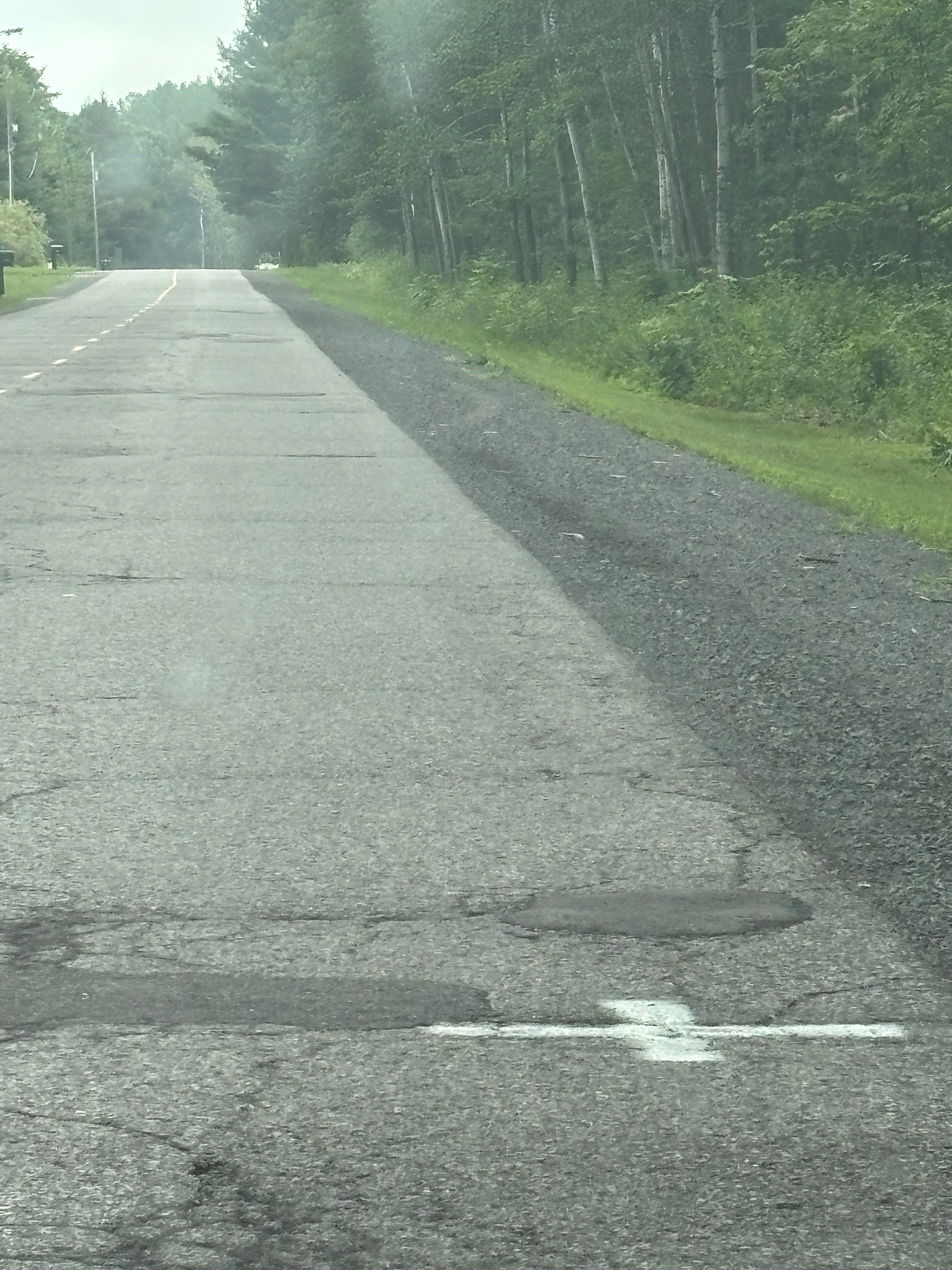
The white X’s appeared on the road one day. Dozens of them in all directions. The consultation was closing. It was spring. Some sort of survey plane arrived the same day. There was no warning but lots of X’s and lots of flyovers in an obvious grid throughout the study corridor near Ottawa.
Eventually there was an explanation, after a city councillor demanded one. She was told, at first, that it was not Alto. When she asked a second time, it was confirmed to be for the project. The news said the white X’s would wash off. The X’s, however, remain on the roads despite record-high rain in July.
The drones.
These have been less of an issue at our house, thankfully. Some farm owners in St. Isidore, however, report drones at their house, which is also their farm business, late at night. Every night. For hours. For days at a time. Without any warning.
Alto has repeatedly denied it is related to them.
So farm business owners are being led to believe that there are mystery drones over the exact same properties that received letters that Alto wants to study their land. Maybe two different projects want the same land. Who knows. Not the business owner.
What’s that in the sky!?
The southeast end of Ottawa also just happens to be directly under the approach to the Ottawa airport. The sky is busy on a normal day. From a yard or a house it’s hard to tell the difference between the sound of a survey aircraft and a Porter Airlines flight. Which means every plane or other flying object becomes a potential survey or surveillance apparatus.
Then there is the current VIA Rail line. Trains pass regularly. People drive over the tracks multiple times a day and wonder why we can’t just build a railway that allows communities to cross the tracks.

The letters from Alto.
A Vankleek Hill farmer went to the mailbox and found three letters from Alto received on the same day. The letters said the same thing but were about different land parcels.
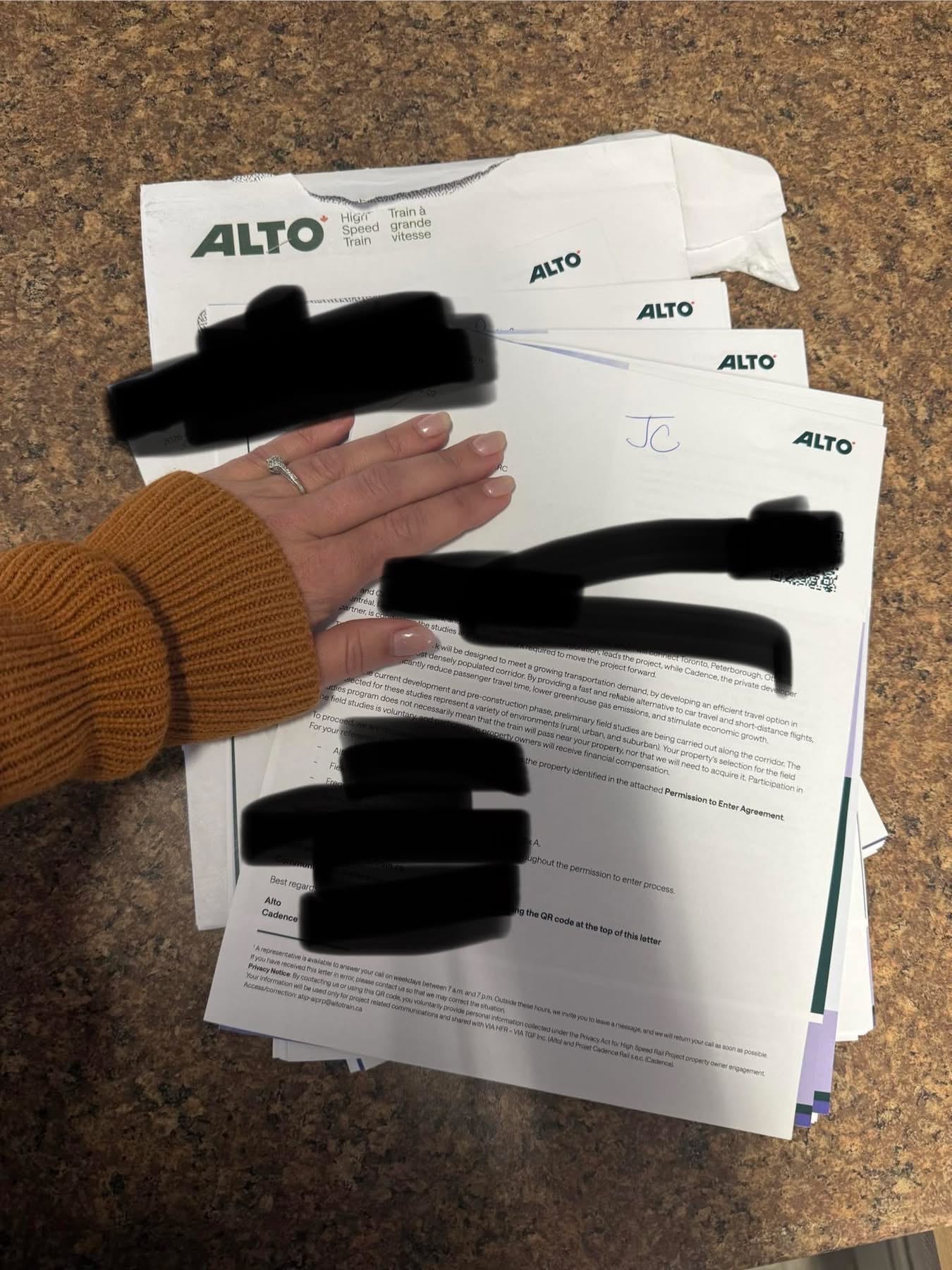
Someone else reported receiving eight. For some those letters were the introduction to the existence of the project. They had no warning they were on the menu. The letters wanted three years of access to their land. 8 a.m. to midnight. On 48 hours' notice. I’ve yet to meet anybody who agreed to the terms - even people who could really use the money offered.
We now know that there will also be letters sent to those along the preferred route before the public announcement is made. We don’t know more than that. Like when the shoe will drop.
So, going to the mailbox is unpleasant. Will there be a bill today or an expropriation notice?
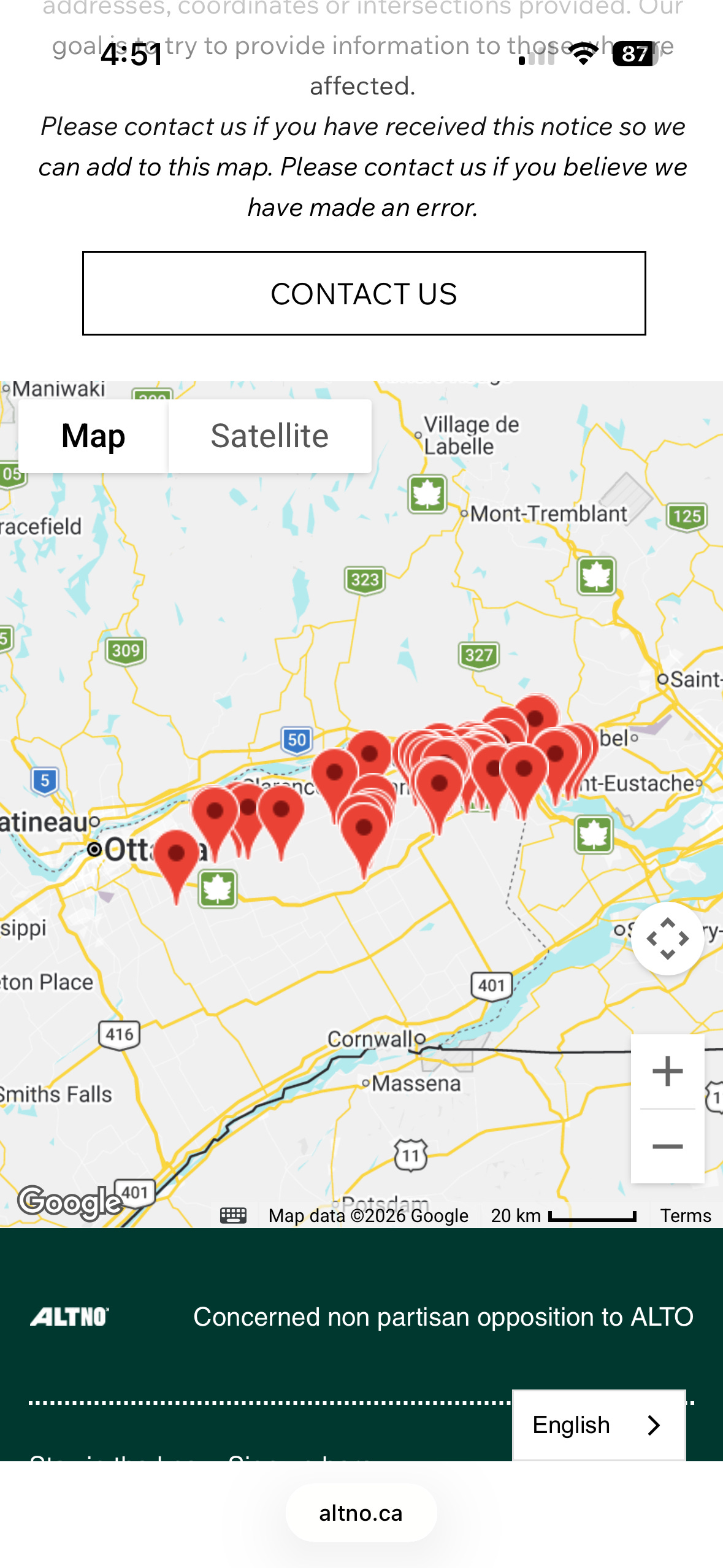
We didn’t get a letter that our land would be studied. But people just down the street did. There are maps online of the locations of people who have reported receiving letters. A volunteer creates the map because Alto won’t show the routes being considered. An unpaid citizen has to do the work instead of the Alto, funded by billions of taxpayer dollars, just providing the actual route options under consideration.
The house that sells. The house that doesn’t.
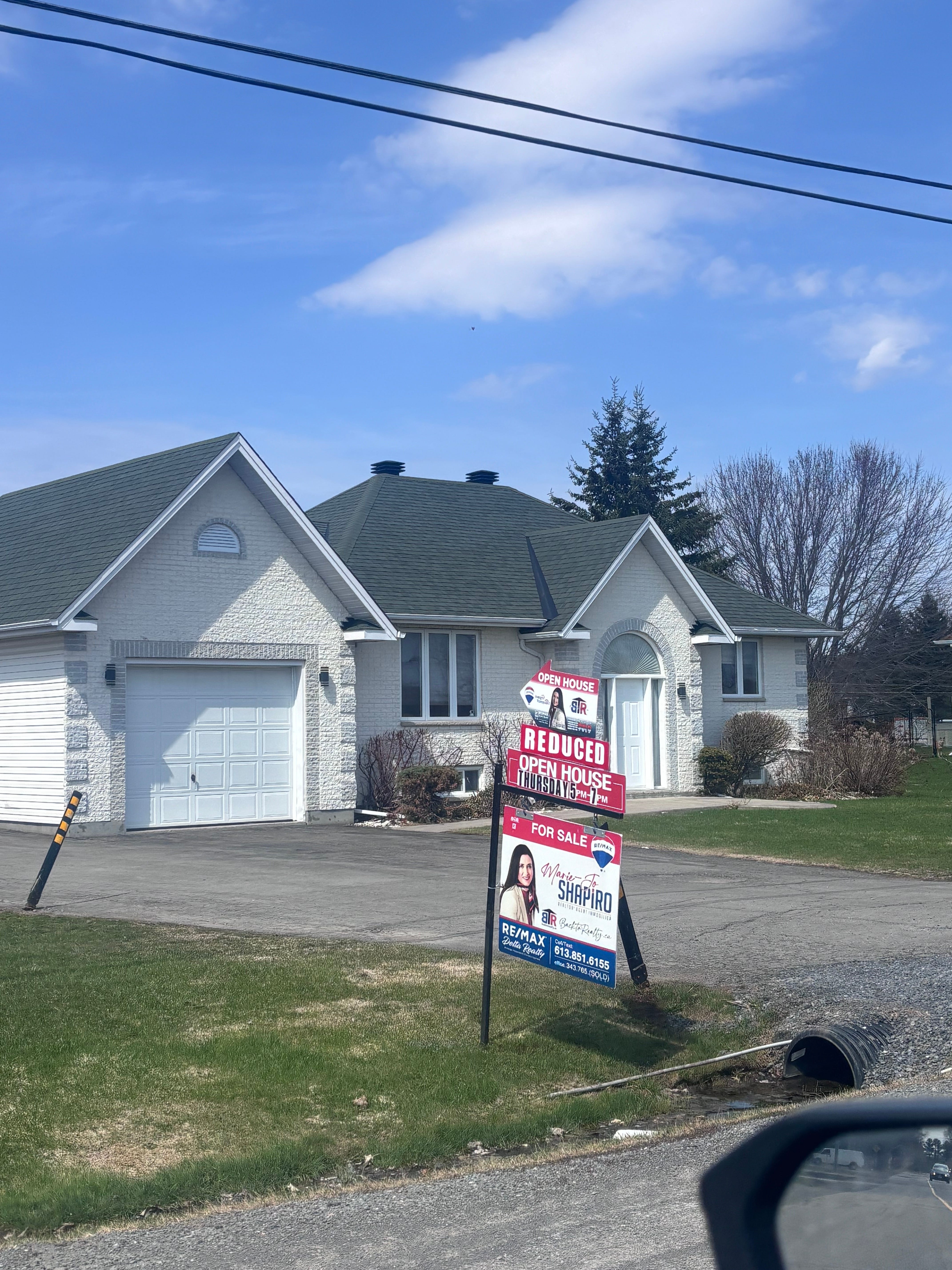
A house was listed with a sold sign on the lawn. But nobody moved in. And then there are the houses that are sitting and listed, unsold. Everyone pays more attention to real estate and what is and is not moving. Real estate agents are in a tough situation.
We wonder how we could possibly move and get the value for the home that we thought existed just a few months ago.
The unmarked van.
Clearly construction. Unmarked. High-visibility vests.
Alto, Cadence, a subcontractor, or just a hydro locate with nothing to do with any of it?
No way to tell so every contractor in an unmarked van gets a dirty look.
The Leda Clay and regular building and environmental restrictions.
Part of the case selling Alto is environmental benefits. But the environmental and planning laws that govern the people in its path do not govern Alto. Odd, that is.
A farmer in the Quebec green zone who wants to put up a building that isn't strictly agricultural files an application with the Commission de protection du territoire agricole du Québec and waits months for an answer that may well be no. A federally owned Crown corporation that wants to run a 300 km/h railway through the same field operated by a private company may not have to file anything with CPTAQ at all.
The Loi sur la protection du territoire et des activités agricoles is among the strictest farmland protection statutes in Canada. It binds the Quebec government, its ministries and its agencies. It prevails over any inconsistent municipal zoning, subdivision or construction by-law, and over inconsistent provisions of development plans. It is, in its own domain, supreme and, for some, supremely annoying to have to deal with.
And it may have no purpose on the Alto project.
In eastern Ontario, land underlain by sensitive Champlain Sea clay — Leda clay — falls within conservation authority regulation. Ontario Regulation 41/24 defines "hazardous land" to include land unsafe for development because of naturally occurring processes associated with flooding, erosion, dynamic beaches, or unstable soil or bedrock. South Nation Conservation administers permits in those regulated areas and it can be a real challenge. The strictness has a local origin: the village of Lemieux, in South Plantagenet, was abandoned between 1989 and 1991 after testing showed it sat on unstable Leda clay. The slope failed just two years later. Nobody in Prescott-Russell thinks these rules were invented just to be annoying. You can see visible signs of landslides throughout the area if you know where to look. A volunteer created the below map using open source soil maps, survey plane flight data and access request letters. There is a lot of landslide activity and people have safety concerns because of it.
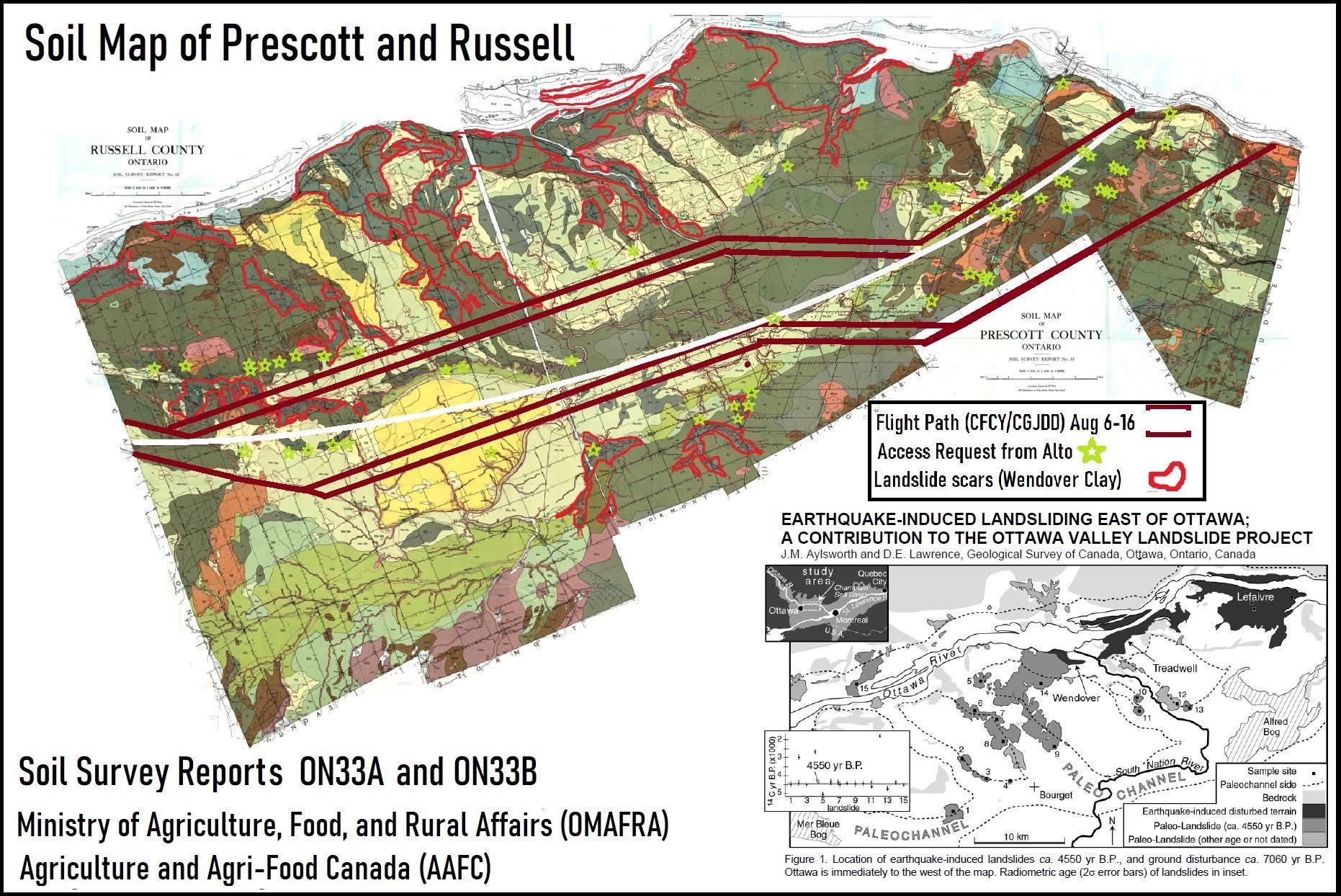
In Quebec, the LPTAA. In Ontario, the Planning Act, official plans, and provincial policy on prime agricultural areas all apply. None of this is trivial to comply with. All of it applies to the individual land owner and most of the private sector. Alto and its private sector partners get special treatment.
People notice when different rules apply. It does not make sense that the government can build a high speed rail structure in a location where the municipality or conservation authority won’t let a resident or small business construct a building.
The roads that will be closed.
Knowing roads will be closed leads to everyday questions when you drive around, such as, most obviously, “I wonder if this road will be closed?”
Not knowing the route makes that question apply to most north-south roads.
The uncertainty and lack of investment
We delayed planting new orchard trees. We definitely won’t be doing significant work at our property until we know what’s going on. The hardware store, greenhouse and pool contractors are suddenly less busy as others make those same decisions due to the uncertainty.
We get annoyed that we did not know this was coming when we moved here in 2019 and wish we had moved someplace else. We are annoyed by the impact this already has had on our largest asset and wonder if we will be able to find a comparable property elsewhere - if a comparable elsewhere even exists given all the properties and communities impacted by this 1000 km long piece of infrastructure.
Work
If you work as a lawyer or real estate agent you start getting questions from anxious people about hypothetical situations.
Then you start getting questions from people requiring real advice about actual situations. You cannot get what should be basic, foundational, public information for yourself or your clients. You find the lack of review process dystopian.
You wonder what on earth the government has been working on during the 50 or so years it has studied high-speed rail if they have no plan at all for the people negatively impacted.
You wonder why very few outside the corridor are paying attention to the cost, salaries, governance problems and gaps and undemocratic processes. You wonder why high speed rail was chosen at all but can find no report containing an answer or comparison to other less disruptive options.
You know the land will be expropriated and expensive, irreversible mistakes made before people in cities become personally impacted and start asking questions.
You wonder how on earth any of this came to be without anybody in the community having any knowledge at all that it was coming.
No posts
Comments
Nothing yet. Say the first thing.
Sign in to join the conversation.