
One of Canada’s favourite things to do when politicians cannot or will not decide on what to do is to hold a royal commission. There have been several commissions on transportation methods and infrastructure and my next few articles focus on them and what they had to say about passenger rail.
I have many friends who have worked as part of commissions. They report that it is very intellectually stimulating work. But they can also be very frustrating, especially when the commission is over and the government puts the report in a drawer and forgets about it until the next crisis. A whole lot of good people put in a whole lot of work only to be ignored. It happens repeatedly across subjects. Passenger rail recommendations simply fits the trend.
This article is just a high-level overview of what prior commissions have recommended. I will review the commissions independently in more detail in later articles. This article looks at the high level recommendations and discusses how well Canada has done at implementing them. Spoiler alert: Canada has done very poorly.
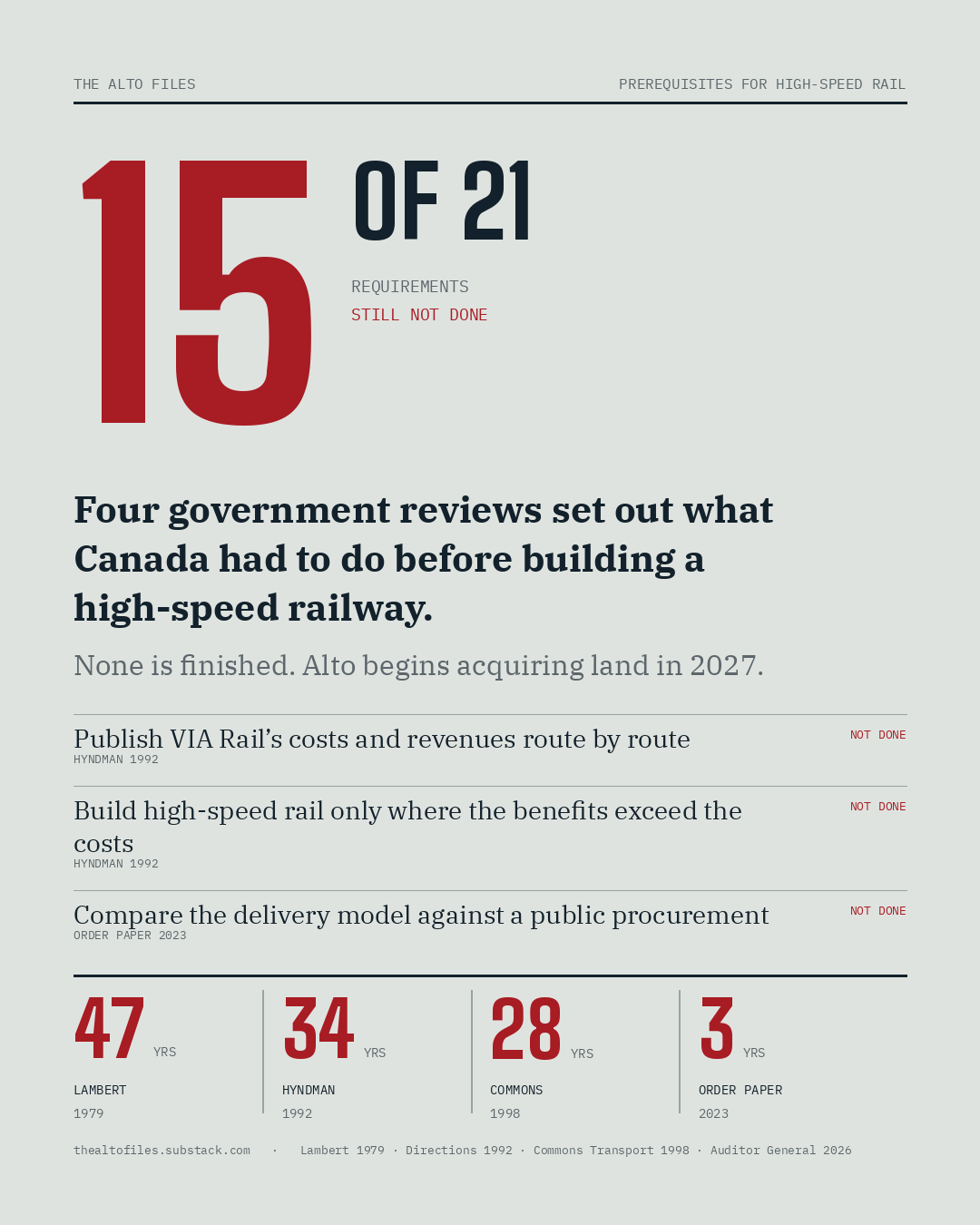
Four government reviews set out what Canada should put in place before making a decision and proceeding to build high-speed rail. Fifteen of the twenty-one suggestions were not actioned. Alto begins expropriating land in 2027 - and is already buying up other land from the market and hoarding it until it knows if it’s needed.
There is a particular kind of Canadian document that nobody bothers to read after millions of dollars of public money funded it. It is very expensive to write and lawyers and judges spend years of their life working on it along with various independent experts. It is a process usually launched after a crisis to make it look like the government is doing something. It takes three to five years, it costs several millions of dollars, it produces mountains of evidence, and it ends with a numbered list of things the government should do.
The ignored document is a report from a commission of inquiry. Canada has produced at least four of them on passenger rail since 1979. Between them they set out, in numbered recommendations, the governance and research preconditions that should be set prior to spending billions of public money on a high-speed railway.
I went through them and made a list to score how much of the to-do list has been done.
Canada did not pass the test.
TWENTY-ONE RECOMMENDATIONS.
FIFTEEN NOT DONE.
Of the remaining six, three cannot be verified from anything the government has published, two have been partly done or met by a different instrument than the one recommended, and one is currently before a regulator.
None of them are finished and yet Alto is already acquiring land and expropriations start as soon as the initial project definition is filed this fall or early 2027.
We have put the cart before the horse.
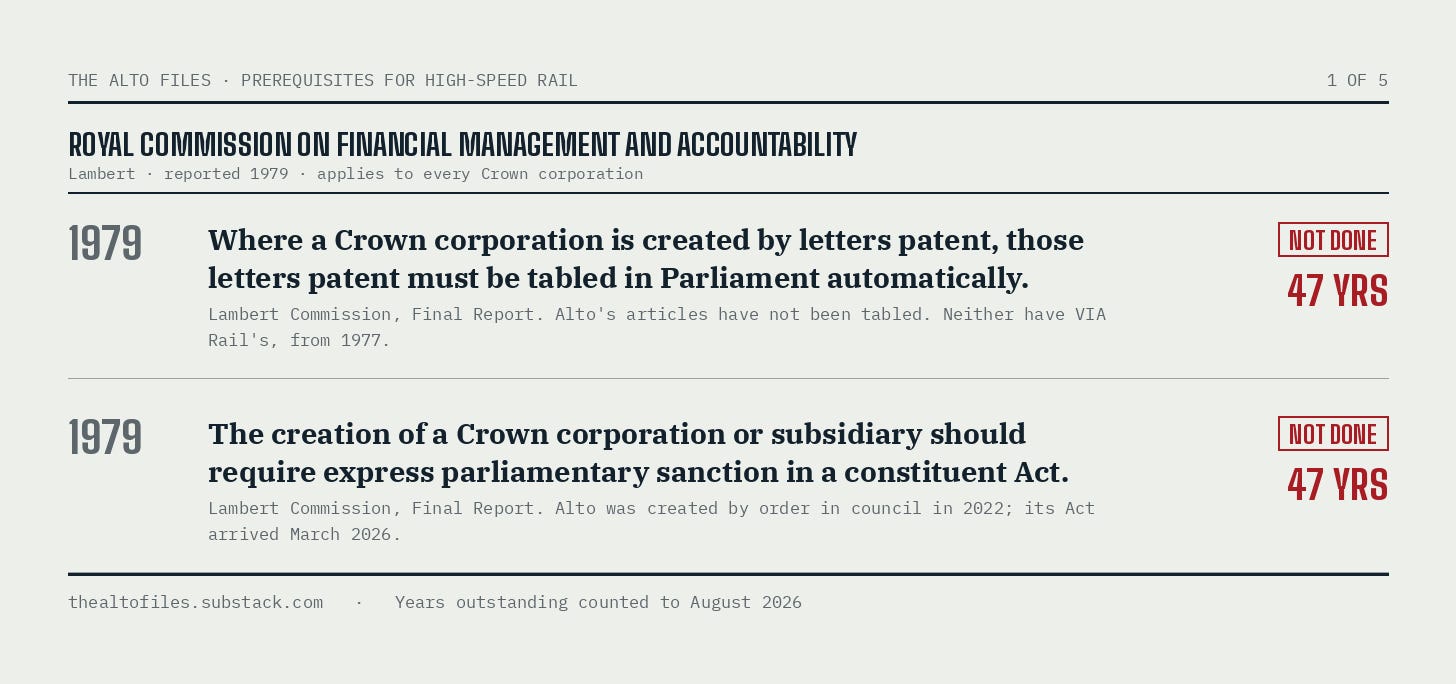
The Royal Commission on Financial Management and Accountability, known as the Lambert Commission, looked at how Ottawa was creating Crown corporations and found something it found objectionable. In five cases, it wrote, Parliament had been given no say in approving the mandate, and no opportunity even to scrutinize the founding document. One such case was VIA Rail. You can also add VIA HFR aka Alto to that list since its incorporation.
The commission recommended two fixes. That where letters patent are used, they be tabled in Parliament automatically. And that the creation of a Crown corporation or subsidiary require express parliamentary sanction in a constituent Act of parliament.
Alto was incorporated by order in council on November 29, 2022. Its articles have not been tabled in Parliament. It has no founding legislation.
I had to request the articles of incorporation and bylaws with an ATIP request. I’m sure nobody in Parliament has even read them.
During the crisis involving amateur sport, national sport organizations receiving government funding were criticized for not having their corporate bylaws and board meeting minutes on their websites. Crown corporations spending Billions should be held to the same and probably a much higher standard.
We have not fixed the governance of crown corporations. We have intentionally chosen one to build a railway anyway.
The Hyndman Commission was announced on the same afternoon that a minister cut half of VIA Rail's passenger train network. The national broadcaster reported it, at the time, as an attempt to “soften the blow”.
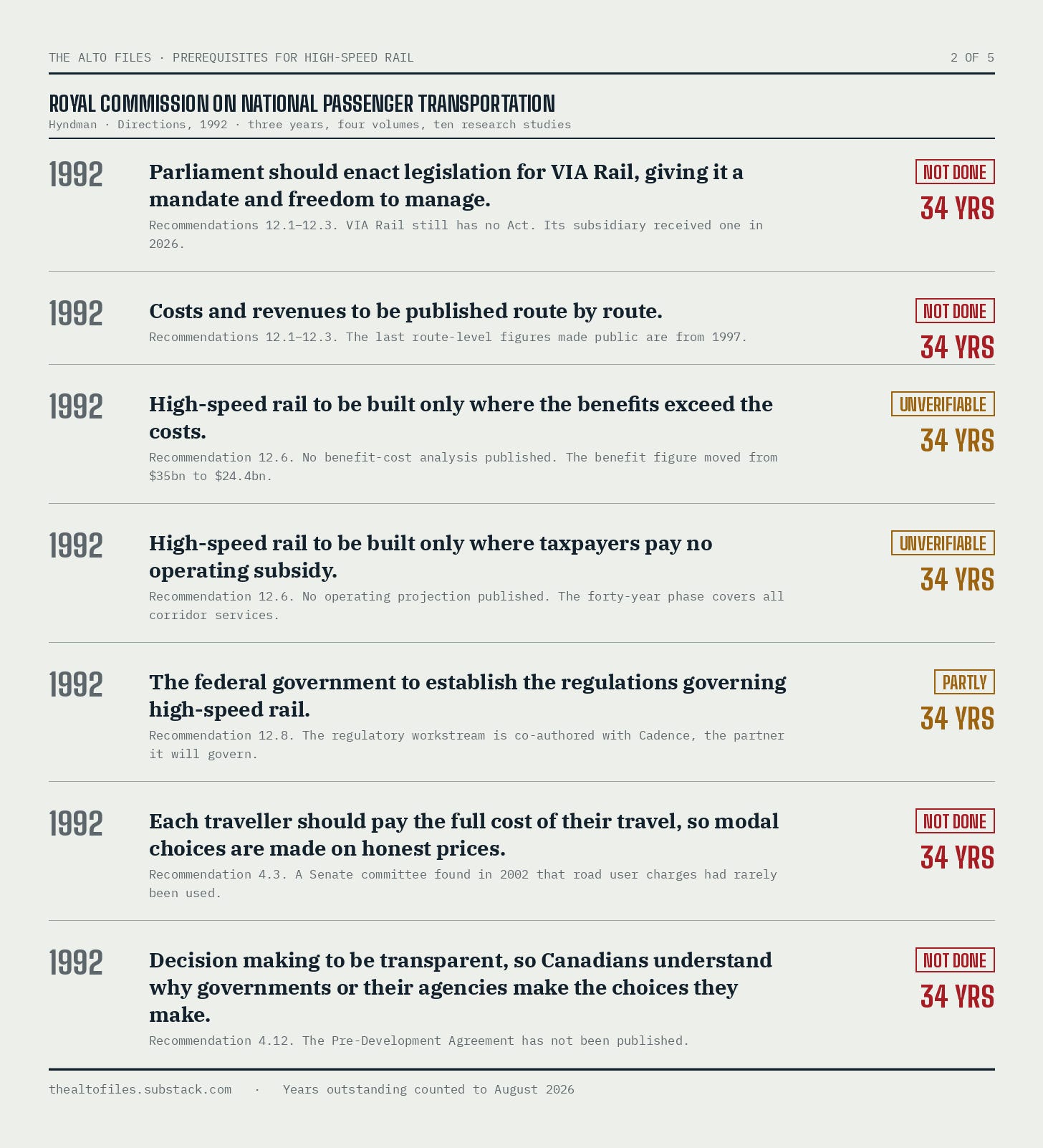
It then spent three years costing the entire Canadian intercity transportation system, which nobody had done before or since. On high-speed rail its recommendation was short and to the point. Build it only where the benefits exceed the costs, and only where taxpayers pay no operating subsidy.
The benefit figure attached to Alto was given as $35 billion in November 2025. In the 2026–27 corporate plan it appears as $24.4 billion. The change was made without announcement and was corrected by a footnote on August 20, 2026.
No benefit-cost analysis has been published. No operating projection has been published. So the condition cannot be tested, not because the answer is bad, but because the work is not public and is being hidden from even ATIP requests.
The Commission also asked that VIA Rail's costs and revenues be published route by route. The last route-level figures that I can find were made public in 1997. They showed the corridor losing more than the rest of the country's services combined, although it also brings in, by far, the most revenues. Alto’s CEO said in a media interview that publishing an Ottawa to Montreal analysis only was nonsensical. The European high speed rail auditors say such work is a necessity.
At recommendation 12.8, the Commission also recommended that the federal government establish the regulations governing high-speed rail. That has not been done. The Rail Safety and Regulatory Measures workstream is being co-authored with Cadence, the private partner those regulations will apparently govern.
In June 1998 a House of Commons committee reported on passenger rail. Its title was The Renaissance of Passenger Rail in Canada.
It found that every issue but one had already been studied and put on paper. Its own summary of why nothing had happened is the best sentence in the whole literature:
The clear answer is that governments have not addressed these issues.
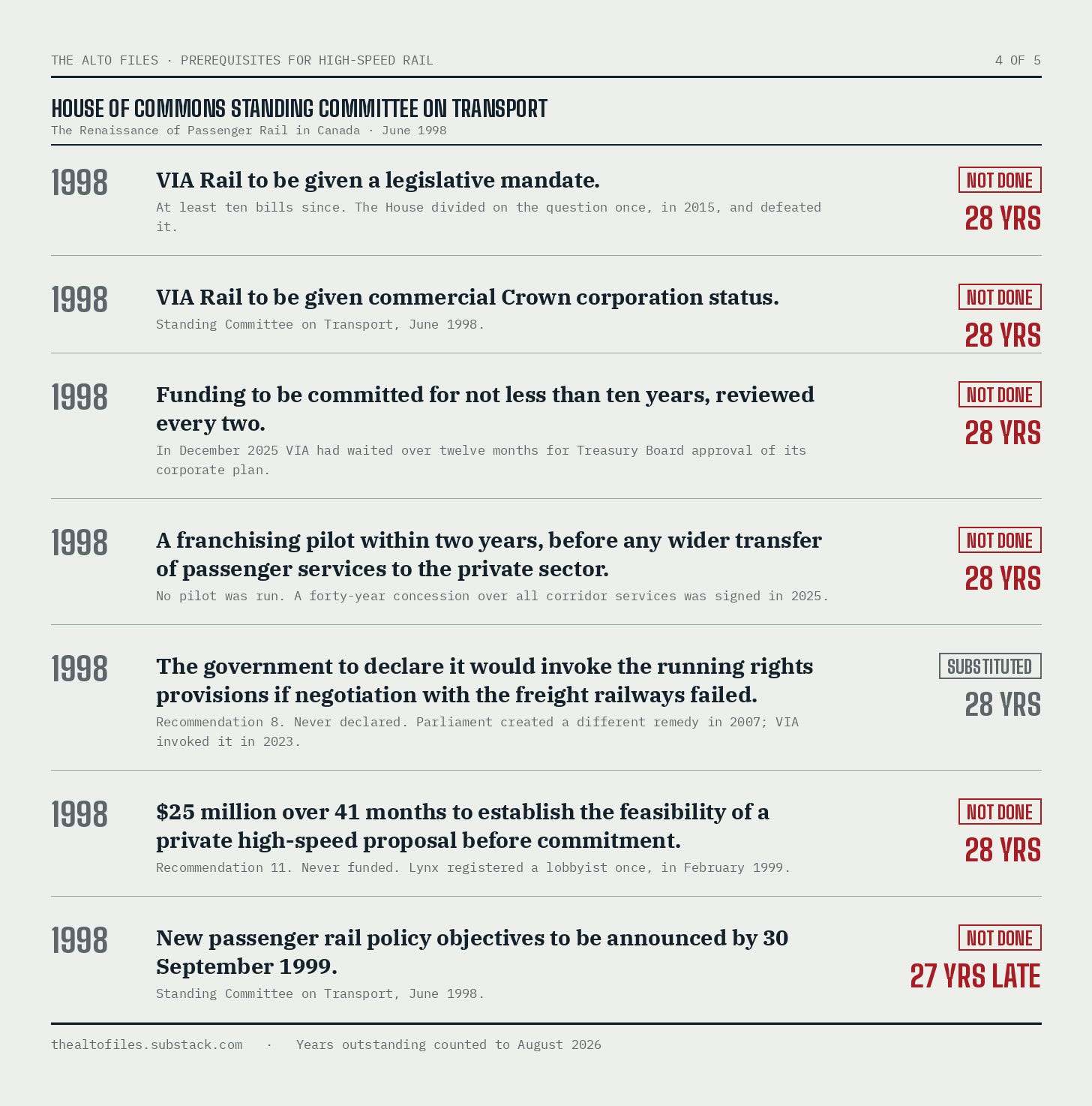
It asked for a legislative mandate for VIA Rail. For commercial Crown corporation status. For funding committed for not less than ten years. For a franchising pilot within two years, before any wider transfer of passenger services to the private sector. For the government to declare it would invoke the running rights provisions if negotiation with the freight railways failed. For $25 million to establish, over 41 months, whether a private high-speed proposal was feasible. And for new policy objectives to be announced by September 30, 1999.
None of that happened.
There was no franchising pilot. In 2025 a forty-year concession was signed covering all passenger services in the Windsor to Quebec City corridor.
The $25 million was never spent. The consortium that would have received it, Lynx, registered a lobbyist once, in February 1999, and never again.
The running rights declaration was never made. In 2007 Parliament built a different remedy instead, and VIA used it against Canadian National in 2023 after what the Auditor General describes as years of unsuccessful discussions. That case has not been decided. I cannot determine from anything on the public record what happened to it. I guess that’s another $5 for another ATIP request that will be responded to in a few months.
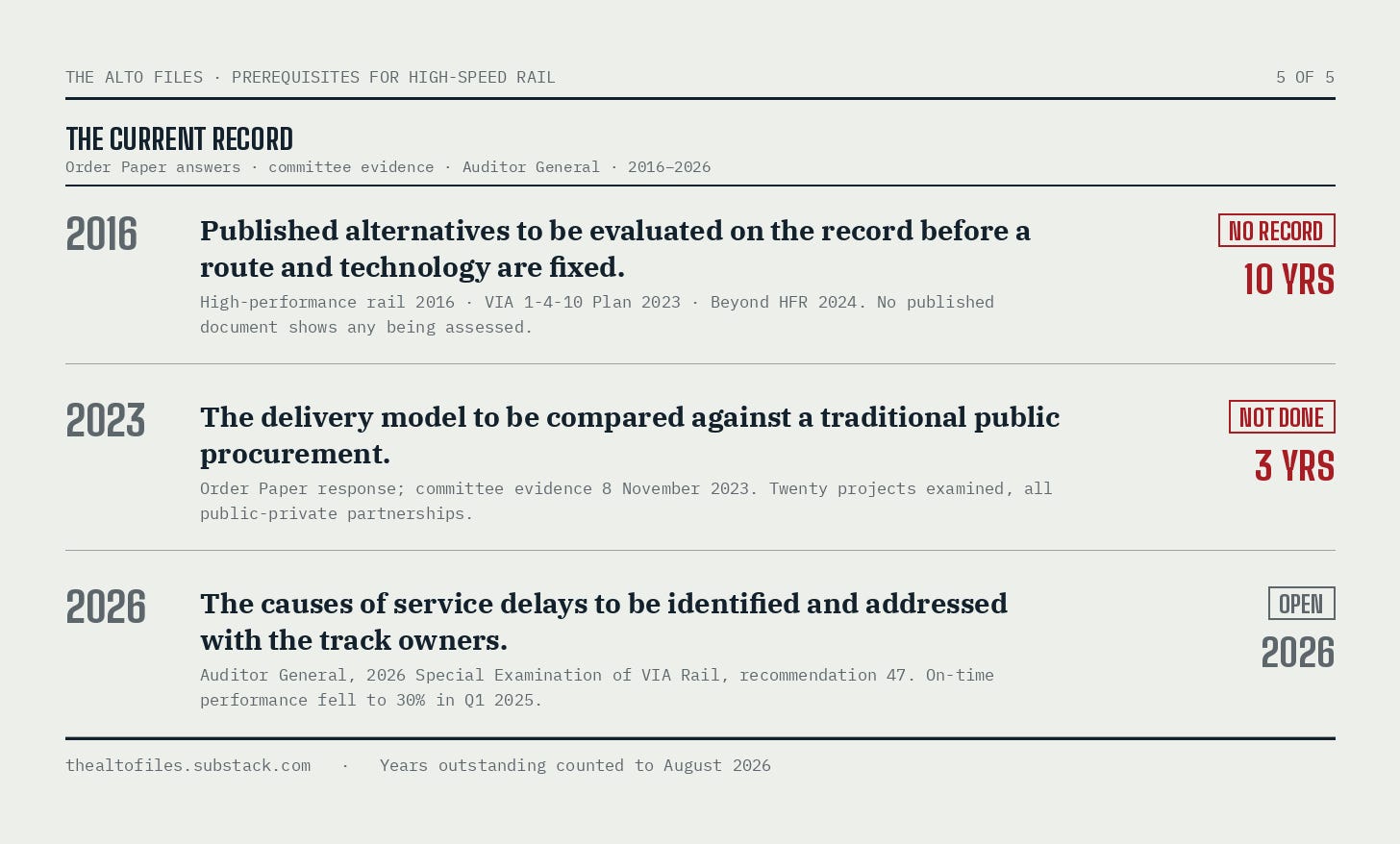
When the government assessed how to deliver this project, it examined twenty transportation projects.
All twenty were public-private partnerships.
There were no publicly procured comparators. This is established from an Order Paper answer, and when it was put to the responsible Assistant Deputy Minister at a Commons committee in November 2023, the premise was not disputed.
Compare that with 1998, when the same corridor was under review and $170 million a year was at stake. That committee analyzed four governance models, and two of them were public.
THE RANGE OF OPTIONS CONSIDERED
NARROWED AS THE MONEY GREW.
Three costed alternatives exist in the public domain: a high-performance rail paper from March 2016, contemporaneous with VIA's own proposal; a ten-year national recovery plan published three weeks after the request for proposals opened; and a report written across the whole procurement window for a parliamentary all-party rail caucus.
No published document shows any of them being assessed. They were not studied and rejected. Rejection would produce some sort of written record and there is none.
There is one more document, and it is different in kind from the four above. It should be read differently, and the difference is the point.
The Lambert Commission, the Hyndman Commission and the 1998 Commons committee were public inquiries. They were created by the state, they answered to Parliament, they had the power to compel evidence, and they were charged with reporting in the public interest. When they made recommendations, they were delivered to a government along with a huge bill that the government paid for the advice.
The document I want to describe now is none of those things. It is a consultant’s report, commissioned and paid for by seven municipalities, to help them argue for something.
In May 2010, SNCF International delivered a Socio-economic study of High Speed Rail implementation on the Quebec–Windsor–(Detroit–Chicago) Corridor for the cities of Quebec, Montreal, Laval, London, Toronto, Windsor and the Montreal Metropolitan Community. Those cities paid for it.
Its stated purpose is on page two, and it is admirably candid:
The evaluation of HSR socio-economical benefits at the municipal and metropolitan areas scales provides local authorities with strong arguments in order to be served by the future network.
In order to be served. The study was commissioned to help cities make the case for getting a station. No such impact study has been commissioned by cities and communities between stations and the federal government does not appear to have commissioned one either.
The framework SNCF applied is the one French national authorities use to evaluate major transport infrastructure, and it expressly requires the losses to be counted:
For central and local government, the project needs to offer a maximum of benefits for the community as a whole: the advantages and disadvantages for all the economic agents involved in the project (State, consumers, companies, etc.) must, therefore, be evaluated. These plus and minus factors, projected forward into the future, are then added together to produce the overall balance sheet for the project.
And the three items in the cost-benefit analysis include the external effects on the community in general.
The cost side follows through. Capital cost is itemised to include land acquisition, the cost of reconstituting sites and ensuring access, underpasses, noise abatement installations, reconstitution of roadways, landscaping and fencing.
And there is a sentence in the engineering specification that anyone who farms beside a railway should read:
The track alignment will be fully fenced and grade separated with intersecting streets, highways and railroad… Box culvert grade separations will be provided at regular intervals and accordingly to the needs to provide wildlife crossings and access for agriculture purposes.
Sixteen years ago, the French national operator — now a member of the Cadence consortium building this line — specified farm access as a design requirement and put it inside the capital cost.
It also gave a figure this file has never held. In rural areas, the alignment is to be built on new right of way acquired from private owners, and the nominal right-of-way width should be 100 feet in average, with more where the ground requires heavier cuts or fills.
Land acquisition came to $945 million of a $22.93 billion total cost. Four per cent.
Having required that disadvantages to all economic agents be evaluated, the study then names the agents. The socio-economic balances, it says, are calculated for actors implicated in the project:
Rail passengers, new and old ·
Users of the other modes of transports ·
Rail operator ·
Public authorities: State, Local Authorities, and in the frame of this study, the cities.
Four classes.
A farmer whose land is severed by the line is not a rail passenger. Not a user of another mode. Not the operator. Not a public authority.
The box culvert is costed as an expense of the project. The person it is built for is not one of the parties whose gains and losses are added up.
The same pattern appears earlier, in a chart setting out what SNCF calls the need to succeed in “mixing concerned actors’ priorities and realities”. Three columns: Local Authorities. Federal Authorities. Operator.
The general report was one of eight documents. Each city that would be served received its own volume analysing impacts at the municipal level: Quebec City, the Montreal Metropolitan Community, Montreal, Laval, Toronto, London, Windsor. There is no volume for the counties in between.
Nobody in between commissioned one and the government hasn’t either. The study was procured by seven municipalities that expected or wanted stations, to produce arguments for stations, and it delivered a separate report to each of them.
The townships the line would cross without stopping were not clients. They had no report, no consultant, and no seat in the four-class balance.
The four public inquiries asked the state to do things and the state did not do them. This study shows what attempted to fill the gaps. In the absence of any independent work on this, the analysis that got done was the analysis somebody paid for — and the people who paid were the people expecting to benefit.
Several studies on the high speed rail file have said additional work needs to be done to understand and quantify the capital cost to municipalities between stations that is required to accommodate the construction of HSR and the track permanently passing through established communities. That work has never been done and released to the public or the communities about to be impacted.
Perhaps they should pool their money and order the study themselves.
Alto's corporate plan schedules land acquisition for 2027 to 2029.
Under the High-Speed Rail Network Act, the corporation may register a notice against the title to your land if it is of the opinion that it may require it. If you then accept an offer from anyone else, you must hand Alto the signed agreement so that it can buy at that price. Any sale to a third party is void. The notice runs to the eighth anniversary.
A second notice may be registered prohibiting you from undertaking any work to the land other than work to prevent its normal deterioration or maintain its normal functional state. Obstructing an inspector is an offence. That notice runs four years.
There is compensation for actual loss if the work notice expires or is lifted, and legal and appraisal costs are covered. That is a real protection and it should be said.
And then there is section 17. The corporation is not required to have attempted to purchase before requesting expropriation. If the Minister of Transport forms the opinion that land is required, the appropriate Minister is deemed to be of the opinion that it is required for a public work, and must have it expropriated.
Sections 8 to 11 of the Expropriation Act, the public hearing of objections and the oldest protection an expropriated owner has in Canadian law, do not apply.
What replaces them is a letter, a notice in the Canada Gazette, thirty days to object in writing, and reasons on request.
Roughly one thousand public and private crossings will be closed, because a train travelling at three hundred kilometres an hour cannot be crossed at grade.
None of this says the railway should not be built. I have not made that argument and this list does not support it.
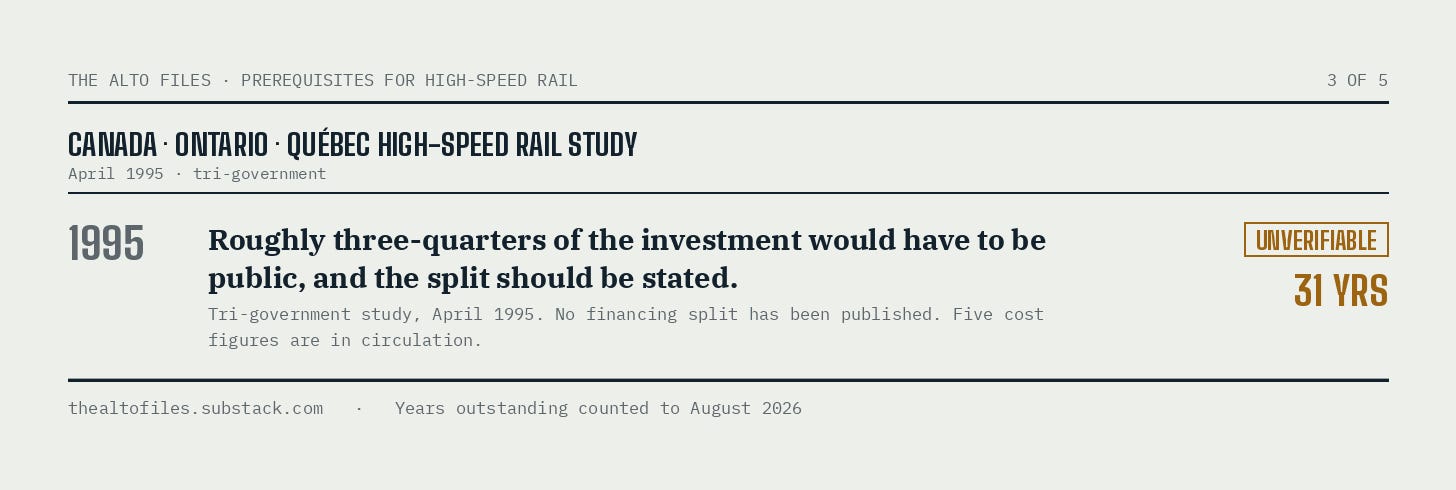
Every one of these requirements was written by the government's reviewers, for the government, at a cost of several millions of dollars per recommendation. They are not objections raised by opponents. They are the recommendations that independent experts set for the state: publish the route-level numbers, show that the benefits exceed the costs, compare the delivery model against a public one, run the pilot before the concession, table the founding documents, write the regulations yourself.
Most items were listed more than once in multiple inquiries. The Lambert reform of 1979 was reaffirmed by a Commons committee in 1985, by a Prime Minister in 2002, by the Public Accounts Committee in 2005, and by the Gomery Commission in 2006.
They were asked for by royal commissions with subpoena powers, by parliamentary committees of all parties, and most recently by the Auditor General of Canada.
And the answer, in 1998, was already this:
The clear answer is that governments have not addressed these issues.
Twenty-eight years later the sentence is still true, and the land acquisition programme has already started.
No posts
Comments
Nothing yet. Say the first thing.
Sign in to join the conversation.