
In February 2026, the Ontario Federation of Agriculture and the Union des producteurs agricoles issued a joint communiqué on the Alto high-speed rail project. It contained five requests. Four of them concerned route selection, farm fragmentation, drainage, and the recurring costs of fencing and farm crossings. The fifth was this: that agricultural impact studies be independent, rigorous, and that they be made public.
The communiqué followed a resolution adopted two days earlier at the annual general meeting of the Canadian Federation of Agriculture. The resolution was moved by UPA general president Martin Caron and seconded by OFA president Drew Spoelstra. It formally asked the Government of Canada to suspend the Alto project to permit a complete assessment of economic, social and environmental impacts, and meaningful consultation with the affected farm, forestry and rural communities. It goes on to specify that if the project proceeds, it must guarantee continued full access to farmland, sugar bushes and woodlots, provide farm and forestry crossings of at least ten metres in width where required, and deliver compensation that is fair and proportional, recognising that the permanent impacts of high-speed rail are greater than those of highways or transmission lines.
The OFA represents 38,000 farm families in Ontario. The UPA represents 42,000 farm producers and 163,000 forest owners in Quebec.
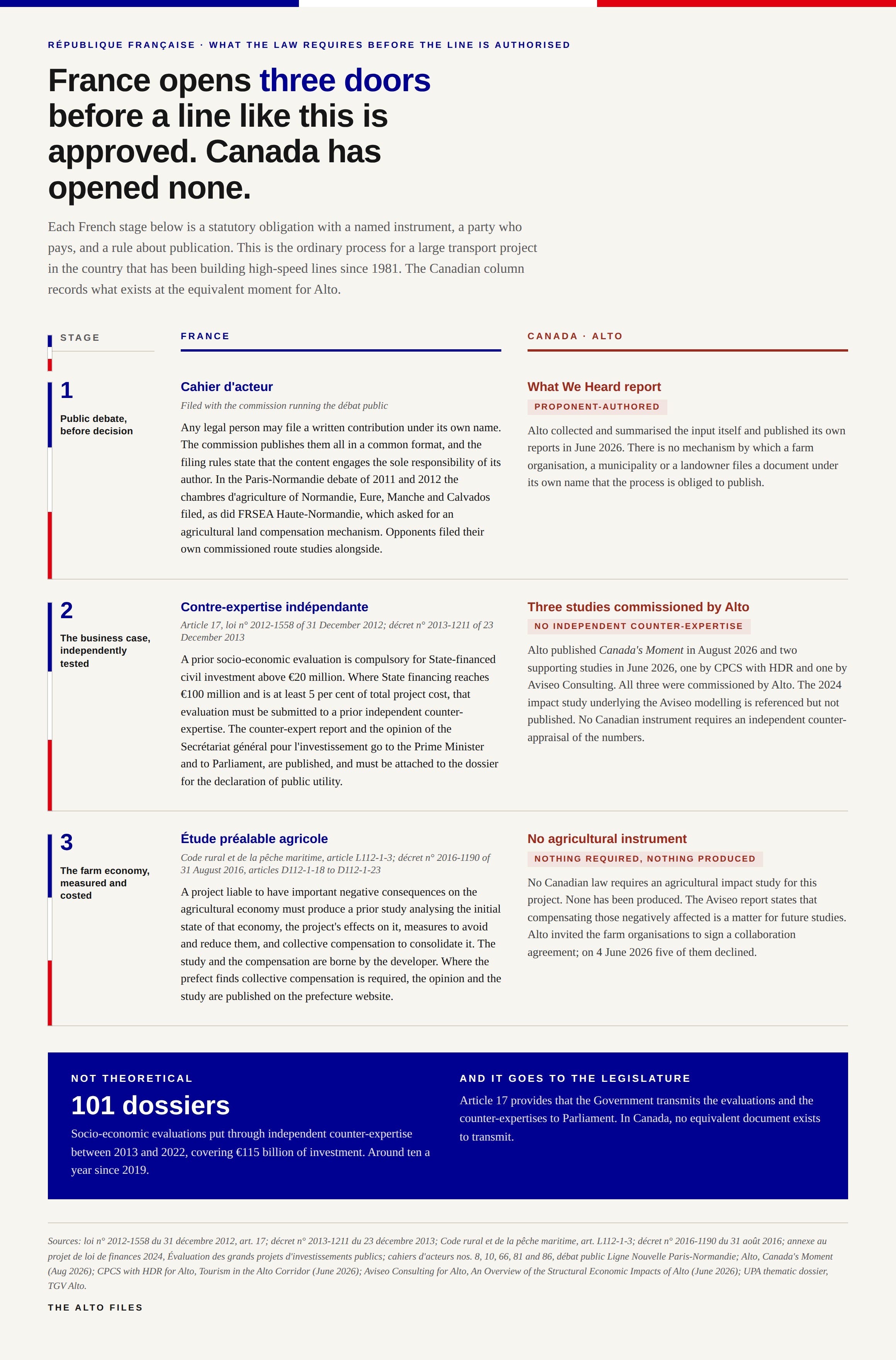
That request has been described in some quarters as an attempt to “stall the project”. It is worth setting out what the request actually is, because in the country with the longest continuously operating high-speed rail network in Europe, it is not a demand. It is a statutory obligation, and the developer pays for it. The same rail company from France is in the consortium building Alto and apparently does not want to play by the same rules in Canada.
The French statute
Article 28 of the loi n° 2014-1170 du 13 octobre 2014 d'avenir pour l'agriculture, l'alimentation et la forêt(https://www.legifrance.gouv.fr/) inserted a new article L112-1-3 into the French Code rural et de la pêche maritime.
The article provides that public and private works projects which, by their nature, dimensions or location, are liable to have important negative consequences on the agricultural economy must be the subject of a prior study. That study must contain, at minimum:
a description of the project
an analysis of the initial state of the agricultural economy of the territory concerned
a study of the effects of the project on that agricultural/rural economy
the measures contemplated to avoid and reduce the significant negative effects of the project on the agricultural economy
collective compensation measures intended to consolidate the agricultural economy of the territory
The article then states that both the study and the compensation measures are paid for by the project developer.
The implementing instrument is décret n° 2016-1190 du 31 août 2016 (https://www.legifrance.gouv.fr/jorf/id/JORFTEXT000033084702), which created articles D112-1-18 to D112-1-23 of the regulatory part of the same code. Article D112-1-18 sets the trigger. The study is required for projects subject to systematic environmental impact assessment under article R122-2 of the Code de l'environnement whose footprint falls, in whole or in part, on land zoned agricultural, forest or natural by an enforceable planning document.
Article D112-1-21 governs publication. Where the prefect concludes that the scale of the project's negative consequences on the agricultural economy requires collective compensation measures, the prefect's opinion and the prior study are published on the prefecture's website. Where several prefects are consulted because the project crosses more than one department, publication occurs on the website of each department concerned.
Independent.
Rigorous.
Made public.
Paid for by the developer.
That is not an unusual ask. In France it is the law.
Before the statute, the same request
The 2014 statute did not appear from nowhere. It was preceded by a decade in which French farm organisations made the argument in a forum that Canada does not even have.
Under the French débat public process, any legal person can file a cahier d'acteur, a formal written contribution published by the commission running the public debate. The filers include local authorities, chambers of commerce, chambers of agriculture, professional unions, businesses and associations. The commission publishes them in a common format. They remain online years later for anybody to read.
In the débat public on the Ligne Nouvelle Paris-Normandie (https://cpdp.debatpublic.fr/cpdp-lnpn/site/DOCUMENTS/CONSULTATION_CAHIER_ACTEURS.HTM), held in 2011 and 2012, more than one hundred briefs were filed. The agricultural filings appear under the filers' names: the Chambre régionale d'agriculture de Normandie at number 8, the Chambre d'agriculture de l'Eure at number 10, the Chambre d'agriculture de la Manche at number 81, the Chambre d'agriculture du Calvados at number 86. The Manche filing states that every impact, direct or indirect, must be the subject of an agricultural diagnostic. The FRSEA Haute-Normandie filed at number 66 under a title translating roughly as "agriculture is not to be sold off cheap," and asked for the creation of a mechanism it called compensation foncière agricole.
Three years later, Parliament in France enacted a version of what those filers had asked for.
The mechanism also allowed opponents to put their own evidence on the record. ARDIES Val d'Oise, filing at number 22, commissioned an independent route study from the Institut Géographique National, filed it with the commission, then filed a second confirming study. All of it sits on the commission's website alongside the developer's material. It was considered equally by an independent decision maker.
What exists in Canada instead
Alto has published three economic studies in 2026.
Canada's Moment: The Economic Opportunity of High-Speed Rail, published in August 2026 under the signature of president and chief executive officer Martin Imbleau, sets out benefits to Canadians of approximately $49.5 billion and a permanent GDP uplift of $24.5 billion. The word "rural" appears once in the document, inside a URL in one of the endnotes.
Tourism in the Alto Corridor, prepared for Alto by CPCS in association with HDR in June 2026, analyses six census metropolitan areas corresponding to seven proposed station locations. Corridor communities between stations are not studied.
An Overview of the Structural Economic Impacts of Alto, prepared for Alto by Aviseo Consulting in June 2026, models productivity, labour supply and tourism effects using a computable general equilibrium framework. On the question of the people whose land the line crosses, the report says that the government has a leading role in “redistributing” the benefits, especially to communities that could be adversely affected by construction or operation, and that “future studies” “could” examine the compensating variation required to fairly compensate those who are negatively impacted. That work is expressly deferred. The report also states that a “more in-depth analysis of spatial distribution and equity implications should follow.” Again, work that is not done.
Three commissioned economic studies. None of them measures the rural economy of the corridor or the harms done to it. Reports to government have said this needs to be done for decades. The one that raises the question of compensating the people who lose says the question belongs to a “future study”. Alto is already acquiring land and is preparing to expropriate more. The studies should be done before any of that is allowed to happen - especially the expropriation.
In June 2026, the OFA, the UPA, the National Farmers Union (Ontario), the Christian Farmers Federation of Ontario and the Union des cultivateurs franco-ontariens met to consider Alto's invitation to sign a collaboration agreement. They concluded that signing was not in their members' interest at that time, and cited the need for greater transparency and open communication with their members.
In France, the study farm organizations are asking for is not an obstacle raised by opponents or a delay tactic. It is a document the developer is required by law to produce, at the developer's expense, before the project is authorized or funded. An independent person is required to review and publish it. The public gets to read it and respond.
In Canada, no such document is required, none has been produced, and the organization building the railway has asked the farm organizations to sign a collaboration agreement complete with a confidentiality agreement not to speak to their members instead. Members of the Cadence consortium building Alto already need to comply with this very requirement in France. They refuse to do so here. Our government has not required it.
There is a basic economic reason why the work has not been done. Carefully studying the costs including capital costs in corridor communities would necessarily drive down the benefit-cost ratio by driving up the costs. When that ratio is too low, governments and finance ministers do not approve the funding. It is in the proponents own interest not to fund such a study, which is why it is not done unless required.
The government of Canada should be funding such a study and should be making the findings public. Otherwise, we are blind to the real costs.
No posts
Comments
Nothing yet. Say the first thing.
Sign in to join the conversation.