
I should have included the details in this article into yesterday’s piece about Alto’s CEO compensation. Unfortunately, I only came across it this morning.
In 2024 the chief executive of Metrolinx was paid $883,990.63. He was the fourth-highest-paid public servant in Ontario. For five years he also collected a vehicle allowance of roughly twelve to thirteen thousand dollars a year, and sources told Global News that he did not own a car. That, understandably, became a story in the media.
Every March, under the Public Sector Salary Disclosure Act, the province prints the name of every public sector employee paid more than $100,000, the amount, and the taxable benefits. Every appointment and reappointment of the Metrolinx chief executive is made by order in council, and the order in council states the base salary, the bonus percentage, the vacation entitlement and the allowances.
Reporters read both. Then they get to write things down and publish it. It helps keep public sector salaries in the public eye to ensure accountability and is one way the public can monitor spending of tax dollars.
Metrolinx and Alto's CEO compensation comparison chart
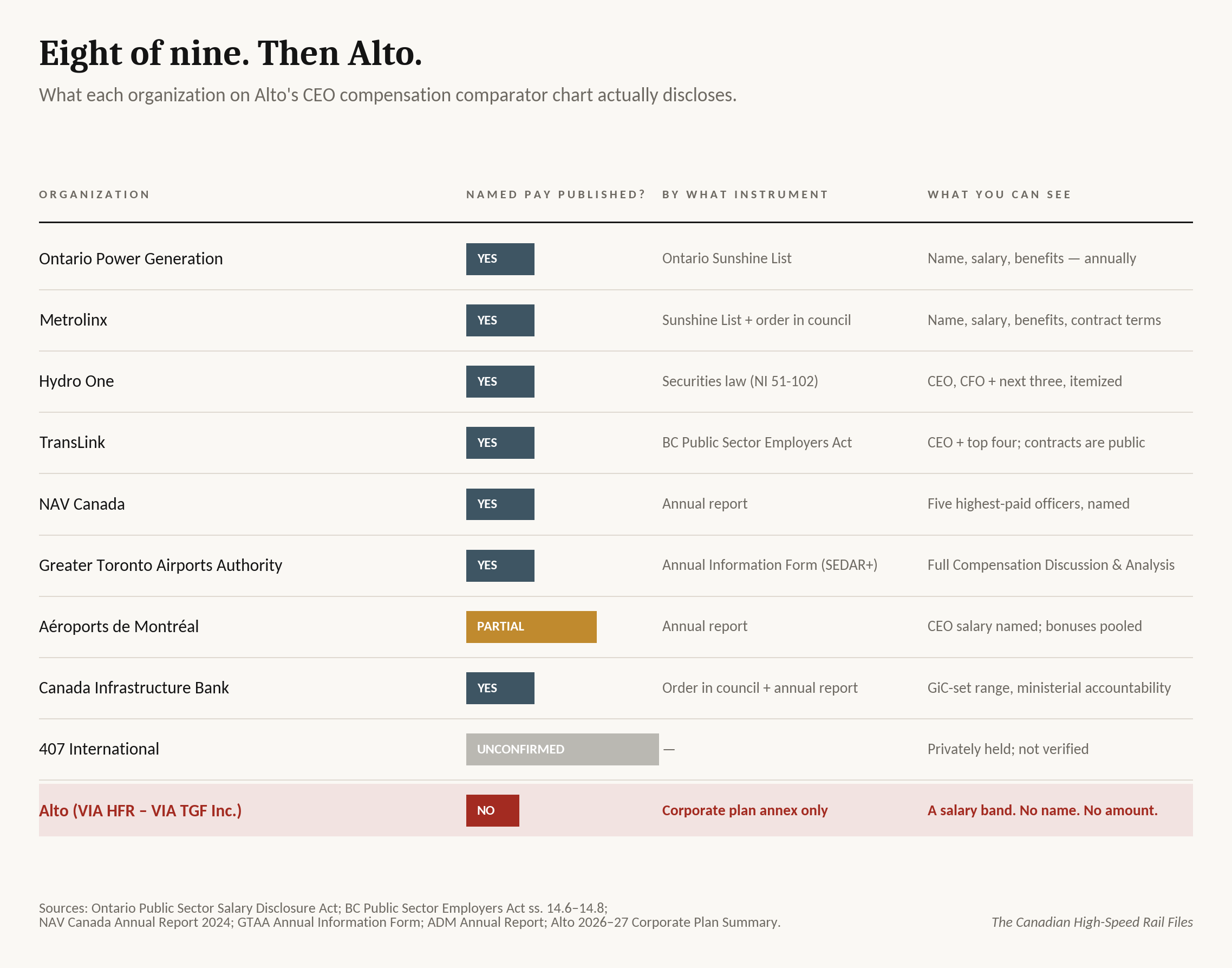
The July 12, 2023 briefing note told the Minister of Transport what Alto's board chair had decided to pay the incoming chief executive. It is Alto’s Board, not the Ministry, that gets to set the pay which is not the case with most crown corporations. The memo showed benchmarking for the compensation included nine organizations: Ontario Power Generation, Metrolinx, Hydro One, TransLink, the Greater Toronto Airports Authority, 407 International, Aéroports de Montréal, NAV Canada and the Canada Infrastructure Bank.
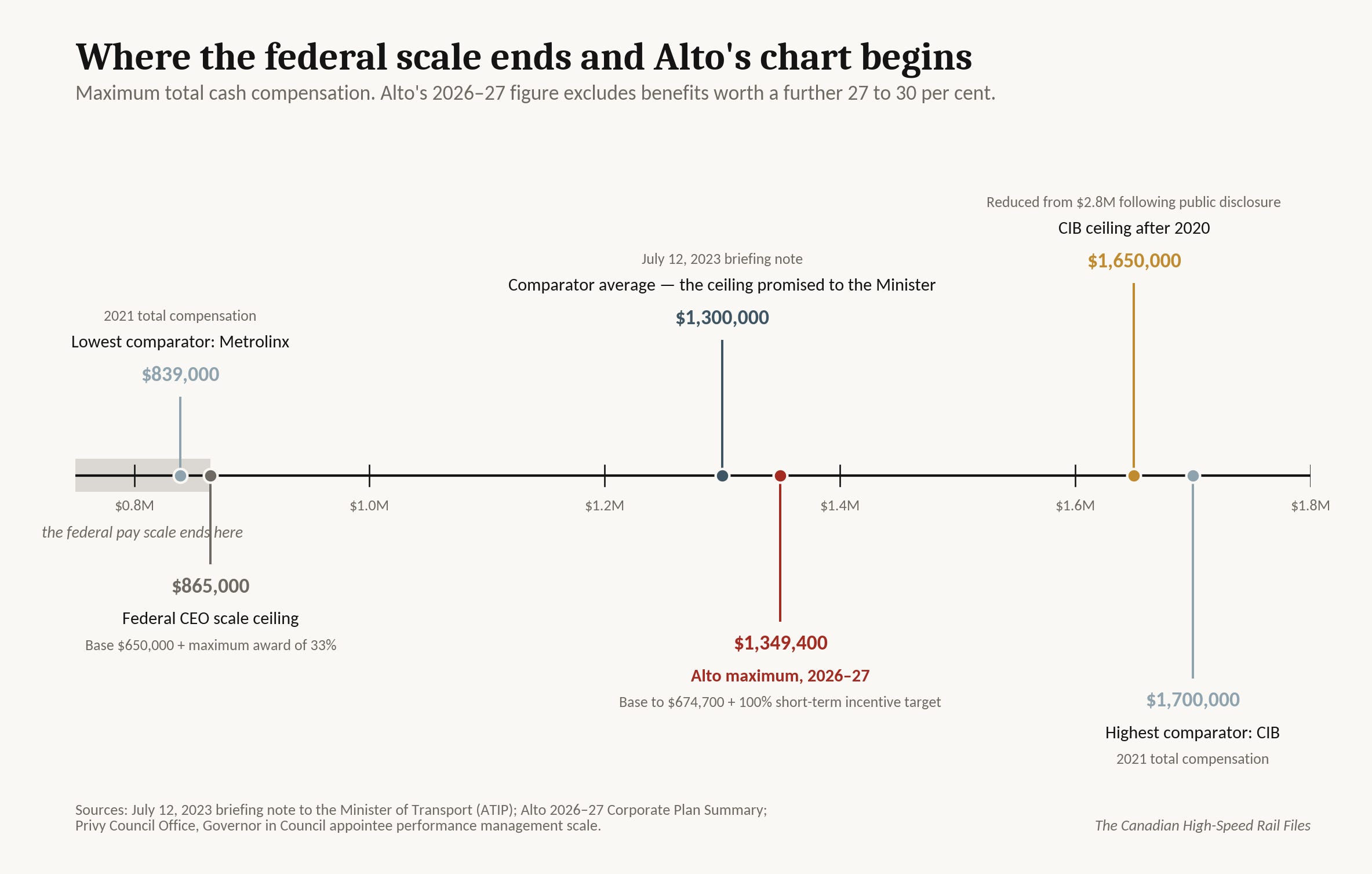
Total compensation across those nine in 2021 went from $839,000 at the bottom to $1.7 million at the top, averaging $1.3 million. Metrolinx was the bottom. It was the number that anchored the low end of the range from which the $1.3 million ceiling was derived.
CEO compensation at Metrolinx has certainly not been without criticism. That criticism didn’t find its way into the briefing note.
What was actually happening at Metrolinx
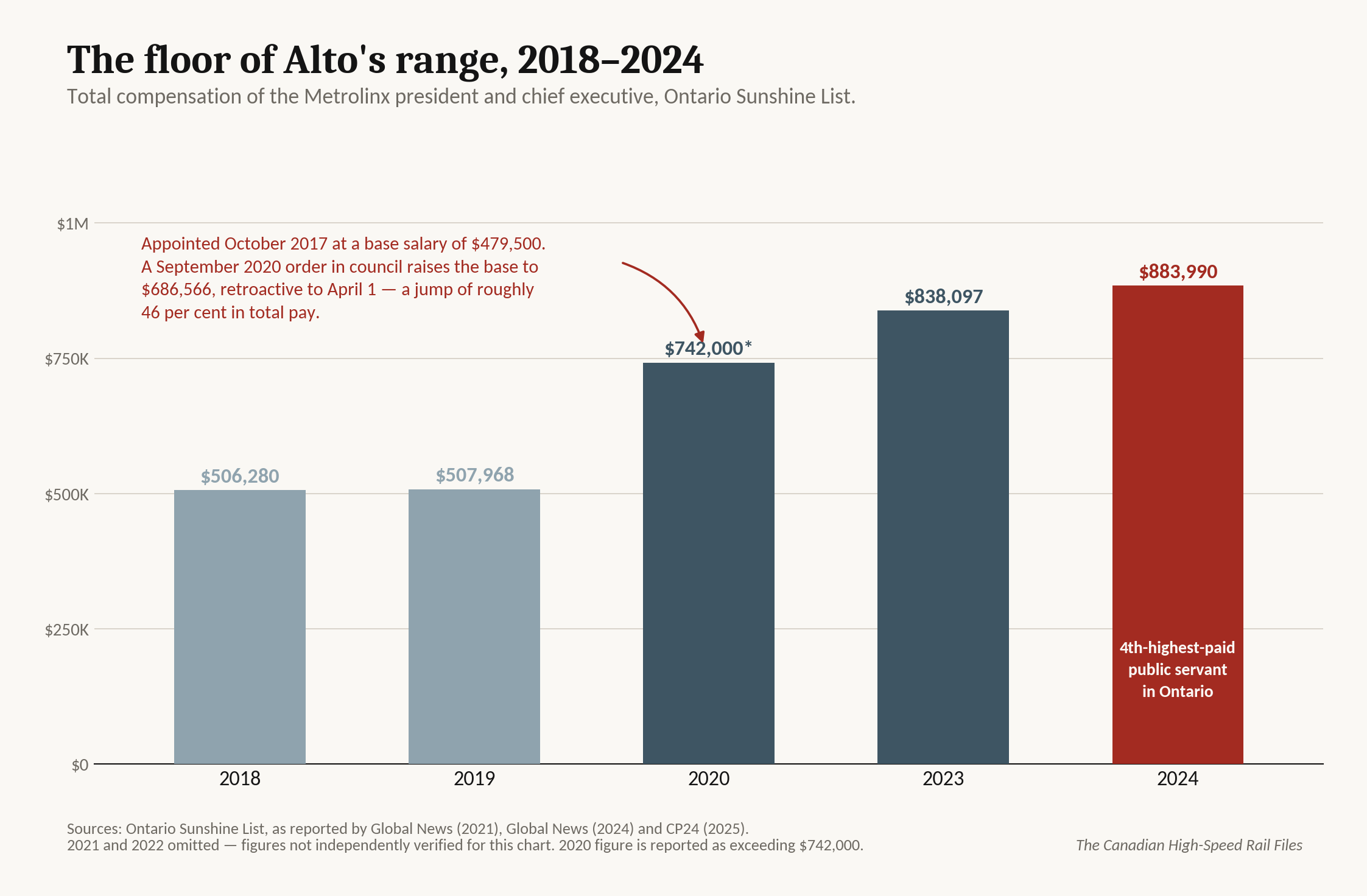
The chief executive at Metrolinx was appointed in October 2017 on a base salary of $479,500. His total pay was roughly $506,000 in 2018 and $508,000 in 2019.
Then, in September 2020, an order in council reappointing him and significantly raised his base salary to $686,566, retroactive to April 1 of that year. His total pay for 2020 came in above $742,000 which is an increase of about 46%, and enough to put him eleventh on the Sunshine List.
Asked to account for the jump, Metrolinx said he was eligible for a performance-based bonus. That was the whole answer. How the amount above base was determined was never explained, and it never has been as far as I’ve been able to tell with internet searches.
The number kept increasing higher and higher year after year. $838,097 in 2023, the year of the Alto CEO compensation memo. $883,990.63 in 2024. By then, he was the fourth highest paid public sector employee in the entire province.
Layered on top was the vehicle allowance — a taxable benefit running between $12,575 and $13,392 a year, written into the 2020 order in council, paid for five years to the head of a transit agency who, Global News reported, did not own a car.
He resigned on December 3, 2024.
Why this matters to the Alto file
Alto's board chair was Metrolinx's president and chief executive from 2009 to 2010 and chair of its board from 2010 until his resignation on July 12, 2018. He appointed the Metrolinx CEO who was in the middle of the compensation story and helped set the initial compensation principles. Ontario's Ministry of Transportation confirmed that the Metrolinx CEO's salary is decided by the chair of the Metrolinx board.
In July 2023 the chair of the company now known as Alto benchmarked a new federal Crown corporation against nine organizations, and at the bottom of the range an organization he had run, then chaired, and whose chief executive's starting pay was fixed on his watch.
We do not have the full compensation report that would disclose how the comparators were set, why it included so few federal crown corporations and why so many of the corporations are so much larger than Alto. It also did not explain why the usual federal compensation range was seen as insufficient to attract the required talent. VIA Rail, which runs a much larger enterprise including an actual train service, was left off the comparator list and its CEO’s pay is well below what Alto’s would be set at.
Second, and more important: the Metrolinx story existed because Ontario had instruments that require disclosure of salary and compensation specifics and journalists pay attention to it. The annual salary disclosure produced the name and the number. The order in council produced the terms — the base, the bonus ceiling, the vacation, the car allowance. Press curiosity and public scrutiny did the rest.
The instruments worked. When the successor's contract was signed, it was posted as an order in council as required: a base of roughly $687,000, a performance bonus capped at 20 per cent of base for a maximum pay of about $823,879, six weeks of vacation, and no motor vehicle allowance for the CEO of a transit company. The perk that had been found to be controversial did not survive into the next contract. The maximum salary and top end of the bonus also corrected itself.
Public oversight works. When it is permitted to function.
Alto’s mechanism
There is no order in council fixing Alto's CEO pay, because P.C. 2022-0260 carved section 108 of the Financial Administration Act out of Alto's governing framework — the section that would otherwise put the number in the Governor in Council's hands. That was the subject of my last article.
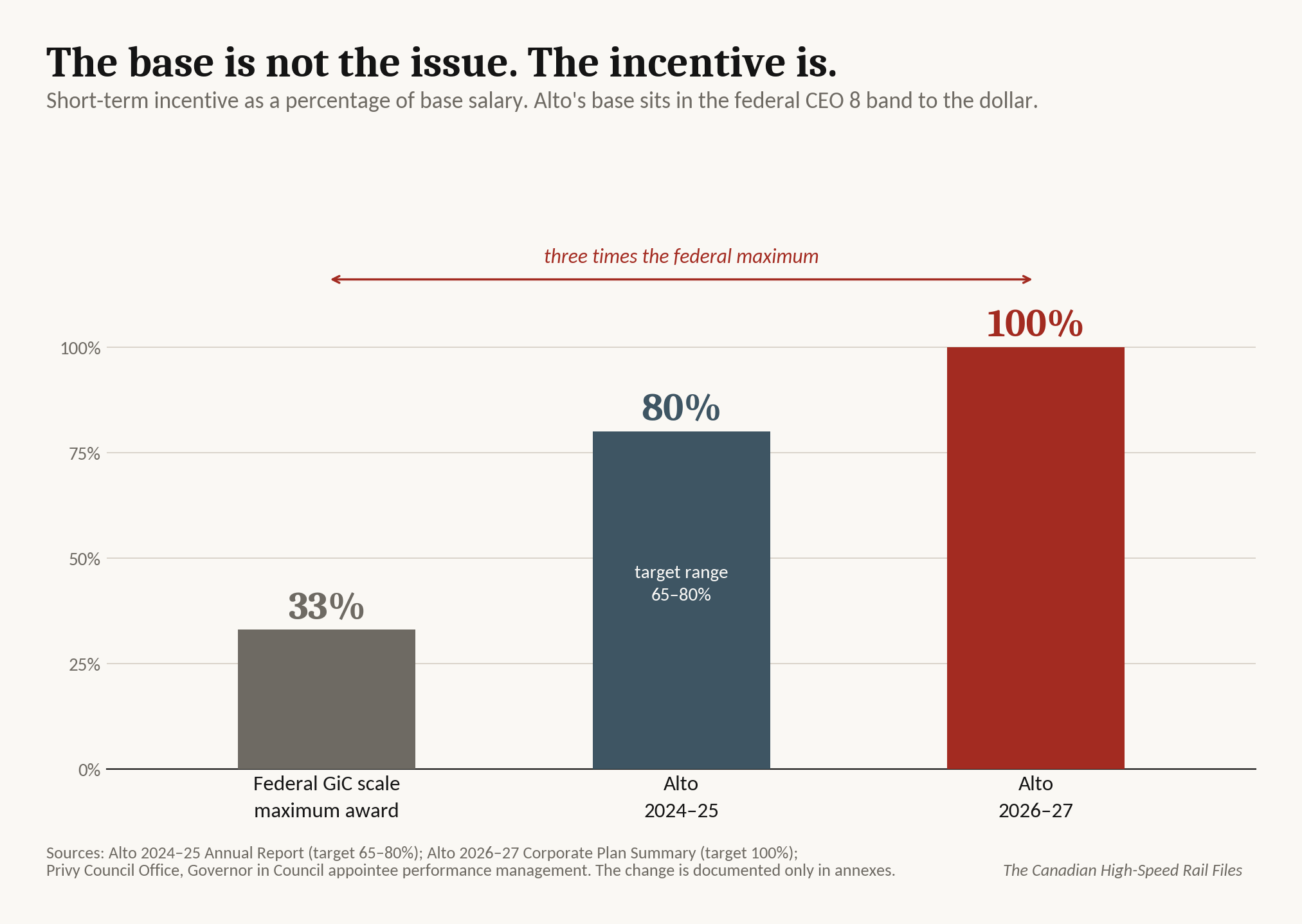
What is left is a band in an annex to a corporate plan summary that nobody reads. For 2026–27: a base of $573,500 to $674,700 and a short-term incentive target of 100 per cent, for about $1,349,400, with benefits worth a further 27 to 30 per cent on top. No actual figure. No individual disclosure. No minister or government official who had to agree.
For the lowest-paid organization on Alto's comparator chart, I can tell you the person, the year, the exact dollar figure, the size of the taxable benefit, and the fact that the car allowance was dropped from the next contract. For Alto, I can tell you a salary range.
The fix is not complicated
Three options, any of which would work, and all of which already exist somewhere in Canada.
Name Alto as being subject to section 108 of the Financial Administration Act, so the Governor in Council sets the compensation and a minister answers for it. That is the CIB model, and it is the model Alto was deliberately carved out of for reasons that have never been explained.
Require Alto to publish named executive compensation in its annual report the way NAV Canada does voluntarily and Hydro One does under securities law — actual amounts, individually, after the fact based on actual bonuses paid.
Adopt the British Columbia rule: total compensation for the chief executive and the next four, a board chair's signed attestation, publicly released contracts, and no confidentiality clauses.
I would settle for any of them.
No posts
Comments
Nothing yet. Say the first thing.
Sign in to join the conversation.