
March is Women’s Month and it is also when we get to call the wine and mezcal makers by their name. If you swing by Colonia verde, printed on the menu you’ll see a list of names, all women, all carrying their own story. When us wine folks list out wines, we tend to think of the name of the producer, the grape, the location. Maybe we even get hyper specific on region, and rever a vintage. In this process, we forget about the name of the person that actually made the wine.
March is the month we think of the names of all women makers, but calling out makers by their name is a journey that began years ago, with our list of mezcaleros and mezcaleras, and more specifically, through a visit to see Berta Vasquez, the ‘Gran Mezcalera’. During this visit is when we realized the amount of hands that mezcal goes through, till it gets to us, the final drinker. In this hand over process, the actual maker is lost.
As we wrap up this femme month, let me share with you Berta’s bitter sweet story and next time you come over to our spot, look for her name, chin chin to her and sip away.
EL CHOCOLATE CALIENTE DE BERTA
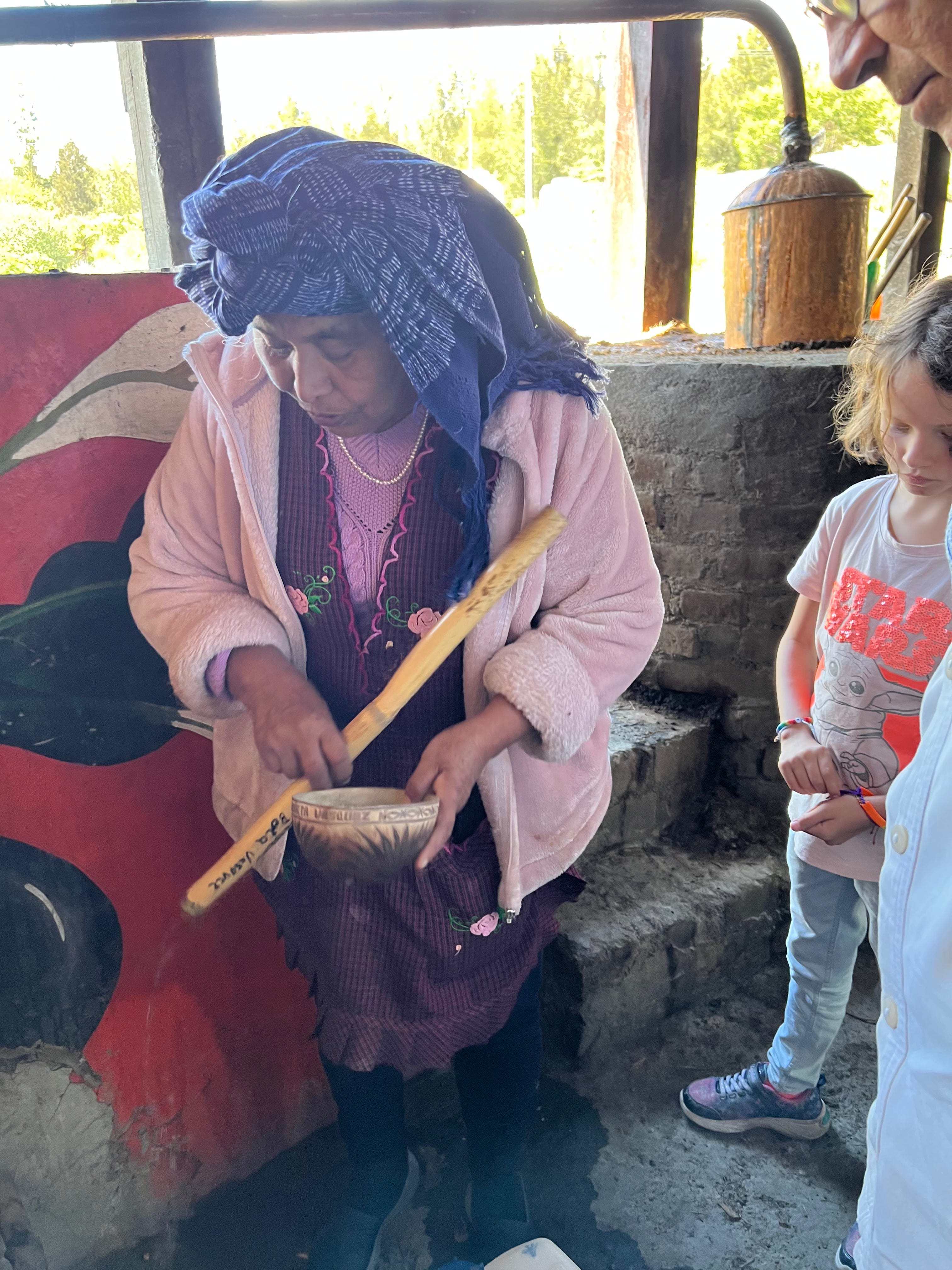
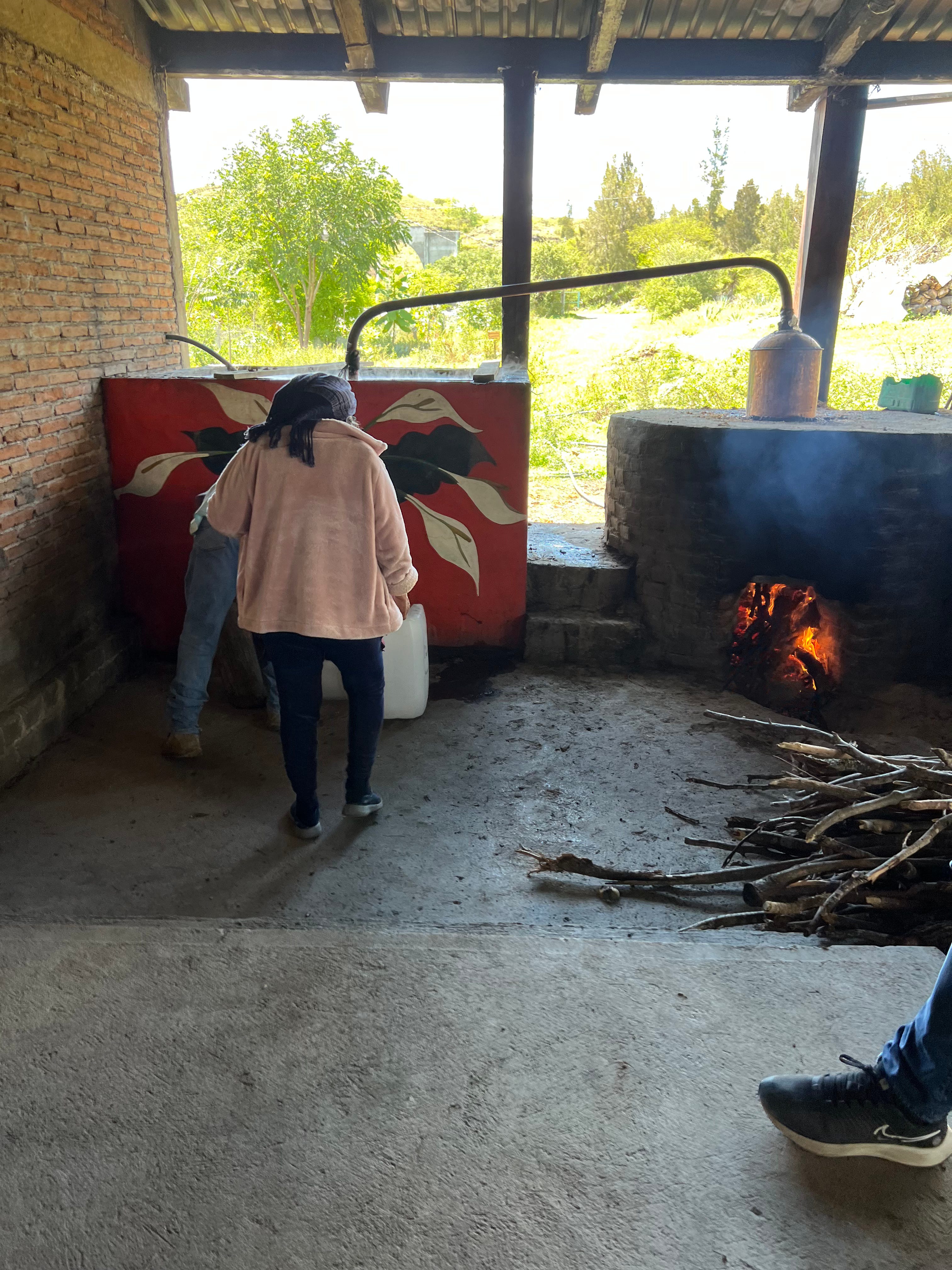
Our visit to meet the gran mezcalera, Berta Vasquez, was not exactly what I imagined. It ended up being bittersweet, reminiscent to the taste of Mexican chocolate. Layered, complex, delicious but also, slightly bitter. When calling Berta a ‘gran mezcalera’, I want to clarify this isn’t a descriptor, or my grand opinion about her, which I have. ‘La gran’ or ‘el gran’ is a title given by the Oaxacan community to honor those makers who have kept an ancestral tradition alive, and those who hold knowledge above all industry. These individuals are the keepers of the mezcal tradition. While most of them are men, Berta is in this group. This is why a trip to Oaxaca meant a trip to see Berta, ‘si, o si’. We had heard many anecdotes around Berta, of how she has the power to move you to your core when you met her, and about her green parrot, always on her shoulder.
‘Oooof have you heard Berta’s tragic story?!’ distributors and industry people would say, without diving into it, emotionally unable to go there but still carrying the story with them as a ghost. What we all do know collectively is that Berta’s husband passed away at an early age and she carried on with the palenque. Today, it is her mezcal that is known not just in Oaxaca, but around the world, and in the best bars of New York City and beyond.
We drove to the city center of Oaxaca, where one of the importers would meet us so he could hop in our car and we could all go see Berta. He sat in the front; I was in the back with my daughter Natalia. What started as one conversation lasted the entire hour and a half duration of the trip. The guy had FACTS, on mezcal, its production, its distribution, its licensing…it was dizzying. He finally took a singular, longer breath to say, ‘we are close, its right around here’. And without pulling any GPS map, purely mentioning a house here and a tree there, Felipe was tasked to take a sharp curve up a mountain, all the way up to Berta’s palenque. We parked and I whispered to Natalia ‘are you ready to meet Berta?’. I felt the excitement in my sweaty palms as I helped my daughter out of the car. And there she was, Berta, with a peaceful smile but no parrot on her shoulder, rugged just as I had seen her in photos. We embraced and she invited us to seat down to chat. She seemed both exhausted and exhilarated. Berta told us she had been going on these elaborate walks in unknown territory, chasing down wild agaves called Llama del Horno. She had become obsessively curious about what kind of mezcal could be produced from these wild agaves. Let me just paint a clearer picture - Berta is around eighty years old, most likely inching to her nineties, so these walks I imagine could be brutal, and her expression while telling us this story painted that picture. During one of her walks into the unknown, a van drove by her slowly with a bunch of man in it. The van stopped and pulled next to her. One of the men asked her what she was doing there. My heart was pumping harder when she said this. She felt threatened and scared by the group, but also, her body so incredibly tired she figured these men could actually help her cut the agave and carry it down the hill. That, or something really bad could happen to her. Either way, she decided to convince them she’d hop in the van with them and take them to see these wild agaves. She offered the men some money and petrified when the men got their machetes out, they chomped the agave and loaded them all into the truck. She wanted to tell us this story because it would be the agave we were going to taste. I could tell this was one of the many stories, versus the singular one, of that time when she braved it all. She said it with such tenderness and so quietly though, that it was hard to believe that story belonged to her. We tasted the mezcal. It was mineral and ephemeral but also punchy, like her. A man came by as we were tasting and casually greeted Berta without much affection then quickly moved on to other tasks around the palenque. I found that interaction odd and cold, given how warm Berta seemed to be, but I moved from that thought and went on to follow her as she was showing us around. She then asked us to go to her home to taste more mezcales. We said yes, of course, what an intimate way to get to know her story even more personally.
We got to her home - Real humble living. There was a very sweet wall showcasing all photos of Berta, in action, at the Palenque and in the fields, it was very touching. There were also flies everywhere and plastic bottles laying around all over the place. Her home felt far away and disconnected from her one ounce pour of eighteen-dollar mezcal you get in Brooklyn. For Berta, as soon as we stepped foot in her house, it was a ‘first thing is first’ situation. “Natalia, mi amor, te hago una agua de chocolate?”. Before diving into any type of tasting, Berta wanted to make my daughter Natalia a hot chocolate. In Mexico, its “agua de chocolate” and we use water instead of milk. She asked Natalia to follow her to the kitchen, we all did. “I have a trick my mom taught me”, Berta said, and pulled out a small coffee pot. “You brew the cacao chunk in a coffee pot”. It was the greatest shortcut hack, for a woman that made mezcal, the most elaborate and long process of any kind of 'making'. It made us all laugh, Natalia found it hilarious. She stuck a big chunk of cacao inside the pot and let the hot water melt it on its way down. She poured some for all of us. Mexican cacao is so incredibly loaded with flavor, that it truly just needs nothing more but water. It carries it all - The sweet, the bitter, the spicy. It tasted delicious.
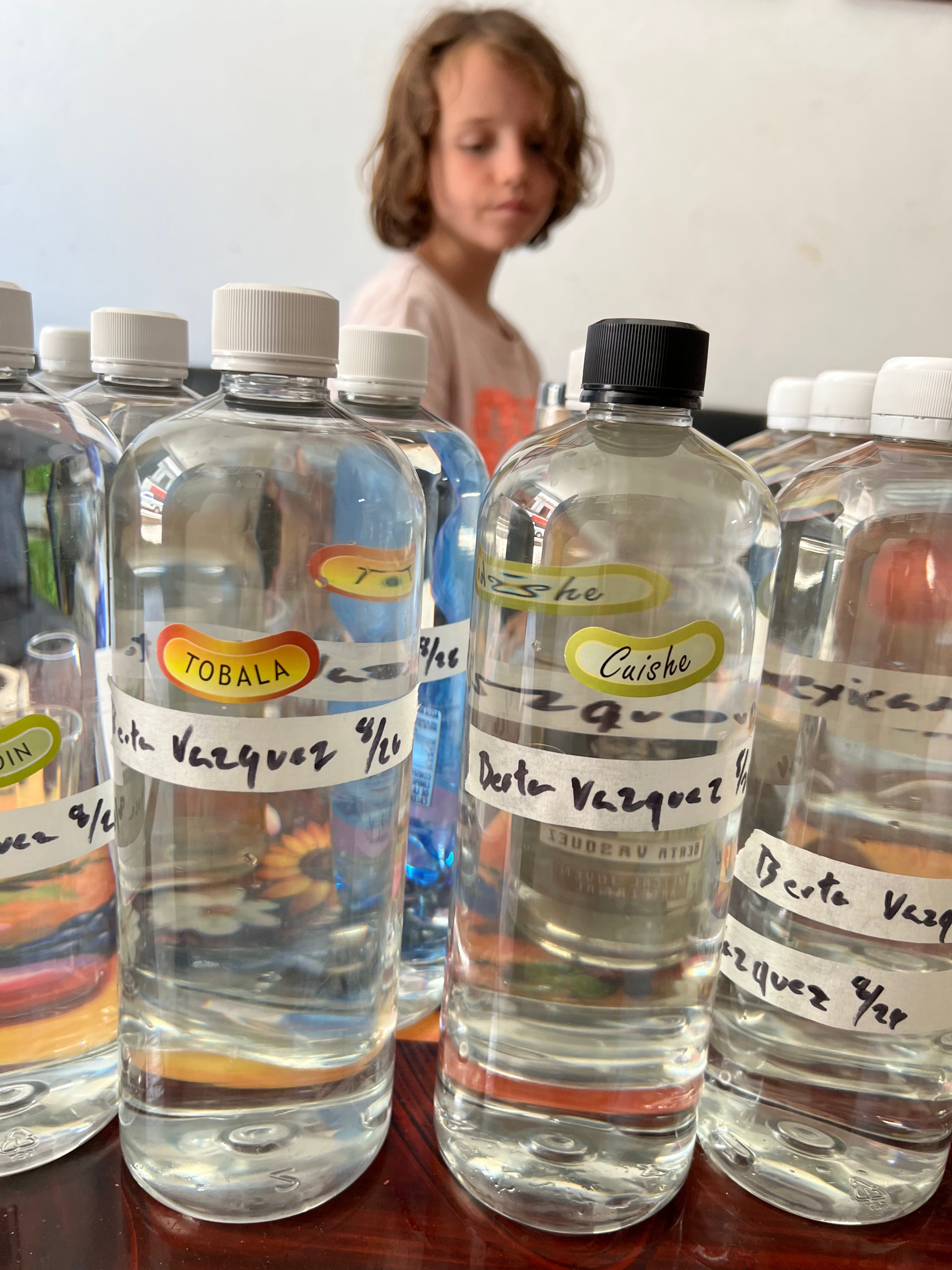
We went back to the main room and began to taste, through a lineup of wild agaves including her Espadin, which is the best I’ve ever tasted. A woman came in and quickly out, no real interaction with Berta. As soon as this mystery woman stepped out, Berta began to cry. ‘That is my daughter in law’ she said to us with teary eyes and continued to let it out for us, ‘we don’t really speak to one another’. She tried to explain the business intricacies of working with family and sharing the palenque. The dots began to connect for me. The man I had met back at the palenque, who gave the cold hello to Berta, was actually her son. She tried to explain but was carried by her emotions. I couldn’t quite get the intricacies but the main rub was that her daughter in law wanted a bigger chunk of the business, Berta refused to give it. I began to cry with her, unsure if it was the agua de chocolate, or a power that Berta held over me. Berta recognized I was emotionally locked in with her and let the entire story unfold. It turns out that the tragedy wasn’t just that her husband had died and left her with no mezcal knowledge and the entire palenque to run, it became clear throughout the day she’d be brave enough to overcome that. The real tragedy as it turns out was that soon after her husband’s death, she also lost her young son in a car accident. And it was this second shot to the heart, that never let her recover. Berta kept going back to the painful past and jumping into the present. She finally said, “I can’t give up the work in the palenque because when I stop working is when I remember what happened to me, and wonder why it did and how I am still alive and able to carry this’. A loss too big to bare, her only salvation was to lose herself in her work. I sobbed with her, our mother hearts aching together. I stopped sipping the mezcal and went back to the hot cacao. Like Berta and her mezcal, it carried so many contradictions in flavor, too many spices in the pot. It tasted deliciously bitter and beautifully overwhelming. We said our goodbyes and jumped in the car. Complete silence, no one spoke. We had all felt it.
Back in Brooklyn and back at our restaurant, it was clear to us that the name of the Mezcaleros themselves had to be the first thing outlined on our menu. Their name listed, before the brand name, and the distributor’s name, and the type of agave and the location. It is crucial that we don’t turn away from the name, the maker, that we let their story consume us, as we sip and melt into its entire complexity.
Salud por Berta! and salud for all our female makers on the wine list this month:
ELISABETTA montesissa ‘ rosissima’. Barbera. Emilia Romagna, Italy
JAHDÉ common wealth crush ‘ love echo’. Blend. Virginia, USA | 2024
CAMILA la montañuela, ‘onda de luz’. La Crescent. Vermont, USA | NV
ALESSANDRA divella, ‘dady’. Chardonnay. Francciacorta, Italy | 2019
CHRISTINE piri natural. Blend. Nahe, Germany | 2023
KATRIN lautner ‘wiesenmargerite’. Grüner. Burgenland, Austria | 2024
ANNA cortes de cima, branco. Alvarinho Blend. Alentejo, Portugal | 2022
MARTHA stoumen ‘honeymoon’. Colombard. California, USA | 2021
MIRKA mira, riesling. Velkopavlovickâ, Czech Republic | 2023
ARIANA occhipinti ‘sp68’ binaco. Zibibbo & Albanello. Sicily, Italy | 2023
CLAIRE naudin ‘le clou 34’. Aligote. Burgundy, France | 2021
LIDIA rocco di carpinetto ‘reis’. Cortese. Piedmont, Italy | 2024
ELENA la stoppa, ‘ageno’. Blend. Emilia-Romagna, Italy | 2022
BARBARA mainova, ‘moinante’ rosé. Castelaõ. Alentejo, Portugal | 2023
ZWANN est. wines ‘the feeder’ Blend. Oregon, USA | 2024
ANNE-MARIE domaine de gimios, ‘rosé’. Languedoc, France | 2012
ALINE menina d’uva ‘ciste’. Blend. Alto Douro. Portugal | 2023
CHIARA condello ‘predappio’. Sangiovese. Emilia-Romagna, Italy | 2025
INGRID clos des mourres, ‘adessias’. Grenache Blend. Rhone, France | 2022
MARIANA revela ‘alfocheiro’. Dão, Portugal | 2021
MYLENE bru ‘monts & merveilles’. Syrah. Languedoc, France | 2019
DEIDRE la garagista ‘loups garoux’. Frontenac Noir. Vermont, USA | 2021
No posts
Comments
Nothing yet. Say the first thing.
Sign in to join the conversation.