
In the 1920s and 1930s, a new movement emerged on the American cultural landscape: the Harlem Renaissance. The Renaissance was labelled an eruption of African American artistic and intellectual thought, primarily centered in and around New York. While it served as a harbinger of the Civil Rights Movement in the 1940s and 50s, the movement’s contributions were primarily to the literary and artistic world by many accounts.
Among the many artists the movement awoke, Duke Ellington, remained one of the most resoundingly notable. While the jazz legend’s career crescendoed at several points, it was his 70th birthday (celebrated nearly 57 years ago this week) on April 29, 1969 that remained among the musician’s most noteworthy personal highlights.

Ellington’s contributions to the American cultural milieu were so notable, that in 1969, then US President Richard Nixon bestowed him with the Presidential Medal of Freedom.
While conferring the honour, Nixon said the following of Ellington’s immense talent and contributions to jazz:
Edward Kennedy Ellington, pianist, composer, and orchestra leader, has long enhanced American music with his unique style, his intelligence, his impeccable taste. For more than 40 years he has helped to expand the frontiers of jazz, while at the same time retaining in his music the individuality and freedom of expression that are the soul of jazz. In the royalty of American music, no man swings more or stands higher than the Duke.”
Nixon however ended his remarks with the following:
“You see, this is his birthday. Now, Duke Ellington is ageless, but would you all stand and sing “Happy Birthday” to him. And, please, in the key of G.”
With this invitation, Nixon sat down at the piano and led the guests in a rendition of the classic tune.
What may be similarly worthy of widespread attention and causing significant waves in Indian society is the recent GenomeIndia project, initiated six years ago.
“...the GenomeIndia project has already thrown up results that will reshape how Indian society looks at itself and addresses its deepest public policy challenges” writes Nitin Pai (Takshashila Co-founder and Director) as he examines the project in his latest piece in The Mint.
Nitin’s reflections come following recently published research on the sequencing of the whole genomes of 10,000 individuals across over 80 communities. The authors of the study reveal inter alia, that the country’s population is far too genetically diverse to be managed under a single public health framework.
In light of these findings, Nitin makes the argument for why the GenomeIndia database should be treated as critical public health infrastructure (and three other recommendations in that vein).
To read Nitin’s other recommendations in full, follow this link.
Drawing on the wisdom of Madan Mohan Malaviya (founder, Banaras Hindu University) who extolled the virtues of prudent spending when he said, “Do not spend a single paisa on useless things, spend lakhs on good deeds,” Narayan Ramachandran (Takshashila Co-founder) examines Uttar Pradesh’s remarkable revenue story.
Narayan’s recent column in The Mint, elaborates on UP’s fiscal features that boasts a revenue surplus for over two decades:
Unlike many large states in India, UP has been running a revenue surplus for two decades now…as India’s most populous state, it is the beneficiary of a sizeable chunk of the destination-oriented goods and services tax (GST). Its population combined with the fact that the governing party is the same both in the state and at the Centre (‘double engine sarkar’) results in the single largest share of central tax devolution.
With assembly elections approaching, Narayan scrutinises the political pressure the state may face with regards to expensive unconditional cash transfers. His commentary covers a comparison between UP and other states, including structural advantages UP enjoys.
To read his reflections in full, follow this link.
Do you want to play a part in shaping India’s future? Be at the forefront of policymaking and governance? Look no further than Takshashila’s Post Graduate Programme (PGP) in Public Policy.
The PGP is Takshashila’s 48-weekend hybrid public policy program, offers a multidisciplinary curriculum delivered through webinars on Saturdays and in-person workshops across India. It balances academic learning with policy simulations and provides exclusive access to Takshashila’s experts and alumni network.
Apply here by May 1, 2026 to avail of a ten percent scholarship - the programme begins on June 20, 2026.
Where does India stand on the question of whether the US should sell advanced GPUs to China? Pranay Kotasthane (Takshashila Deputy Director and Chair, High-Tech Geopolitics Programme)’s answer may surprise those who assume India’s interests align neatly with Washington’s.
The US chip denial strategy, he argues, has succeeded in one sense (China cannot manufacture leading-edge chips) but has failed at the goal of constraining China’s AI ecosystem, as DeepSeek and Qwen demonstrate.
To read Pranay’s policy prescriptions in full, follow this link.
India’s modernised census process was the subject of discussion in a recent episode of StratNewsGlobal.tech, where Dr Y Nithiyanandam (Head, Takshashila Geospatial Programme) outlined the key elements of this new approach, alongside some of the upcoming challenges the exercise may face.
While this self-enumeration process enables the use of layered databases through satellite data and GPS, data privacy and technical accuracy of location tracking in densely populated areas will present unique challenges.
To hear Nithiya’s detailed explanation of these developments, follow this link.
Despite driving India’s economy and supporting millions, cities face significant limits in their authority, finances, and accountability.
This episode features Sarthak Pradhan (Assistant Professor of Economics at Takshashila) and Prabhat Kumar (Director of Public Finance Management) discussing urban governance in India and Janaagraha’s Municipal Finance Blueprint submitted to the 16th Finance Commission.
To be a fly on the wall for their insightful conversation, follow this link.
Welcome back to the Tabletop Trove of Dispatch! As you may well know, this section is intended to be a virtual repository of the books that sit at a high-table located in Takshashila’s physical office space in Bengaluru, Karnataka.
This week’s curated theme: Geopolitics Untethered curated by yours truly.
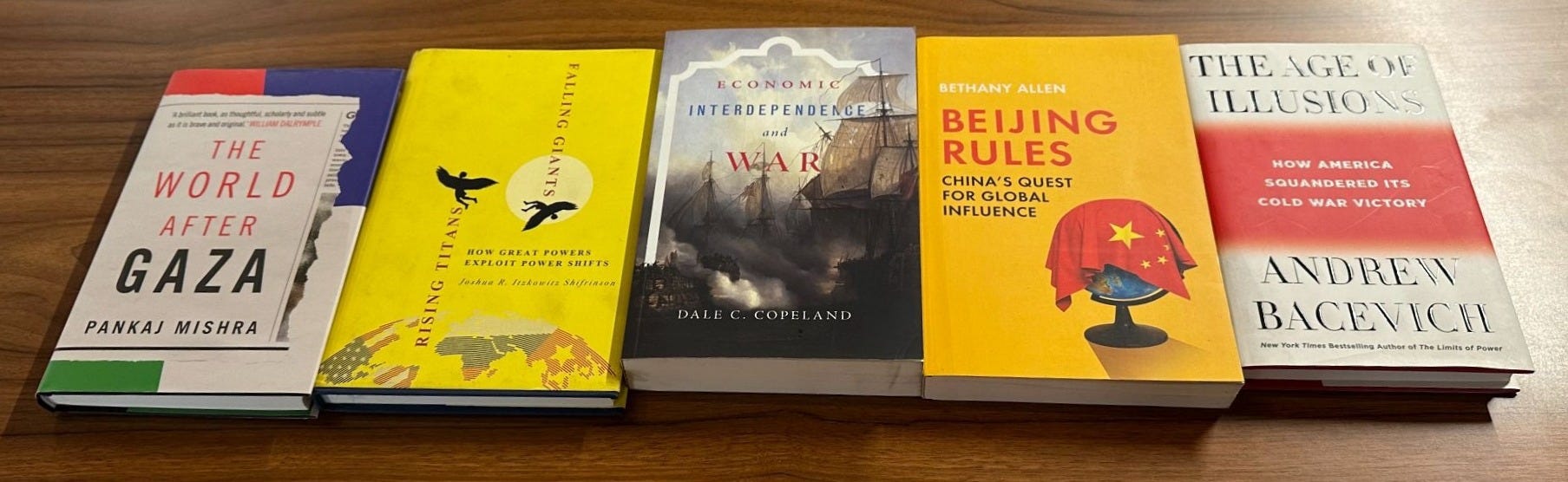
The World After Gaza (by Pankaj Mishra)
Rising Titans, Falling Giants: How Great Powers Exploit Power Shifts (by Joshua R. Itzkowitz Shifrinson)
Economic Interdependence and War (by Dale C. Copeland)
Beijing Rules: China’s Quest for Global Influence (by Bethany Allen)
The Age of Illusions: How America Squandered Its Cold War Victory (by Andrew Bacevich)
While we have you here, care to participate in the Dispatch’s new trivia section so you have a fun fact to share over dinner time?
Responses can be mailed to us at: publications@takshashila.org.in. And of course, the answer will be shared in a future Dispatch edition! This week’s question is:
Q: Before it was known as Djibouti, what was the small African country’s former name (from 1896–1967)?
P.S.: See below the response for our previous edition’s trivia question!
Q: Siachen is located in the eastern Karakoram range in the Himalayas. What does its name mean in the Balti language?
A: Land of Wild Roses
Until next time!
This edition of the Dispatch was written by Kripa Koshy, Staff Programme Manager for Takshashila’s Post Graduate Programme in Public Policy.
Comments
Nothing yet. Say the first thing.
Sign in to join the conversation.