
Nestled between Zambia (to the north) and Zimbabwe (to the south) sits the world’s greatest sheet of falling water, the Mosi-oa-Tunya (The Smoke That Thunders) - more commonly known as the Victoria Falls.
The first European explorer to encounter it was David Livingstone, who drew inspiration from the reigning British monarch at the time, Queen Victoria, to name the natural wonder in 1855.
Spanning 1708m wide with an average depth of 100m, the Falls purportedly produce a mist that is visible more than 20km away. Bird species such as the Taita Falcon and Black Eagle settle in its dewy embrace, and over the years, owing to changing waterfall positions, eight steep sided gorges have been formed along the Falls.
But the woe from one Zimbabwean photographer was that none of it was visible on Google Street View - and ergo to the world.
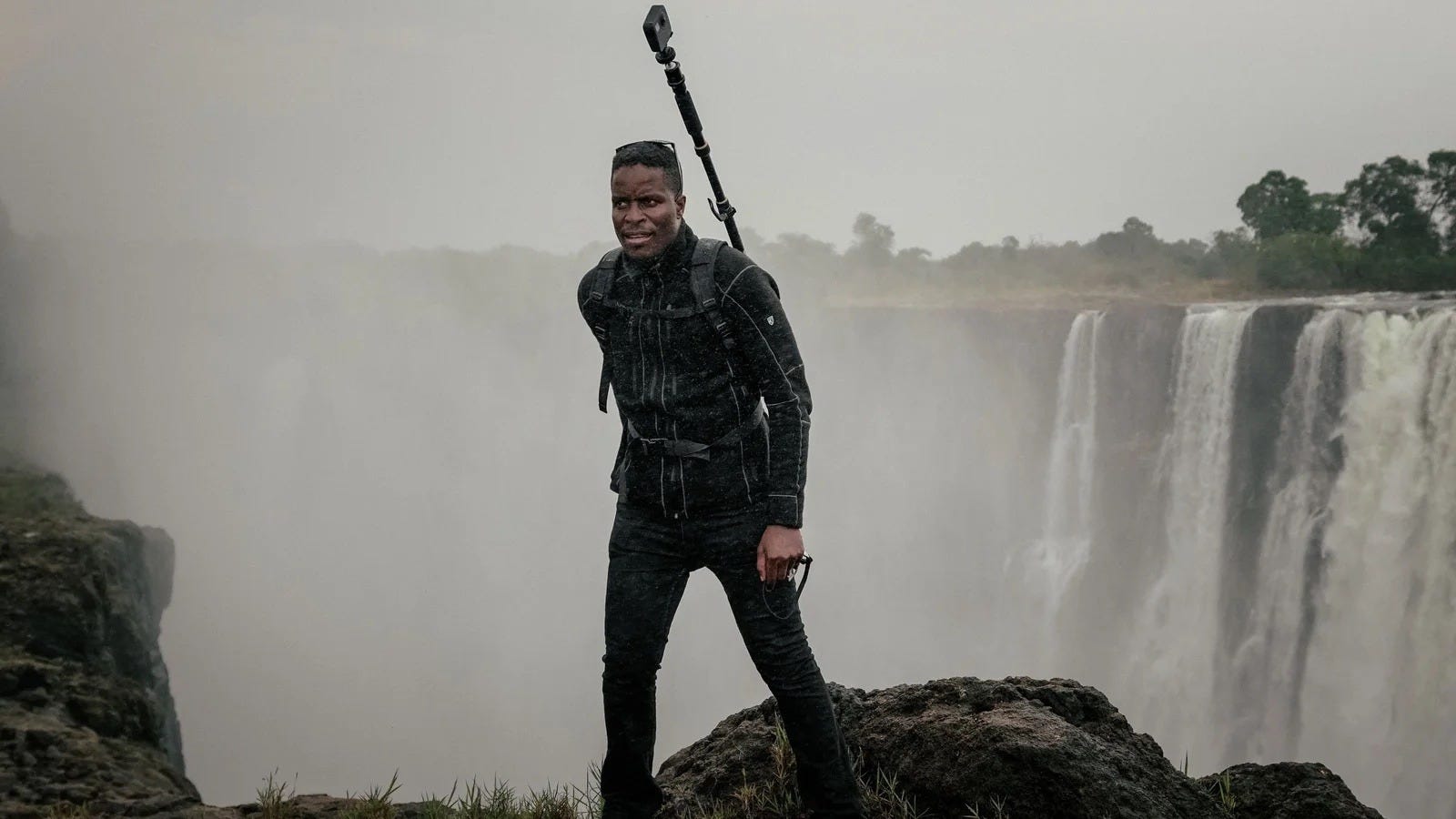
Tawanda Kanhema found Street View’s interactive mapping technology largely featured landscapes in European or North American countries but none of his home country, or several parts of Africa or Asia for that matter. So in 2018, he set out to remedy this, armed with a loaned Insta360 Pro 2 (via Google’s Street View camera loan programme).
Kanhema speaks of his experience taking to the streets of Zimbabwe with, what he called, a “conspicuous 4-foot contraption” attached to the roof of his car. The Victoria Falls were on his short list of places to document. Strapping his camera to the dashboard of a helicopter, he ventured to capture the thunderous spectacle from 400 feet above.
Of his documentary efforts he said, “Imagine being able to lend a ticket to get on a helicopter tour of one of the seven natural wonders of the world and being able to bring at least a million other people with you by creating these images that people can look at and feel as though they were there.”
Covering over 3000 odd kilometers across the country documenting as he went along, Kanhema helped put Zimbabwe on the map.
A more recently undertaken arduous journey that captured the public’s imagination was NASA’s Artemis II mission, which undertook a flyby of the moon with Canadian and American astronauts (and a jar of Nutella) on board.
In that vein, this week’s All Things Policy (ATP) episode we’d like to showcase is a conversation between researchers from our High-Tech Geopolitics, Advanced Military Technologies and Space Programmes. Together, they unpack technical nuances related to this mission, reflections on the Apollo Programme of old, how launch costs factored into this journey, among many other strands of conversation.
Join Lokendra Sharma (Staff Research Analyst, High-Tech Geopolitics), Aditya Ramanathan (Head, Advanced Military Strategy) and Ashwin Prasad (Staff Research Analyst, Outer Space Programme) for their discussion here.
P.S.: For those curious, virtually visit the Victoria Falls here.
It’s time for India to build a coalition to respond to the war in West Asia, asserts Nitin Pai (Takshashila Co-founder and Director) in his latest piece in The Mint.
Nitin makes the compelling case for why India must gather “like-minded and like-affected countries” to provide a diplomatic intervention in West Asia, in the midst of a faltering global community. On the needed features for such a coalition, he elaborates:
The coalition’s main purpose would be to engage in diplomacy to encourage the warring parties to exercise restraint and prevent escalation and expansion of the wars in West Asia. If its members agree on political and economic coordination, the coalition will have greater leverage and a bigger set of diplomatic tools to engage Washington, Tel Aviv, Tehran and the Gulf capitals.
To read his article in full, including his argument for why such a coalition building effort is neither “exercise in moral grandstanding or peacemaking“, follow this link.
Timely analysis on the Assembly Elections in Kerala, Tamil Nadu and West Bengal comes from Narayan Ramachandran (Takshashila Co-Founder) in his latest column in the Mint.
While each state is unlike the other, they share one similarity, in Narayan’s words, all have “unique sociopolitical paths from the time of India’s independence [and] these paths are quite distinct from those followed by the other states of India.”
To read his article in its entirety, including the serious fiscal situation each of these states face, follow the provided link here.
Critical mineral supply chains have never been more salient, and China dominates the game. But how did this geopolitical landscape emerge? How should one understand the “geopolitical tug-of-war” shaping supply chains? And where does India find itself in such a milieu?
To learn all this and plenty more, join our newly minted ECC, Politics and Policy of Critical Minerals. We’ve curated the curriculum. We’ve curated the faculty. All that’s left? Seeing you there.
Applications close by 3 May and the programme begins 9 May. Apply here!
As India–China relations enter a phase of “cautious yet fragile re-engagement”, this reality sits alongside deeper structural tensions. How should India’s political leadership navigate such terrain?
Luckily, our Takshashila Indo-Pacific Studies Programme researchers have begun to draw these contours and would like to bring you along. Join us next week as they discuss their latest book, Taming the Dragon: A Manifesto for a New Modus Vivendi with China (edited by Manoj Kewalramani, Chairperson of Takshashila’s Indo-Pacific Studies Programme).
We’d love to host you on 24 April, 17:30 to 19:30 at the Takshashila office to unpack the many considerations to understand this unique dragon. RSVP here so we know to expect you.
Welcome back to the Tabletop Trove of Dispatch! As you may well know, this section is intended to be a virtual repository of the books that sit at a high-table located in Takshashila’s physical office space in Bengaluru, Karnataka.
This week’s curated theme is Lives in the Spotlight:
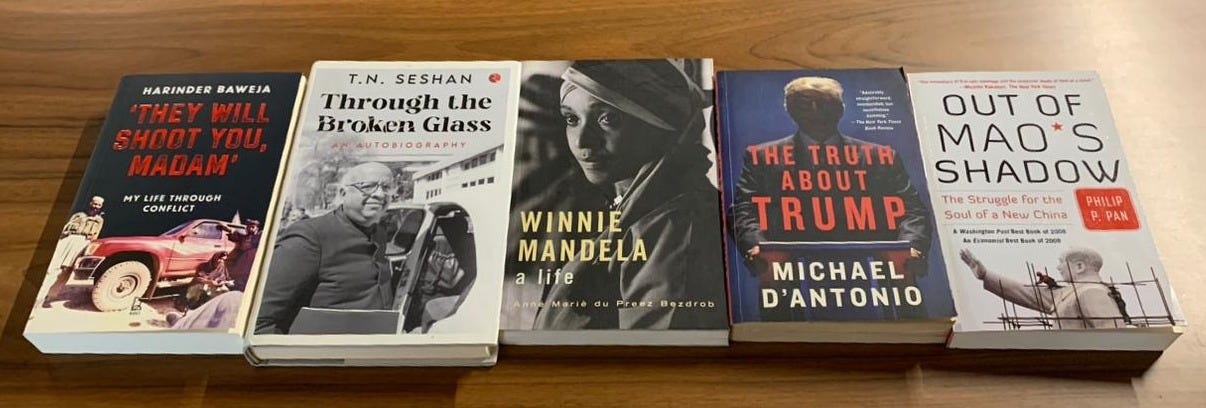
They Will Shoot You, Madam: My Life Through Conflict (Harinder Baweja)
Through the Broken Glass: An Autobiography (T. N. Seshan)
Winnie Mandela: A Life (Anne Marie du Preez Bezdrob)
The Truth About Trump (Michael D’Antonio)
Out of Mao’s Shadow: The Struggle for the Soul of a New China (Philip P. Pan)
While we have you here, care to participate in the Dispatch’s new trivia section so you have a fun fact to share over dinner time?
Responses can be mailed to us at: publications@takshashila.org.in. And of course, the answer will be shared in a future Dispatch edition! This week’s question is:
Q: Siachen is located in the eastern Karakoram range in the Himalayas. What does the place’s name mean in the Balti language?
P.S.: See below the response for our previous edition’s trivia question!
Q: Name India’s first satellite launched on April 19, 1975.
A: Aryabhata
Until next time!
This edition of the Dispatch was written by Kripa Koshy, Staff Programme Manager for Takshashila’s Post Graduate Programme in Public Policy.
Comments
Nothing yet. Say the first thing.
Sign in to join the conversation.