
Among the many allegorical tales that have emerged from the legend of the Greek demigod Hercules (the Greek imagining knew him as Heracles), few may be as enduring in its contemporary applicability as the Choice of Hercules.
The myth goes as follows: our famed demigod finds himself at a crossroads confronted by two competing paths: one personified by the figure of Kakia (Vice) and one, the figure of Arete (Virtue).
Kakia proposes a path characterised by minimal friction and immediate consumption. She promises leisure, avoiding the toils of existence exploiting the labour of others. Arete in contrast offers a path of struggle and toil, asserting that hard labor and service offers more gratification, an opportunity to reject short-term ease for long term gain.
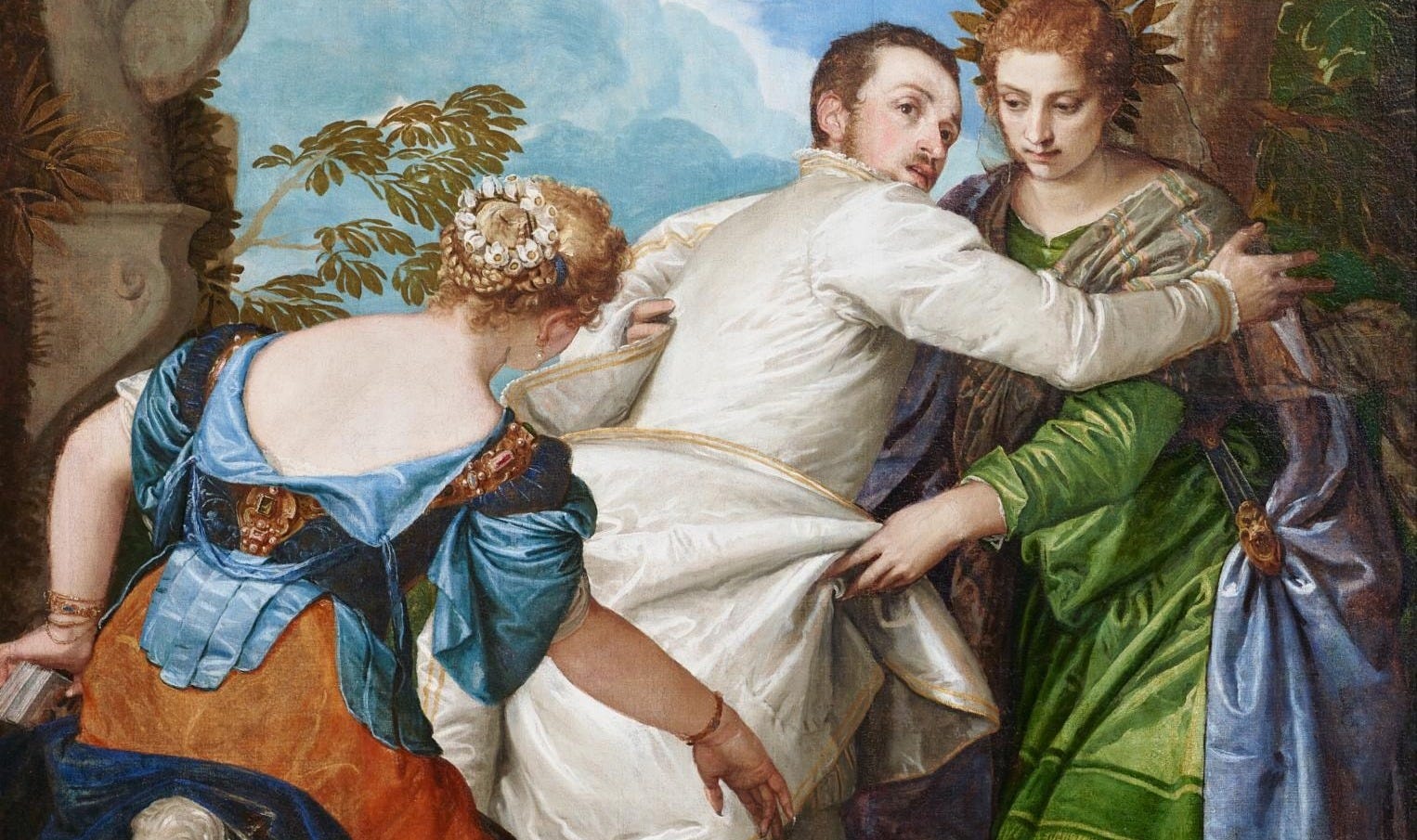
Vice, on seeing our hero’s dilemma offers the following invitation (imagined by philosopher Xenophon, born circa 430): “Heracles, I see that you are in doubt which path to take towards life. Make me your friend; follow me, and I will lead you along the pleasantest and easiest road. You shall taste all the sweets of life; and hardship you shall never know.”
In contrast, Virtue’s invitation Xenophon articulates as such, “if you take the road that leads to me, you will turn out a right good doer of high and noble deeds….but I will not deceive you by a pleasant prelude: I will rather tell you truly the things that are, as the gods have ordained them. For of all things good and fair, the gods give nothing to man without toil and effort.”
Hercules is said to have ultimately accepted Arete’s call, establishing the trope of a hero choosing the trying uphill path with struggle and eventual success.
Similarly, could it be a struggle for Pakistan to decide what to do with the international goodwill it has received as it serves as mediator between the United States and Iran amidst the West Asia war?
In his latest column in the Mint, Nitin Pai (Takshashila Co-founder and Director) suggests that there may be a predictable direction Pakistan may head in. He writes:
It is far more likely that Pakistan’s trajectory will follow a pattern that has been recurring since its creation. That goes something like this: Global politics creates an opportunity for Pakistan, relieving the immediate economic crisis; the military establishment then corners the lion’s share of the benefits and the economy gets worse; the military takes up its anti- India agenda and in the ensuing crisis, Pakistan goes back into the international doghouse.
To read his analysis in full, including his premonition of how such initiatives by Pakistan tend to prioritise the military establishment’s survival, follow the provided link here to read.
Three countries—Indonesia, Angola and the UAE—have quit Opec due to quota restrictions. The UAE chose to leave recently, signalling both a need to produce more oil as well as a political fissure with Saudi Arabia over the current Iran war.
This decision, which at first glance seems sudden, has been in the making for several years. With oil demand over the last 10 years growing only 1% compounded per annum, the UAE wishes to monetize its resources today and use the proceeds to transform its economy away from oil dependency.
In his recent column in The Mint, Narayan Ramachandran (Takshashila Co-founder) examines why Opec’s loss may be India’s gain. Through a careful recounting of the historical context around oil production, his analysis looks at the critical inflection point of UAE’s strategic exit from Opec.
His commentary examines the UAE’s strategic decision and what the energy security implications could be for major importing nations like India. To read his reflections in full, follow this link.
Following the announcement of a Rs 5,000cr Emergency Credit Line Guarantee Scheme for Indian airlines, Anupam Manur (Takshashila Professor of Economics) offers a nuanced take on the ills plaguing the aviation industry.
His reflections are particularly salient given the recent attention around the surge in the price of Aviation Turbine Fuel (ATF). In his recent piece in The Times of India, he pens the following:
“…what FIA seeks in the form of temporary duty waivers, or a reinstated crack band (a mechanism that caps refining margins within a defined range), or the approved emergency credit lines, are not silver bullets. They merely suppress symptoms. Disease lies deeper, in a tangle of government interventions that have left Indian aviation structurally fragile, long before the Hormuz shock arrived. While global oil prices are beyond India’s control, their shock is amplified domestically by a series of policy choices, which demand correction.”
For a more fulsome read of his analysis, including the four deep-rooted flaws in the policies that govern the aviation section, follow this link.
Do you want to play a part in shaping India’s future? Be at the forefront of policymaking and governance? Look no further than Takshashila’s Post Graduate Programme (PGP) in Public Policy.
The PGP is Takshashila’s 48-weekend hybrid public policy program, offering a multidisciplinary curriculum delivered through webinars on Saturdays and in-person workshops across India. It balances academic learning with policy simulations and provides exclusive access to Takshashila’s experts and alumni network.
Apply here by June 1; the programme begins on June 20, 2026.
DeepSeek’s preview of V4, its massive 1.6-trillion-parameter AI model, has picked up attention the world over. The model has been trained and can run exclusively on China’s internal hardware, thus eliminating the need for any NVIDIA technology and our Geostrategy Programme team has thoughts to share.
In the latest episode of All Things Policy, Amit Kumar (Staff Research Analyst, Takshashila Geostrategy Programme) and Satya Sahu (Associate, The Asia Group’s South Asia practice) analyse these milestones and their consequences for the broader geopolitical rivalry between the US and China.
To give their insightful chat a listen, follow this link.
Welcome back to the Tabletop Trove of Dispatch! As you may well know, this section is intended to be a virtual repository of the books that sit at a high-table located in Takshashila’s physical office space in Bengaluru, Karnataka.
This week’s re-curated theme is ‘Criminal Playbooks’ picked by our Geostrategy Programme Staff Research Analyst, Anushka Saxena:
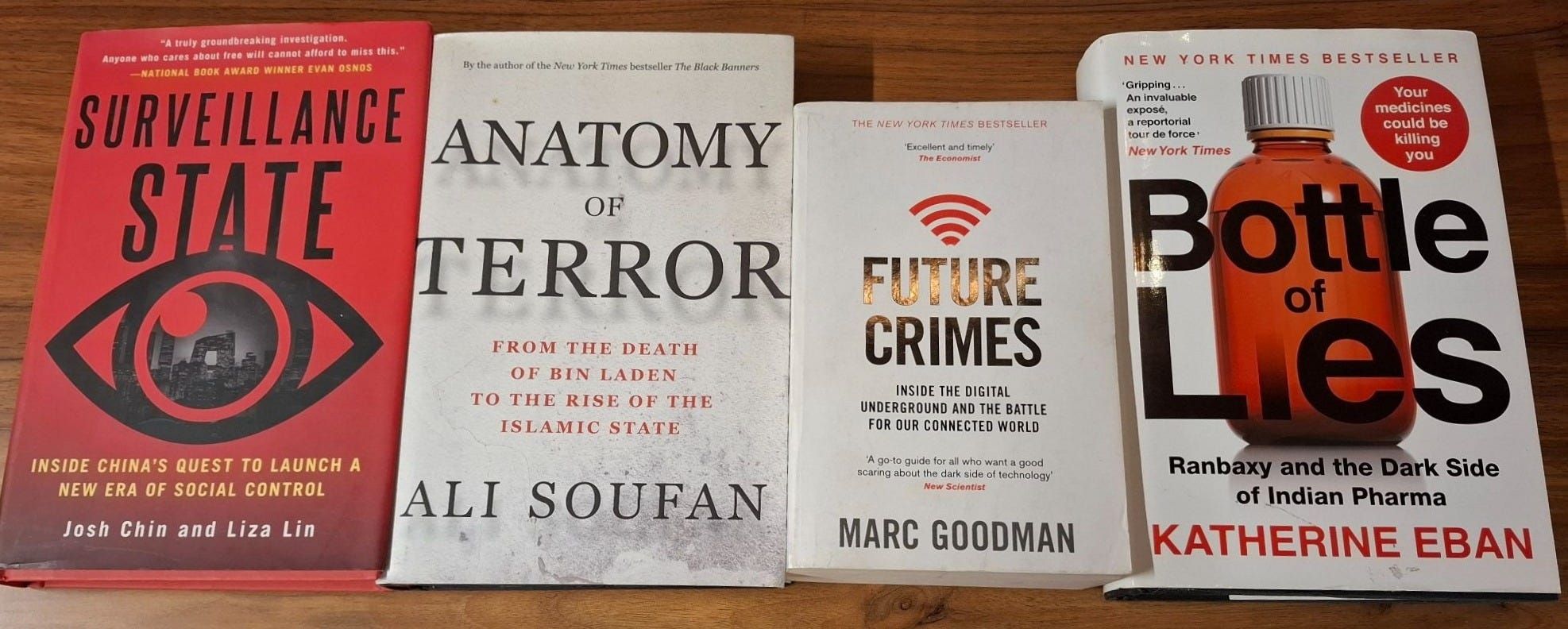
Surveillance State: Inside China’s Quest to Launch a New Era of Social Control (Josh Chin and Liza Lin)
Anatomy of Terror: From the Death of Bin Laden to the Rise of the Islamic State (Ali Soufan)
Future Crimes: Inside the Digital Underground and the Battle for our Connected World (Marc Goodman)
Bottle of Lies: Ranbaxy and the Dark Side of Indian Pharma (Katherine Eban)
While we have you here, care to participate in the Dispatch’s new trivia section so you have a fun fact to share over dinner time?
Responses can be mailed to us at: publications@takshashila.org.in. And of course, the answer will be shared in a future Dispatch edition! This week’s question is:
Q: What commodity accounts for 85 to 95 percent of total export revenue in Burkina Faso?
P.S.: See below the response for our previous edition’s trivia question!
Q: Before it was known as Djibouti, what was the small African country’s former name (from 1896–1967)?
A: French Somaliland
Until next time!
This edition of the Dispatch was written by Kripa Koshy, Staff Programme Manager for Takshashila’s Post Graduate Programme in Public Policy.
Comments
Nothing yet. Say the first thing.
Sign in to join the conversation.