
While the melting of sea ice has slowed down over the past 20 years (in what scientists are calling a “temporary reprieve”), projections by NASA indicate that we are still poised to experience an ice-free Arctic for at least part of the year before the end of the 21st century.
This trend also applies to a region that for a while used to be the single notable exception to such melting, an outlier in the high Arctic zone bordering Greenland and Canada, known as the Last Ice Area (or LIA).
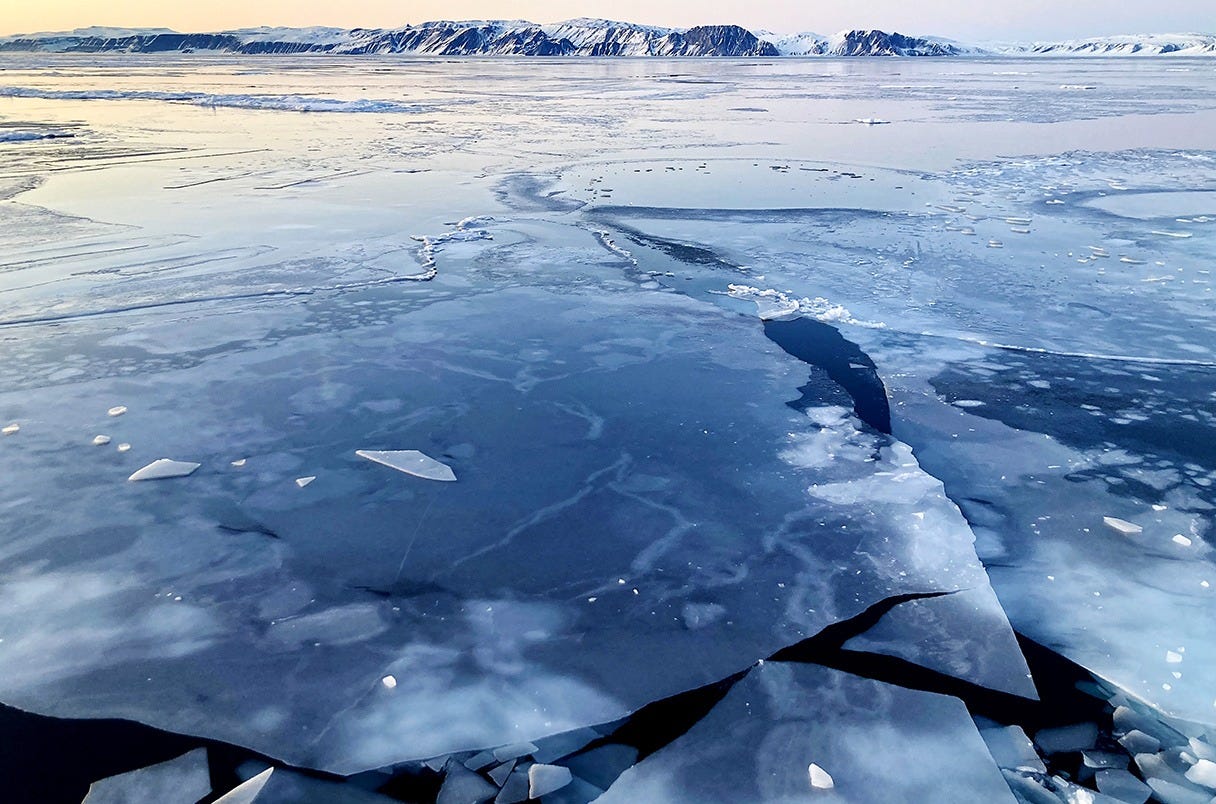
Anticipating that the region would serve as the final bastion for summer sea ice amidst global warming, led to a 2015 World Wildlife Fund Canada initiative to develop the term Last Ice Area, in a lobbying effort to preserve the region.
Why should this melting cause hue and cry I hear you ask, dear reader.
The lifecycle of the Arctic sea ice follows an annual rhythm. Every autumn and winter, expansion occurs across the Arctic Ocean, followed by an equally dramatic melt through the summer.
Satellites that have monitored sea ice melting since 1978 have shown a gradual decline in sea ice, with 2002 showing that the “summer minimum ice extent was the lowest it had been since 1979” according to NASA’s Earth Observatory.
The melting of winter sea ice, results in less insulation that buffers the warmer Arctic waters from the frigid air above, its depletion suggests a future with higher levels of oceanic warmth and greater moisture escape into the atmosphere. Further, sea ice reduces wind and wave activity, and as a result, mitigates coastal erosion.
In addition, scientists raise concerns for the impact on the survival of species such as polar bears, walrus and seal who rely on a predictable Arctic ecosystem.
As the future of the LIA remains under scrutiny, so too should we scrutinise the future of air power argues Nitin Pai (Director and Co-founder, Takshashila) in his recent column in The Mint.
Air defence and the future of warfare, is the subject of Nitin’s examination, with a strong caution against claims that “autonomous drones and precision missiles will be decisive in future wars.”
Nitin writes the following, while offering a nuanced perspective on stalled developments in India’s air defence space:
Once missiles and drones become the primary means of war-fighting, the questions of what, who, how, when and how much need to be asked afresh by defence planners….perhaps it is just as well that India’s formation of theatre commands has been delayed, because it is not clear how rocket forces, drones and air defence are best organized in the Indian context.
For his full commentary on the future trajectory of such developments including the way forward for India, follow the link here.
Historically, America’s greatest strength has been its ability to adapt and re-invent itself in the face of crisis. The country still possesses reservoirs of political talent and well-built institutions and mechanisms of democracy, apart from the personality traits required for a resurgence.
So writes Narayan Ramachandran (Co-founder, Takshashila) in his latest column in The Mint as America marks its 250th year, citing historical precedents of long-lasting civilizations arguing the nation is at a middle-aged crossroads rather than its twilight.
Narayan astutely examines the nation’s past, present and future, with particular attention to America’s, as Francis Fukuyama termed it, “‘high trust’ society” and its “ability to attract the best to its universities and its pathway for that talent to develop”
To read his analysis in full, including his caution against speculations of America’s decline and the historical strength the nation can count on, follow this link.
Dear reader, pencil in 26 July, 2026 in your calendars - it’s the application deadline for Takshashila’s 12-week Graduate Programme in Public Policy (or the GCPP as it is fondly known).
Designed for full-time professionals, the GCPP offers a hybrid learning experience and offers you the best introduction to the world of public policy. The programme includes weekly webinars on Saturdays, with occasional guest webinars on weeknights.
The highlights of the programme include an online Academic Conference and an interactive in-person workshop.
Apply here by 26 July, 2026 to avail of our 10 percent early bird scholarship!
This week’s All Things Policy episode we’d like to highlight is a conversation on the underlying drivers of India’s water crisis.
Join Adya Madhavan (High Tech Geopolitics Programme, Research Analyst) in conversation with Maj Gen Akash Kaushik, author of India’s Water Security: Threats, Strategies and Solutions. Together, they explore the precarious nature of India’s water security, from the historical Indus Waters Treaty to the Brahmaputra’s Tibetan headwaters.
Their discussion covers how to navigate a complex landscape of climatic pressure, aging infrastructure, and fraught geopolitical river systems.
Follow this link to be a fly on the wall for their conversation.
Welcome back to the Tabletop Trove of Dispatch! As you may well know, this section is intended to be a virtual repository of the books that sit at a high-table located in Takshashila’s physical office space in Bengaluru, Karnataka.
This week’s theme is the China Challenge, curated by yours truly:
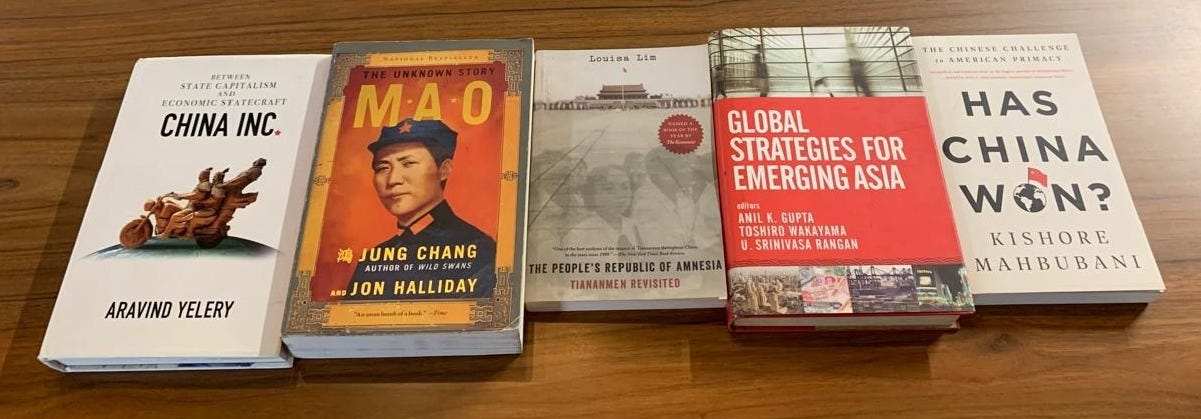
China Inc.: Between State Capitalism and Economic Statecraft (Aravind Yelery)
Mao: The Unknown Story (Jung Chang and Jon Halliday)
The People’s Republic of Amnesia: Tiananmen Revisited (Louisa Lim)
Global Strategies for Emerging Asia (Anil K. Gupta, Toshiro Wakayama, and U. Srinivasa Rangan)
Has China Won? The Chinese Challenge to American Primacy (Kishore Mahbubani)
While we have you here, care to participate in the Dispatch’s new trivia section so you have a fun fact to share over dinner time?
Responses can be mailed to us at: publications@takshashila.org.in. And of course, the answer will be shared in a future Dispatch edition! This week’s question is:
Q: Which is the second largest cold desert in the world?
P.S.: See below the response for our previous edition’s trivia question!
Q: Which two natural woodchips are used to make the traditional Arab incense, bakhoor?
A: Agarwood and sandalwood
Until next time!
This edition of the Dispatch was written by Kripa Koshy, Staff Programme Manager for Takshashila’s Post Graduate Programme in Public Policy.
Comments
Nothing yet. Say the first thing.
Sign in to join the conversation.