
Born in 1920 amidst the post-WWI era of nation-building, the Group of Seven (also known as the Algonquin School) was considered to be a conscious effort toward Canada’s cultural self-determination, aiming to craft a unique national artistic identity.
The Group (formed in 1920 and disbanded in 1933) was a collective of Canadian landscape painters who are credited with pioneering a movement “equated with a romanticized notion of Canadian strength and independence”.
Formed in 1920 in Toronto, its initial members were: Lawren Harris, A.Y. Jackson, J.E.H. MacDonald, Arthur Lismer, Frederick Varley, Franklin Carmichael, and Frank Johnston. The Group’s origins however were as an informal network where they met for regular lunches at the Arts and Letters Club of Toronto. At these meetings they debated the finer points of their burgeoning creative voice.
Once formed, the Group’s defining decision was to move away from European aesthetic styles that depicted Canada’s terrain as muted and soft pastoral landscapes. Instead, they advocated for a “more assertive visual language” to depict the diverse scenery of the North American nation.
However this decision was not entirely divorced from external influence, particularly from Europe. Each painter in the Grouping drew inspiration from French Post-Impressionists including Vincent Van Gogh and Paul Gauguin. As well, their attendance at a Scandinavian exhibit in 1912 provided them with an example of how bright colours could be thoughtfully incorporated into landscape paintings.

Nonetheless, the Grouping is credited with popularising the use of post-impressionist methods and vibrant colouring to document the textured ruggedness of the Canadian Shield (considered the largest mass of exposed Precambrian rock).
While local critics initially rejected their work, the Group’s global acclaim in the mid-1920s (ironically in London), was seen as pivotal for Canada’s cultural institutions, and carved out space for local artistic endeavours.
Much like the Grouping’s decision to move away from the conventional and mainstream European aesthetic of its time so too it may be time for India’s bio-economy to move away from its existing governance systems argues Nitin Pai (Takshashila, Director and Co-founder).
How have escalating US-China trade tensions and the convergence of AI with biotechnology created a potential window of opportunity for India to become a major technological power? Nitin writes in his latest column in The Mint:
Reforming the biotech sector is no longer only about healthcare, agriculture and economic growth. It has been turned by China and the US into an area of geopolitical contestation. This creates a new salience and urgency.
Nitin examines India’s pharmaceutical and biotech sectors that find themselves at a pivotal juncture. Pointing to NITI Aayog’s recently announced $2.6 trillion bio-economy target by 2047, Nitin argues that a concerted governance reform is required if India is to become a global biotech leader.
To read his commentary in full, including greater insight on the nuances of what this reform will entail, follow the link provided here.
Independent India is on the verge of beginning its 80th year. One aspect of India’s development that needs a full recalibration is its approach to research and development (R&D). Both India and the world are changing rapidly, and this system cannot sustain the next eight decades as it has done in the past. The global order now operates in a framework of ‘impeded globalization,’ where access to certain technologies and critical raw materials is subject to restrictions.
So writes Narayan Ramachandran (Takshashila Co-founder) in his recent column in The Mint where he astutely diagnoses three contemporary challenges India’s R&D ecosystem faces.
While recent government initiatives like the Anusandhan National Research Foundation (ANRF) and the ₹1 trillion Research Development and Innovation (RDI) Fund infuses needed funding into the ecosystem, this alone cannot resolve deep-seated struggles that hamper Indian science and engineering from reaching the “highest global quality level”, Narayan argues.
What more can be done to revive the ecosystem? Read more here.
As outer space rapidly evolves from a scientific preserve into a contested strategic domain and commercial frontier, our four-week online expert capsule delivers a structured policy breakdown of orbit-bound geopolitics.
Offered in partnership with the Indian Space Association (ISpA) the course promises you a thoughtful and nuanced view of India’s domestic space reforms, IN-SPACe’s private sector integration, space domain awareness, and the legal nuances of the Outer Space Treaty among many other topics.
Apply here by 31 August 2026.
This week’s All Things Policy (ATP) episode we’d like to highlight is a conversation between Anisree Suresh (Research Associate) and Suman Joshi (Staff Programme Manager) on the recently signed India-UK trade agreement. Together they unpack the key provisions of the India–UK CETA, the changing nature of FTAs and why issues like carbon border taxes and industrial policy may matter as much as tariff cuts.
To be a fly on the wall for their conversation, see here.
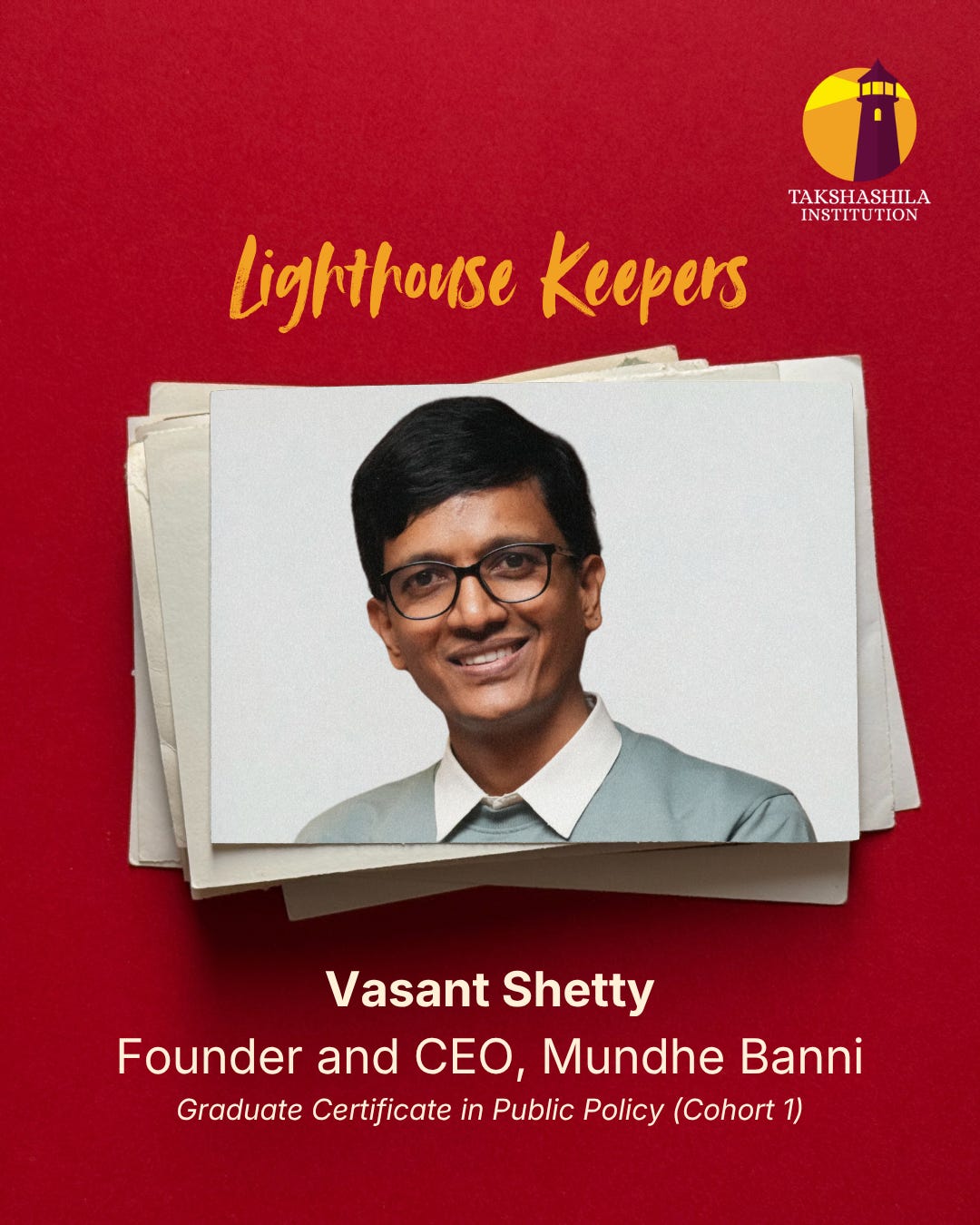
In this new section of the Dispatch, we’re turning the spotlight onto alumni of our public policy courses, or ‘lighthouse keepers’ to hear their reflections from their time with Takshashila’s Policy School.
This week we’re featuring Vasant Shetty, CEO of Mundhe Banni and alumnus of the Graduate Certificate in Public Policy (Cohort 1). Below are his reflections:
Cultural change happens through storytelling. Mundhe Banni, which translates to “Come Forward” or “Come Up” in Kannada, is our attempt to create that cultural shift among youngsters in the tier two and tier three towns and cities of Karnataka. Alongside storytelling via a podcast, we are building a community that provides aspiring entrepreneurs with mentorship, knowledge, networks, and access to funding.
My time at Takshashila gave me a systems perspective on public policy. It helped me understand how incentives shape individual and institutional behaviour, how governments approach complex societal challenges, and how meaningful change often requires aligning narratives, incentives, and institutions.
Welcome back to the Tabletop Trove of Dispatch! As you may well know, this section is intended to be a virtual repository of the books that sit at a high-table located in Takshashila’s physical office space in Bengaluru, Karnataka.
This week’s theme is Sour State of Affairs, curated by yours truly:
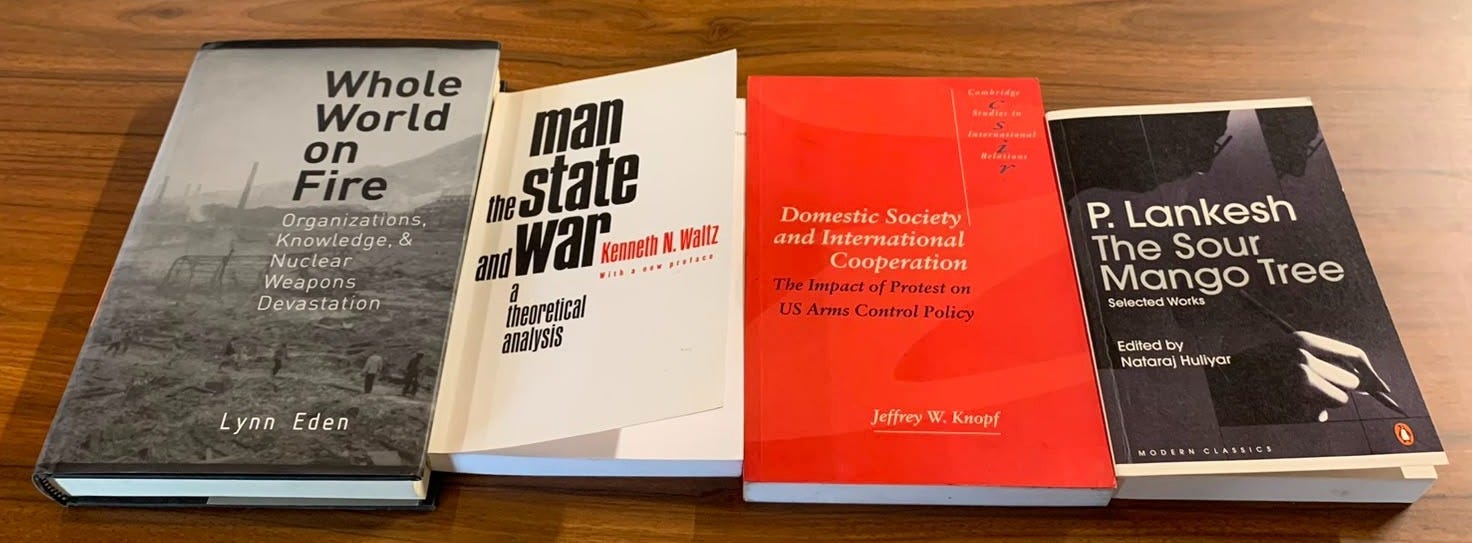
Whole World on Fire: Organizations, Knowledge, & Nuclear Weapons Devastation (Lynn Eden)
Man, the State, and War: A Theoretical Analysis (Kenneth N. Waltz)
Domestic Society and International Cooperation: The Impact of Protest on US Arms Control Policy (Jeffrey W. Knopf)
The Sour Mango Tree: Selected Works (P. Lankesh (Edited by Nataraj Huliyar))
While we have you here, care to participate in the Dispatch’s new trivia section so you have a fun fact to share over dinner time?
Responses can be mailed to us at: publications@takshashila.org.in. And of course, the answer will be shared in a future Dispatch edition! This week’s question is:
Q: Which bird has the unique distinction of being the national bird of Zambia, Zimbabwe, South Sudan, Malawi and Namibia?
P.S.: See below the response for our previous edition’s trivia question!
Q: Which is the second largest cold desert in the world?
A: The Arctic Desert
Until next time!
This edition of the Dispatch was written by Kripa Koshy, Staff Programme Manager for Takshashila’s Post Graduate Programme in Public Policy.
Comments
Nothing yet. Say the first thing.
Sign in to join the conversation.