
Published as a series between 1934 and 1935, Georges Remi’s (or Hergé as we’ve come to know him) The Blue Lotus is regarded as one of the first true masterpieces in his The Adventures of Tintin series.
Before this volume, the travels that Hergé documented for Tintin were said to have relied heavily on (oft) offensive European stereotypes, seen as typical of the era of writing. The Blue Lotus however, was said to have been a pivotal work that turned Tintin from being a superficial character reinforcing tired tropes into a well researched, adventure story with our intrepid fictitious journalist at the helm.
When Hergé announced his upcoming series (that is, where his protagonist heads to China), a chaplain at the University of Louvain, Father Leon Gosset, reached out with some unsolicited advice: do better research.
According to those familiar with the historicity of the issue, our author took the advice to heart. This led to Father Gosset introducing him to Zhang Chongren, a 27-year-old Chinese sculpture student at the Brussels Académie des Beaux-Arts.
Zhang is credited with fundamentally shifting Hergé’s writing approach and arguably, his worldview when it came to developing each of Tintin’s adventures thereafter.

Zhang was said to have taught him about Chinese history and politics, and in an expression of gratitude for this tutelage, Hergé introduced the character Chang Chong-Chen into The Blue Lotus’ storyline, considered a rare instance where the vibrant Tintin universe had a character based on a real person.
An example of Zhang’s influence is also seen in illustrations found in the comic where the Chinese characters on the walls and street signs of an illustrated Shanghai were personally drawn by Zhang. Instead of generic shop names, they featured agitprop like “Down with Imperialism!”, said to reflect the growing anti-colonial sentiment of the era.
Much like for our famed author, there are certain relationships that have played an important role in India’s geopolitical story. Japan is one such relationship, Vanshika Saraf (Geostrategy Programme, Research Analyst) would argue.
Japanese Prime Minister Sanae Takaichi’s recent visit to India, she writes, marks a noteworthy chapter for the India-Japan partnership. While former Japanese Prime Minister Shinzo Abe and Prime Minister Narendra Modi are credited with building significant political trust and vital institutional frameworks over the last decade, the bilateral relationship has matured considerably, Vanshika argues:
[The bilateral relationship] has evolved from discussions centred largely on infrastructure and development finance to one that now focuses on economic security, digital cooperation, and advanced technologies. Abe’s greatest contribution was not a single agreement but a strategic idea. He argued that the Indian and Pacific Oceans formed a single geopolitical theatre and that India was indispensable to maintaining a free, open and rules-based Indo-Pacific.
For a more fulsome reading of Vanshika’s article, including how the Japanese view of India has looked across prime ministerial changes, follow the link provided.
Pakistan is quietly stepping up to broker a peace plan to unify Libya’s Government of National Unity (GNU) in Tripoli and the eastern Government of National Stability (GNS) in Benghazi but there more to this than meets the eye, argues Aishwaria Sonavane (Pakistan Studies, Geostrategy Programme, Research Analyst).
The driving force behind this sudden diplomatic push is a historic $4 billion defence deal, writes Aishwaria in her recent Op-Ed in NDTV.com, as she calls into question Pakistan’s ostensible role as mediator:
While Pakistan’s broader position as a mediator deserves further investigation, its relationship with the LNA [Libyan National Army] will undermine Islamabad’s claim to neutrality. This stands in defiance of conventional mediation theory that necessitates the mediator’s impartiality. In that light, to view Pakistan’s intentions as a product of altruism would be naive.
Under the agreement, Islamabad will export 16 Chinese-co-developed JF-17 fighter jets and 12 Super Mushshak trainer aircraft to the eastern Libyan administration. However, what could be some of the consternation around this development? To learn more, access her full Op-Ed here.
As investments in artificial intelligence (AI) infrastructure surge, Arindam Goswami (High-Tech Geopolitics Research Analyst) argues that the phenomenon is defined by a circular financing web and demonstrates how such collective overinvestment is rational for tech giants stuck in a Prisoner’s Dilemma trap.
He offers some nuanced observations amidst these developments:
The infrastructure and capabilities being built are most likely to outlast the financial cycle that is funding them. This has been the pattern in every prior technological revolution, as Carlota Perez documents. What we cannot know is when the cycle will turn, or which companies will be present when it does. The answer depends primarily on how quickly AI diffuses through organisations and sectors - an institutional process that takes longer than current financial structures are designed to wait for.
To read his detailed research up close, including the five recommendations proffers to Indian policymakers, follow this link.
This week’s All Things Policy episode we’d like to showcase is an analysis of the current global economic order.
The global economy has been governed for eight decades by a unified architecture anchored by the US dollar and steered by key institutions like the IMF, World Bank, and WTO. However, this structure currently faces unprecedented strain, marked by escalating tariff walls, the weaponisation of finance, and the reconfiguration of supply chains based on geopolitical trust.
While many observers claim the post-war order is breaking down completely, is that truly the case?
In the debut episode of Turbulence, a limited-series of All Things Policy, host Anupam Manur (Professor of Economics) sits down with Narayan Ramachandran (Takshashila Co-founder) who offers a different perspective.
Together, they unpack how the current order is experiencing everything from deliberate friction to selective deceleration, ultimately developing a more multipolar framework. Follow this link to be a fly on the wall for their rich conversation.
Welcome back to the Tabletop Trove of Dispatch! As you may well know, this section is intended to be a virtual repository of the books that sit at a high-table located in Takshashila’s physical office space in Bengaluru, Karnataka.
This week’s re-curated theme is ‘Prepping for Propaganda’ as pulled by our Geostrategy Programme Staff Research Analyst, Anushka Saxena:
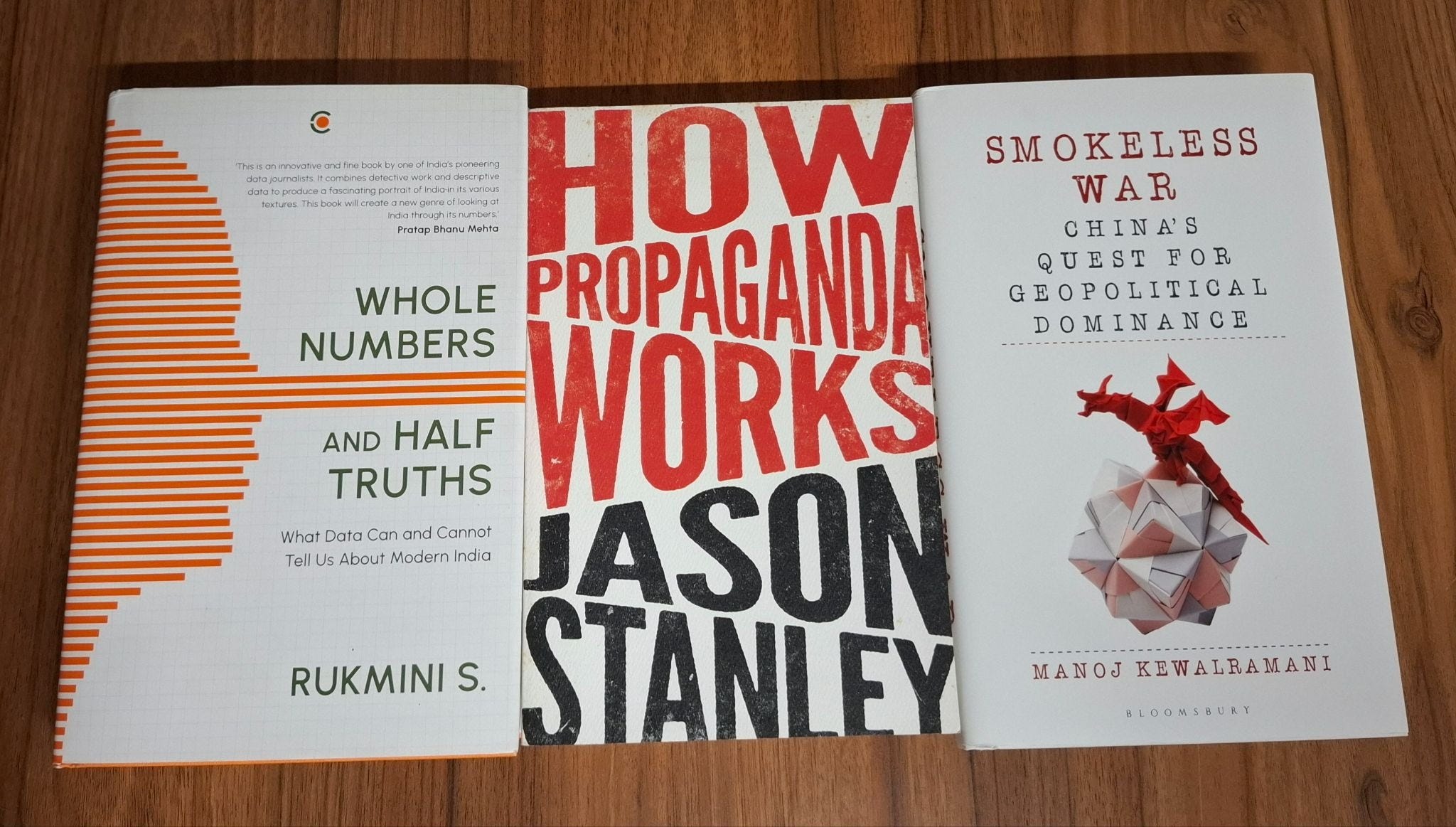
Whole Numbers and Half Truths: What Data Can and Cannot Tell Us About Modern India (Rukmini S.)
Smokeless War: China’s Quest for Geopolitical Dominance (Manoj Kewalramani)
How Propaganda Works (Jason Stanley)
While we have you here, care to participate in the Dispatch’s new trivia section so you have a fun fact to share over dinner time?
Responses can be mailed to us at: publications@takshashila.org.in. And of course, the answer will be shared in a future Dispatch edition! This week’s question is:
Q: Which two natural wood chips are used to make the traditional Arab incense, bakhoor?
P.S.: See below the response for our previous edition’s trivia question!
Q: Which country is widely credited with having the world’s oldest known winery?
A: Armenia
Until next time!
This edition of the Dispatch was written by Kripa Koshy, Staff Programme Manager for Takshashila’s Post Graduate Programme in Public Policy.
Comments
Nothing yet. Say the first thing.
Sign in to join the conversation.