
In 1925, the standard competitive tennis circuit in France witnessed a dramatic change. Their locally dubbed French Clay-Court Championships, usually reserved for participation from players who were members of French clubs, was opened to foreign players for the first time.
And so the French Open or Roland-Garros was born, now considered one of the four major Grand Slam tennis tournaments. Importantly for the purposes of this Dispatch, it is the only Grand Slam played on a clay court.
The vibrant European red, a distinctive feature of the 20-court, 34 acre complex, is widely considered a gold standard. The origins of the iconic clay court however are said to date back to 1880, when grass tennis courts were coated with powdered terra cotta as the greenery wilted in the summer heat.
Today, the Rolland-Garros courts are no longer terra cotta-laden…nor are they truly clay-covered. Instead, the 80 centimetre-thick court is composed of five distinctive layers: red brick dust, crushed white limestone, coal residue, crushed gravel and stones.
This layered and carefully watered court presents a unique challenge to players: game play is slower, the ground more slippery thus requiring more strategic moves and a different stamina (especially of players who may typically rely on power shots, which can countered relatively easier when the ball has a slower bounce to it).
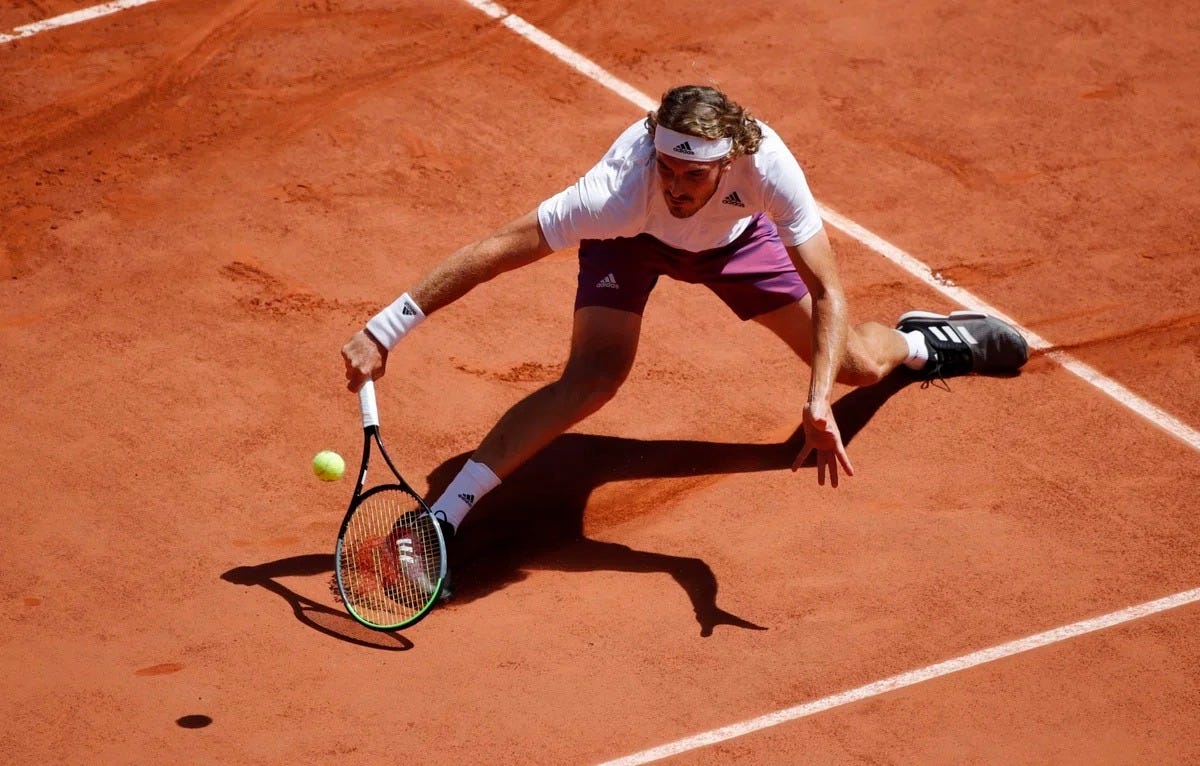
Players playing a clay court game consequently require a different approach that accounts for the unique physical characteristics of the court.
Similarly, India’s gold-related dilemmas may also require new nuances in how it is understood and navigated. Nitin Pai (Takshashila Co-founder and Director) offers some of this perspective in his latest column in The Mint.
Nitin writes of India’s current account deficit, and offers the following context:
Our appetite for gold is not an irrational cultural quirk. It is, in part, a revealed preference and a tangible symptom of our collective distrust in one another, society and civic institutions…Distrust of civic institutions compounds the pre-existing generalized distrust in our hyper-diverse society, leaving India with a severe social capital deficit. We buy gold to cover this deficit.
To read his commentary in full, including how to understand some of the institutional scaffolding around India’s insatiable demands for gold, and the two consequent recommendations he proffers to, follow the provided link here.
China and Pakistan have once again demonstrated the strength of their all-weather and cross-domain defence partnership.
Such are Anushka Saxena’s (Staff Research Analyst, Takshashila Geostrategy Programme) opening words as part of her latest Op-Ed in NDTV.com, where she analyses the recent commissioning of PNS Hangor.
Citing notable military and defense investments between Pakistan and China, she postulates on the implications this burgeoning bilateral relationship has for India.
To read her detailed analysis in full, including what makes the Hangor model unique, follow this link.
US President Donald Trump is approaching diplomatic engagement with Beijing from a position of relative strategic and structural weakness, writes Brigadier Anil Raman (retd) (Research Fellow and Head of Defence Fellowship Programme), in his latest Op-Ed in the Deccan Herald.
Anil argues this position has largely been exposed by the fallout of recent American military friction in Iran. His analysis underscores critical vulnerabilities currently undermining Washington’s posture ranging from geopolitical overstretch to notable defence-industrial bottlenecks.
For a more fulsome read of his analysis, including how Asia should respond to a “distracted US and a more confident China” follow this link.
This week’s All Things Policy episode we’d like to highlight is a chat between Malathi Renati (Head of Policy School, Takshashila) and Dr. (Maj) Ameya Kagali, Chief Team Physician for India’s Paralympic contingent.
Together, they discuss the essential systems needed to support para-athletes and India’s evolving sports policy in this context. To listen to their insightful chat, including what is needed to build an inclusive, high-performance ecosystem for parasport to flourish, follow this link.
Welcome back to the Tabletop Trove of Dispatch! As you may well know, this section is intended to be a virtual repository of the books that sit at a high-table located in Takshashila’s physical office space in Bengaluru, Karnataka.
This week’s theme is Radical Propositions, curated by yours truly.
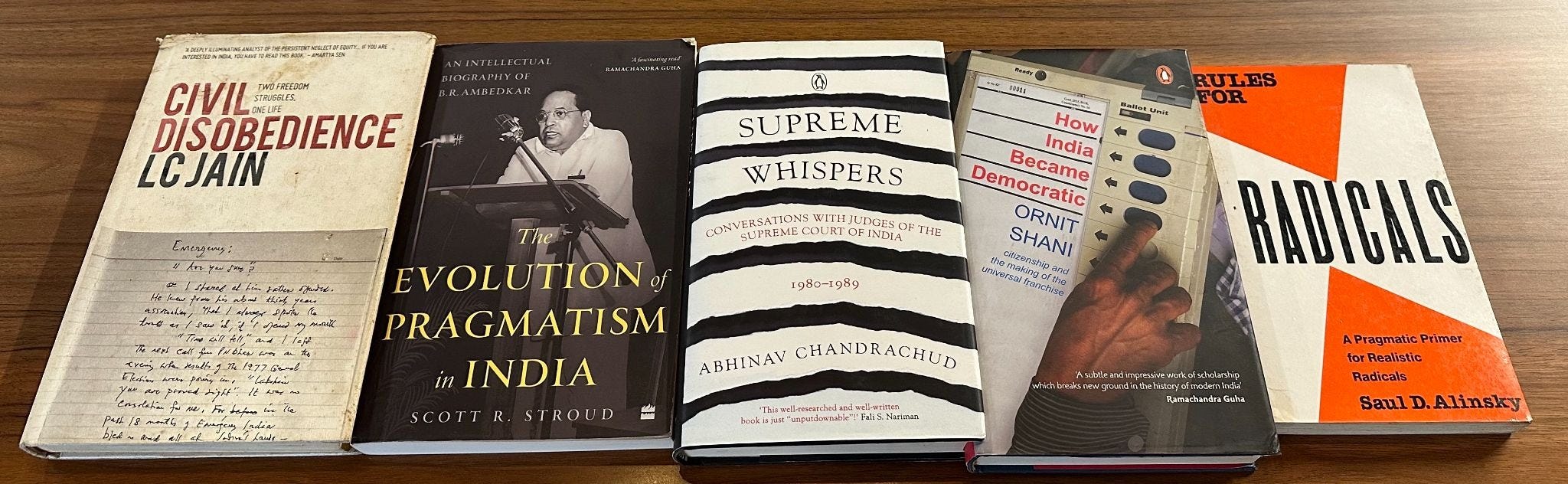
Civil Disobedience (LC Jain)
The Evolution of Pragmatism in India (Scott R. Stroud)
Supreme Whispers (Abhinav Chandrachud)
How India Became Democratic (Ornit Shani)
Rules for Radicals (Saul D. Alinsky)
While we have you here, care to participate in the Dispatch’s new trivia section so you have a fun fact to share over dinner time?
Responses can be mailed to us at: publications@takshashila.org.in. And of course, the answer will be shared in a future Dispatch edition! This week’s question is:
Q: By legally distributing 80% of hunting permit fees directly to local villages, which animal was successfully revived by a conservation programme in Pakistan?
P.S.: See below the response for our previous edition’s trivia question!
Q: What commodity accounts for 85 to 95 percent of total export revenue in Burkina Faso?
A: Gold
Until next time!
This edition of the Dispatch was written by Kripa Koshy, Staff Programme Manager for Takshashila’s Post Graduate Programme in Public Policy.
Comments
Nothing yet. Say the first thing.
Sign in to join the conversation.