
Those familiar with the East India Company’s (EIC) presence in India may argue that one of the most existential threats they faced was microscopic in nature. “More British soldiers displaced in the new subcontinent died of malaria than battling the local armies trying to contain their expansion”, in the words of medical historians familiar with the history of the disease in British India.
This urgent demand had a pharmacological answer found in the cinchona bark, known to be the natural source of quinine. The latter became famed for its anti-malarial properties, and as one Indian historian articulated, the paths of quinine and malaria became “locked in symbiotic bonds of co-determination”.
By the early 19th century, quinine was said to have been included in a mandatory daily ration for EIC personnel. While found to be effective, however pure quinine did have one tangible drawback: it was almost punishingly bitter.
It was only a matter of time before quinine consumers found innovative ways to complete their dosage and began mixing their medicinal tonics with novel additions to make their medication drinkable.
One that worked remarkably was the addition of a distilled spirit received as part of their official rations: gin. The participation of lime was only a matter of time, given the ubiquitous concerns around scurvy.

And so with time, the modern cocktail, gin and tonic, was said to have been born and lent to Winston Churchill’s memorable quip, “the gin and tonic has saved more Englishmen’s lives, and minds, than all the doctors in the Empire.”
Similarly, what are some valuable additions that India should consider to improve the proverbial ‘health’ of its digital economy? India’s ranking as the fifth-most digitalised country in the world, and its model digital public infrastructure, should be considered products of a different time, writes Nitin Pai (Takshashila Co-founder and Director), necessitating new interventions for India’s digital economy.
In his latest column in The Mint, he explains:
…these wins came in a world that no longer exists. They were built during the heyday of globalisation, when open trade and division of labour were treated as the natural order of things. Now that order has given way to mercantilism and vertical integration, and we are in an age of economic statecraft in which the powerful seek to own entire supply chains and seem to see inter-dependence for its chokepoints rather than mutual gain.
Nitin argues that there are prudent steps that can be taken to manage the risks of India’s broad but shallow digital stack, offering three recommendations in that vein. To read them in their entirety, follow this link.
Could the West Asian conflict have nipped some of India’s proverbial economic ‘green shoots’ in the bud? Narayan Ramachandran (Takshashila Co-founder) would argue yes, if examining India’s Composite PMI (or Purchasing Managers’ Indices), with India’s fuel prices, capital inflows and the rupee being damaged in particular.
In his latest column in The Mint, Narayan elaborates:
For most countries, stagflation is a dangerous economic scenario. For developing countries like India, it is even more significant because it is particularly difficult to combat. Intervening through monetary policy by increasing interest rates risks a negative impact on growth, while doing the opposite to stimulate employment risks stoking inflation.
To read his commentary in full, including what his economic reform recommendations are, follow this link.
The latest IPPR edition is released and contains among its pages everything from a lead paper from Shambhavi Naik (Takshashila Chairperson for the Advanced Biology Programme), arguing that resilience-building is “biotechnology’s most consequential near-term contribution to defence lies”, to Bibhu Prasad Mohapatra’s paper on the theme of Governance Without Guarantees (GWG), describing “environments in which institutional action unfolds without stable causal expectations”.
To read these insightful pieces and the other featured work in this edition, follow the provided link.
For the last quarter-century, West Asia has dominated the global news cycle, but what if you’re interested in what’s happening beyond the headlines?
A new OpenTakshashila-hosted course allows you to examine the deeper structural currents at play in the region. The course offers a curated curriculum focusing on significant regional players and looks ahead to postulate on the future of the region.
Early bird deadline (25% scholarship) ends on 20 June. Apply for the course here!
This week’s All Things Policy episode we’d like to highlight is a discussion among our Geostrategy Programme team on last month’s 2025 Quad Foreign Ministers Meeting in New Delhi.
Research Analysts, Vanshika Saraf and Abhishek Kadiyala unpack the grouping’s pivot from its security focus to economic security and supply chain framework, influenced by the current American administration.
Together, they analyse the key outcomes of the meeting including the Maritime Surveillance Cooperation Initiative, and the Indo-Pacific Energy Security Framework, and importantly, address what the future of the Quad may be.
Follow this link to be a fly on the wall for their conversation.
Welcome back to the Tabletop Trove of Dispatch! As you may well know, this section is intended to be a virtual repository of the books that sit at a high-table located in Takshashila’s physical office space in Bengaluru, Karnataka.
This week’s theme is Tech Distortion, curated by yours truly.
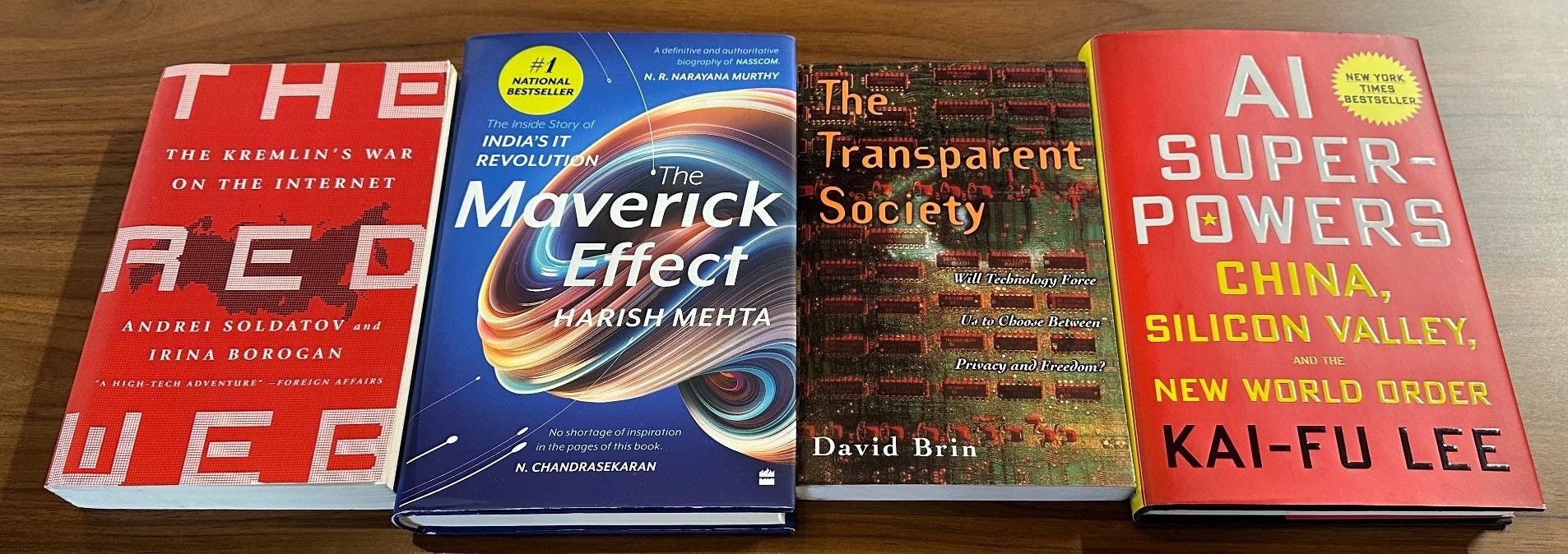
The Red Web: The Kremlin’s War on the Internet (Andrei Soldatov and Irina Borogan)
The Maverick Effect: The Inside Story of India’s IT Revolution (Harish Mehta)
The Transparent Society (David Brin)
AI Superpowers: China, Silicon Valley, and the New World Order (Kai-Fu Lee)
While we have you here, care to participate in the Dispatch’s new trivia section so you have a fun fact to share over dinner time?
Responses can be mailed to us at: publications@takshashila.org.in. And of course, the answer will be shared in a future Dispatch edition! This week’s question is:
Q: Which organic chemical compound accounts for the vanilla-like smell of the cherry blossom flowers?
P.S.: See below the response for our previous edition’s trivia question!
Q: By legally distributing 80% of hunting permit fees directly to local villages, which animal was successfully revived by a conservation programme in Pakistan?
A: The markhor
Until next time!
This edition of the Dispatch was written by Kripa Koshy, Staff Programme Manager for Takshashila’s Post Graduate Programme in Public Policy.
Comments
Nothing yet. Say the first thing.
Sign in to join the conversation.