
Long before she was known by the elaborate folklore and complex conspiracy theories that followed her name, Grand Duchess Anastasia Nikolaevna of Russia (1901 - 1918) was best known within the Imperial Household by a much simpler title: shvybzik.
Translated as the Russian word for “imp,” or “little mischief”, the title was conferred onto the youngest daughter of Tsar Nicholas II (the last emperor of Russia) by her aunt, Grand Duchess Olga Alexandrovna, and her French tutor, Pierre Gilliard.
A natural entertainer within the family circle, historical accounts of Anastasia, point to her possessing a sharp wit and a penchant for mimicry, regularly guilty of planning practical jokes amongst her family and the palace staff.
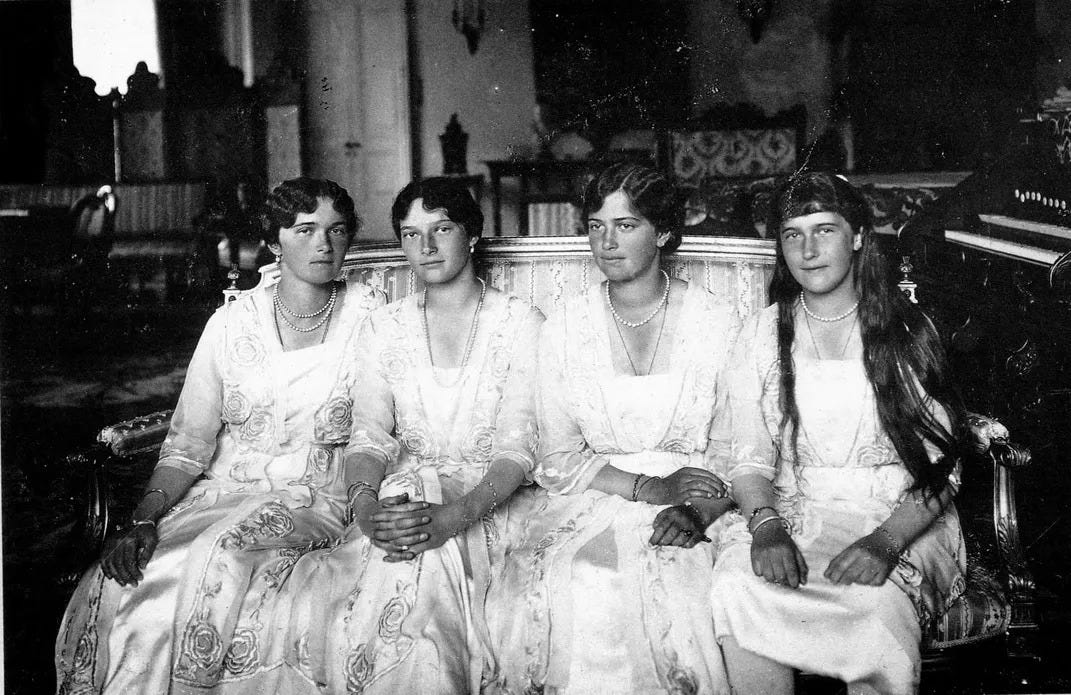
The young royal embraced her moniker with great aplomb, and in the many personal letters she wrote to her father about the everyday happenings in her life, she often signed her personal letters simply as “Nastasia (Shvybzik)”.
Photographs of the youngest Romanov daughter usually testify to her sense of humor. In one image, she dons a set of false teeth and strikes a silly pose, while in another, she poses while hanging from an exercise bar in a palace room.
A significant collection of candid Romanov photos was saved by Anna Vyrubova, Empress Alexandra’s closest friend and lady-in-waiting, and was eventually acquired by the Beinecke Rare Book and Manuscript Library at Yale University.
According to Natalia Sidlina, a curator of a London exhibition about Nicholas, the lack of novelty of the pictures were what stood out to her the most, “What amazed me was how alike those albums were to any other family albums we have, the Romanovs looked just like any middle-class family.”
As the Romanovs demonstrate, a number of societal archetypes remain alive and well even in Imperial households. Narayan Ramachandran (Co-founder, Takshashila)’s latest column in The Mint casts light on other “societal scaffolding” that have stood the test of time.
An exploration of Christopher Nolan’s cinematic take on the concept of xenia (the ancient civilizational duty of hospitality) is the subject of Narayan’s column this week. In an age when social media echo chambers and populist politics fuel ‘othering’ and calls for protectionism, these age-old ethical frameworks may provide a necessary corrective, he argues.
Narayan’s commentary highlights how stable societies rely on the powerful exercising restraint to safeguard the vulnerable.
A shift in societal attitudes towards ‘strangers’ or guests has resulted in widespread anti-immigrant sentiment, protectionism in economic spheres and an environment where ‘hating’ your neighbour appears to be getting normalized. Social media and its narrow thought bubbles hand us false certainty about who the stranger is by tokenizing them. This is an illusory certitude that is the exact opposite of not knowing who the stranger is.
For a closer read, follow the link provided.
Market forces may perhaps be the only instrument that may discipline private companies, argues Nitin Pai (Director and Co-founder, Takshashila) in his recent column in The Mint.
This reflection comes from his recognition of the asymmetry that technological development brings, as he writes:
Now, technology has certainly empowered the user, consumer and citizen, which is why they would prefer using digital platforms. However, platforms, corporations and governments have used their influence over the direction of technological development to create a sharp asymmetry that empowers them disproportionately over their stakeholders.
What then could be one of the needs of the hour? Perhaps, inter alia, “a new digital consumer rights movement to re-empower the consumer-citizen”? To read Nitin’s reflections in depth, follow this link.
What questions come up when we see technology at the centre of national power, economic growth, and societal change? Some include: Why are tech and geopolitics inseparable? How do we build technology responsibly while anticipating its unintended consequences? What will it take to strengthen India’s technology R&D ecosystem?
To begin to unpack all these questions and more, apply to our 12-week Technology Policy certificate programme here by August 23.
If technology policy isn’t your cup of tea, apply to our 12-week Advanced Public Policy certificate programme here or our Defence and Foreign Affairs certificate programme here.
This week’s All Things Policy Episode we’d like to highlight is a discussion on how the Chinese state grapples with significant internal challenges, while being adept at bolstering its global influence through economic statecraft.
In this episode of Turbulence, Manoj Kewalramani (Chairperson, Geostrategy Programme) and Anupam Manur (Professor of Economics) together discuss how Beijing has insulated itself from American pressures since 2018 while leveraging critical mineral exports and green-tech investments to exploit international supply chain vulnerabilities.
Their conversation explores answers to the question: “How does a weakening economy end up with more leverage than ever?”
To be a fly on the wall for their rich conversation, follow the link here.
In this new section of the Dispatch, we’re turning the spotlight onto alumni of our public policy courses, or ‘lighthouse keepers’ to hear their reflections from their time with Takshashila’s Policy School.
This week we’re featuring Vijayabharathi Chelladurai, Senior Staff Engineer/Manager at Qualcomm and alumnus of the Graduate Certificate in Public Policy (Cohort 31). Below are his reflections:
One policy challenge I am thinking about today is how societies should respond to the rapid advancement of Artificial Intelligence. While much of the discussion focuses on AI’s capabilities, I believe the more important question is whether our institutions can adapt quickly enough to the changes it will bring.
My time at the Takshashila Institution fundamentally changed how I approach this challenge. The programme taught me to examine technology through the lenses of economics, governance, regulation, competition, and society. Today I ask how governments, businesses, educational institutions, and labour markets should respond so innovation creates broad opportunities while managing risks. Takshashila gave me a structured policy mindset that still guides me.
Welcome back to the old faithful, Tabletop Trove of Dispatch! This little section of our newsletter has become a virtual repository of the books that sit at a high-table located in Takshashila’s physical office space in Bengaluru, Karnataka.
This week’s theme is The Fatigued Fight, re-curated by yours truly. Have you read any of the below? If yes, let us know your thoughts by writing to us here.
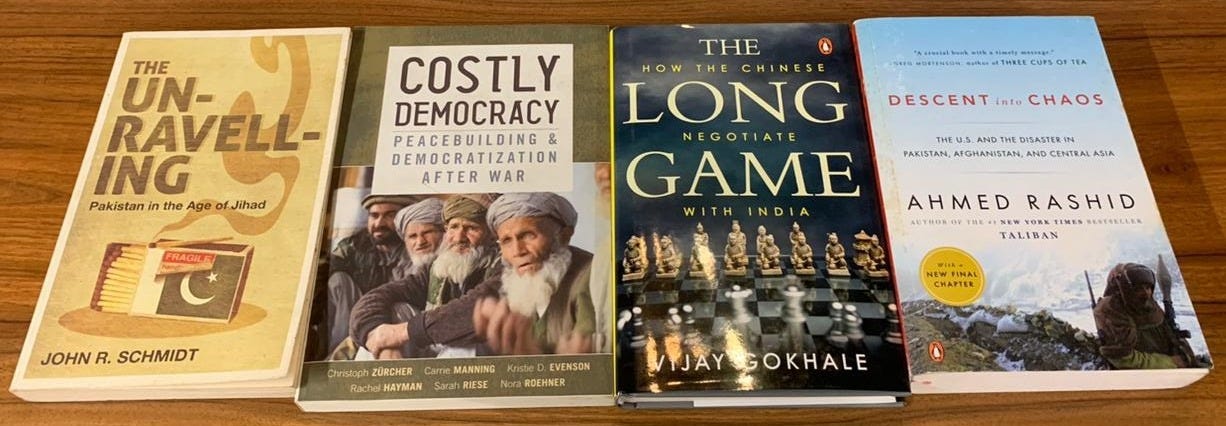
The Unravelling: Pakistan in the Age of Jihad (John R. Schmidt)
Costly Democracy: Peacebuilding and Democratization After War (edited by Christoph Zürcher, Carrie Manning, Kristie Evenson, Rachel Hayman, Sarah Riese, and Nora Roehner)
The Long Game: How the Chinese Negotiate with India (Vijay Gokhale)
Descent into Chaos: The U.S. and the Disaster in Pakistan, Afghanistan, and Central Asia (Ahmed Rashid)
While we have you here, care to participate in the Dispatch’s new trivia section so you have a fun fact to share over dinner time?
Responses can be mailed to us at: publications@takshashila.org.in. And of course, the answer will be shared in a future Dispatch edition! This week’s question is:
Q: Which country is considered the ‘flattest’ in the world with its highest natural point reaching 2.4 meters above the ocean, and its average ground level sits at 1.5 meters?
P.S.: See below the response for our previous edition’s trivia question!
Q: Which bird has the unique distinction of being the national bird of Zambia, Zimbabwe, South Sudan, Malawi and Namibia?
A: The African Fish Eagle
Until next time!
This edition of the Dispatch was written by Kripa Koshy, Staff Programme Manager for Takshashila’s Post Graduate Programme in Public Policy.
Comments
Nothing yet. Say the first thing.
Sign in to join the conversation.