
The Industrial Revolution was (in) famous for many reasons, chief among them was its role in fuelling a number of creative developments in the Romantic movement.
Audiences sought an emotional escape from rapid urbanisation into idyllic, folklore-driven fantasy and this especially held true of the ballets produced in this period. The story ballet, Giselle, remains widely renowned as the quintessential masterpiece of the Romantic ballet era.
Created by French poet and critic Théophile Gautier and first performed in Paris in 1841 at the Royal Academy of Music, the play draws inspiration from a Slavic myth about vengeful spirits of young women who died just before their wedding days.

Act I of Giselle begins much like a quintessential fairy tale: a charming peasant girl (Giselle) falls in love with a young man who turns out to be a duke in disguise. However our male protagonist hides the fact that he is betrothed to another, resulting in a heart-broken Giselle.
Our maiden’s grief soon drives her to dance till the point of exhaustion and eventual death. In a pivotal Act II, she is then inducted by the Wilis, a clan of spirits made up of souls of young girls abandoned by unfaithful lovers. Set to a haunting score, the ballet was said to have reflected the 19th-century European fascination with tragic love and the supernatural.
Perhaps just as the Willis, opportunity is lurking for New Delhi vis-a-vis its bilateral relationship with Tehran, Nitin Pai (Director, Takshashila) would argue.
If the United States of America had not coerced India to throttle its relationship with Iran in 2018, we would likely have had bilateral annual trade of over $20 billion (importing 650,000 barrels a day of crude oil) and built strategic connectivity to Afghanistan and Central Asia through the Chabahar port.
Such read the opening lines of Nitin’s recent Op-ed in the The Mint, where he offers a thoughtful perspective on what New Delhi’s engagement with Iran should look like in light of the changing geopolitical circumstances in the region.
Contextualsing his recommendations alongside India’s engagement with countries such as UAE and Saudi Arabia, Nitin argues for why it is also in India’s interests for the “divide between Washington and Tehran to be bridged”.
To read his recommendations in full, including a suggested timeline for action, follow this link.
The year 2026 may have officially inaugurated the global era of artificial intelligence stock listings, writes Narayan Ramachandran (Takshashila Co-founder), in his recent column in The Mint.
While noting that Chinese frontier LLM firms like Zhipu.ai and Minimax have already paved the way with explosive market debuts on the Hong Kong Stock Exchange, Narayan contends that market debuts offer no guarantees.
For mainstream Indian investors, it’s not all sunshine and roses as they lack direct access to such stocks while also not having local alternatives to choose from - not to mention such developments are set against the backdrop of India’s reduced capital inflows.
To read more about how these pressures play out in the Indian market, follow this link.
As the global race for technological supremacy shifts from software code to geopolitical leverage, there’s never been a more timely moment to catch up on the world of AI. In that vein, we’re happy to announce that applications are open for our upcoming Expert Capsule Course onPolitics and Policy of AI.
This unique five-week course bridges the gap between technical AI capabilities and strategic governance frameworks. Participants will dive deep into the governance, regulation, and decision frameworks surrounding the use of AI.
Space is limited, so apply here by 26 July, 2026!
This week’s All Things Policy episode we’d like to highlight is a conversation on the escalating volatility within Pakistan-occupied Kashmir, which has brought to the fore foundational questions of governance, disenfranchisement, and structural marginalisation.
In this episode, Aishwaria Sonavane (Research Analyst, Geostrategy Programme) is in conversation with Malik Moin Abbas to examine everything from the systemic triggers of these demonstrations, to the chasm separating Pakistan’s global rhetoric from the lived struggles of the region’s inhabitants. Listen in here.
This week, our high-table repository in Bengaluru features a curated collection on the theme, And the World Spins Madly on, focused on the intersections of global advantage, platforms, and the future structures of work:
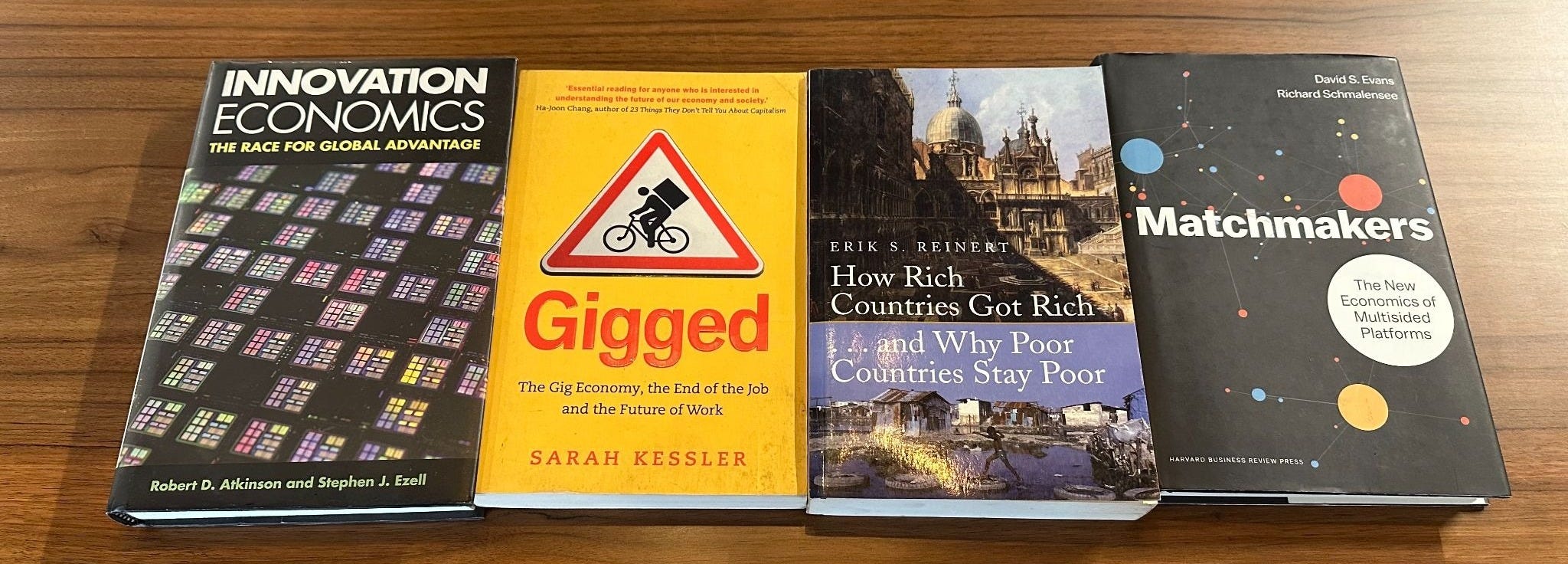
Innovation Economics: The Race for Global Advantage (Robert D. Atkinson and Stephen J. Ezell)
Gigged: The Gig Economy, the End of the Job and the Future of Work (Sarah Kessler)
How Rich Countries Got Rich and Why Poor Countries Stay Poor (Erik S. Reinert)
Matchmakers: The New Economics of Multisided Platforms (David S. Evans and Richard Schmalensee)
While we have you here, care to participate in the Dispatch’s trivia section so you have a fun fact to share over dinner time?
Responses can be mailed to us at: publications@takshashila.org.in. And of course, the answer will be shared in a future Dispatch edition! This week’s question is:
Q: Which country is widely credited with having the world’s oldest known winery?
P.S.: See below the response for our previous edition’s trivia question!
Q: Which organic chemical compound accounts for the vanilla-like smell of the cherry blossom flowers?
A: Coumarin
Until next time!
This edition of the Dispatch was written by Kripa Koshy, Staff Programme Manager for Takshashila’s Post Graduate Programme in Public Policy.
Comments
Nothing yet. Say the first thing.
Sign in to join the conversation.