
By Stacey B. Lee, JD
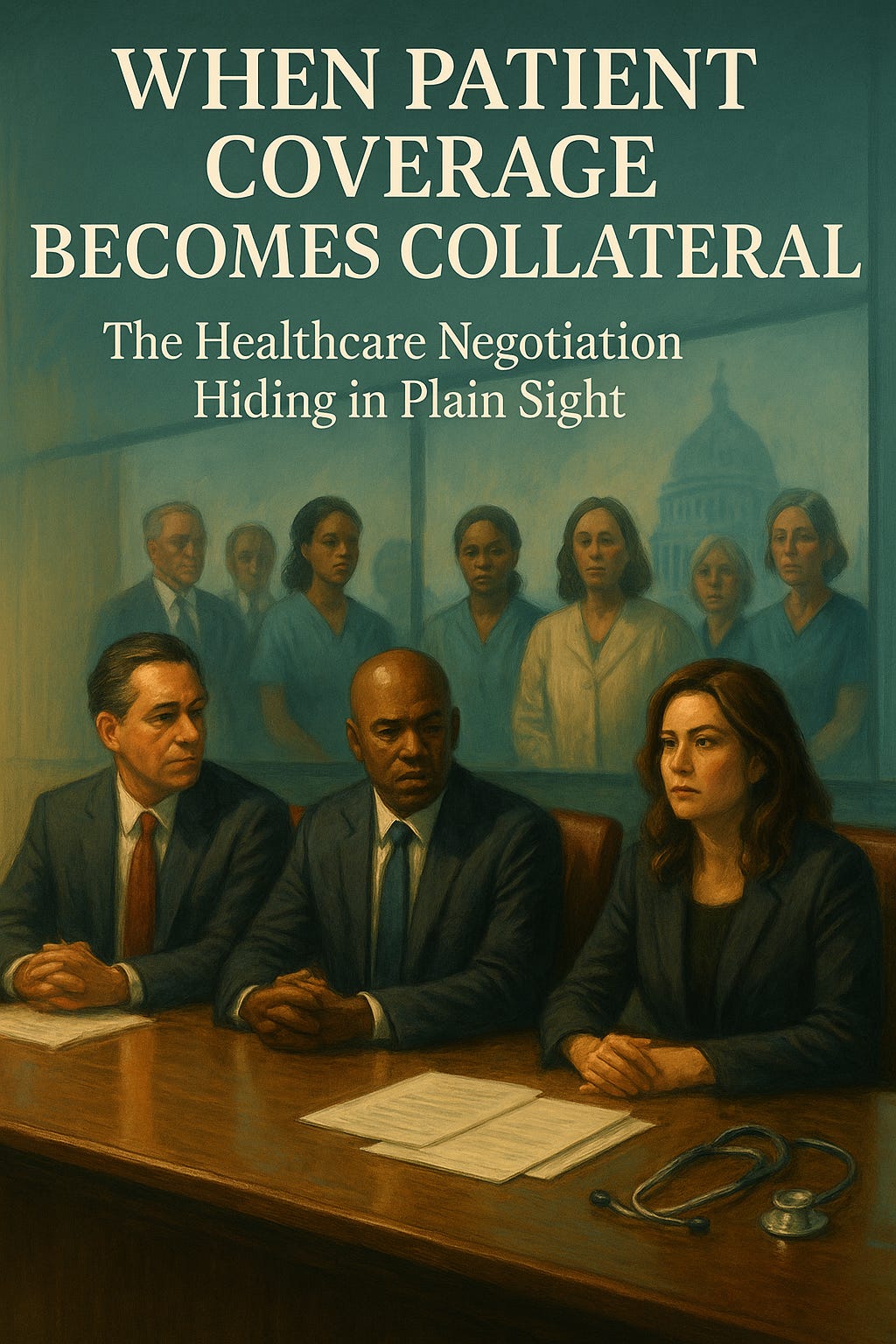
The federal government shutdown has turned enhanced ACA subsidies into the centerpiece of a high-stakes political negotiation.
But if you’re a hospital CFO, payer executive, or care delivery leader—this isn’t political theater.
It’s a multi-party negotiation where millions of patients have become unintended variables in someone else’s bargaining strategy.
This is what I call constrained negotiation—when the people who bear the consequences aren’t at the table.
Senate leaders, the White House, and congressional negotiators are treating this like a bilateral standoff.
Healthcare doesn’t work that way. Every deal affects actors who aren’t in the room—patients, providers, and payers—who end up carrying the cost.
Traditional negotiation wisdom centers on your BATNA—Best Alternative To a Negotiated Agreement. It’s the foundation of leverage: know your walk-away point and negotiate from a position of strength.
But in healthcare, the walk-away isn’t yours to control.
For hospitals, walking away means absorbing charity care and patient churn.
For insurers, it means destabilized risk pools.
For patients, it’s losing coverage entirely.
No one at the negotiating table owns those consequences directly—and that’s the structural flaw.
When I work with healthcare leaders navigating multi-stakeholder negotiations, I start with one question:
What does success look like for everyone, including those not in the room?
In this case, the shared outcome isn’t “Democrats win” or “Republicans win.”
It’s coverage stability with program integrity.
A six-month subsidy extension could create breathing room for the GAO to analyze eligibility and fraud controls—without forcing millions into immediate premium shock.
That’s not compromise for its own sake; it’s designing a functional solution around shared outcomes.
If you’re in hospital operations, payer contracting, or community benefit strategy:
• Quantify local impact. What’s the premium delta if subsidies lapse? What’s your projected charity care exposure?
• Make it visible. One-page summaries to your congressional delegation are powerful negotiation artifacts.
• Push for transparency. Any extension should include monthly enrollment and denial metrics—turning policy into data-backed accountability.
• Model both futures. Budget for a one-week and six-month horizon. Intelligent systems are doing both.
In my research, I call this the Trilingual Planner skill—negotiating fluently across:
• Policy and regulation
• Clinical operations
• Financial impact
When you say, “Premium shock destabilizes risk pools,” staffers hear actuarial jargon.
When you say, “Families in your district will lose coverage next month,” you’ve translated policy into consequence—and that’s negotiation.
The shutdown may end tomorrow or next month. Subsidies may extend or expire.
However, the pattern will repeat: healthcare policy will be treated as a bargaining chip while the system absorbs the fallout.
Healthcare leaders can’t sit this out. Your data, impact metrics, and operational voice are leveraged. Use them.
Because in healthcare negotiation, the parties not at the table often matter most.
Make sure they’re not invisible.
No posts
Comments
Nothing yet. Say the first thing.
Sign in to join the conversation.