
On October 1, when Medicare extenders lapsed and CMS told contractors to hold claims, my phone started ringing.
CFOs wanted to know: How do we make payroll when revenue stops?
GCs asked: What contract language protects us when rules change mid-agreement?
COOs were calculating: Which service lines do we pause?
By October 21, CMS released most holds—physician fee schedule, ambulance, and FQHC payments resumed—but non-behavioral telehealth and Hospital-at-Home programs remain frozen.
During the government shutdown, CMS recalled furloughed staff to sustain open enrollment operations, but broader claims processing remains compromised.
This wasn’t a crisis.
It was a pattern revealing itself.
Healthcare organizations negotiate contracts—with payers, vendors, and partners—assuming regulatory stability.
But that assumption is increasingly unaffordable.
When I researched healthcare negotiations for my book Transforming Healthcare Through Negotiation, I found that most contract failures weren’t caused by poor performance or bad faith.
They failed because external rules changed—and the contracts had no mechanism to adapt.
The October claims hold exposed that vulnerability perfectly.
Services were delivered in good faith. Costs accrued. Clinical teams performed as contracted.
But revenue stopped—not because of any provider action, but because policy moved faster than contract language.
The AMA Advocacy analysis calls this out: labeling these holds as “temporary” masks real financial harm.
And firms like Foley & Lardner warn that waiting for Congress without contract fixes is a material risk.
They’re right. But most healthcare leaders still ask:
What do those “contract fixes” actually look like?
In my book, I introduce Contingency Agreements as a negotiation framework for transforming uncertainty into structured flexibility—protecting both parties when external rules shift.
Grounded in Howard Raiffa’s decision analysis theory and adapted for healthcare, this model creates adaptive contracts that evolve with regulation, not against it.
Healthcare’s fragility isn’t driven by market volatility—it’s driven by regulatory volatility.
When Medicare changes reimbursement mid-cycle, when Congress lets extenders lapse, or when CMS shifts claims protocols overnight,
standard contracts fail.
That’s why every organization needs pre-negotiated contingencies that answer one simple question:
What happens when policy changes?
When payment rules pause, cash flow becomes a legal problem.
Bridge payment mechanisms sustain operations during holds and define how payments reprocess once the rules change retroactively.
Sample clause:
“In the event CMS or other federal agencies implement claims holds affecting covered services, Payer agrees to advance bridge payments at 80% of historical averages for affected service categories, with reconciliation within 60 days of hold release or retroactive authorization.”
Why it matters:
Organizations that had this language before October 1 kept payroll stable. Those that didn’t are negotiating from desperation.
Providers delivering care under existing rules shouldn’t face penalties when those rules shift.
Sample clause:
“Provider shall not be penalized for delivering services in good faith compliance with regulations in effect at the time of service. Payer agrees to hold Provider harmless for retroactive regulatory reinterpretations or payment denials resulting from such changes.”
Why it matters:
This reframes compliance as intent-based—“Were you operating in good faith?”—not retroactive perfection.
Most contracts fail because they assume static policy.
Instead, create triggers that initiate renegotiation when external rules change.
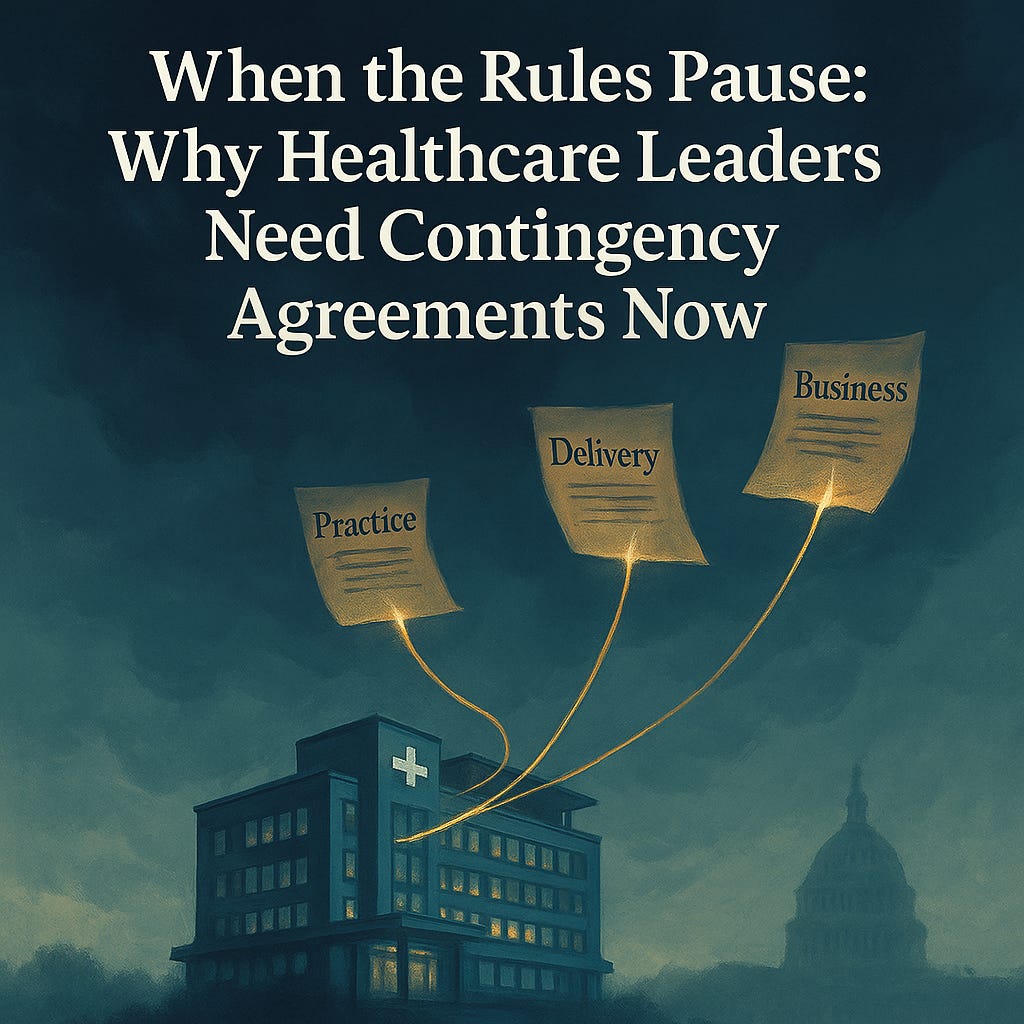
Practice of Medicine:
“If CMS or FDA changes materially affect clinical protocols or formulary standards, either party may request review within 30 days.”
Delivery of Care:
“Changes to telehealth or site-of-service regulations trigger operational review within 90 days.”
Business of Health:
“If Medicare payment or value-based care metrics alter projected revenue by >10%, either party may request rate renegotiation with 60-day notice.”
The rule: Be specific.
“Material change” means nothing without thresholds, timelines, or notice terms.
Resilience isn’t waiting for Congress.
It’s pricing uncertainty into agreements before the next policy lapse happens.
The October Medicare claims hold wasn’t an anomaly—it’s a preview.
It will happen again: with telehealth, with Hospital-at-Home, with every “temporary” policy Congress extends instead of funding permanently.
The organizations that will thrive aren’t those predicting the next rule change—
They’re the ones negotiating contracts that adapt to any change.
That’s what Contingency Agreements do.
They make adaptability a design principle, not a crisis response.
Traditional negotiation frameworks assume market-driven leverage and alternatives.
Healthcare operates in the opposite reality—regulatory dependency, geographic constraints, and limited market mobility.
The Contingency Agreement framework acknowledges that constraint—and transforms it into strength.
The question isn’t if policy will change again.
It’s whether your contracts are ready when it does.
What policy area do you think will trigger the next wave of contract renegotiations—and are your agreements ready for it?
👇 Share your perspective in the comments.
No posts
Comments
Nothing yet. Say the first thing.
Sign in to join the conversation.