
Singapore – or more precisely, the Singapore government – is all in on AI. In under three months, from Budget 2026 to his May Day Rally speech, Prime Minister Lawrence Wong has announced a slew of AI-accelerating policies, including enhanced tax breaks to incentivise companies’ AI adoption, training programmes for students and professionals, and free access to premium AI tools. For the government, the genie is already out of the bottle, and Singapore cannot be a laggard in a post-AI world.
Because Singapore will use AI, the critical questions are: Who benefits? Who bears the risks? And do Singaporeans trust the bargain being offered?
The government is not blind to Singaporeans’ AI anxieties. During his rally speech last week, PM Wong said: “We want to support more of such job transformations. But I know not everyone feels ready. Many Singaporeans are anxious about AI. They ask: Will it replace jobs? Will it be harder to keep up? Will the next generation still have good opportunities? These concerns are real.” Critically, the speech made clear that Singapore’s AI strategy encompasses both technological and social considerations.
So, how worried is the average Singaporean? What do they think about AI? And how effectively do they use AI tools like LLMs (large language models)? Fundamentally, understanding the level of public support will determine whether and how quickly Singaporeans buy into the government’s vision.
For instance, in the US – which houses most frontier models and where the AI technological frontier is relentlessly pushed – Americans are increasingly souring on the technology. This has manifested in protests against AI data centres, and, worryingly, threats and acts of violence, including alleged attacks on property associated with Sam Altman, the CEO of OpenAI (the company behind ChatGPT). Growing American cynicism of AI coalesces around three related explanations.
First, they think the risks outweigh the benefits. AI itself is not an unalloyed good. From the unauthorised use of copyrighted content to environmental and water concerns, Americans are wary: “Half of US adults say they are more concerned than excited about AI, compared with only one in 10 who are more excited than concerned.”
Second, they think the benefits do not flow fairly to them. They worry about being left behind and fear that AI will be disruptive at their expense. People are told by industry leaders that AI will take away their jobs, and against a background of widening income and wealth inequality, those who are socio-economically disadvantaged risk being left further behind.
In 2025, for example, Anthropic CEO Dario Amodei (the company behind Claude) warned that 50 per cent of all entry-level white-collar jobs could be eliminated by AI. Whether or not that forecast proves accurate, such statements have sharpened anxieties about entry-level positions and labour’s bargaining power. Relatedly, a company (or those who own capital) may benefit from their employees using AI productively, but the workers themselves (or those who produce labour) may not enjoy proportionate benefits.
Third, they think the government is acting too slowly. In general, the regulatory response has been tepid, especially when juxtaposed with the increasing ubiquity of AI tools such as LLMs. A cynical and vociferous public conversant in AI critiques and wary of the unequal accrual of benefits will start to wonder about a government that is missing in action. Over time, public legitimacy can fray when technological adoption and economic anxiety run ahead of public confidence.
Singapore is not the US. Singapore is also not shrouded in the same US political malaise. However, there is little reason to believe that such scepticism or even cynicism will not manifest in Singapore if AI progress and adoption – alongside lagging regulation and inequality threats – are not adequately interrogated. More fundamentally, we know less than we should about how Singaporeans understand, use, trust, and worry about AI.
It is no coincidence that labour chief Ng Chee Meng, during his most recent parliamentary motion on AI “with no jobless growth,” advocated for “a market intelligence and foresight system.” He stressed: “Good research can also help us avoid reactive policymaking.”
To aggregate what we currently know about public perceptions in Singapore, I drew primarily from three large-scale surveys: an Institute of Policy Studies (IPS) report with 3,713 Singapore citizens and PRs aged 21 and above (with a section on AI chatbots), a S. Rajaratnam School of International Studies (RSIS) paper involving 1,014 valid responses from adult Singapore residents (explicitly focused on AI public opinion), and a global KPMG study (which includes a Singapore section).
Importantly, these surveys were completed before PM Wong’s 2026 Budget speech. RSIS’s fieldwork was earlier, in May 2024, while IPS’s was conducted in October to November 2025. They therefore capture public attitudes before the government’s most recent AI push and before this year’s wider discourse about AI agents and accelerating disruption. For example, the viral online essay, “Something big is happening,” captured this wider discourse about accelerating AI disruption in the US.
In summary, what do we know?
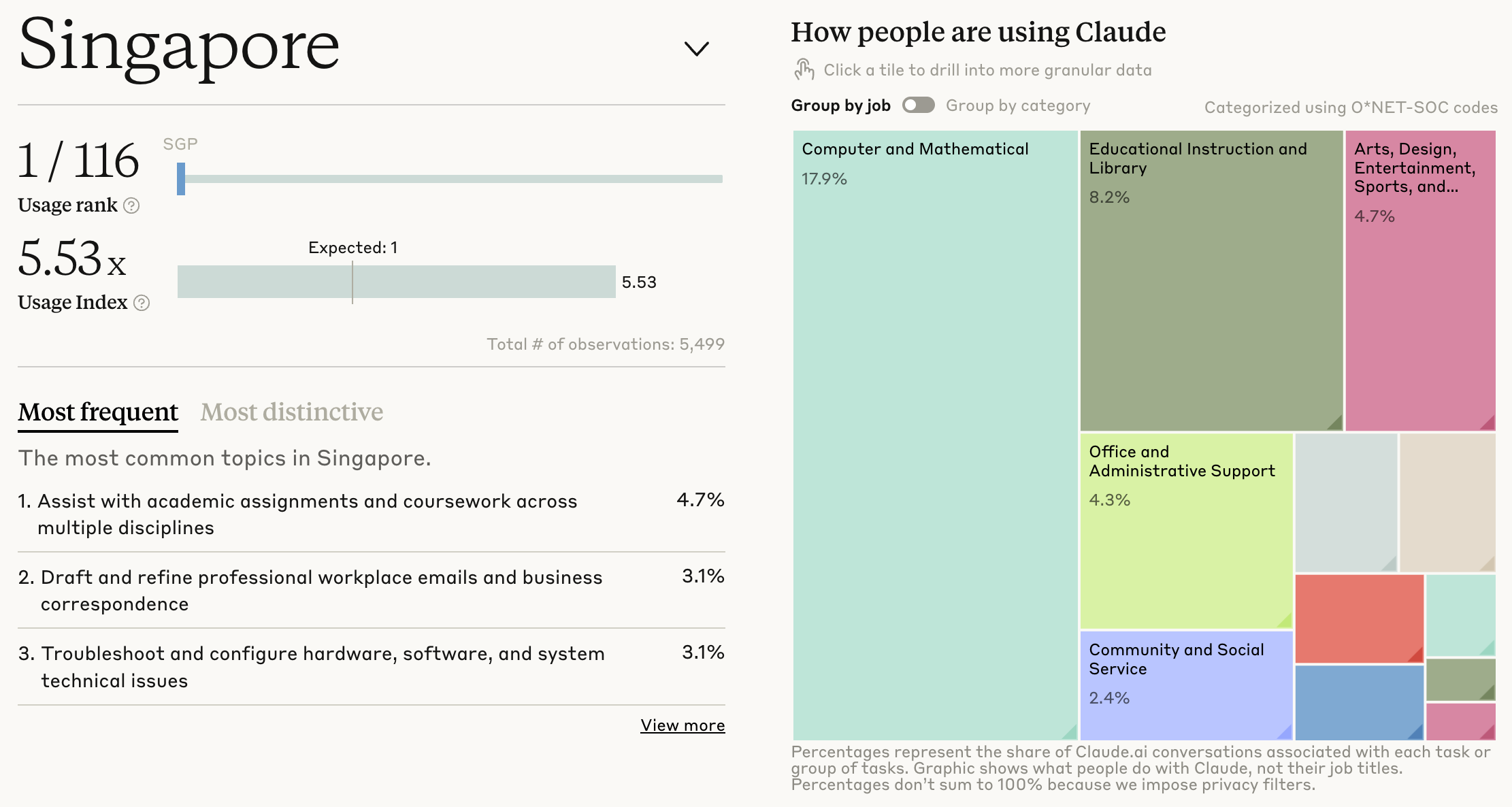
Individuals are using AI tools. Companies and organisations, less so: Among individual users, there is some evidence of widespread AI adoption in Singapore, at least relative to the rest of the world, through LLM subscription and usage numbers. In the IPS report, 64 per cent of Singaporeans use AI chatbots. Additionally, there is broad familiarity and engagement with AI tools in life and at work. Conversely, among companies, the Ministry of Manpower (MOM) just reported that 71.5 per cent of firms have yet to adopt AI, 28.5 per cent have started, and only 3.8 per cent are integrating AI into core processes.
Individual AI usage, while widespread, frequent, and often perceived positively, appears limited to practical, informational, and assistive tasks: In the IPS report, the 64 per cent of Singaporeans who use AI chatbots are mostly searching for information, reviews, or recommendations, getting assistance with school or work tasks, or planning and organising events or trips.
“School or work tasks” is an admittedly broad category. As such, the KPMG study offers some workplace-related indicators. A necessary caveat here is that KPMG’s study respondents appear far more AI-exposed than the average firm in MOM’s establishment survey: 78 per cent said their organisation uses AI (compared to the earlier MOM finding that only 30 per cent of Singaporean firms have adopted AI). Overall, they have grown more reliant on AI. Positively, the usage and reliance have resulted in increased efficiency, quality of work, innovation, and revenue-generating activity. Negatively, a smaller proportion reported increased workload, stress, and pressure.
Singaporeans are cautiously optimistic and somewhat clear-eyed about AI’s limitations: A topline finding from the IPS report is that 92.8 per cent of respondents agreed that “People need to exercise caution when using AI chatbots.” In fact, they believe that these chatbots can share misleading information (87.3 per cent agreement), give harmful advice (75.3 per cent), create unrealistic expectations about human relationships (74.8 per cent), make it harder for people to form social connections with others (73.1 per cent), and make individuals less likely to seek help from real people (72.4 per cent).
This is echoed in the KPMG study, in which 65 per cent of respondents reported experiencing or observing loss of human interaction and connection associated with AI. While only 25 per cent believe that AI risks outweigh the benefits, 81 per cent are concerned about AI’s negative outcomes, and 49 per cent have personally experienced or observed negative outcomes from AI.
The RSIS paper asked its respondents the different ways AI could be used for good and harm. The most common benefits included increased efficiency and productivity, enhanced quality of life, language and learning, and assistance in planning and decision-making. On the other hand, the most common challenges included cybersecurity threats and negative societal impacts. Although these categories are very broadly defined, Singaporean perceptions of good and harm could be characterised as nuanced.
Cumulatively, given their awareness of AI’s potential harms and desire for a fair share of AI’s benefits, Singaporeans want some AI regulation.
Globally, consider the common critiques of LLMs and AI image generators. That LLMs are built upon and use datasets scraped from the web, often bypassing creator consent, proper attribution, and financial compensation. That growing electricity demands and cooling water required to operate global data centres can be harmful to the environment. That deepfakes and AI misinformation disproportionately target and harm marginalised groups, especially women and minority communities. That online child safety is paramount, with growing knowledge that smartphones and social media have been deleterious for positive youth development.
The Singapore government has not been absent from AI governance. But much of the response remains assurance- and framework-led, with binding remedies still emerging unevenly across harms. In my opinion, regulation around labour displacement, model transparency, copyright, and environmental externalities remains disproportionately less developed than the accelerated pace of AI promotion.
What might regulation look like, particularly of immediate AI harms? Expect discourse about data centres in Singapore and South East Asia (especially Johor, Malaysia) and the expected environmental costs. In parliament, MPs are raising questions about how perpetrators of technology-facilitated sexual violence (e.g., AI deepfakes and image-based sexual exploitation) may be punished and how victims may seek remedies. In schools, there are concerns over AI-based cyberbullying as well as the learning and developmental impact of AI usage, and the Ministry of Education is similarly trying to balance AI benefits and harms.
If we accept that AI progress is a fait accompli, and the Singapore government believes that Singaporeans have to adapt or lose competitiveness, AI promotion and regulation are not necessarily antithetical to each other. In fact, regulation may be what sustains the public’s continued consent for AI promotion. In the KPMG study, 67 per cent of respondents believe that AI regulation is required, and 52 per cent believe current safeguards are sufficient.
Among the multiple problems and threats that AI might bring about, the government and Parliament have paid the most attention to economic and employment disruption. To its credit, the government says Singaporean workers will not be left behind. PM Wong has said: “We will exploit AI to grow the economy, and we will ensure that growth translates into good jobs and better wages.”
If the long-term aim of AI advancement and adoption is increased productivity alongside higher-paying and better-quality jobs, the government’s overall approach – such as job matching and institutional restructuring – seems to be that the workers of today will be protected through skills training as well as career conversion and job reskilling programmes.
I see two issues with that approach. First, assuming there are indeed productivity gains in some sectors, at what cost to the worker? Rather than reducing workers’ work hours or improving their work-life balance, LLMs and AI tools may instead increase productivity expectations and stressors. One suggestive study of a US-based tech company with 200 employees has provided some evidence of labour intensification. In the beginning, employees worked faster, took on more work, and worked more hours, yet it was unsustainable, because the initial productivity could give way to “cognitive fatigue, burnout, and weakened decision-making.”
Second, if we take seriously the prognostications of AI industry leaders about widespread job loss, then what careers are Singaporeans supposed to be converting to, or what jobs should they be reskilling for? This uncertainty matters most for fresh graduates and younger workers, whose first jobs often depend on the very entry-level tasks and responsibilities that AI tools and LLMs are now expected to augment or compress.
In other words, what comes after job displacement is not clear. Moreover, the track record of training and reskilling programmes is neither clear nor uniform. Previously, software engineering and coding-related industries were the purported solutions to keep up with technological disruption. Now, the tech sector is threatened.
If these disruptions materialise and persist, the threat of socio-economic inequality is likely to be most pernicious. Many are worried that the economic benefits from AI advancements will primarily accrue to a small group of elite corporations and wealthy individuals. Past evidence has shown that technology-facilitated economic disruption disadvantages those who are already disadvantaged.
Take the aforementioned IPS report as an example. Degree-holders are using AI chatbots much more (at 81.4 per cent) than those with post-secondary education (at 65.6 per cent), and only 30.9 per cent of those with a secondary education and below use the chatbots. Those who are younger are also more likely to use the chatbots. The RSIS paper also found that one’s education level was associated with whether they were likely to recognise AI’s benefits and harms. The paper explicitly warns that uneven familiarity and use could exacerbate inequalities in digital participation, employment opportunities, and information access.
Put otherwise: how these different groups use AI and chatbots is likely to vary, and a continued digital divide is expected. In this vein, the AI conversation is an extension of the past digitisation discourse. What happens to those who are left behind?
I fully understand that the uncertainty associated with AI and its rapid development renders policymaking more challenging. At the same time, the government finds itself in somewhat of a pickle because it is going all in on AI against Singapore’s context of income inequality and wealth inequality (in a paper published days before the 2026 Budget). More precisely, it does not bode well for PM Wong’s vision of a “We First” society if some households feel that their prospects for upward social mobility are circumscribed, and they similarly believe that AI will only widen those existing gaps.
Ultimately, the question is not whether Singapore should use AI. It will, and it arguably should. The harder question, I think, is whether the AI transition can be made politically and socially legitimate. A “We First” Singapore cannot be built on an AI transition that emphasises advancement and catching up without an equally serious discussion about the fair distribution of benefits, risks, and voice. Regulation must catch up with immediate harms, and Singaporeans must believe that AI-related productivity gains are not limited only to higher expectations for workers or higher returns to capital.
If AI is truly to become a national advantage, Singaporeans must be convinced that it will not become another engine of unequal opportunity.
No posts
Comments
Nothing yet. Say the first thing.
Sign in to join the conversation.