
(Disclaimer: Opinions expressed are solely my own and do not express the views or opinions of the Singapore-based social service and non-profit organisations with whom I work or consult.)
It’s 8pm on May 3 in Singapore, which marks the conclusion of Polling Day (and GE2025). The nine-day campaign has whizzed by, and I think the election will ultimately be decided by the following five numerical figures.
#01: The approximately 30 per cent of undecided voters. Online market research firm YouGov Surveys – using data collected a month ago – found that 19 per cent of voters were undecided, and 11 per cent would decide during the campaign period (with three per cent more deciding at the voting booth). More recently (April 15), and similarly, market research company Blackbox Research said 30 per cent of voters were still undecided. Undecided voters appear to be younger. A June 2024 voter sentiment survey by magazine “Jom” also documented that younger Singaporeans were less confident of their vote.
#02: Nine per cent (GST) versus $5,000 (financial support): Obvious prognostications about the centrality of bread-and-butter issues – specifically, the cost of living, housing affordability, as well as jobs and salaries – have borne out, as expected. For the undecided voter, a vote against the ruling People’s Action Party (PAP) will likely reflect dissatisfaction with their socio-economic conditions and that of Singapore, epitomised by the opposition’s persistent focus on the nine per cent GST hike. Conversely, a vote for the PAP may indicate agreement with the government’s justification for the increase, alongside the perceived adequacy of financial support (e.g., the prime minister repeating how the average Singaporean family with two young children will receive about $5,000 in comprehensive financial support this year).
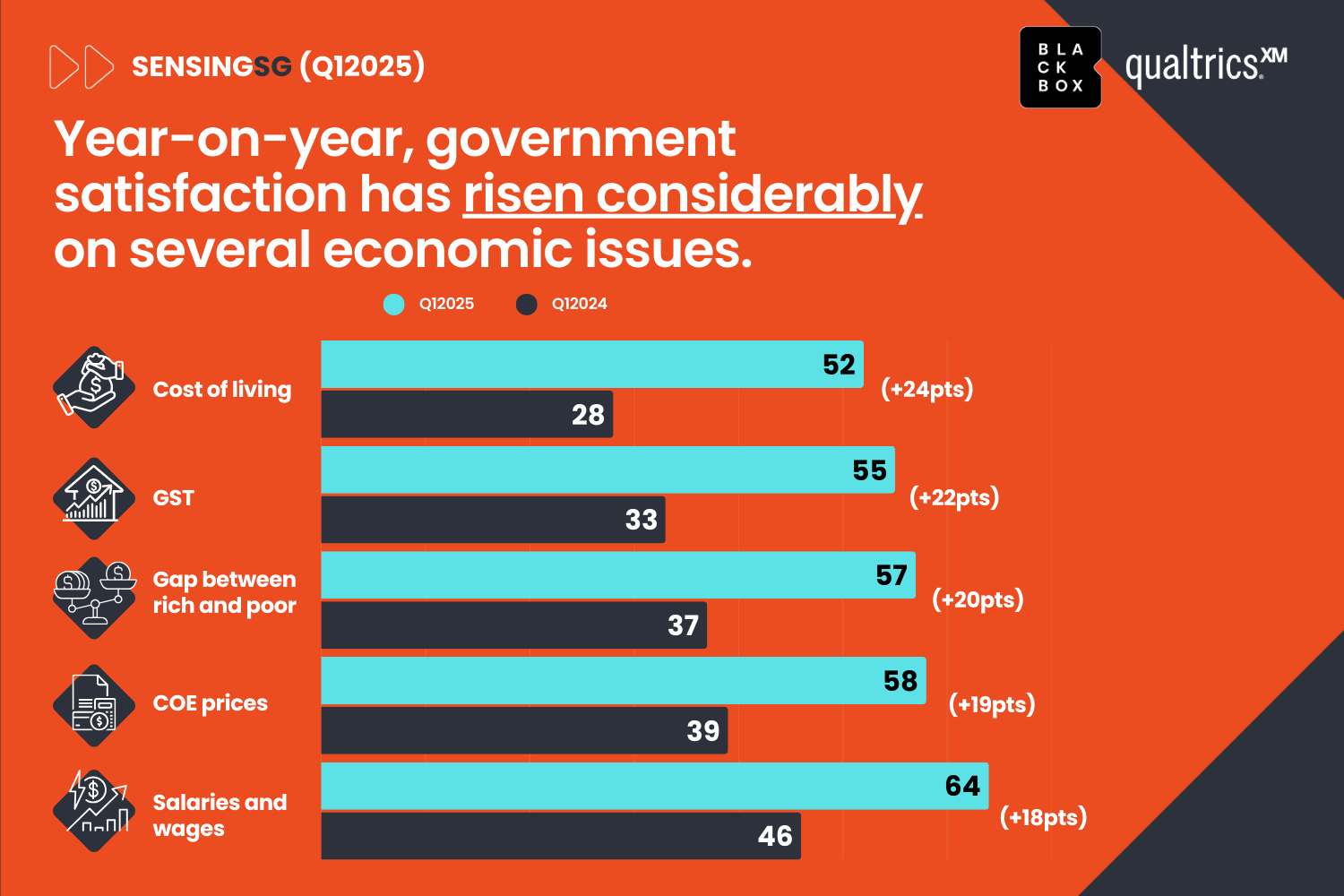
#03: For the PAP, it helps that it’s 2025, not 2024. Last year was a particularly terrible electoral year for incumbents around the world. This year, Singaporeans appear more satisfied and optimistic, and the experiences of some voters are backed by objective indicators such as rising household incomes, lower income equality, and fewer households requiring financial assistance. Based on the aforementioned survey from Blackbox Research, overall, 88 per cent of the respondents believe that Singapore is headed in the right direction. Year-on-year government satisfaction on economic issues has further improved, which can only bode well for the PAP:
#04: Separately, beyond bread-and-butter issues, many Singaporeans may have another numerical figure in mind: Two-thirds, or the supermajority the PAP possesses in parliament (since pre-independence), giving it the ability to amend most articles in the constitution. For further reference, in GE2020, it won 89 per cent of all parliamentary seats. The closing arguments of most opposition parties have centred on denying the ruling government of that supermajority, by increasing parliamentary diversity across parties. Polymarket – a cryptocurrency-based prediction market deemed illegal in Singapore – still indicates that the PAP will secure at least 78 seats (as of 1pm on May 3 in Singapore, when I finalised this newsletter), translating to at least 80 per cent of all seats. However, even if the loss of a PAP supermajority is very unlikely, the argument will feature in voting considerations.
In a post-GE2020 survey by the Institute of Policy Studies, “pluralist” voters – “who agree that there is a need for change in the electoral system, checks and balances and different voices” – increased from 18 to 22.4 per cent between 2015 and 2020.
#05: Finally, will it be one or many opposition parties? The Workers’ Party (WP) has dominated as Singapore’s main opposition party in the past two decades, and GE2025 will determine if the other parties are resigned to be “coalitions of electoral losers.” WP’s non-contestation of Marine Parade-Braddell Heights GRC quickly became a non-issue, and the overall conduct of the nine-day campaign – such as the parties’ online presence and content, rallies, as well as on-the-ground mobilisation – has set the WP, Progress Singapore Party, and Singapore Democratic Party further apart from the rest of the pack. Finally, the diversity of match-ups will offer clues of the proportion of anti-PAP votes vis-à-vis pro-opposition party ones.
No posts
Comments
Nothing yet. Say the first thing.
Sign in to join the conversation.